
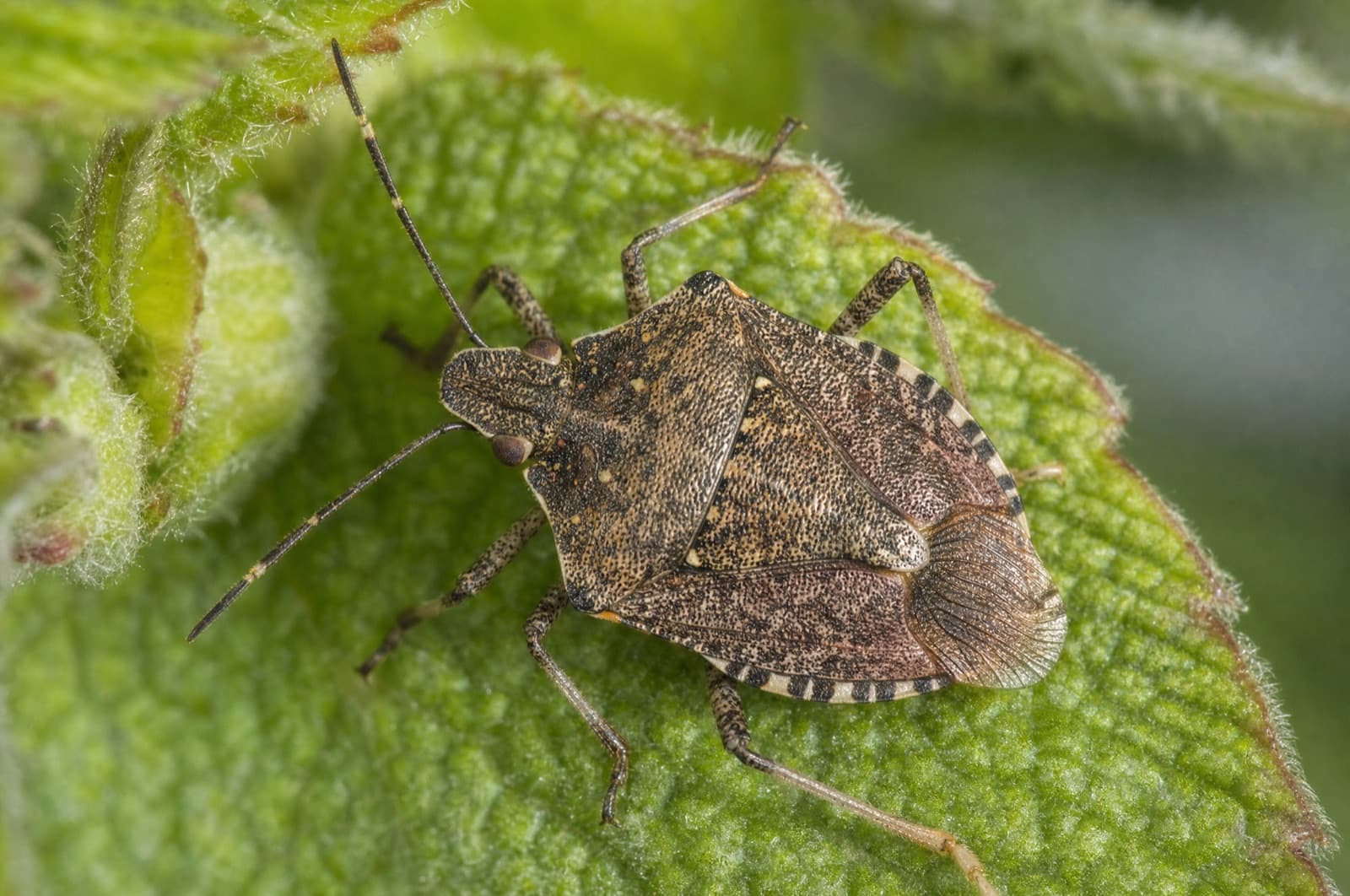
Brown Marmorated Stink Bug in New Hampshire — ID & Control
Also called BMSB · stink bug · shield bug
The brown marmorated stink bug (BMSB) is an invasive Asian shield bug first confirmed in NH at Portsmouth in 2010. It masses on warm walls in fall and slips inside to overwinter — but indoors it is a pure nuisance: it won't bite, breed, or damage your home. It releases a cilantro-like odor when disturbed. The fix is exclusion before frost, not insecticide spray.
- Adult size
- ~⅔ in (14–17 mm), about the size of a U.S. dime
- EPA; UMD Extension
- ID tell
- Bold light/dark banded antennae — unique vs. native stink bugs
- UNH Extension
- First NH record
- Portsmouth, summer 2010; 20+ NH towns by Feb 2015
- UNH Extension; National Invasive Species Information Center
- Breeds indoors?
- No
- UNH Extension; USDA
- Defensive odor
- Trans-2-decenal and trans-2-octenal — compounds also found in cilantro
- PMC (peer-reviewed)
- NH massing window
- ~September 1–20 on buildings
- UNH Extension
- Host plant range
- Over 300 susceptible plant species (outdoors)
- Minnesota Dept. of Agriculture
The shield bug with the cilantro smell — and the antennae check
The brown marmorated stink bug wears two hats in New Hampshire, and conflating them is the number-one reader mistake. Outdoors and on farms it is a serious, economically significant agricultural pest capable of damaging hundreds of plant species. Indoors in your home, it is a pure nuisance — it won't bite you, won't breed in your walls, won't damage your house or stored food, and has no credible human-health threat. The cilantro-like odor it releases when disturbed is unpleasant, not dangerous.
The NH-seasonal story: BMSB masses on warm, sunny building walls roughly September 1–20, ahead of Manchester's first hard frost (~Oct 19 at 50% probability per NOAA 1991–2020). It slips inside through any gap it can find — utility penetrations, window trim gaps, soffit seams — and overwinters in wall voids. On warm late-winter or early spring days, overwintered adults emerge near windows seeking the outdoors. First confirmed in NH at Portsmouth in the summer of 2010, it was found in more than 20 NH towns and cities by February 2015 (UNH Extension).
The one-second NH ID: check the antennae. Bold, alternating light-and-dark bands = BMSB. Uniform antennae = a harmless native stink bug. UNH Extension rates the antennal check as the single most reliable field ID. The durable household fix is exclusion — caulking entry points before early September — not insecticide spray, which UNH does not recommend for this nuisance and which BMSB resists.
How to identify the brown marmorated stink bug
The antennal check is the fastest field ID: BMSB has bold, alternating light-and-dark bands on the antennae that no native NH stink bug shares. Pair that with the marbled (marmorated) brown shield body, the alternating light/dark banding along the abdominal edge, and the nearly-as-wide-as-long proportions, and the ID is conclusive.
Brown marmorated stink bug
- Scientific name
- Halyomorpha halys
- Family
- Pentatomidae (stink bugs / shield bugs)
- Size
- 14–17 mm (~⅔ in)
- Coloration
- Mottled brown shield body; antennae with alternating light and dark bands; alternating light/dark banding on the abdominal edge; smooth shoulders
- Habitat
- Orchards, crops, ornamentals, and gardens in summer; south- and east-facing building walls in fall; wall voids and structural gaps through winter
- Active season
- Masses on building exteriors ~Sep 1–20; overwinters indoors; active on warm winter days; returns outdoors in spring
- Diet
- Highly polyphagous outdoors — more than 300 plant species susceptible; does not feed indoors
- Reproduction
- Eggs laid June–August on host plants outdoors; does not reproduce indoors under any conditions
- Lifespan
- Overwintering adults can survive several months to approximately one year
Native to China, Japan, and Korea; first US detection Allentown PA ~1998; first NH record Portsmouth summer 2010; now confirmed in 20+ NH towns and statewide
The tells — key ID features
- Bold, alternating light/dark banded antennae — the single best tell vs. all native NH stink bugs.
- Marbled ('marmorated') mottled brown shield body, almost as wide as it is long.
- Alternating light and dark banding along the outer edge of the abdomen.
- ~⅔ inch — about the size of a U.S. dime.
- Smooth, rounded 'shoulders' with no spines (unlike some look-alikes).
- Cilantro-like or coriander odor released immediately when disturbed or handled.
Size, to scale
14–17 mm (~⅔ in)
About the size of a U.S. dime (17.9 mm diameter) — almost as wide as it is long
Native brown stink bugs (e.g., Euschistus spp.)
How to tell — Native NH stink bugs have plain, unbanded antennae. Check the antennae first — BMSB is the only common NH species with bold light/dark bands.
Western conifer seed bug
How to tell — WCSB is narrower, longer (~¾ in), brown with a white zigzag, and has distinctive leaf-shaped flares on its hind legs. BMSB is wider and shield-shaped with no leaf-feet.
Boxelder bug
How to tell — Boxelder bug is black with bold red stripes, narrower, and distinctly not brown. If you see red markings, it is not BMSB.
Squash bug
How to tell — Squash bug is flatter and darker, found on squash plants in summer, and lacks the banded antennae of BMSB.
Signs of a problem
The BMSB has a signature NH fall behavior pattern that makes it easy to recognize once you know the timeline.
Shield-shaped mottled-brown bugs on warm, sunny walls September through October
What it means — Classic fall aggregation — they are collecting solar warmth before overwintering, not establishing an infestation.
Bugs on interior windowsills, curtains, or near lights in late winter
What it means — They overwintered successfully in your wall voids and are re-emerging; this is expected and harmless.
A cilantro- or coriander-like smell immediately after a bug is disturbed or vacuumed
What it means — The BMSB's defensive aldehydes (trans-2-decenal, trans-2-octenal) — an unpleasant but harmless scent; confirms BMSB identity.
Bugs near porch or garage lights at night in late August and September
What it means — Young adults are attracted to artificial light in late summer as they move from host plants to overwintering sites.
Bugs found near fruit trees, ornamentals, or vegetable gardens in summer
What it means — BMSB feeding on outdoor host plants — the agricultural/garden-pest role, unrelated to home intrusion.
The real risks, calibrated
The key is separating the outdoor agricultural risk (real) from the indoor home risk (negligible). For NH homeowners, the indoor risk profile is genuinely low.
Unpleasant odor when disturbed indoors
Low riskOnset: Immediately when handled, crushed, or vacuumed
The cilantro-like defensive odor (trans-2-decenal and trans-2-octenal) can linger on fabrics and upholstery. Not a health hazard but very difficult to remove from light textiles.
Agricultural and garden crop damage (outdoors only)
Low riskOnset: Summer feeding on host plants
A serious economic pest on fruit, vegetable, and ornamental crops in regions with large established populations. In NH homes it poses no crop-level threat, but nearby garden plants may show cosmetic damage.
Rare eye or skin irritation
Low riskOnset: Direct contact with body fluids when handled or crushed
A small number of people report minor eye irritation or skin redness from direct contact with crushed BMSB — avoid handling barehanded and crush outdoors if at all.
Bite, sting, or disease transmission
Low riskOnset: Not applicable
BMSB does not bite or sting people and does not transmit any known human pathogen. No indoor breeding, no structural damage.
DIY — what works, what backfires
For BMSB, timing is everything. The exclusion window is late August through mid-October. Act early and you prevent most bugs from entering; act late and they are already in your walls for the winter.
What actually works
- Seal entry points before September 20: caulk around all windows, door frames, siding laps, soffit seams, pipe/utility penetrations, and attic vents — prioritize south- and east-facing walls.
- Use a dedicated shop-vac or a vacuum with a bag for indoor bugs; empty or seal the bag immediately outdoors to contain the odor.
- Install or repair window screens, door sweeps, and chimney caps in August, before peak activity.
- Use indoor light traps to reduce populations of overwintered bugs trying to find their way out in late winter.
- Knock wall clusters off with a forceful water stream outdoors rather than crushing them.
What backfires
- Don't crush BMSB indoors — the odor embeds in fabrics and is very hard to remove.
- Don't rely on insecticide sprays: UNH Extension does not recommend them for this nuisance, and BMSB shows resistance to many common insecticide classes.
- Don't squash on light-colored curtains, upholstery, or carpet — staining is essentially permanent.
- Don't wait until you see bugs on the walls — by then the exclusion window is closing.
Brown marmorated stink bug in New Hampshire
The BMSB is now confirmed and established statewide in NH. First documented in Portsmouth in the summer of 2010, it spread to more than 20 NH towns and cities by February 2015 per UNH Extension and the National Invasive Species Information Center. Per UNH, it is not yet a major NH crop pest at the scale seen in Mid-Atlantic states, but it is a recognized and growing home nuisance across Manchester, Nashua, Concord, and surrounding communities. The September 1–20 massing window on sun-exposed walls is the clearest indicator: homes with south- and east-facing walls bordered by fruit trees, ornamentals, or vegetable gardens see the heaviest fall activity.
Peak season
Masses on building exteriors ~September 1–20; overwinters in wall voids; emerges on warm winter/spring days
You might actually have
- Boxelder bug (same fall clustering, black/red, narrower)
- Western conifer seed bug (same fall entry, larger, leaf-shaped hind legs)
- Cluster fly (same fall overwintering, different cluster)
- Multicolored Asian lady beetle (same fall clustering, orange/spotted, different cluster)
We serve these communities
- NH-licensed applicator · #782664
- Same-day service
- Family-owned since 2017
Service Area Map
Southern New Hampshire
When to call Anchor Pest Services for stink bugs
Exclusion is the only durable fix for BMSB, and the earlier in fall it happens the better. A professional inspection identifies every gap and penetration on the exterior that a homeowner's eye misses — especially on complex rooflines, vinyl-sided homes with hidden channels, and homes near orchards or vegetable gardens that attract larger fall populations.
When to call a pro
- Large, recurring fall aggregations on multiple walls despite self-sealing attempts.
- Bugs are consistently entering living space even after caulking visible gaps.
- A commercial property or orchard-adjacent residence with significant fall populations.
- You want a full exterior audit for entry points before the September window opens.
Start exclusion before September 1
BMSB begins moving to buildings as early as September 1 in NH. Complete all caulking, screen repair, and door-sweep work by late August to close off entry before peak aggregation.
Seal utility and pipe penetrations
BMSB is adept at following any utility penetration — cable, plumbing, gas lines, electrical conduit — through siding and into wall voids. Foam sealant around each penetration eliminates a major entry route.
Screen attic and soffit vents
Fine-mesh screens (no larger than 1/16 inch) on gable vents, soffit vents, and ridge vents prevent BMSB from mass-overwintering in attic spaces, which is where the largest indoor populations originate.
Not sure it's a brown marmorated stink bug?
A licensed NH technician can confirm the species and tell you honestly whether it's a DIY fix or a job for a pro — free inspection, same-day service across Southern New Hampshire.
Frequently asked questions
Sources(8)
- [1]UNH Cooperative Extension — Brown Marmorated Stink Bug
NH first record (Portsmouth 2010), 20+ towns by 2015, antennal ID, exclusion-over-spray guidance
extensionverified 2026-06-30 - [2]Penn State Extension — Brown Marmorated Stink Bug
First US collection Allentown PA ~1998; biology, life cycle, host range
extensionverified 2026-06-30 - [3]EPA — Brown Marmorated Stink Bug
Adult size ~14–17 mm; general biology and US distribution
govverified 2026-06-30 - [4]University of Maryland Extension — Brown Marmorated Stink Bug
Size reference (dime-sized); identification features
extensionverified 2026-06-30 - [5]Minnesota Department of Agriculture — Brown Marmorated Stink Bug
Over 300 susceptible plant species in agricultural, horticultural, and natural settings
govverified 2026-06-30 - [6]PMC — Alarm Pheromone Compounds of Brown Marmorated Stink Bug
Defensive odor chemistry: trans-2-decenal and trans-2-octenal
academicverified 2026-06-30 - [7]National Invasive Species Information Center — BMSB New Hampshire
NH establishment timeline; 20+ NH towns by February 2015
govverified 2026-06-30 - [8]Garden.org — NOAA Frost Date Calculator (Manchester, NH)
Manchester first hard frost ~Oct 19 (50%) / Oct 29 (80%), NOAA 1991–2020 normals
govverified 2026-06-30
Written & reviewed by
VerifiedDaniel Brady
NH-Licensed Pesticide Applicator · License #782664 (NHDAMF, RSA 430)
Daniel Brady is the New Hampshire–licensed applicator behind Anchor Pest Services, a family-owned pest control company serving the Manchester area since 2017.
Last updated 2026-06-30

New Hampshire pest control
Dealing with brown marmorated stink bugs in your home?
Anchor Pest Services identifies and handles brown marmorated stink bug problems across southern and central New Hampshire. Family-owned since 2017, NH license #782664.
- NH-licensed applicators (#782664)
- Same-day service · free inspection
- Family-owned since 2017
Your next step
- Fall guide
Fall Pest Control in New Hampshire
What matters before frost: the fall invader window, mice at the foundation, and what to seal first.
Read the answer - What to do next
How to Get Rid of Brown Marmorated Stink Bugs
Read the answer - What to do next
How do I recognize a stink bug infestation?
Read the answer - What to do next
Can stink bugs harm indoor plants?
Read the answer - What to do next
How to remove stink bugs safely?
Read the answer - What to do next
How to prevent stink bugs from entering?
Read the answer