
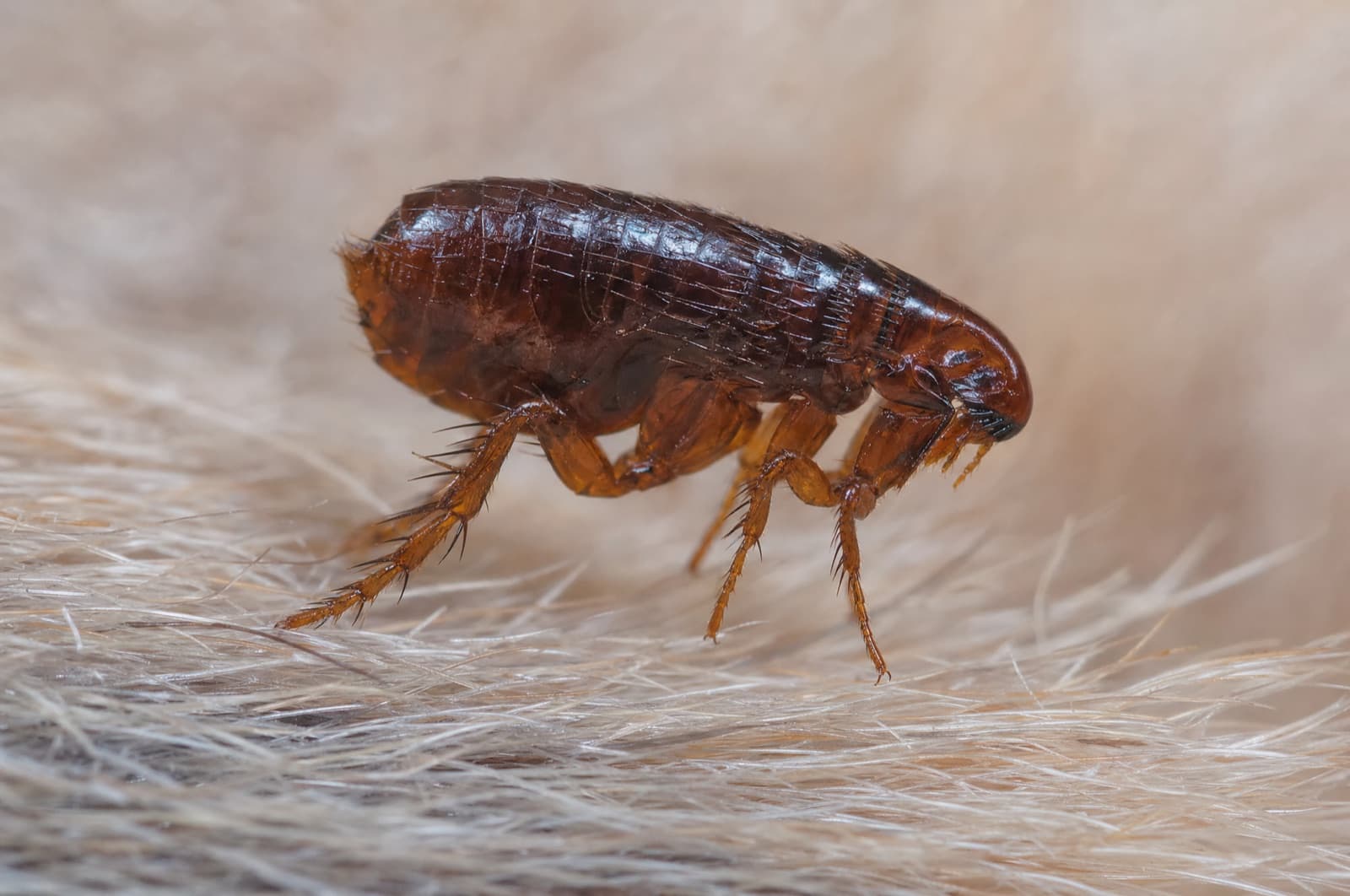
Flea — Quick ID for New Hampshire Homeowners
Also called Cat flea · Dog flea
Fleas are tiny, wingless, reddish-brown insects flattened side-to-side that jump rather than fly. The cat flea is the most common species on NH pets. Key tells: pets scratching, black flea-dirt specks on fur that turn red when wet, and small itchy bites clustered around human ankles. This is the fast identifier; for the full home-and-pet treatment cycle, see the Ticks and Fleas guide.
- Size
- 1–3 mm
- tiny; Ctenocephalides felis (cat flea most common)
- Shape
- Laterally flattened
- thin side-to-side; allows movement through fur
- Movement
- Jumps up to 150× body length
- does not fly; wingless
- Flea dirt test
- Turns red on wet paper
- digested blood — confirms active infestation
Is it a flea?
Fleas are the most common indoor ectoparasite on New Hampshire pets — tiny, reddish-brown, and wingless, they jump rather than fly and often go unnoticed until the infestation is well established. The flea-dirt test on a damp paper towel is the fastest field confirmation.
This page is a fast identifier. For the complete treatment approach — breaking the egg-larva-pupa-adult cycle in the home, coordinating with veterinary flea care, and yard treatment options — read the full Ticks and Fleas guide linked above.
Quick flea ID
A few features confirm a flea immediately — size, shape, and the characteristic jump are usually enough without a magnifier.
Flea
- Scientific name
- Ctenocephalides felis (cat flea; most common on NH pets)
- Family
- Siphonaptera
- Size
- 1–3 mm
- Coloration
- Dark reddish-brown, shiny, hard-bodied
- Habitat
- On cats, dogs, and wildlife hosts; eggs and larvae develop in carpet, pet bedding, upholstered furniture, and floor cracks where pet dander accumulates
- Active season
- Year-round indoors; outdoor acquisition peaks late spring through fall
- Diet
- Blood from mammal hosts at all life stages; larvae feed on organic debris including flea dirt
- Reproduction
- Females lay up to 50 eggs per day on the host; eggs fall into carpet and bedding; full life cycle in 2–4 weeks in warm conditions
- Lifespan
- Adults live weeks to months; cocoons can remain dormant for up to a year
Found year-round in New Hampshire in homes with pets; outdoor activity peaks in warm months but indoor infestations can persist year-round.
The tells — key ID features
- Tiny, wingless, and laterally flattened — thin when viewed from the side, allowing movement through fur.
- Jumps long distances relative to body size — does not fly; jumping movement is diagnostic.
- Dark reddish-brown and hard-bodied; visible to the naked eye on light-colored fur or skin.
- Found on pets and in their sleeping areas, bedding, and carpet — not just on the animal.
Flea dirt vs. regular dirt
How to tell — Place black specks from pet fur on a damp white paper towel. Flea dirt (digested blood) turns reddish-brown or rust-red when wet. Regular dirt stays black or gray. This is the definitive field test for flea infestation.
Springtail
How to tell — Springtails also jump and are tiny, but they are found in damp soil, potting mix, and drains — not on pets or in pet bedding. They do not bite.
Signs of a problem
Two signs together confirm a flea infestation.
Pets scratching persistently with black specks ('flea dirt') visible in the fur that turn reddish on a damp paper towel
What it means — Active flea infestation on the pet — adults are feeding and eggs are being deposited in the home.
Small, intensely itchy bites clustered around human ankles and lower legs
What it means — Fleas jumping from carpet or floor level — an established infestation in the home, not just on the pet.
Flea control in New Hampshire
Breaking a flea infestation requires treating the pet, the home, and — in some cases — the yard simultaneously. Only about 5% of the flea population is on the pet at any time; the rest are eggs, larvae, and pupae in carpets and bedding. Coordinating home treatment with veterinary flea care is essential. The full Ticks and Fleas guide covers the complete life-cycle treatment approach.
When to call a pro
- Pets are infested and home treatment has not broken the cycle.
- Human bites (ankles, lower legs) persist despite treating the pet.
- You need a coordinated home, yard, and pet treatment alongside veterinary flea care.
Not sure it's a flea?
A licensed NH technician can confirm the species and tell you honestly whether it's a DIY fix or a job for a pro — free inspection, same-day service across Southern New Hampshire.
Frequently asked questions
Sources(3)
- [1]
- [2]
- [3]Anchor Pest — Ticks and Fleas Guide
full NH flea and tick treatment cycle guide
industryverified 2026-06-30
Written & reviewed by
VerifiedDaniel Brady
NH-Licensed Pesticide Applicator · License #782664 (NHDAMF, RSA 430)
Daniel Brady is the New Hampshire–licensed applicator behind Anchor Pest Services, a family-owned pest control company serving the Manchester area since 2017.
Last updated 2026-06-30

New Hampshire pest control
Dealing with fleas in your home?
Anchor Pest Services identifies and handles flea problems across southern and central New Hampshire. Family-owned since 2017, NH license #782664.
- NH-licensed applicators (#782664)
- Same-day service · free inspection
- Family-owned since 2017
Your next step
- Next step
How Do I Stop Flea Bites From Itching?
Read the answer - Also relevant
What Is the Difference Between a Tick and a Flea?
Read the answer - Also relevant
Are Flea Shampoos Effective Long Term?
Read the answer - Also relevant
How Do I Check My Pet for Fleas Effectively?
Read the answer - Also relevant
Do Flea and Tick Sprays for the Home Actually Work?
Read the answer - Related guide
Can Flea Infestations Make Pets Seriously Ill?
Read the answer