
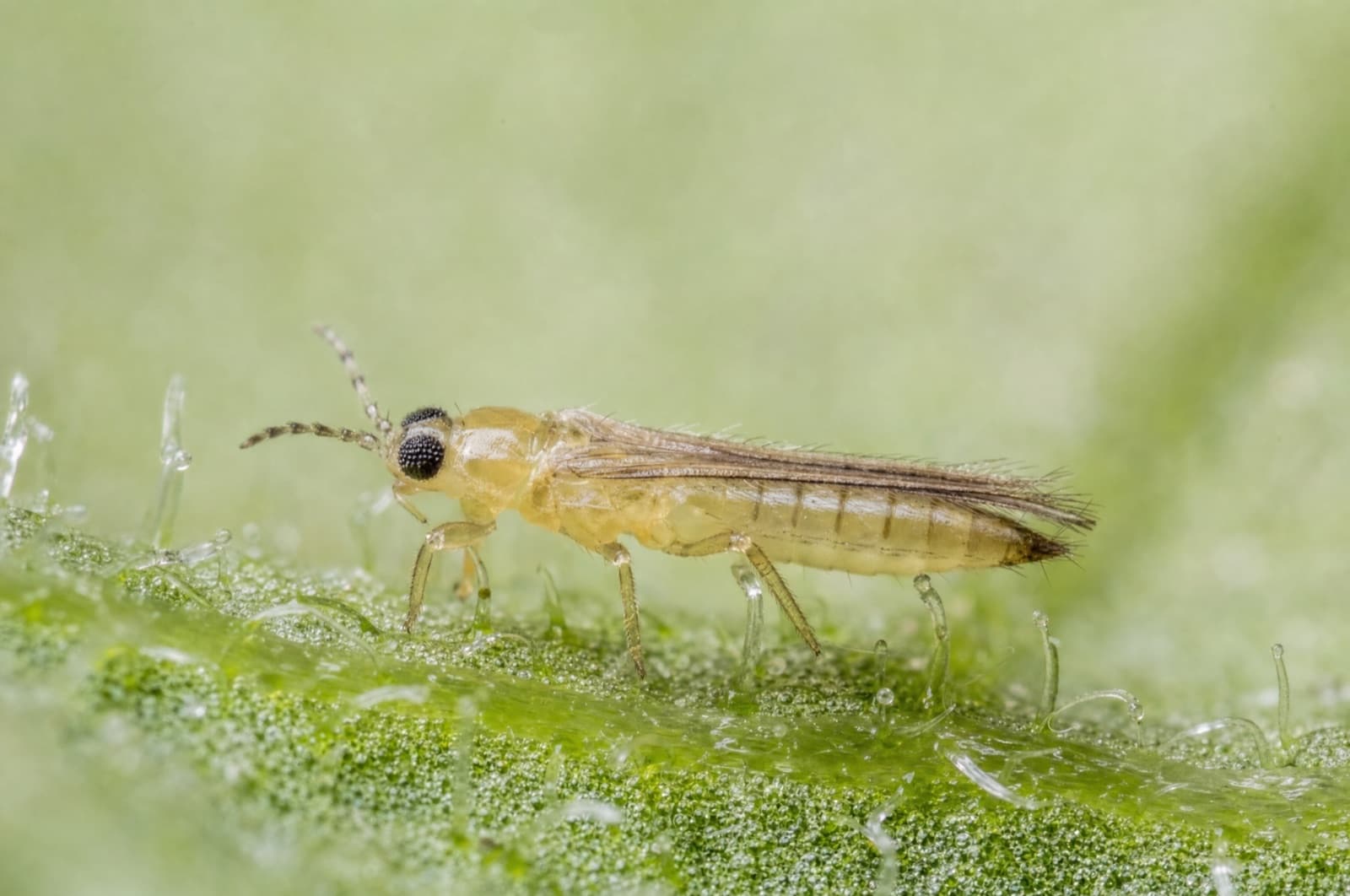
Thrips in New Hampshire — Plant Pest, Not a Home Invader
Also called thunderflies · thunderbugs · storm flies
Thrips are tiny (~1 mm) slender plant pests — not a household-infesting pest. Outdoors in large numbers they occasionally land on people and probe skin for moisture, causing minor, short-lived irritation. The honest verdict: they are a garden and crop pest that sometimes annoys people outdoors, not something that infests a home. The fix is plant management, not whole-house spraying.
- Size
- ~1 mm (order ranges 0.5–15 mm)
- Dermatology review (BioOne)
- What it is
- Outdoor plant pest — not a home-infesting pest
- Research/brief consensus
- Bites people?
- Incidentally — minor, short-lived skin irritation only
- BioOne review; MDedge
- Disease to humans
- None
- A-Z Animals; BioOne review
- Diversity
- 5,000+ species (order Thysanoptera)
- Dermatology review (BioOne)
- Plant damage
- Significant to crops and ornamentals
- BioKIDS, University of Michigan
The honest outlier: a plant pest, not a home invader
Thrips are the honest outlier in this pest cluster. They are tiny (~1 mm) slender plant feeders that damage crops and ornamentals outdoors — but they do not infest homes the way moisture-driven invaders do. In large outdoor numbers during hot, dry weather, they occasionally land on people and probe skin for sweat or moisture, causing minor, brief skin irritation — a condition researchers call Thysanoptera dermatitis — but they are not biting in any predatory sense and transmit no disease to people.
The honest verdict we'll give you here instead of selling you a treatment: thrips are a garden story that sometimes irritates skin outdoors, and for most NH homeowners the answer is garden-plant management, not a pest-control visit. If you have thrips on your houseplants or in a greenhouse, that is a localized plant issue we can help with — but thrips in the garden biting you while you weed is not a structural home-infestation problem.
How to identify thrips
Thrips are identified by their extreme smallness (~1 mm), their slender elongate shape, and their plant association. They have fringed wings — the order name Thysanoptera literally means 'fringe wings' — and are found on plant tissue, not nesting in home structures. On skin they feel like a faint crawling or pricking sensation before they are visible.
Thrips
- Scientific name
- Order Thysanoptera
- Family
- Multiple (e.g., Thripidae)
- Size
- ~1 mm typically; order ranges 0.5–15 mm
- Coloration
- Pale yellow, brown, or black depending on species
- Habitat
- On plants — flowers, leaves, crops, and ornamentals; occasionally on people outdoors in large numbers
- Active season
- Warm season; peaks in hot, dry weather
- Diet
- Plant tissues and sap (phytophagous); some predatory species; incidental probing of human skin for moisture
- Reproduction
- On plant material; rapid in warm conditions
- Lifespan
- ~40 days average depending on species
Worldwide; 5,000+ species. Common on plants and in gardens throughout New Hampshire during the warm season.
The tells — key ID features
- Extremely tiny (~1 mm), slender, elongate body — like a moving sliver on the skin or a plant leaf.
- Fringed ('hairy') wings — the order name Thysanoptera means 'fringe wings.'
- Pale to dark coloring; found on plants and flowers, not nesting in home structures.
- Piercing-sucking mouthparts used on plants; incidental probing on human skin.
- Often noticed as moving specks on light-colored clothing or skin when outdoors near plants.
- Plant association: thrips are tied to their plant hosts, not to structures or indoor moisture.
Size, to scale
~1 mm
About 1 mm — smaller than a lowercase letter 'o' on this page; a moving sliver noticed more by feel than by sight.
Springtail
How to tell — Springtails jump from damp surfaces indoors and do not infest plants. Thrips are slender, plant-associated, and found outdoors on flowers and leaves. If it is jumping near a sink, it is a springtail.
Biting midge / no-see-um
How to tell — Biting midges are true flies that take a blood meal and leave a more painful, persistent bite with a welt. Thrips probe for moisture and cause only minor, short-lived irritation. If bites are really itchy and welt-forming, consider no-see-ums.
Booklice
How to tell — Booklice are soft, slow-moving, and found on damp books and papers indoors. Thrips are slender, fringed-wing insects found on plants outdoors.
Signs of a problem
Because thrips are primarily a plant pest, the most reliable signs are on the plants themselves — not in the home structure.
Silvery stippling, streaking, or distorted growth on plant leaves and flowers
What it means — Thrips feeding damage on plants — the primary sign of a thrips problem, outdoors or in houseplants.
Tiny specks of various colors on light-colored clothing while gardening outdoors
What it means — Thrips on the move from plants in hot, dry weather — normal seasonal activity, not a home infestation.
Minor itchy pinpricks or a crawling sensation on skin while gardening in hot weather
What it means — Incidental probing by thrips attracted to human sweat or moisture — brief and harmless.
Specks on or in houseplants or greenhouse plants
What it means — A localized plant infestation — manage the affected plant, not the whole house.
The real risks, calibrated
Thrips pose no structural home risk and no health risk beyond minor, brief skin irritation during outdoor activity.
Skin irritation from outdoor probing
Low riskOnset: On contact during outdoor activity near large thrips populations
Minor itching or a brief rash from thrips probing skin for moisture. Usually resolves within hours. Wash the area with soap and water.
Allergic or dermatitis reaction in sensitive individuals
Low riskOnset: Uncommon; in people with heightened skin sensitivity
Itching or mild dermatitis that can persist for a day or more. Per MDedge, 'Thysanoptera dermatitis' is documented but uncommon. Most people have no lasting reaction.
Plant damage outdoors and in greenhouses
ModerateOnset: During the growing season when populations are high
Significant economic damage to crops, ornamentals, and vegetable gardens. Leaves show silvery stippling, streaking, and distortion. Thrips can also transmit plant viruses.
Disease transmission to humans
Low riskOnset: N/A
Thrips do not transmit disease to people or pets. Per A-Z Animals and published peer-reviewed reviews, no disease transmission to humans has been documented.
DIY — what works, what backfires
The fix for thrips is plant management, not whole-house pest control. Here is the honest guidance for NH gardeners and homeowners.
What actually works
- For skin irritation: wash the affected area with soap and water — most reactions resolve quickly and need no medical care.
- Wear loose, light-colored clothing when gardening in hot, dry weather to reduce thrips contact with skin.
- Manage thrips on plants: rinse plants with water, prune heavily infested leaves, and use appropriate horticultural soap or neem oil on affected plants following label directions.
- For persistent or concerning skin reactions, call the Northern New England Poison Center at 1-800-222-1222 — free, 24/7, serving NH, ME, and VT.
- Inspect houseplants or greenhouse plants for thrips damage (silvery stippling) and treat the plant, not the room.
What backfires
- Do not treat thrips as a structural home infestation requiring whole-house spraying — they are plant pests, not home colonizers.
- Do not expect indoor pest control to solve an outdoor garden thrips problem.
- Do not ignore significant plant damage — thrips are a real economic pest on crops and ornamentals that benefits from timely plant management.
Thrips in New Hampshire gardens
Thrips are present in New Hampshire gardens, on crops, and on ornamental plants throughout the warm season. Outdoor biting or probing incidents peak during hot, dry weather when large thrips populations are on the move and people are gardening or sitting near flowering plants. Thrips are not established as a structural home pest in NH — they do not colonize homes the way moisture-driven invaders or overwintering insects do. Concerns about any skin reaction can be directed to the Northern New England Poison Center at 1-800-222-1222 (free, 24/7).
Peak season
Warm season; biting incidents peak in hot, dry weather
You might actually have
- Springtails (also tiny hopping bugs — but springtails don't infest plants; they live in damp soil indoors)
- Biting midges / no-see-ums (true biting flies — if bites are persistent and itchy, these are the more likely culprit)
We serve these communities
- NH-licensed applicator · #782664
- Same-day service
- Family-owned since 2017
Service Area Map
Southern New Hampshire
When to call a pro for thrips
Anchor starts every thrips inquiry with correct identification — tiny biting or crawling specks have several possible causes, and confirming it is actually thrips matters. For indoor plant or greenhouse thrips problems, targeted plant treatment is the right approach. For outdoor biting incidents, the answer is usually plant management, not structural spraying.
When to call a pro
- Indoor plant or greenhouse thrips infestation that is damaging valued plants.
- Unable to identify tiny biting or crawling specks — correct identification is the first step.
- Recurring outdoor biting incidents that make the garden or yard unusable.
Manage garden and houseplant health
Healthy plants resist thrips better. Regular inspection, appropriate watering, and prompt treatment of infested plants prevents large populations from building up in NH gardens.
Wear protective clothing while gardening
Loose, light-colored long sleeves and pants during hot, dry NH summer weather reduce incidental thrips contact with skin.
Inspect plants before bringing them indoors
Thrips on outdoor plants or purchased nursery stock can establish on indoor plants or in greenhouses. Inspect and quarantine new plants before placing them with healthy ones.
Not sure it's a thrips?
A licensed NH technician can confirm the species and tell you honestly whether it's a DIY fix or a job for a pro — free inspection, same-day service across Southern New Hampshire.
Frequently asked questions
Sources(6)
- [1]BioOne — A Review of Thrips Species Biting Man (Florida Entomologist, 2005)
biting species (Frankliniella, Limothrips), probing for moisture, minor irritation, no disease transmission
academicverified 2026-06-30 - [2]MDedge — Thysanoptera Dermatitis
Thysanoptera dermatitis terminology, dermatitis reaction in sensitive individuals
medicalverified 2026-06-30 - [3]BioKIDS, University of Michigan — Thysanoptera
significant plant damage to crops and ornamentals
academicverified 2026-06-30 - [4]A-Z Animals — Do Thrips Bite People?
no disease transmission, bites minor and harmless to people
industryverified 2026-06-30 - [5]Northern New England Poison Center
free 24/7 resource for NH/ME/VT residents with skin-reaction questions; 1-800-222-1222
medicalverified 2026-06-30 - [6]UNH Cooperative Extension — Insect Identification
NH presence on garden plants and ornamentals; identification support for NH homeowners
extensionverified 2026-06-30
Written & reviewed by
VerifiedDaniel Brady
NH-Licensed Pesticide Applicator · License #782664 (NHDAMF, RSA 430)
Daniel Brady is the New Hampshire–licensed applicator behind Anchor Pest Services, a family-owned pest control company serving the Manchester area since 2017.
Last updated 2026-06-30

New Hampshire pest control
Dealing with thripss in your home?
Anchor Pest Services identifies and handles thrips problems across southern and central New Hampshire. Family-owned since 2017, NH license #782664.
- NH-licensed applicators (#782664)
- Same-day service · free inspection
- Family-owned since 2017