
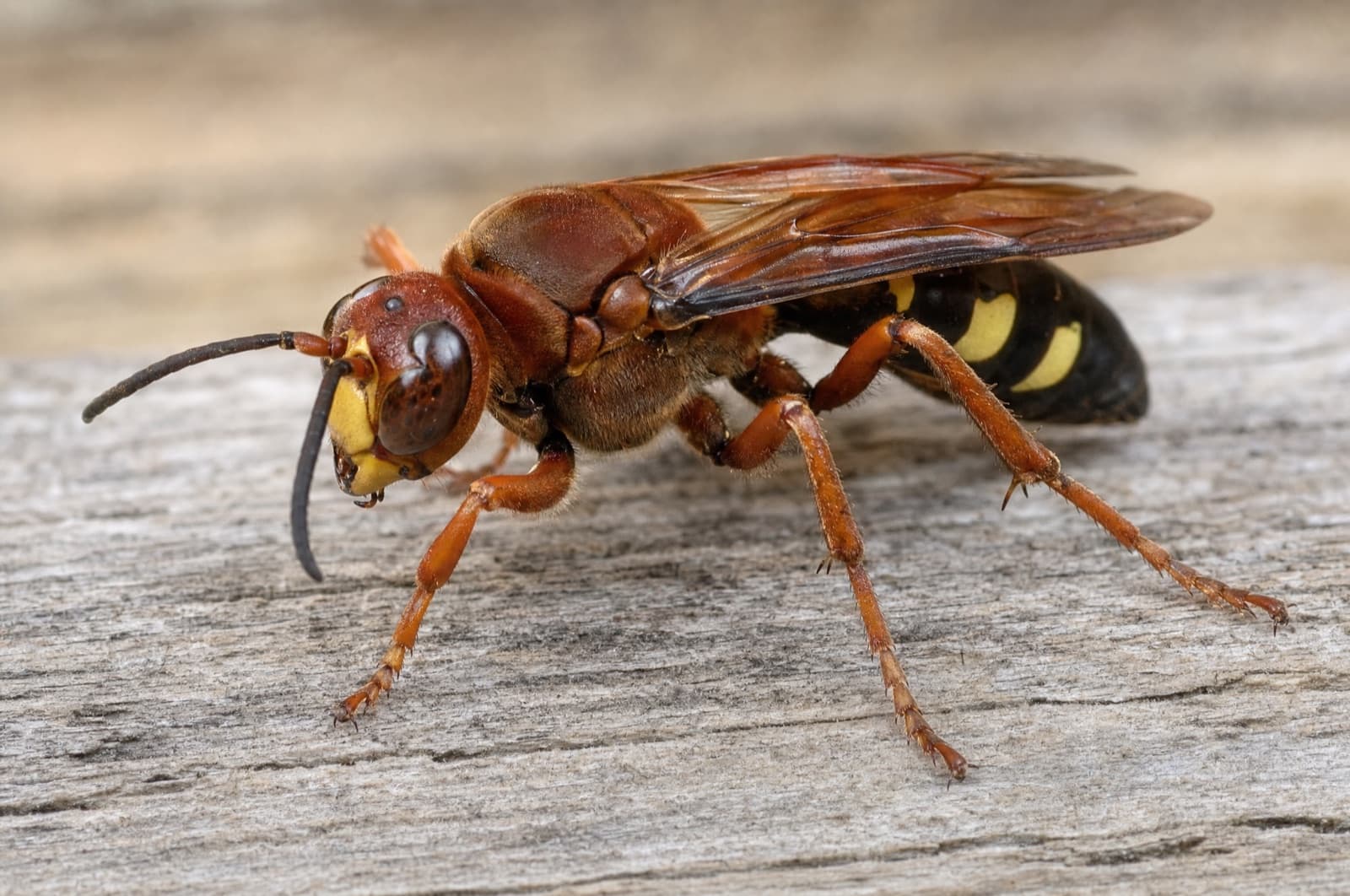
Cicada Killer Wasp in NH — Giant but Harmless
Quick facts
- Size: 30–50 mm (up to 2 in)New England's largest solitary wasp; CT Agricultural Experiment Station / Wikipedia
- Sting: Female rarely stings; males have no stingerOK State Extension; males display aggressively but are physically incapable of stinging
- Sociality: Solitary — single burrow per female, no colony to defendIllinois DNR
- Active season: Late June / July through SeptemberTimed to dog-day cicada emergence; Illinois DNR
Size
30–50 mm (up to 2 in)
New England's largest solitary wasp; CT Agricultural Experiment Station / Wikipedia
Sting
Female rarely stings; males have no stinger
OK State Extension; males display aggressively but are physically incapable of stinging
Sociality
Solitary — single burrow per female, no colony to defend
Illinois DNR
Active season
Late June / July through September
Timed to dog-day cicada emergence; Illinois DNR
New Hampshire's biggest wasp — and why it is nothing to fear
In July and August, NH homeowners sometimes spot an enormous wasp — rusty-red head, black-and-yellow-banded abdomen, amber wings — hovering low over a lawn or patio, or hovering over a single hole in bare or sandy soil. The size alone is alarming: at up to 50 mm, the eastern cicada killer (Sphecius speciosus) is genuinely one of the largest wasps in the eastern United States. And since the "murder hornet" story dominated headlines before USDA and Washington State declared Vespa mandarinia eradicated from the United States on December 18, 2024, that alarming size has made the cicada killer the #1 "is that a murder hornet?" panic species in NH lawns.
It is not a murder hornet. It was never close to one. The cicada killer is a solitary digger wasp — not social, not colonial, and not defensive — with the personality of a gentle giant. The males you see patrolling and hovering look aggressive, but they cannot sting: male wasps across all species lack a stinger. The females carry a stinger but rarely use it; entomologists who have handled hundreds of cicada killers describe them as able to sting only if you squeeze one in your hand. Oklahoma State Extension calls them "unusually docile and harmless" and Justin Schmidt himself — creator of the sting pain index — called cicada killers "gentle giants of the wasp world."
Cicada killers are genuinely uncommon in New Hampshire. The state sits near the northern edge of the species' range, and documented NH records are sparse — roughly one record in BugGuide's contributed-data table versus 31 for Massachusetts and 64 for New York. A homeowner report from Plaistow, NH confirms they do occur here. If you are seeing this wasp in your yard, you are among a relatively small group of NH residents who encounter it, and the honest answer to "should I do anything about it?" is almost always no.
This page covers how to identify the eastern cicada killer, how to tell it from the European hornet and the now-eradicated murder hornet, what the soil mounds in your lawn actually are, and the narrow circumstances in which professional assessment is warranted.
Cicada killers in New Hampshire — uncommon but documented
New Hampshire sits near the northern edge of the eastern cicada killer's range. The Massachusetts Cicadas project states plainly that cicada-killer records are "extremely lacking especially in Vermont, New Hampshire and Maine," and BugGuide's contributed-occurrence data shows approximately one NH record compared with 31 for Massachusetts and 64 for New York. A documented homeowner report from Plaistow, NH confirms that cicada killers do reach the state — specifically in bare sandy soil between patio pavers — but they are genuinely uncommon here compared with southern New England. Where cicada killers do appear in NH, they favor bare, well-drained, and sandy soils in sunny areas: garden edges, lawn patches with thin or worn grass, sandy utility strips, and disturbed ground near driveways or paths. They are active in the July–August window timed to the emergence of annual (dog-day) cicadas, which are their prey. By September, adults are gone. The solitary nature of cicada killers means there is no colony, no defended nest territory, and essentially no sting risk to people or pets going about normal yard activity. Treatment is warranted only in rare cases where dozens of females are sharing the same sandy area and the physical soil disturbance is damaging turf.
We serve these communities
UNH Cooperative Extension notes cicada killers and other solitary digger wasps as part of New Hampshire's solitary wasp fauna; solitary ground-nesting wasps are docile and rarely require treatment — Resource000532.
- NH-licensed applicator · #782664
- Same-day service
- Family-owned since 2017
Service Area Map
Southern New Hampshire
How to identify the eastern cicada killer — and what it is not
The eastern cicada killer is large enough that it can be identified on size and color alone from a few feet away. Three field marks separate it instantly from European hornets and from the now-eradicated murder hornet.
Eastern cicada killer
Also called: Cicada hawk, Sand hornet (misnomer)
- Scientific name
- Sphecius speciosus
- Family
- Bembicidae (formerly Crabronidae / Sphecidae)
- Sociality
- Solitary
- Size
- 30–50 mm (1.5–2.0 in); females are larger than males
- Coloration
- Rusty-red head and thorax; black abdomen with three pairs of pale yellow bands; brown or amber wings; orange legs. The combination of rusty-red and yellow on a wasp of this size is unlike any common social wasp in New Hampshire.
- Range
- Present but uncommon in New Hampshire, near the northern edge of the species' range. Approximately one BugGuide NH contributed-occurrence record versus 31 for Massachusetts; documented Plaistow, NH homeowner report. Massachusetts Cicadas notes NH data is 'extremely lacking.'
- Nest style
- Single ground burrow 10–20 inches deep, excavated by the female alone using her jaws and hind legs, with a fan of loose soil at the entrance. One burrow per female. No shared colony.
- Sting
- Female rarely stings — only if directly grabbed or trapped; males have NO stinger. Oklahoma State Extension: 'this wasp is unusually docile and harmless.'
- Beneficial role
- Natural control of annual (dog-day) cicada populations; secondary late-summer pollinator
Scale
~2× the width of a US quarter (24.26 mm)
The size that triggers murder-hornet alarm — but behavior is completely different
Males sting?
No — males are physically incapable of stinging
Male wasps across all species lack a stinger; hovering territory display is bluff
Murder hornet?
No — Vespa mandarinia eradicated from US Dec 18, 2024; never in NH
WSDA / USDA news release
Active window
Late June / July–September
Timed to annual cicada emergence; gone by early fall
Head and thorax
Distinctly rusty-red or reddish-orange — a warm, brick-red color unlike the brown-and-yellow of a European hornet or the all-yellow/orange head of the Vespa mandarinia. The rusty-red thorax is one of the fastest single ID cues.
Abdomen
Black with three pairs of pale yellow bands, tapering to a point — a teardrop or spindle shape. Contrast with the European hornet's more cylindrical abdomen and teardrop-shaped black marks on yellow. The yellow bands on the cicada killer are on a primarily black background; on the European hornet, black marks are on a primarily yellow background.
Wings
Brown or amber-tinted, translucent. Held flat at rest. No metallic sheen. Span roughly equal to body length.
Legs
Orange. The orange leg color combined with the rusty-red thorax makes the cicada killer warm-toned overall — very different from the cooler yellow-and-brown European hornet.
Size
30–50 mm — up to 2 inches. Females are at the larger end of this range. At 50 mm, the cicada killer is approximately twice as wide as a US quarter (24.26 mm) and noticeably larger than any social wasp in New Hampshire except a large European hornet queen.
Common look-alikes
European hornet (Vespa crabro) — NH's only true hornet
How to tell: Size overlap (25–35 mm) is the main confusion source. Key tells: European hornet is brown-and-yellow rather than rusty-red-and-yellow; its abdomen is more cylindrical with teardrop-shaped black marks on a yellow ground (cicada killer has yellow bands on a black ground); it flies actively at night attracted to lights (cicada killers are daytime-only); and it builds a social paper nest inside a cavity (tree hollow, wall void, attic), never a solitary ground burrow with a soil mound. If a large wasp is bumping against your porch light at 11 p.m., it is almost certainly a European hornet, not a cicada killer.
Northern giant hornet / 'murder hornet' (Vespa mandarinia) — eradicated from the US Dec 18, 2024
How to tell: Vespa mandarinia was declared eradicated from Washington state and the entire United States on December 18, 2024 by WSDA and USDA, after three years with no confirmed detections. It was never found in New Hampshire or anywhere in New England — Washington was the only US state where it ever occurred. For the record: the murder hornet had a very large solid orange head (unlike the cicada killer's rusty-red head blending into a banded abdomen), no teardrop abdominal markings, and was a highly social species that defended a colony. The giant docile solitary wasp digging in your NH lawn in July is a cicada killer. The murder hornet chapter is closed.
Great black wasp (Sphex pensylvanicus)
How to tell: The great black wasp is all matte-black with smoky blue-iridescent wings — no rusty-red, no yellow banding. It is also a solitary ground digger, also harmless, and also active in summer. Cicada killers are unmistakably larger and distinctively patterned with rusty-red and yellow. Both are equally docile.
Frequently asked
Sources & further reading (13)
- [1]Oklahoma State Extension — Cicada Killer (Sphecius speciosus)
extension · Cicada killer 'unusually docile and harmless'; males aggressive but cannot sting; females rarely sting · verified Jun 2026
- [2]CT Agricultural Experiment Station — Cicada Killers
gov · Eastern cicada killer identified as New England's largest solitary wasp · verified Jun 2026
- [3]Illinois DNR — Cicada Killer
gov · Burrow depth 10–20 inches; dug with jaws and hind legs; adult activity window late June–September · verified Jun 2026
- [4]Virginia Tech Extension (VCE) — Cicada Killers in Managed Turf
extension · Cicada killer 'not an insect of concern to humans and pets'; generally docile; turf management context · verified Jun 2026
- [5]Wikipedia — Sphecius speciosus (Eastern Cicada Killer)
encyclopedia · Size 30–50 mm (1.5–2 in); coloration (rusty-red head/thorax, yellow-banded black abdomen, amber wings); family Bembicidae; species biology · verified Jun 2026
- [6]Massachusetts Cicadas — Cicada Killers of New England
forum · NH records 'extremely lacking'; Plaistow, NH homeowner report; data-gap context for New England cicada-killer records · verified Jun 2026
- [7]BugGuide — Sphecius speciosus range data
encyclopedia · ~1 New Hampshire contributed-occurrence record vs 31 Massachusetts and 64 New York; confirms NH near range edge · verified Jun 2026
- [8]WSDA / USDA — Northern Giant Hornet Eradicated (Dec 18, 2024)
gov · Vespa mandarinia declared eradicated from Washington and the entire US on December 18, 2024; never found in NH or New England · verified Jun 2026
- [9]Wikipedia — Vespa crabro (European Hornet)
encyclopedia · European hornet size 25–35 mm; cylindrical abdomen with teardrop black marks; attracted to lights at night; cavity paper nest · verified Jun 2026
- [10]UNH Cooperative Extension — Controlling Wasps, Bees and Hornets Around Your Home
extension · NH solitary wasp fauna; solitary wasps rarely require treatment; after-dark treatment guidance for social wasps · verified Jun 2026
- [11]UF/IFAS — Cicada Killer (EENY295)
extension · Cicada killer biology; prey provisioning; range and habitat · verified Jun 2026
- [12]US Mint — Quarter (United States) Coin Specifications
gov · US quarter diameter 24.26 mm — true-to-scale size reference (cicada killer ~2× a quarter wide) · verified Jun 2026
- [13]Northern New England Poison Center
medical · 24/7 poison control for NH/ME/VT; 1-800-222-1222 · verified Jun 2026
Written & reviewed by
VerifiedDaniel Brady
NH-Licensed Pesticide Applicator · License #782664 (NHDAMF, RSA 430)
Daniel Brady is the New Hampshire–licensed applicator behind Anchor Pest Services, a family-owned pest control company serving the Manchester area since 2017.
Last updated Jun 2026
Anchor Pest Services
Wasps gone — and they stay gone.
Same-day service across Southern New Hampshire. NH-licensed #782664, family-owned since 2017. We handle ground, wall, and aerial nests with EPA-registered products and an approximately 30-day re-treat guarantee.
- NH-licensed applicator
- Same-day service
- Pet & family-conscious
NH License #782664 · No obligation · We answer in person