
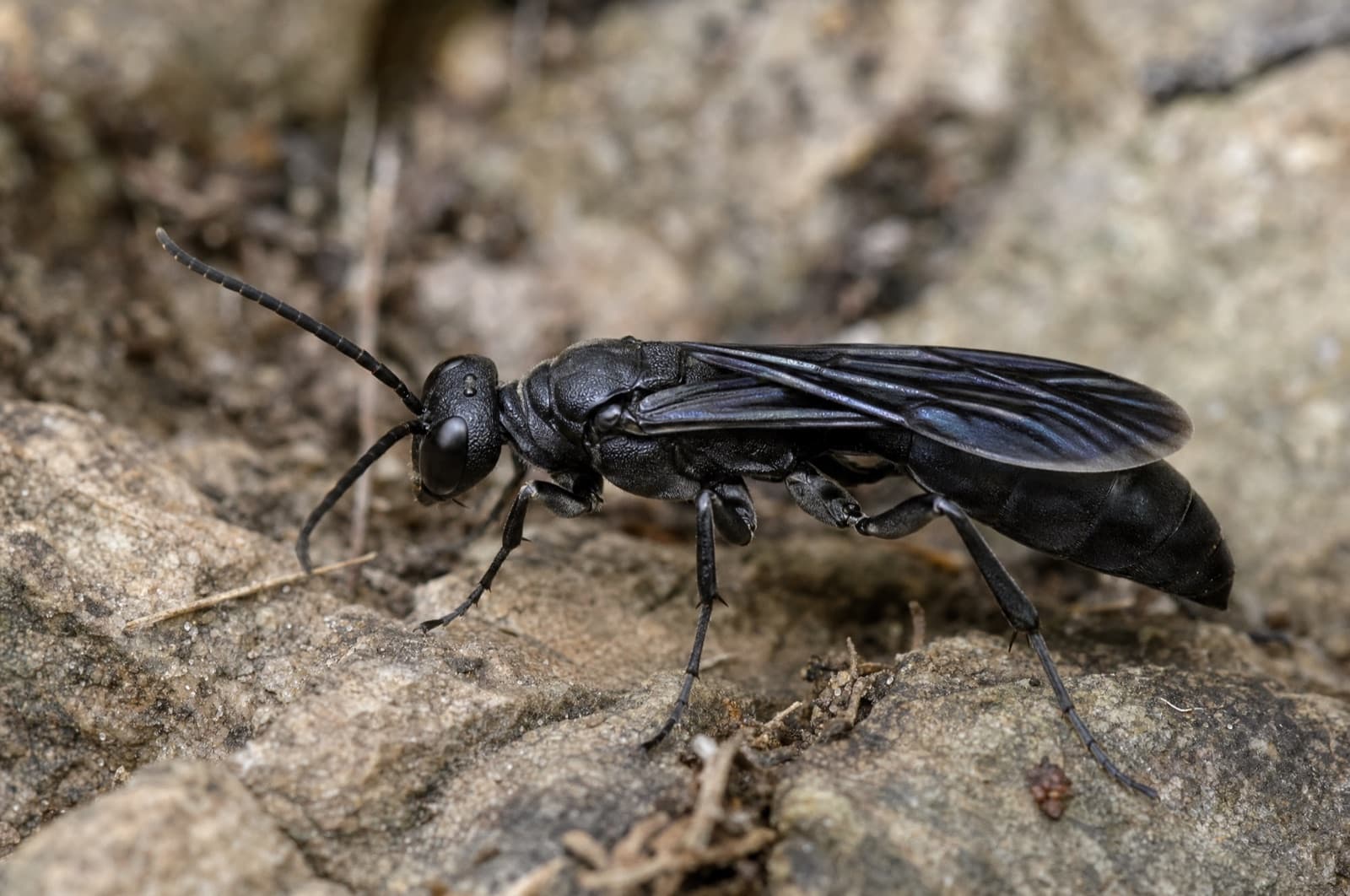
Great Black Wasp — What It Is & Whether It Stings in NH
Quick facts
- Size: 20–35 mm (females 25–34 mm; males 19–28 mm)Wikipedia — Sphex pensylvanicus; insectidentification.org
- Sociality: Solitary — no colony, no nest to defendUMN Extension; Illinois DNR
- Sting risk: Only if handled; males have no stingerUniversity of Minnesota Extension
- Diet (prey): 2–6 katydids or grasshoppers per nest cellWikipedia — Sphex pensylvanicus
Size
20–35 mm (females 25–34 mm; males 19–28 mm)
Wikipedia — Sphex pensylvanicus; insectidentification.org
Sociality
Solitary — no colony, no nest to defend
UMN Extension; Illinois DNR
Sting risk
Only if handled; males have no stinger
University of Minnesota Extension
Diet (prey)
2–6 katydids or grasshoppers per nest cell
Wikipedia — Sphex pensylvanicus
Big, black, and buzzing — but not the threat it looks like
If a large, glossy-black wasp has stopped you mid-step in a garden or along a sunny path, you are almost certainly looking at a great black wasp (Sphex pensylvanicus) — and you can relax. At up to 35 mm long, it is one of the most visually striking insects in the Northeast, but it is also one of the most docile. Entomologists routinely describe it as a 'gentle giant': it is solitary, which means it has no colony and no defended nest, and it will not sting unless you physically grab or pin it. Males, which you see as often as females, have no stinger whatsoever.
The great black wasp's reputation suffers from a simple equation — big plus black plus buzzing equals dangerous — that does not hold up. Size correlates with social-wasp colony populations, not with aggression in solitary species. The wasps that actually sting people are the social ones (paper wasps, yellowjackets, hornets) defending hundreds or thousands of nestmates. A solitary wasp has no alarm pheromone cascade, no workers to recruit, and no evolutionary reason to waste its venom on a person.
In New Hampshire the great black wasp occurs near the northern edge of its range — listed for the state, but photo records are sparse and it should be treated as present-but-uncommon rather than a common backyard fixture. Where it does occur, adults are active from mid-July through September, when females are digging soil burrows and hunting katydids and grasshoppers to provision them, and when both sexes are important pollinators of late-summer flowers.
This page covers how to identify the great black wasp, how to tell it from its metallic-blue lookalike (the steel-blue cricket hunter), what its sting risk actually is, and what — if anything — you should do about it.
Great black wasp in southern and central New Hampshire
The great black wasp reaches the northern edge of its range in New England, and New Hampshire sits at that edge. The species is listed for NH on reference range maps, and its documented range expanded northward into New York, Quebec, Ontario, and Nova Scotia during the late twentieth century. However, NH-specific photo records in citizen-science databases remain sparse, and the species should be understood as present-but-uncommon rather than a common sight across Anchor's service area of Manchester, Nashua, Concord, and surrounding communities. Where great black wasps do occur in southern NH, adults are active from roughly mid-July through early September — the same window as late-summer pollinators and katydid/grasshopper season. Females excavate individual soil burrows in compact, sunny, often sandy ground (garden edges, unpaved paths, landscaped beds); each burrow is solitary and undefended. The presence of one or two large black wasps visiting flowers or patrolling the ground near a burrow entrance is a harmless event that requires no action. If what you are seeing instead is a steady stream of wasps flying in and out of a single hole with any sign of defensive behavior, that is not a great black wasp — it is almost certainly a ground-nesting yellowjacket colony, which is a very different situation.
We serve these communities
- NH-licensed applicator · #782664
- Same-day service
- Family-owned since 2017
Service Area Map
Southern New Hampshire
How to identify the great black wasp — and tell it from its lookalikes
The great black wasp looks formidable — it is one of the largest wasps a New Hampshire resident is likely to encounter — but three field marks confirm its identity and its harmlessness instantly.
Great black wasp
Also called: Katydid hunter, Black digger wasp
- Scientific name
- Sphex pensylvanicus
- Family
- Sphecidae
- Sociality
- Solitary
- Size
- 20–35 mm (females 25–34 mm; males 19–28 mm)
- Coloration
- Entirely matte-to-glossy black body; smoky blue-iridescent wings; narrow, thread-like waist (petiole); spiny hind legs. No yellow markings, no banding. In direct sunlight the wings show a faint blue-violet tint, but the body reads as flat black — not metallic blue like the steel-blue cricket hunter.
- Range
- Present in NH near the northern range edge — listed for the state and documented via range expansion into NY, Quebec, Ontario, and Nova Scotia in the late 20th century, but NH-specific photo records are sparse. Treat as present-but-uncommon. Active July–September where it occurs.
- Nest style
- Solitary underground burrow ~30 cm deep in compact, sunny soil (garden borders, unpaved paths, bare ground); each burrow is a single female's nest with no shared entrance and no colony
- Sting
- Mild and rare — stings only if physically handled; males have no stinger
- Beneficial role
- Provisions nest cells with 2–6 paralyzed katydids or grasshoppers per cell (natural pest control); significant late-summer pollinator of milkweed, mountain mint, and goldenrod
Colony?
None — each female nests alone
No nest to defend = no sting risk under normal circumstances
Active season
Mid-July through early September in NH
Timed to katydid and grasshopper peak; late-summer flower bloom
Historical note
Subject of the first scientific paper on a New World insect (Bartram, Royal Society 1749)
University of Minnesota Extension
Body color
Uniformly matte-to-glossy black with no yellow, brown, or banding of any kind. This immediately separates it from paper wasps (banded), yellowjackets (bright yellow markings), and cicada killers (rusty-red and yellow). The metallic blue-green sheen of the steel-blue cricket hunter is also absent — great black wasp reads as flat black.
Wings
Smoky and slightly blue-violet when viewed in direct sunlight — translucent with a dark tint. Held flat over the body at rest. Noticeably darker and less iridescent than the oil-slick wings of the steel-blue cricket hunter.
Waist (petiole)
Long and conspicuously narrow — a thread-like connection between thorax and abdomen typical of the Sphecidae family. This 'thread waist' is even more pronounced than on paper wasps and is a useful confirming mark when the wasp is at rest.
Legs
Black, slender, and spiny. Females use their strong hind legs together with their mandibles to excavate burrows in soil. In flight, legs do not dangle as prominently as paper wasps but are slender rather than tucked.
Size
Females 25–34 mm; males 19–28 mm. Noticeably larger than a yellowjacket (12 mm worker) or paper wasp (15–21 mm). A large female at ~35 mm is roughly 1.4 times the diameter of a US quarter (24.26 mm) — the size that triggers alarm but signals nothing dangerous in a solitary species.
Common look-alikes
Steel-blue cricket hunter (Chlorion aerarium)
How to tell: The most common great-black-wasp lookalike. The steel-blue cricket hunter is similarly sized (20–25 mm) and also has a slender black body — but its defining feature is a vivid metallic steel-blue or blue-green sheen across the body and oil-slick iridescent wings. In good daylight, Chlorion aerarium looks blue, not black. The great black wasp's body is matte-to-glossy flat black; its wings are smoky and dark but not oil-slick blue. Both are solitary, harmless, and beneficial — if you cannot determine which you have, the correct action is the same: leave it alone.
Eastern cicada killer (Sphecius speciosus)
How to tell: Also a large solitary digger wasp, but the cicada killer is dramatically different in color: rusty-red or orange head and thorax, black abdomen banded with bright yellow markings, and amber-tinted wings. It is also typically larger (30–50 mm). If the big wasp in your yard has any rusty-red or yellow on it, it is a cicada killer — not a great black wasp. Both are harmless solitary species.
European hornet (Vespa crabro)
How to tell: The European hornet is NH's only true hornet — brown and yellow, not all-black, and significantly bulkier. Workers are ~25 mm and queens reach 35 mm. The European hornet is a social species that flies at night and is attracted to lights, which the great black wasp is not. If you see a large brown-and-yellow wasp at a porch light after dark, that is a European hornet. See /bald-faced-hornet/ for hornet depth.
Frequently asked
Sources & further reading (10)
- [1]University of Minnesota Extension — Great Black Wasp
extension · Docility; 'not aggressive toward humans'; females sting only if handled; males have no stinger; beneficial predator and pollinator; Bartram 1749 first scientific paper · verified Jun 2026
- [2]Illinois DNR — Great Black Wasp
gov · Size (males ~0.7–1.1 in; females ~1.0–1.3 in); late-summer pollinator role; katydid/grasshopper prey; active July–September · verified Jun 2026
- [3]Wikipedia — Sphex pensylvanicus (Great Black Wasp)
encyclopedia · Size range 20–35 mm; females 25–34 mm vs males 19–28 mm; 2–6 katydids per cell; range expansion to NY/Quebec/Ontario/Nova Scotia; males lack stinger · verified Jun 2026
- [4]insectidentification.org — Great Black Wasp
encyclopedia · NH state listing (corroborative); size range confirmation · verified Jun 2026
- [5]insectidentification.org — Steel-Blue Cricket Hunter
encyclopedia · Steel-blue cricket hunter (Chlorion aerarium) metallic-blue coloration and size (20–25 mm); lookalike disambiguation · verified Jun 2026
- [6]USFWS — Steel-Blue Cricket Hunter (Chlorion aerarium)
gov · Chlorion aerarium taxonomy; metallic steel-blue sheen; harmless solitary behavior; lookalike disambiguation from great black wasp · verified Jun 2026
- [7]US Mint — Quarter Coin Specifications
gov · US quarter diameter = 24.26 mm (0.955 in) — true-to-scale size reference · verified Jun 2026
- [8]WSDA / USDA — Northern Giant Hornet Eradication (December 18, 2024)
gov · Vespa mandarinia declared eradicated from the US on Dec 18, 2024; only ever found in Washington State; never in NH or New England · verified Jun 2026
- [9]UMD Extension — Solitary and Social Wasps
extension · Solitary wasps sting only to capture prey, not in defense; field-test sorter (one hole + defensive stream = social; scattered holes + calm wasps = solitary) · verified Jun 2026
- [10]Northern New England Poison Center
medical · 24/7 poison control for NH/ME/VT; 1-800-222-1222 · verified Jun 2026
Written & reviewed by
VerifiedDaniel Brady
NH-Licensed Pesticide Applicator · License #782664 (NHDAMF, RSA 430)
Daniel Brady is the New Hampshire–licensed applicator behind Anchor Pest Services, a family-owned pest control company serving the Manchester area since 2017.
Last updated Jun 2026
Anchor Pest Services
Wasps gone — and they stay gone.
Same-day service across Southern New Hampshire. NH-licensed #782664, family-owned since 2017. We handle ground, wall, and aerial nests with EPA-registered products and an approximately 30-day re-treat guarantee.
- NH-licensed applicator
- Same-day service
- Pet & family-conscious
NH License #782664 · No obligation · We answer in person
Your next step
- Next step
Do wasps chew on wood to build nests?
Read the answer - What to do next
Chemical Wasp & Hornet Control: Aerosols, Timing & Allergy Safety
Read the answer - Related guide
Wasp vs Hornet — How to Tell Them Apart (New Hampshire Guide)
Read the answer - Related guide
Executioner Wasp — World's Worst Sting & Why It's Not in the US
Read the answer - Also relevant
Can Wasp Stings Become Life-Threatening If I Attempt to Remove a Nest?
Read the answer