
Skip to content
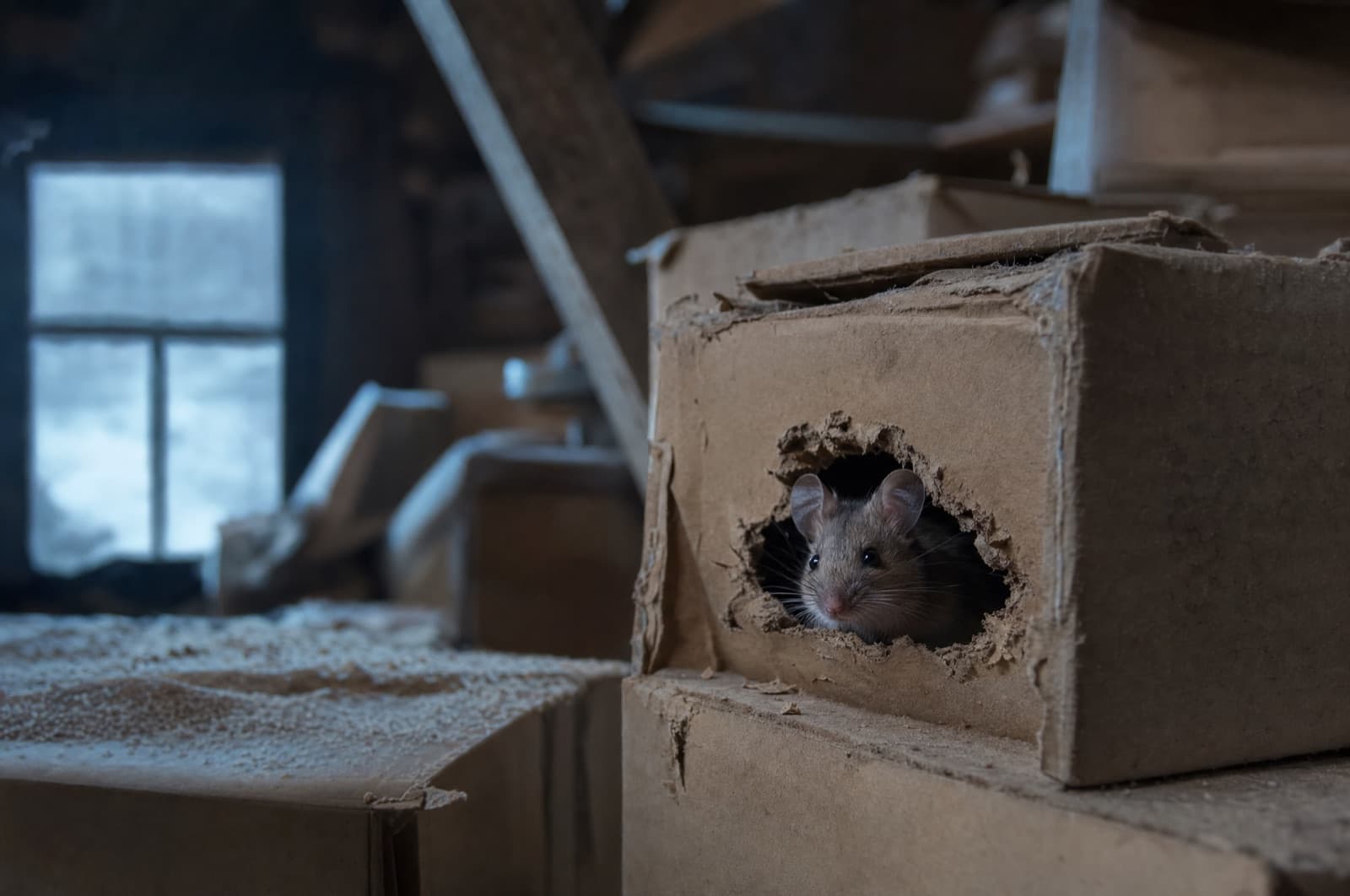
A house mouse in a gnawed cardboard storage box in a cold New Hampshire attic
Daniel Brady · NH-Licensed Pesticide Applicator · License #782664
Reviewed by Daniel Brady

Do homes near woods or water have higher winter pest risk?

Major risk factor — and one you genuinely cannot change
Yes, and this is a major risk factor with an honest limit attached: you cannot move the tree line, the field, or the pond.Homes bordering woods, fields, or water sit next to larger reservoir populations of mice and overwintering insects, all of which move toward the nearest warm structure as temperatures drop. Extension entomologists document boxelder bugs traveling up to two miles from host trees and one documented case of 26,000 stink bugs collected from a single house over six months. Location sets your baseline pressure — what changes the outcome is how aggressively you seal the envelope against it.

At a glance

  • The verdict: Major risk factor — and one you genuinely cannot change
The honest answer

The short of it

The verdict
Major risk factor — and one you genuinely cannot change

Yes — proximity to woods or water is one of the few honestly unchangeable risk factors in this hub, and the right response is sealing harder, not pretending it away.

Why your house

How much this factor matters

Proximity to woods, fields, or standing waterMajor factor
Why

Overwintering insects — boxelder bugs, stink bugs, lady beetles, cluster flies — breed on nearby vegetation and migrate toward the warmest available structure each fall. Illinois Extension is direct about the mechanism for boxelder bugs specifically: they need host trees such as boxelder, maple, or ash nearby, and "if you don't have those, more than likely you're not going to have box elder bugs." K-State research documents boxelder bugs flying up to two miles from a host tree, which is more than enough range to make a whole neighborhood, not just the adjacent lot, the relevant source population. The scale this creates is not theoretical: an Illinois Extension entomologist cites a documented case of one Maryland homeowner collecting 26,000 brown marmorated stink bugs from a single house over a roughly six-month period. Mice and rats living in nearby fields and woods follow the same pattern, moving toward structures in September and October as the outdoor food supply and cover diminish with the harvest and the cold.

No — you cannot change this
You cannot relocate a tree line, drain a nearby field, or move a pond, so the honest response is to redirect effort toward what you fully control: seal the building envelope before the first hard frost, manage the immediate perimeter around the foundation (firewood, mulch, and vegetation contact points), and plan for a higher baseline of pest pressure than a home in a denser, less wooded area would face. Homes in this position often benefit from a more thorough, earlier seal-up than the general timeline suggests, precisely because the source population nearby is larger.

Assessed from: Illinois Extension Good Growing Ep. 227; K-State Research & Extension boxelder/red-shouldered bug bulletin

In depth

The full picture

01

Why location outweighs almost everything else

Most risk factors in this hub are about your house — its age, its basement, its clutter. This one is almost entirely about what's around your house, and that's what makes it different: the population of mice and overwintering insects near a wooded or waterside property is simply larger than near a home surrounded by pavement and lawn.

Boxelder bugs need host trees within range, and a two-mile flight radius means "near woods" covers a lot of ground. Fields and standing water support their own reservoir populations of insects and the small mammals that follow them. None of that changes because you'd prefer it didn't.

02

What the scale actually looks like

The numbers extension entomologists have documented are worth sitting with. One Maryland homeowner near stink bug host habitat collected 26,000 individual bugs from a single house across roughly six months. That's not a worst-case scare story — it's a documented field observation, and it illustrates how much pressure a nearby source population can generate compared to a home further from that habitat.

Mice follow a parallel logic. As fields are harvested and outdoor food and cover disappear heading into a New Hampshire fall, populations that have been living outdoors all season begin actively searching for the nearest warm, sheltered structure — and a house adjacent to woods or fields is simply closer to more of them.

03

The honest response: seal harder, not smarter

Because you can't change where the house sits, the entire strategy shifts to exclusion. That means treating the ¼-inch gap standard — the threshold at which a mouse can squeeze through a foundation or sill-plate gap — as non-negotiable rather than optional, and doing it earlier in the season than a home further from woods or water might need to.

It also means being realistic about expectations. A property in this position will likely see more overwintering insects on sunny walls in fall and more mouse pressure at the foundation all winter than a comparable home in a denser suburb — not because anything is being done wrong, but because the math of nearby source populations doesn't change with better housekeeping alone.

Key takeaways
5 points
  • Homes near woods, fields, or water sit next to larger source populations of mice and overwintering insects — a documented, major risk factor.
  • Boxelder bugs can fly up to two miles from host trees; one documented case involved 26,000 stink bugs collected from a single house over six months.
  • This is honestly unchangeable — you cannot move the tree line, drain the field, or relocate a pond.
  • The correct response is redirecting effort to sealing the envelope earlier and more thoroughly than a less-exposed home would need.
  • Expect a higher baseline of pest pressure than average; that's a fact about geography, not a failure of maintenance.
New Hampshire context

What this means for a wooded New Hampshire property

Southern and central New Hampshire is thick with exactly the mixed woodland, field-edge, and pond habitat that supports large overwintering insect and rodent populations, and Manchester's first hard frost — typically October 19 to 29 (NOAA) — is the trigger that sends all of it looking for shelter at once.

If your property borders woods, a field, or water, treat the seal-up work in the entry-points cluster as higher priority and start it earlier than the general timeline suggests. The source population isn't going anywhere, so the only variable left in your control is how good the seal is by the time the frost arrives.

  • NH-licensed #782664

    Southern New Hampshire

  • Family-owned

    Since 2017

  • Honest routing

    Even when it isn’t us

We serve these communities

ManchesterNashuaConcordDerryBedfordSalemHudsonAmherst

Can't move the woods. Can seal the house.

Location sets your baseline pressure — a tighter envelope is the honest answer we can actually help with, and winter is the season it matters most.

Follow-up questions

Frequently asked

Sources & citations(4)
  1. University of Illinois Extension — Good Growing Podcast, Ep. 227: Stink Bugs, Lady Beetles, Boxelder Invasions

    Host-tree proximity drives boxelder bug presence; documented case of 26,000 stink bugs collected from one house over roughly six months

    extensionverified 2026-07-16
  2. K-State Research & Extension — Boxelder Bug / Red-Shouldered Bug

    Boxelder bugs fly up to two miles from host trees; fall migration toward structures

    extensionverified 2026-07-16
  3. University of Minnesota Extension — Boxelder Bugs

    Boxelder bugs overwinter in wall voids after entering the previous fall; sealing as the primary prevention

    extensionverified 2026-07-16
  4. NOAA — Manchester, NH freeze climatology

    Manchester first hard frost typically ~Oct 19-29 — the seasonal trigger for pest movement toward structures

    govverified 2026-07-16

Written & reviewed by

Verified

Daniel Brady

NH-Licensed Pesticide Applicator · License #782664 (NHDAMF, RSA 430)

Daniel Brady is the New Hampshire–licensed applicator behind Anchor Pest Services, a family-owned pest control company serving the Manchester area since 2017.

Verify license

Last updated Jul 2026

Honest pest help for New Hampshire homes

We Can't Move the Tree Line. We Can Seal What's Behind It.

If your home borders woods, fields, or water, you're facing a measurably higher baseline of pest pressure — we'll say so rather than promise a fix for something nobody can fix. What Anchor Pest Services can do is help seal the envelope and handle rodent exclusion before winter sets in. Family-owned since 2017, NH license #782664, serving Manchester, Nashua, Concord and nearby towns.

  • Honest advice — we'll tell you when a risk factor is location, not a fixable mistake
  • NH-licensed applicators (#782664) — free inspection, same-day service
  • Rodent exclusion and winter pest control across southern and central New Hampshire

NH License #782664 · No obligation · We answer in person