
Skip to content
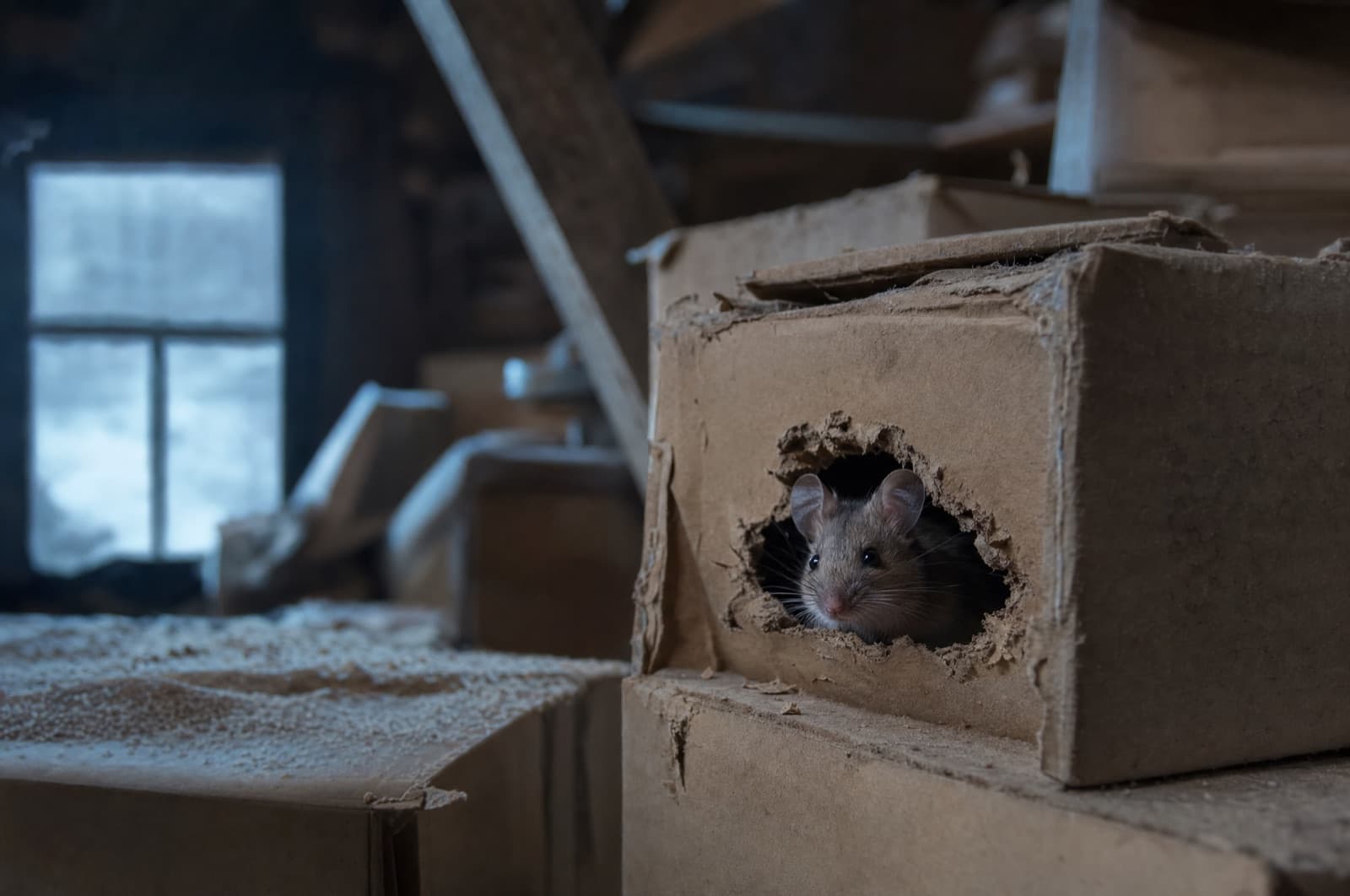
A house mouse in a gnawed cardboard storage box in a cold New Hampshire attic
Daniel Brady · NH-Licensed Pesticide Applicator · License #782664
Reviewed by Daniel Brady

How can homeowner clutter in basements increase winter pest risk?

Minor risk factor — real, but commonly overstated
This is a real but commonly overstated risk factor.Clutter itself doesn't attract pests from outside a house — food, moisture, and unsealed entry gaps do that work. What clutter really does is provide harborage once pests are already in, and make early detection much harder, since a mouse or a cluster of overwintering insects can go unnoticed for weeks behind stacked boxes. Extension guidance consistently lists decluttering as one legitimate step within a broader sanitation and exclusion plan, not as the headline fix — it's worth doing, but it won't stop an entry problem on its own.

At a glance

  • The verdict: Minor risk factor — real, but commonly overstated
The honest answer

The short of it

The verdict
Minor risk factor — real, but commonly overstated

Clutter doesn't summon pests from outside; food, moisture, and entry gaps do that. What clutter does is provide harborage and hide the problem until it's bigger.

Why your house

How much this factor matters

Cluttered basement storage, especially cardboard and stacked soft materialsMinor factor
Why

Extension-published IPM guidance for rodents lists removing clutter as one recommended step, framed explicitly as reducing harborage and enabling proper inspection rather than as a primary attractant. The mechanism is straightforward: mice prefer undisturbed, cluttered spaces because they offer cover from view and predators, and they readily use soft stored materials such as paper, fabric, and foam as nesting material once they're already inside. Cardboard specifically is a documented double problem — cockroaches feed on the glue and cellulose in cardboard, and rodents shred it for nests — so it functions as both food and building material for exactly the pests this hub is about. But none of that mechanism explains how pests got into the basement in the first place; clutter's role is entirely about what happens after entry, which is why extension sources treat it as a secondary lever, not a primary cause.

Yes — you can change this
Declutter basement floors and switch storage from cardboard boxes to sealed metal or hard-plastic totes, which removes both the nesting-material problem and the cockroach food source cardboard represents. Keep a clear inspection gap along the walls rather than stacking storage directly against them, since that's where early signs of activity — droppings, gnaw marks, insect casings — are easiest to spot before a problem grows. Pair this with sealing entry points and controlling moisture; decluttering alone addresses harborage and detection, not the entry problem itself.

Assessed from: eXtension IPM Action Plan for Rodents; NPIC Rodents

In depth

The full picture

01

What clutter actually does — and doesn't do

It's easy to imagine clutter as bait, drawing pests in from outside. That's not how it works. A mouse or an overwintering insect doesn't decide to enter a basement because it's cluttered — it enters because of a gap in the foundation, an open utility penetration, or an attractant like food or moisture. Clutter's role starts after that decision has already been made.

Once something is inside, clutter becomes cover — a place to nest undisturbed, hidden from view and from casual inspection. That's a real function, but it's a downstream one, not the reason pests showed up in the first place.

02

Why cardboard specifically deserves attention

Not all clutter is equal. Cardboard boxes are a documented double liability: cockroaches feed on the glue and cellulose that make up cardboard, turning storage boxes into a literal food source, and rodents shred the same material for nesting. A basement full of cardboard boxes is offering both food and building supplies to exactly the pests a homeowner is trying to avoid.

Switching that storage to sealed metal or hard-plastic containers — the same principle that governs winter storage bins generally — removes both problems at once without requiring any change to what's actually being stored.

03

Why decluttering helps detection more than prevention

The most honest reason to declutter a basement isn't that it stops pests from entering — it's that it lets you see them sooner. A mouse living behind a wall of stacked boxes can go undetected for weeks, during which a small problem becomes an established one. A basement with a clear inspection path along the walls surfaces droppings, gnaw marks, or insect activity much faster.

That's genuinely valuable, and it's why extension guidance includes decluttering as a real step — just not the headline one. Pair it with sealing and moisture control, and the combination does the actual entry-prevention work that clutter reduction alone can't.

Key takeaways
5 points
  • Clutter doesn't attract pests from outside — food, moisture, and unsealed gaps do that. Clutter's role is entirely about what happens after entry.
  • Cardboard is a specific double liability: cockroaches eat it, rodents nest in it. Sealed metal or hard-plastic totes remove both problems.
  • Decluttering's real value is faster detection — a cluttered basement can hide an active problem for weeks.
  • This is fully within homeowner control, and one of the cluster's cheapest fixes — but it doesn't replace sealing entry points.
  • Don't let a tidy basement create false confidence; it reduces harborage and improves detection, not entry prevention.
New Hampshire context

Basement storage in a New Hampshire winter

New England basements tend to double as storage for holiday decorations, off-season gear, and years of accumulated cardboard boxes, which is exactly the combination extension guidance flags as harborage and cockroach food. With Manchester's first hard frost around October 19 to 29 (NOAA) pushing rodent activity toward shelter, a fall basement declutter is a reasonable, low-cost complement to sealing work — not a substitute for it.

If you're already storing seasonal items down there, this is a natural moment to swap cardboard for sealed totes as part of the same afternoon's work.

  • NH-licensed #782664

    Southern New Hampshire

  • Family-owned

    Since 2017

  • Honest routing

    Even when it isn’t us

We serve these communities

ManchesterNashuaConcordDerryBedfordSalemHudsonAmherst

Decluttering helps you see the problem. It won't stop it.

Swap cardboard for sealed totes yourself, this weekend. If you find signs of activity while you're at it, that's when a professional look pays off.

Follow-up questions

Frequently asked

Sources & citations(4)
  1. eXtension — IPM Action Plan for Rodents

    Removing clutter reduces harborage and permits proper cleaning and inspection — framed as a sanitation lever, not a primary cause

    extensionverified 2026-07-16
  2. NPIC — Rodents

    IPM approach: prevention, sanitation, and exclusion; clutter reduction as one component

    npicverified 2026-07-16
  3. UNL Extension — G1982 Reducing Pesticide Use in Sensitive Environments

    Clutter provides hiding places that complicate inspection and pest management

    extensionverified 2026-07-16
  4. NOAA — Manchester, NH freeze climatology

    Manchester first hard frost typically ~Oct 19-29 — the seasonal window for a fall basement declutter

    govverified 2026-07-16

Written & reviewed by

Verified

Daniel Brady

NH-Licensed Pesticide Applicator · License #782664 (NHDAMF, RSA 430)

Daniel Brady is the New Hampshire–licensed applicator behind Anchor Pest Services, a family-owned pest control company serving the Manchester area since 2017.

Verify license

Last updated Jul 2026

Honest pest help for New Hampshire homes

A Tidy Basement Isn't the Fix. Sealing the Gaps Is.

We won't sell you a decluttering service — that's an afternoon with sealed totes and a clear floor. What Anchor Pest Services does is find and seal the actual entry points, and handle it if something's already established itself behind the boxes. Family-owned since 2017, NH license #782664, serving Manchester, Nashua, Concord and nearby towns.

  • Honest advice — we'll tell you when the fix is a weekend project, not a service call
  • NH-licensed applicators (#782664) — free inspection, same-day service
  • Rodent exclusion and winter pest control across southern and central New Hampshire

NH License #782664 · No obligation · We answer in person