
Skip to content
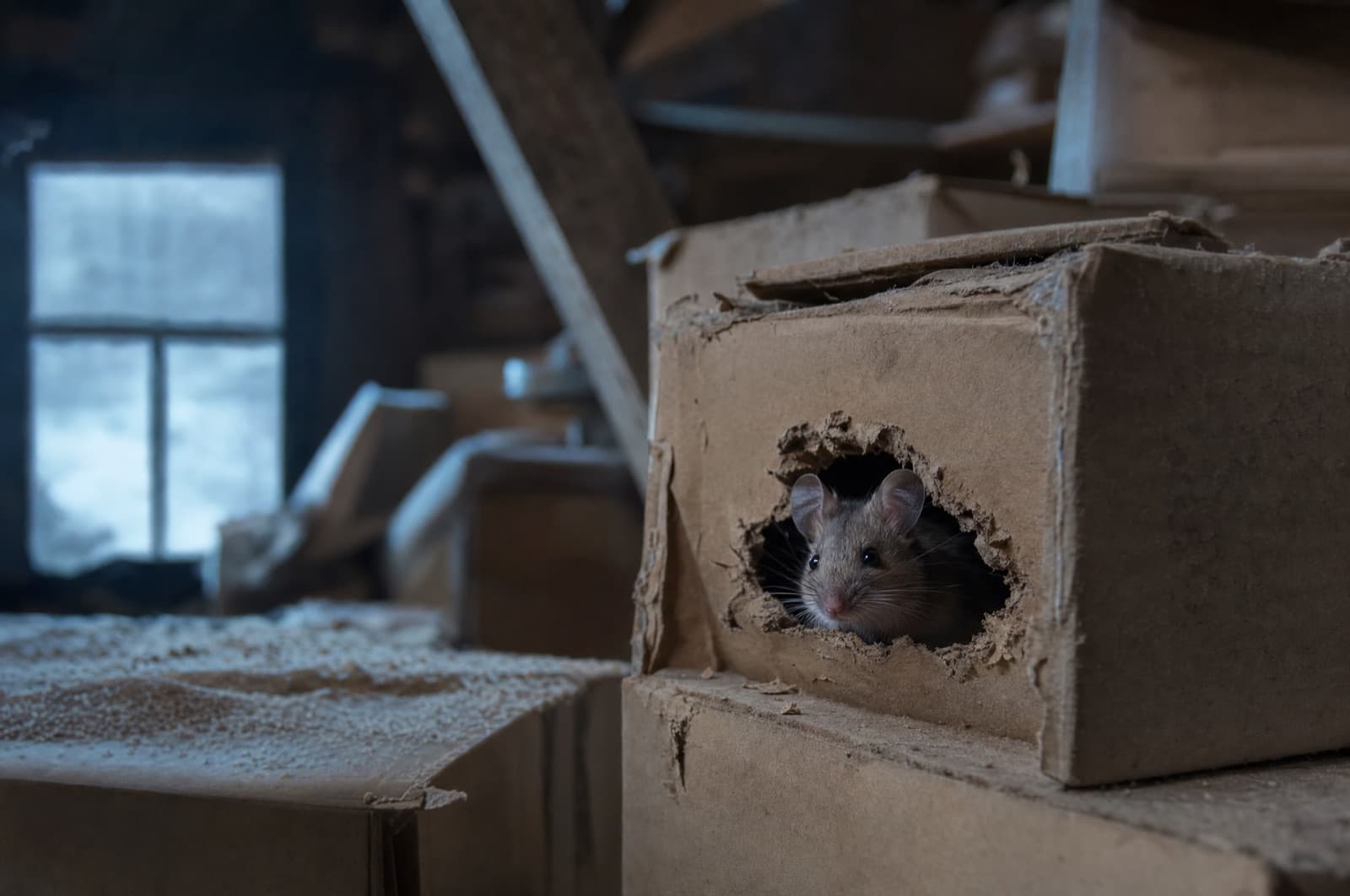
A house mouse in a gnawed cardboard storage box in a cold New Hampshire attic
Daniel Brady · NH-Licensed Pesticide Applicator · License #782664
Reviewed by Daniel Brady

How can I protect my attic from mice and rats during winter?

Do this first
Do this first, but honestly about who does which part.Attics are prime winter rodent real estate — warm, quiet, and full of insulation to nest in — and rodents reach them by climbing rough siding, jumping from tree branches, or squeezing through gaps where the roofline meets the wall. Protection means screening every gable, ridge and soffit vent with quarter-inch hardware cloth, sealing roofline gaps, and cutting back branches within six to eight feet of the roof. Vent screening is a you-with-a-ladder job; roofline repair itself is often a roofer's.

At a glance

  • Verdict: Do this first
  • Who does it: You, with a ladder
  • Effort: A project
  • Payoff: High
The honest answer

The short of it

The verdict
Do this first

Mice don't need a staircase to your attic — a tree branch and a torn vent screen will do.

The one question under all of them

Is this actually worth doing?

Every winter job lands somewhere on one honest scale — from what genuinely matters to what our own industry is selling you. Here is where this one lands.

The job being graded
Do this first

Screening attic, gable, ridge and soffit vents with quarter-inch hardware cloth; sealing soffit and fascia gaps; trimming tree branches back from the roofline

The scale
Who does it
You, with a ladder
Effort
A project
Payoff
High
What it actually does

It closes the elevated entries that ground-level sealing misses. Mice can scale rough vertical surfaces and jump farther than people expect, and roof rats specifically favor high entries, so a house can be perfectly sealed at the foundation and still take on rodents through the attic (UNL Extension). Quarter-inch hardware cloth stops mice; anything wider, including standard half-inch mesh, does not. Once inside, rodents don't just nest — they chew wiring, which is a documented fire hazard, and they shred insulation, which raises heating costs (Texas A&M/eXtension; UNL Extension).

The line

Mice don't need a staircase to your attic — a tree branch and a torn vent screen will do.

Our honest lane

Most of the vent screening and gap sealing here is homeowner work with a ladder and an afternoon or two, and we'll say so. Where Anchor genuinely earns its keep is inspection, trapping an active attic population, and finding entry points you can't see from the ground — and the roofline repair itself is often best handled by a roofer, not a pest company. We don't 'fog' an attic to solve a rodent problem; that sells activity, not exclusion.

In depth

The full picture

01

Why the attic is a top-tier winter destination

An attic offers everything a rodent wants in December: it's warm relative to outdoors, it's quiet and undisturbed for weeks at a stretch, and it's packed with insulation that doubles as nesting material. The part homeowners underestimate is how the animals actually get up there. Mice climb rough vertical surfaces — brick, stone, worn wood siding — competently, and they jump farther and more accurately than their size suggests. Roof rats, where present, are specifically adapted to elevated entry and often prefer the roofline over the ground floor entirely (UNL Extension). So a house that's fully sealed at the foundation and door thresholds can still take on an attic population, because nobody checked the vents.

02

Screening the vents: the part you can do yourself

Gable vents, ridge vents and soffit vents are all designed to let air move, not to keep animals out — factory screening on most vents is thin enough for a mouse to chew through or for a squirrel to pry loose. The fix is quarter-inch hardware cloth, not standard window screen and not half-inch mesh; half-inch is wide enough for a mouse to pass through, so it solves nothing (extension.org). Cut the mesh to fit, screw or staple it over the existing vent opening from the outside, and check that it still allows airflow — the goal is exclusion, not sealing the vent shut, since attics need to breathe.

This part is realistically a ladder-and-an-afternoon job for most one- and two-story homes. It gets harder, and more dangerous, at steep pitches or heights beyond a single-story roofline — that's the point where a roofer's equipment and experience are worth paying for rather than improvising.

03

The roofline itself: often a roofer's job

Gaps where the soffit meets the fascia, or where flashing has pulled away, are common rodent entries that aren't a vent-screening problem — they're a roofing problem. Sealing them properly usually means working on or near the roof edge, sometimes replacing or re-securing trim, which is squarely a roofer's or carpenter's skill set rather than a pest control one. Being honest about this split matters: a pest company that tells you it will "seal your roofline" as part of a treatment visit is often either subcontracting the work or doing a temporary patch. The durable fix is a roofer, and Anchor's honest role is identifying that the gap exists, not repairing the roof.

04

Trees, branches, and the six-to-eight-foot rule

A tree branch touching or overhanging the roof is a bridge, plain and simple — it gives climbing rodents and squirrels a path onto the roof that bypasses every ground-level gap you sealed. Cutting branches back six to eight feet from the roofline removes that bridge and is straightforward homeowner or arborist work depending on the tree's size and location relative to power lines. This is one of the cheapest, highest-leverage moves in the whole cluster, and it's routinely skipped because it doesn't feel like "pest control" — it feels like yard work.

Key takeaways
6 points
  • Attics are warm, quiet, insulation-rich winter real estate — one of the highest-value rodent destinations in the house.
  • Mice climb rough surfaces and jump farther than expected; roof rats specifically favor elevated entries.
  • Quarter-inch hardware cloth on every gable, ridge and soffit vent is the fix — half-inch mesh is too wide to stop a mouse.
  • Vent screening is a you-with-a-ladder job; the roofline itself (soffit/fascia gaps, flashing) is often a roofer's.
  • Chewed wiring in an attic is a documented fire hazard; shredded insulation raises heating costs.
  • Cutting tree branches back six to eight feet from the roof removes a climbing bridge — cheap, easy, and often skipped.
New Hampshire context

Why New Hampshire attics fill up before spring

Manchester's first hard frost typically arrives between October 19 and 29 (NOAA), and that's roughly when rodents step up the search for a heated structure. An unheated crawl space might do for a squirrel, but a heated attic above living space is warmer still, and it stays that way through a New Hampshire winter that runs into March.

The practical lesson: inspect and screen vents in September or early October, before the cold sets the search in motion, rather than in January after you've heard scratching overhead. If you're already hearing activity, screening the vents stops new entries but doesn't remove what's already up there — that's a trapping and inspection question, and one worth calling a professional about before the population grows further.

  • NH-licensed #782664

    Southern New Hampshire

  • Family-owned

    Since 2017

  • Honest routing

    Even when it isn’t us

We serve these communities

ManchesterNashuaConcordDerryBedfordSalemHudsonAmherst

Screened the vents and still hearing activity overhead?

That's an existing population, not a new entry — trapping and finding the hidden gap is squarely our lane, and winter is peak season for exactly this.

Follow-up questions

Frequently asked

Sources & citations(5)
  1. University of Nebraska–Lincoln Extension — Controlling House Mice (G1105)

    Mouse climbing and jumping ability; elevated rodent entry behavior

    extensionverified 2026-07-16
  2. University of Nebraska–Lincoln Extension — Rodent-Proof Construction (G1530)

    Rodent damage to insulation raising heating and cooling costs

    extensionverified 2026-07-16
  3. extension.org (Wildlife Damage Management) — Rodent Exclusion Methods

    Quarter-inch hardware cloth mesh sizing for vent and gap screening

    extensionverified 2026-07-16
  4. Texas A&M AgriLife / eXtension — IPM Action Plan for Rodents

    Rodents cause fires by gnawing on electrical wires

    extensionverified 2026-07-16
  5. NOAA — Manchester, NH freeze climatology

    Manchester first hard frost typically ~Oct 19-29 — the seasonal anchor for attic exclusion

    govverified 2026-07-16

Written & reviewed by

Verified

Daniel Brady

NH-Licensed Pesticide Applicator · License #782664 (NHDAMF, RSA 430)

Daniel Brady is the New Hampshire–licensed applicator behind Anchor Pest Services, a family-owned pest control company serving the Manchester area since 2017.

Verify license

Last updated Jul 2026

Honest pest help for New Hampshire homes

We'll Say When It's a Ladder Job, Not a Service Call.

Screening attic vents with hardware cloth is homeowner work, and we'd rather tell you that than sell a visit for it. Anchor Pest Services is worth calling for inspection and trapping an active attic population, and we'll route you to a roofer for structural roofline gaps rather than pretend we fix those too. Family-owned since 2017, NH license #782664, serving Manchester, Nashua, Concord and nearby towns.

  • Honest advice — we'll tell you which part is a ladder job and which needs a roofer
  • NH-licensed applicators (#782664) — free inspection, same-day service
  • Attic rodent inspection and trapping across southern and central New Hampshire

NH License #782664 · No obligation · We answer in person