
Skip to content
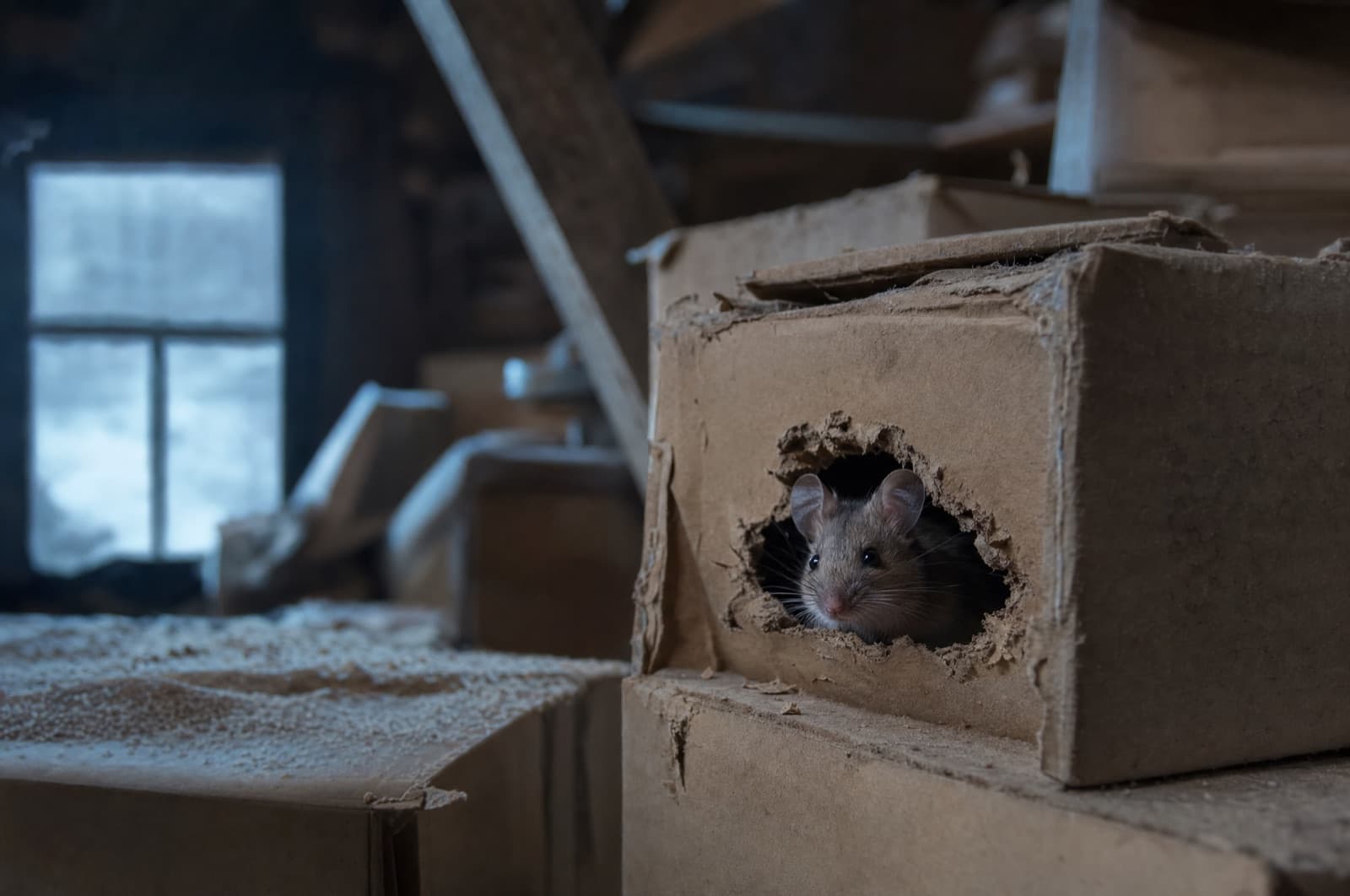
A house mouse in a gnawed cardboard storage box in a cold New Hampshire attic
Daniel Brady · NH-Licensed Pesticide Applicator · License #782664
Reviewed by Daniel Brady

How do mice find their way into homes in cold weather?

Yes — through gaps smaller than most people believe
Yes, mice actively locate and exploit entry points in cold weather, and the mechanism is more specific than "they squeeze in somewhere." A house mouse can pass through any opening its skull fits through, about a quarter inch across, roughly the width of a pencil.They enter low, at foundation cracks, sill-plate seams, utility penetrations, weep holes, and worn door sweeps, and they're guided there by warm air leaking out of the gap and by scent trails from food inside. Functional entry points are smaller and more overlooked than intuition suggests.

At a glance

  • The verdict: Yes — through gaps smaller than most people believe
The honest answer

The short of it

The verdict
Yes — through gaps smaller than most people believe

Mice enter through any gap their skull fits, about a quarter inch, roughly a pencil's width, guided by warm air escaping and the smell of food. A house that "looks sealed" usually isn't.

What actually happens

The busted assumption

Yes

What people assume

"My house looks sealed, so mice can't get in." Visual sealing and functional sealing are different things. A quarter-inch gap around a utility pipe, a slightly worn door sweep, or a crack where a sill plate meets a foundation is easy to overlook on a casual walk-around and is more than enough for a mouse. Effective exclusion specifically requires gnaw-resistant materials — hardware cloth, sheet metal, or mortar — because mice will chew through foam or caulk used alone.

What actually happens

Wildlife damage management guidance confirms mice become most likely to invade structures as outdoor temperatures cool in fall and through winter, entering through openings that can be smaller than most homeowners expect. A house mouse's skull is the limiting dimension, and it can compress its body to pass through a gap of roughly a quarter inch — CDC frames this practically as "a hole the width of a pencil." Mice locate these gaps partly through direct exploration along a building's foundation and partly by following cues: warm air escaping through even a small opening acts like a beacon, and food odor from inside carries through the same gap that lets air out.

What it means for you
Inspect the foundation perimeter and every utility penetration at ground level, not just the obviously visible gaps. Seal with metal or masonry-based materials rather than foam or caulk alone, since mice can gnaw through both of those unaided. Exclusion, done before cold weather concentrates mice near your house, is the real fix — not trapping alone, which addresses mice already inside rather than preventing the next ones from finding the same gap.

Established from: Internet Center for Wildlife Damage Management; CDC

In depth

The full picture

01

The quarter-inch rule, and why it's smaller than intuition

The single most useful fact in this whole question is the size threshold: a house mouse can pass through any opening its skull fits through, which in practice means roughly a quarter inch, about the width of a standard pencil. That's smaller than most people picture when they imagine a mouse-sized gap, and it's exactly why homeowners are often surprised that a house they consider well-sealed still has an active mouse problem.

This isn't a soft guideline — it reflects a mouse's actual skeletal structure, since the skull is rigid while the rest of the body can compress. CDC frames the same fact in consumer terms: seal any hole the width of a pencil or larger. That's the number to actually measure against, not a general sense of whether a gap "looks small."

02

Where mice actually enter, and why low and cold-adjacent

Mice enter structures low, near ground level, because that's where the relevant openings are: foundation cracks, the seam where a sill plate meets the foundation, gaps around utility penetrations (water, gas, electrical, cable lines passing through an exterior wall), weep holes in brick veneer, and worn or gapped door sweeps. These are also, not coincidentally, the same spots where warm interior air is most likely to leak outward in a New Hampshire winter — utility penetrations and sill-plate seams are common points of air leakage in typical home construction.

That overlap matters mechanically: a mouse exploring a foundation perimeter in cold weather is more likely to investigate a gap where it can detect warm air moving outward, because that air current also carries food and structure scent from inside. The gap isn't chosen at random — it's found because it's already leaking exactly the cues a cold, hungry mouse is oriented to follow.

03

Why the sealing material matters as much as finding the gap

Finding the right gaps is only half the job; sealing them with the wrong material undoes the work. Mice are capable of gnawing through foam sealant and caulk, both of which are soft enough that a determined mouse simply reopens the gap over time. Effective exclusion specifically requires gnaw-resistant materials — quarter-inch hardware cloth, sheet metal flashing, or mortar/masonry patching — because these are materials rodents genuinely cannot chew through in a reasonable amount of effort.

This is homeowner-doable work: a foundation walk-around with a flashlight, checking every utility penetration and sill-plate seam, and closing anything a pencil could pass through using metal or masonry rather than foam alone. It's the same exclusion principle covered elsewhere in this hub for rats, just applied at the smaller quarter-inch scale that mice specifically require.

Key takeaways
5 points
  • Mice can pass through any gap roughly a quarter inch across, about the width of a pencil.
  • They enter low: foundation cracks, sill-plate seams, utility penetrations, weep holes, worn door sweeps.
  • Warm air escaping through a gap and food scent both act as cues that guide mice to functional entry points.
  • A house that "looks sealed" often isn't — small, easily overlooked gaps are the real risk.
  • Seal with hardware cloth, sheet metal, or mortar, not foam or caulk alone — mice can gnaw through both.
New Hampshire context

Why the pre-frost window matters in Manchester

Manchester's first hard frost typically arrives October 19 to 29 (NOAA), and that stretch of falling temperatures is roughly when mice begin actively searching for warmer shelter in earnest, following the same warm-air and scent cues that lead them to functional gaps. A foundation walk-around in September or early October — before that pressure builds — is the highest-value timing for this kind of inspection.

If you're reading this mid-winter with an active mouse problem, the same quarter-inch standard still applies: check the foundation, sill plate, and utility penetrations now, seal with metal or masonry, and pair that with trapping for anything already inside. There's no seasonal reprieve coming that reduces the urgency.

  • NH-licensed #782664

    Southern New Hampshire

  • Family-owned

    Since 2017

  • Honest routing

    Even when it isn’t us

We serve these communities

ManchesterNashuaConcordDerryBedfordSalemHudsonAmherst

A quarter-inch gap is all it takes. Most homeowners can find it themselves.

A foundation walk-around with a flashlight is yours to do. If you can't find the gap or mice are already established, that's a fair reason to call.

Follow-up questions

Frequently asked

Sources & citations(3)
  1. Internet Center for Wildlife Damage Management — House Mouse Biology

    Quarter-inch entry threshold, fall/cold-weather structural invasion pattern, gnaw-resistant exclusion materials

    academicverified 2026-07-16
  2. CDC — Hantavirus Prevention

    Seal any hole the width of a pencil or larger

    govverified 2026-07-16
  3. NOAA — Manchester, NH freeze climatology

    Manchester first hard frost typically ~Oct 19-29

    govverified 2026-07-16

Written & reviewed by

Verified

Daniel Brady

NH-Licensed Pesticide Applicator · License #782664 (NHDAMF, RSA 430)

Daniel Brady is the New Hampshire–licensed applicator behind Anchor Pest Services, a family-owned pest control company serving the Manchester area since 2017.

Verify license

Last updated Jul 2026

Honest pest help for New Hampshire homes

We'll Show You the Gap Before We Sell You Anything Else.

Most mouse entry points are homeowner-findable with a flashlight and a walk around the foundation. Where Anchor really helps is a thorough inspection when the gap isn't obvious, or trapping and follow-up exclusion once mice are already established. Family-owned since 2017, NH license #782664, serving Manchester, Nashua, Concord and nearby towns.

  • Honest advice — we'll tell you when it's a DIY sealing job
  • NH-licensed applicators (#782664) — free inspection, same-day service
  • Rodent exclusion and trapping across southern and central New Hampshire

NH License #782664 · No obligation · We answer in person