
Skip to content
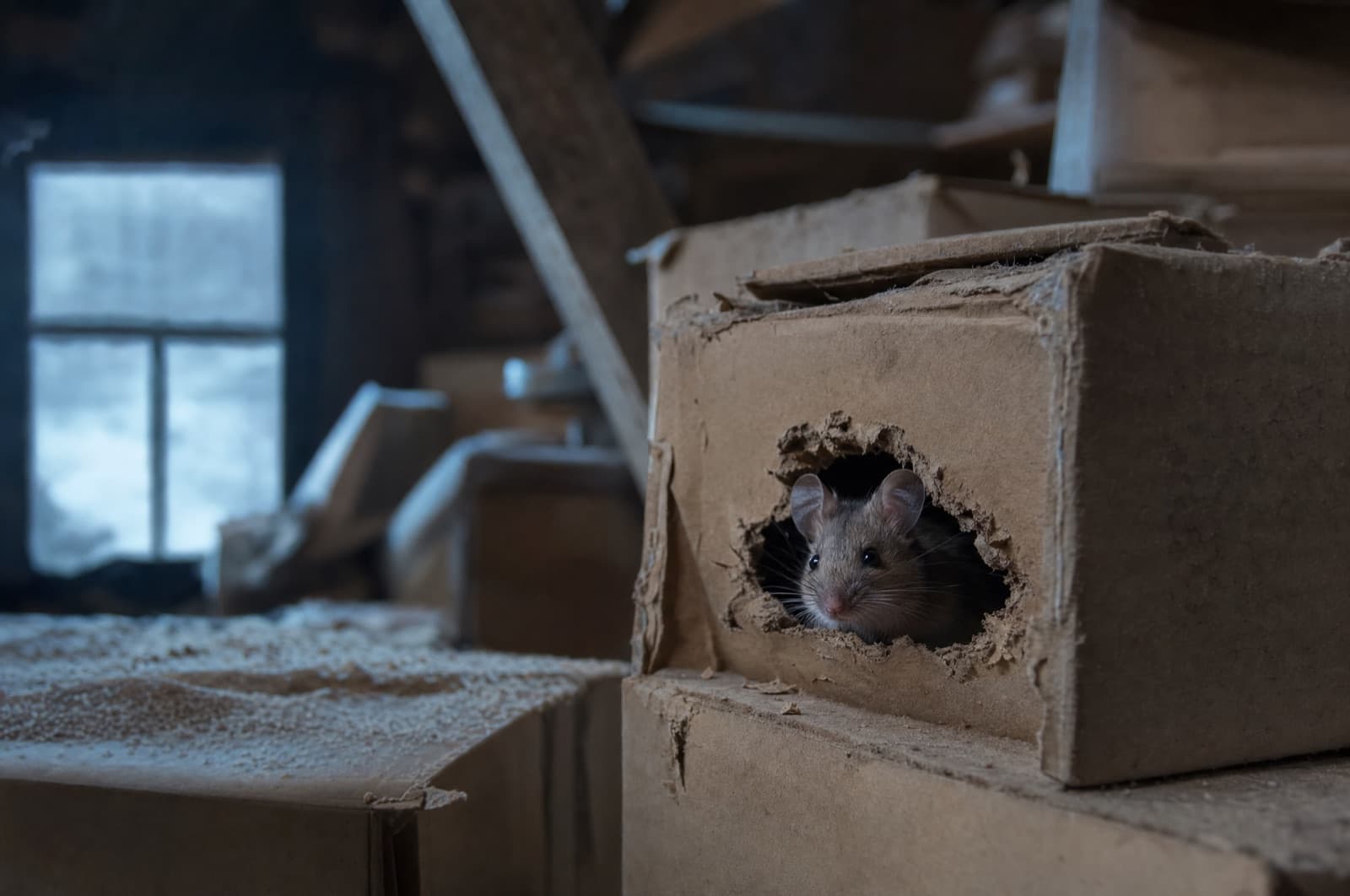
A house mouse in a gnawed cardboard storage box in a cold New Hampshire attic
Daniel Brady · NH-Licensed Pesticide Applicator · License #782664
Reviewed by Daniel Brady

How does interior moisture affect pest risk in winter?

Major — and unusually controllable
Interior moisture is a major, well-documented driver of winter pest risk, and it stands out from most of this hub's risk factors because it's genuinely controllable.Arthropods with permeable cuticles — silverfish, centipedes, springtails, cockroaches — depend on humidity to avoid drying out, and their eggs often need dampness to hatch. In winter, warm indoor air hitting cold surfaces such as single-pane windows, uninsulated walls, or cold pipes creates condensation and damp micro-habitats even in a house that feels dry overall. EPA guidance is to keep indoor relative humidity below 60%, ideally in the 30-50% range. Beyond nuisance pests, dampness combined with rodent and cockroach allergens is a documented, serious asthma concern.

At a glance

  • The verdict: Major — and unusually controllable
The honest answer

The short of it

The verdict
Major — and unusually controllable

Moisture is the master variable for a whole class of winter indoor pests, and unlike most risk factors on this hub, it's one you can truly change with a dehumidifier and some sealing.

Why your house

How much this factor matters

Interior moisture and relative humidity, especially in basements, crawl spaces, and around cold-surface condensation pointsMajor factor
Why

Silverfish need humidity above roughly 75% to reproduce, and their eggs fail to hatch below about 50% relative humidity at room temperature (University of Maryland Extension guidance), while EPA recommends keeping indoor relative humidity below 60%. EPA also documents that cockroaches 'require moisture' to survive, and separately that 'droppings or body parts of cockroaches and other pests can trigger asthma.' The health stakes are quantified in peer-reviewed research: per NIH/PMC (Do et al., 2016, Allergy), 'allergens trigger asthma attacks in 60-90% of children and in 50% of adults,' and 'cockroach allergens are detected in 85% of inner-city US homes, and 60-80% of inner-city children with asthma are sensitized to cockroach.' An EPA asthma-disparities report adds that 'excess moisture supports the growth of mold and provides an environment favorable to dust mites, cockroaches, and rodents' — moisture doesn't just favor one pest category, it favors several simultaneously.

Yes — you can change this
Run a dehumidifier in basements and crawl spaces to hold relative humidity in the 30-50% range. Vent bathroom and kitchen exhaust fans to the outside rather than into an attic or crawl space. Fix plumbing drips promptly and insulate any cold-water pipes that visibly sweat with condensation. Store paper and fabric keepsakes in sealed hard-sided bins rather than cardboard, since damp cardboard is both a moisture sponge and nesting material. Do not fog or spray insecticide as a response to moisture pests — extension guidance directs homeowners to fix the moisture source directly, and pesticide sprays and 'bug bombs' can themselves trigger asthma symptoms in sensitive individuals. Anyone experiencing breathing symptoms alongside a damp, pest-affected space should see a doctor rather than relying on home pest treatment alone.

Assessed from: US EPA — Asthma Triggers: Gain Control (https://www.epa.gov/asthma/asthma-triggers-gain-control)

In depth

The full picture

01

Why moisture, specifically, is the master variable

A lot of winter pest risk factors on this hub are things a homeowner has limited control over — the weather, a neighbor's pest pressure, the age or foundation type of the house. Interior moisture is a genuine exception, and that's worth stating plainly because it changes how this risk factor should be treated. Several arthropod pests common in winter homes — silverfish, centipedes, springtails, and cockroaches among them — have permeable cuticles that lose water readily, so they depend on ambient humidity simply to survive, and their eggs frequently require a minimum humidity level to hatch at all.

University of Maryland Extension guidance on silverfish specifically notes they need humidity above roughly 75% to reproduce, and their eggs fail to hatch below about 50% relative humidity at room temperature. That's a specific, actionable number: a home held reliably below 50% relative humidity is measurably less hospitable to this entire category of pest, independent of any other exclusion work.

02

Where winter-specific condensation comes from

Even a house that feels generally dry in winter can have damp micro-habitats that a homeowner doesn't notice. Warm indoor air meeting a cold surface — a single-pane window, an uninsulated exterior wall, a cold-water pipe — condenses moisture right at that surface, creating small, localized damp zones that persist through the coldest months precisely because the temperature differential driving the condensation is itself a winter phenomenon. A basement or crawl space is often the largest version of this effect, since it combines cooler surface temperatures with less air circulation than living space above it.

This is why 'the house feels dry' isn't a reliable gauge of pest-relevant moisture risk — the risk concentrates in specific, often overlooked locations rather than showing up as general household humidity.

03

The asthma connection is the health stakes, stated proportionately

This isn't just a nuisance-pest question. EPA documents that cockroach droppings and body parts are a recognized asthma trigger, and peer-reviewed research (Do et al., 2016, published in Allergy) found that allergens trigger asthma attacks in 60 to 90 percent of children and 50 percent of adults with asthma, with cockroach allergen detected in 85 percent of inner-city US homes surveyed. Moisture is the upstream condition that makes cockroach presence — and the allergen exposure that follows from it — more likely in the first place, which is part of why EPA frames moisture control as a genuine asthma-prevention strategy, not just a pest-prevention one.

The honest, proportionate framing: this is a real and documented health connection, worth taking seriously for anyone in the household with asthma or respiratory sensitivity, but it's also a risk you have real tools to reduce directly, rather than one that requires panic.

Key takeaways
6 points
  • Moisture is a major, well-documented driver of a whole category of winter pests — silverfish, centipedes, springtails, and cockroaches all depend on humidity.
  • Silverfish eggs fail to hatch below about 50% relative humidity; EPA recommends keeping indoor humidity below 60%.
  • Condensation at cold surfaces (windows, uninsulated walls, cold pipes) creates damp micro-habitats even in a house that feels generally dry.
  • Cockroach and rodent allergens are a documented asthma trigger, with cockroach allergen detected in 85% of inner-city US homes surveyed.
  • This risk factor is truly controllable — a dehumidifier, vented exhaust fans, fixed leaks, and insulated pipes address it directly.
  • Don't respond to moisture pests with insecticide spray or fogging — fix the moisture source, and route anyone with breathing symptoms to a doctor.
New Hampshire context

Moisture control in a New Hampshire winter house

New Hampshire's cold winters mean a large indoor-outdoor temperature differential for months at a stretch, which is exactly the condition that drives condensation at windows, uninsulated walls, and cold pipes — this isn't a mild-climate afterthought, it's a structural feature of a New Hampshire winter. Basements and crawl spaces, common in the region's older housing stock, are frequently the largest concentration of this risk, especially in homes without a dedicated dehumidifier running through the coldest months.

Manchester's first hard frost lands roughly October 19 to 29 (NOAA), and that's a reasonable point to check that basement dehumidifiers are running, exhaust fans vent outdoors rather than into an attic, and any visible pipe condensation has been addressed — before the coldest, highest-humidity-risk months of the New Hampshire winter set in fully.

  • NH-licensed #782664

    Southern New Hampshire

  • Family-owned

    Since 2017

  • Honest routing

    Even when it isn’t us

We serve these communities

ManchesterNashuaConcordDerryBedfordSalemHudsonAmherst

A dehumidifier is yours. An active infestation is worth a call.

Controlling humidity handles the root cause. If moisture pests are already established, a professional inspection can confirm the extent and the fix.

Follow-up questions

Frequently asked

Sources & citations(4)
  1. US EPA — Asthma Triggers: Gain Control

    Recommended indoor humidity below 60%; cockroach and pest allergens as asthma triggers; cockroaches require moisture

    govverified 2026-07-16
  2. US EPA — Indoor Environment Workgroup Report on Asthma Disparities

    Excess moisture supports mold growth and favors dust mites, cockroaches, and rodents

    govverified 2026-07-16
  3. NIH/PMC — Do et al. (2016), Allergy — Cockroach allergen exposure and risk of asthma

    Allergens trigger asthma attacks in 60-90% of children, 50% of adults; cockroach allergen in 85% of inner-city US homes

    academicverified 2026-07-16
  4. University of Maryland Extension — pest and humidity guidance

    Silverfish require humidity above ~75% to reproduce; eggs fail to hatch below ~50% RH

    extensionverified 2026-07-16

Written & reviewed by

Verified

Daniel Brady

NH-Licensed Pesticide Applicator · License #782664 (NHDAMF, RSA 430)

Daniel Brady is the New Hampshire–licensed applicator behind Anchor Pest Services, a family-owned pest control company serving the Manchester area since 2017.

Verify license

Last updated Jul 2026

Honest pest help for New Hampshire homes

Fix the Moisture, Not Just the Symptom.

A dehumidifier and sealed pipes address the root cause of most moisture-pest risk — that's free advice worth taking first. Anchor Pest Services is worth calling once moisture pests are already established. Family-owned since 2017, NH license #782664, serving Manchester, Nashua, Concord and nearby towns.

  • Honest advice — we'll tell you when the fix is a dehumidifier, not a spray
  • NH-licensed applicators (#782664) — free inspection, same-day service
  • Moisture-pest and rodent exclusion across southern and central New Hampshire

NH License #782664 · No obligation · We answer in person