
Skip to content
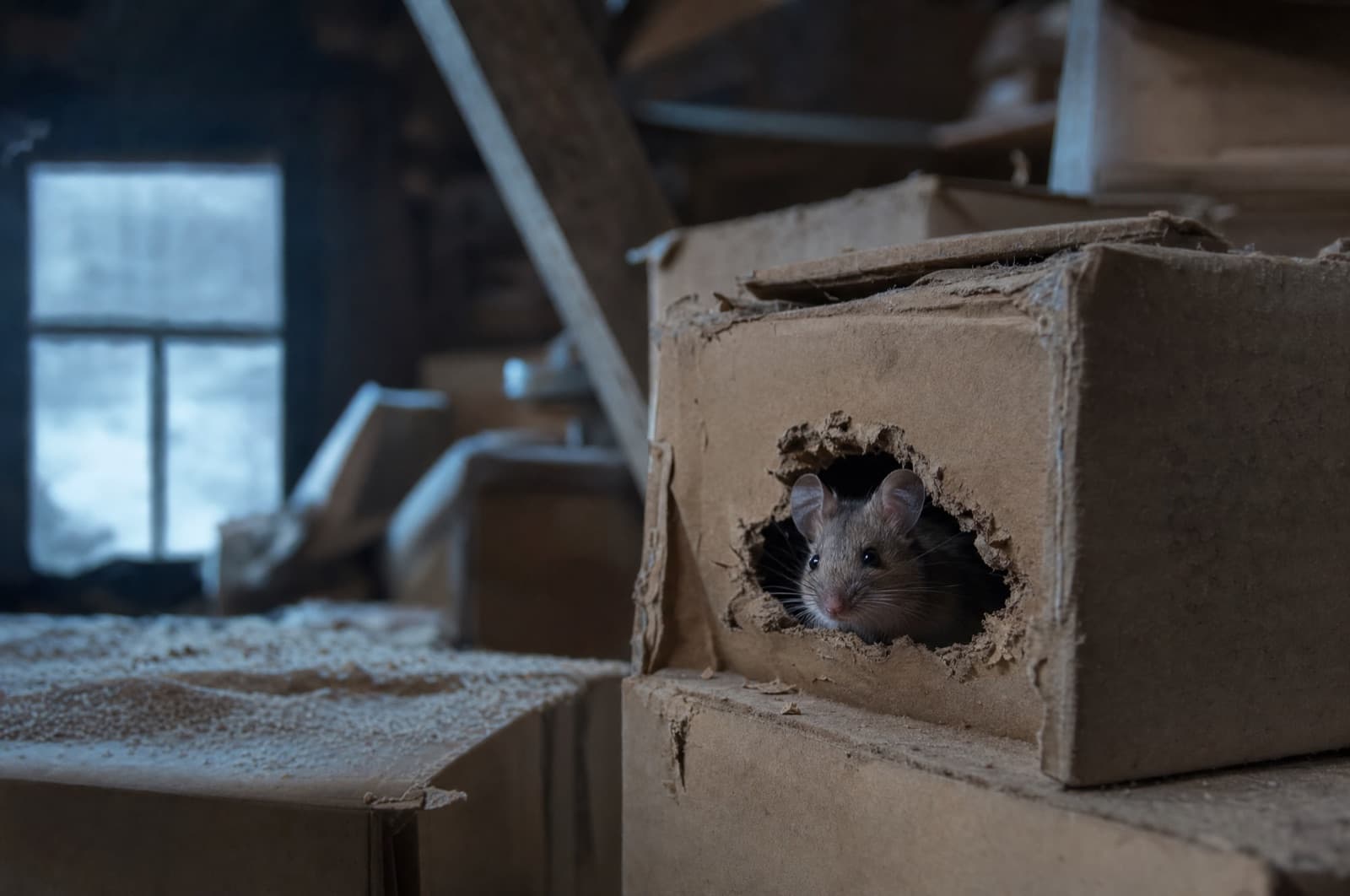
A house mouse in a gnawed cardboard storage box in a cold New Hampshire attic
Daniel Brady · NH-Licensed Pesticide Applicator · License #782664
Reviewed by Daniel Brady

What are the signs of rats nesting indoors during winter?

Partial picture
Rat nesting indoors shows up as large, capsule-shaped droppings around 1/2 to 3/4 inch with blunt, rounded ends, heavy gnaw damage on wood, plastic, and even soft metals, grease-rub trails, nests of shredded material tucked into secluded spots, and a musty ammonia-like smell in heavier infestations.Species matters here: Norway rats stay low, in basements, crawl spaces, and 2-to-3-inch ground burrows, while roof rats stay high, in attics and soffits. A daytime sighting can signal an unusually large infestation, since rats are normally nocturnal and wary of open exposure.

At a glance

  • The verdict: Partial picture
The honest answer

The short of it

The verdict
Partial picture

Rat sign is bigger and louder than mouse sign -- but Norway rats and roof rats hide in opposite places, and one sign is never a population count.

What you would actually see

The signs — and the honest limit

How much warning you get
Partial warning
  • Large droppings, 1/2 to 3/4 inch, blunt or rounded ends

    Already established

    Found near runways and food sources, rat droppings are noticeably larger than mouse droppings and rounder at the ends rather than sharply pointed. Concentration near a specific area marks active feeding or a nearby nest.

    Easily confused with

    Mouse droppings, which are far smaller, or wildlife scat from squirrels or other animals sharing an attic space.

  • Heavy gnaw marks on wood, plastic, wiring, or soft metals

    Already established

    Rats can gnaw through material mice physically cannot, including a documented case of a chewed-through plastic storage container (NC State Extension). Heavy, coarse gnaw damage on a scale beyond typical mouse marks is a strong rat indicator.

    Easily confused with

    Old damage left by a prior owner, or ordinary mechanical wear from tools, moving, or storage handling.

  • Nests of shredded paper, cloth, or insulation in secluded spots

    Already established

    Norway rats build nests low and hidden -- basements, crawl spaces, ground burrows. Roof rats build high, in attics and soffits. The location of the nest itself is the strongest clue to which species you're dealing with, since the two behave very differently.

    Easily confused with

    Bird nests, which roof-rat nests are frequently mistaken for -- inspect the material closely, since bird nests use grass and twigs while rat nests use shredded fabric, paper, and insulation -- or ordinary stored-insulation debris.

  • A musty smell with scratching or rustling noises

    Already established

    A persistent musty or ammonia-like odor combined with audible movement, typically in heavier infestations, per NC State Extension. By the time smell is a noticeable factor, the population is usually more than a single animal.

    Easily confused with

    A dead-animal odor from an unrelated cause, general damp or mildew smell, or HVAC-related noise mistaken for rustling.

What you cannot see
3
  • A burrow entrance or an attic nest tells you rats are present, not how large the colony is or where the full runway network extends under a slab or inside soffits.
  • Rats are neophobic and, per NC State Extension, "fairly adept at going unnoticed" -- the absence of a sighting is not the absence of rats, and a single confirmed sign is not a population count.
  • You cannot determine from sign alone whether a Norway-rat burrow network connects to other structures or extends further under the foundation than the visible entrance suggests.
How often to actually look
In New Hampshire, inspect basements and crawl spaces for Norway rat sign and attics and soffits for roof rat sign on a roughly monthly basis through the winter. A simple paper-plug test over a suspected hole -- covering it loosely and checking a day or two later -- reveals whether that specific opening is still in active use.
In depth

The full picture

01

Why rat sign is bigger, and why that's useful

The scale difference between rat and mouse sign is the single most reliable way to tell them apart without seeing the animal. Rat droppings run roughly 1/2 to 3/4 inch with blunt, rounded ends, compared to a mouse's rice-grain-sized, pointed droppings. Gnaw damage follows the same pattern -- NC State Extension documents rats chewing through a plastic storage container, a scale of damage well beyond what a mouse typically produces.

The practical value here is that size alone lets a homeowner make a reasonably confident call without needing to see the animal directly, which matters because rats are notably better than mice at avoiding detection in the first place.

02

Two species, opposite hiding places

This is the detail that generic rodent-sign advice usually flattens, and it changes where you should actually look. Norway rats stay low -- basements, crawl spaces, and ground burrows roughly 2 to 3 inches wide, per NC State and University of Arizona Extension. Roof rats do the opposite, staying high in attics, soffits, and upper structures.

That means a thorough winter check genuinely needs two separate inspection zones, not one. Checking only the basement misses roof rats entirely, and checking only the attic misses Norway rats. The nest material and location together are usually enough to tell you which species you're dealing with, which matters because their behavior, and the fixes that follow, differ.

03

Why one sign is never a population count

NC State Extension notes rats are neophobic and "fairly adept at going unnoticed," which means the absence of a sighting tells you almost nothing about whether rats are present, and a single confirmed sign -- one dropping, one gnaw mark -- tells you almost nothing about how many there are. This page's average search position, historically very low even though the question is a common one, is itself evidence that generic answers haven't served this query well; the fix is the specificity above, not a vaguer answer.

What a homeowner can reasonably conclude: multiple signs across more than one visit, in a consistent location, indicate an established rather than a passing presence. A single find is worth investigating further, not treated as a confirmed infestation on its own.

Key takeaways
5 points
  • Rat droppings run 1/2 to 3/4 inch with blunt, rounded ends -- clearly larger than a mouse's rice-grain, pointed droppings.
  • Norway rats nest low (basements, crawl spaces, ground burrows); roof rats nest high (attics, soffits). Nest location is the strongest species clue.
  • Heavy gnaw damage on wood, plastic, or soft metal points to rats rather than mice -- a documented case includes a chewed-through plastic container.
  • Rats are neophobic and notably good at avoiding detection -- absence of a sighting is not absence of rats.
  • A single sign is not a population count. Multiple signs across more than one visit indicate an established presence.
New Hampshire context

Rat sign in a New Hampshire winter

Southern New Hampshire homes near woods, water, or open farmland see both Norway and roof rat activity, and winter cold pushes both species toward structures in the same way it does mice. A monthly check of basements and crawl spaces alongside attics and soffits through the winter covers both species' preferred hiding zones without assuming one location tells the whole story.

The paper-plug test -- loosely covering a suspected entry hole and checking whether it's been disturbed a day or two later -- is a low-effort way to confirm which specific openings around a New Hampshire foundation or roofline are still in active use before winter ends and access becomes harder under snow cover.

  • NH-licensed #782664

    Southern New Hampshire

  • Family-owned

    Since 2017

  • Honest routing

    Even when it isn’t us

We serve these communities

ManchesterNashuaConcordDerryBedfordSalemHudsonAmherst

Finding rat-sized sign in both your basement and your attic?

That can mean two separate populations, not one. A professional inspection can confirm species and scope before you commit to a fix.

Follow-up questions

Frequently asked

Sources & citations(3)
  1. NC State Extension — Surveillance and Management of Common Structure-Invading Rats

    Dropping size, gnawed plastic container documentation, neophobia and detection difficulty, musty smell in heavier infestations

    extensionverified 2026-07-16
  2. University of Arizona Cooperative Extension — Roof Rats: Identification, Ecology, and Signs (az1775)

    Roof rat vs. Norway rat nesting location differences

    extensionverified 2026-07-16
  3. ICWDM — Norway Rat Damage Prevention and Control Methods

    Norway rat burrow dimensions and low, hidden nesting behavior

    extensionverified 2026-07-16

Written & reviewed by

Verified

Daniel Brady

NH-Licensed Pesticide Applicator · License #782664 (NHDAMF, RSA 430)

Daniel Brady is the New Hampshire–licensed applicator behind Anchor Pest Services, a family-owned pest control company serving the Manchester area since 2017.

Verify license

Last updated Jul 2026

Honest pest help for New Hampshire homes

Two Species, Two Hiding Places. We Check Both.

Norway rats and roof rats behave differently enough that a proper inspection has to check both the basement and the attic, not just wherever you happened to find a sign. Anchor Pest Services identifies which species you're dealing with and where the entry point actually is, rather than guessing from one dropping. Family-owned since 2017, NH license #782664, serving Manchester, Nashua, Concord and nearby towns.

  • Honest advice — species identification before any treatment plan
  • NH-licensed applicators (#782664) — free inspection, same-day service
  • Rodent inspection and exclusion across southern and central New Hampshire

NH License #782664 · No obligation · We answer in person