
Skip to content
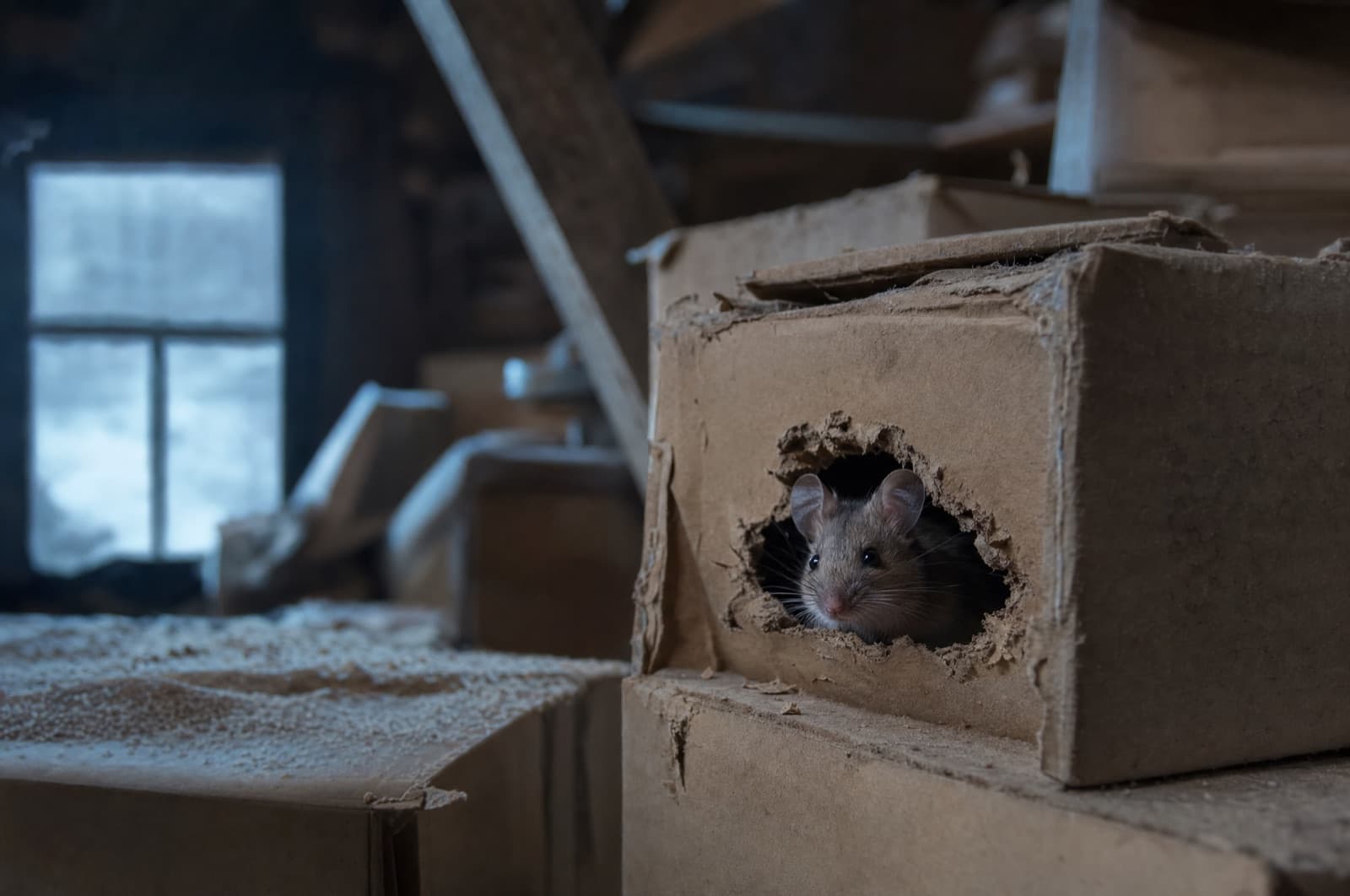
A house mouse in a gnawed cardboard storage box in a cold New Hampshire attic
Daniel Brady · NH-Licensed Pesticide Applicator · License #782664
Reviewed by Daniel Brady

What DIY steps should homeowners take against winter pests?

Ranked by evidence
Most winter pest work is genuinely DIY and effective — this is the homeowner-only version of the full plan, meaning every item here is something you can do yourself, no ladder-and-trade or professional required.In order of payoff: inspect the exterior with a pencil and mark every quarter-inch-plus gap, seal what you find with metal mesh and caulk, switch stored food to metal or glass, set snap traps where you see droppings, and declutter around the foundation. Know your stop line: repeated reinfestation, entries you can't locate, or a large active population is when this stops being a DIY job.

At a glance

  • The verdict: Ranked by evidence
The honest answer

The short of it

The verdict
Ranked by evidence

Most of winter pest defense really is DIY — the honest list is short, boring, and it works.

The roll-up

Ranked by what actually pays off

The homeowner-only subset of winter pest defense — every row here is something you can do yourself, with nothing requiring a ladder-and-trade job or a professional. See our vulnerability-map page for WHERE to look including the roofline and chimney, and our winter-proofing overview for the full plan including those trade-level tasks.

Ranked by
Evidence-backed payoff among tasks a homeowner can do entirely without hiring anyone.
RankItemGradeWho does itNote
01Inspect the exterior with a pencil in hand; mark every gap a pencil fits throughDo firstYouReframes the whole job — a quarter inch is the CDC's real entry threshold, not a guess.
02Seal what you find: copper or steel mesh plus caulk for holes, mortar for masonry cracks, metal door sweeps for thresholdsDo firstYouDurable exclusion — foam or caulk alone gets gnawed through eventually.
03Store food and pet food in metal or glass containersDo firstYouRemoves the attractant that makes staying worthwhile once something gets in.
04Set snap traps along walls wherever droppings appearWorth itYouEffective, viewable, and carries none of the secondary-poisoning risk of bait.
05Declutter and maintain a roughly three-foot foundation bufferWorth itYouRemoves harborage close to the house without needing any special material.
06Broadcasting rodenticide bait yourselfSkip itYouFeels decisive, but disappearing bait can just mean feeding a population, and it risks poisoning owls, hawks, foxes and pets up the food chain.
What people get wrong
Homeowners expect DIY pest defense to mean buying a chemical — a spray, a bait station, a fogger. The DIY steps that actually work are almost entirely physical and unglamorous: a pencil test, a caulk gun, metal containers, a few snap traps. Scattering rodenticide bait is the one step on this list that looks like decisive DIY action but often isn't — a New Hampshire wildlife necropsy study found the large majority of animals tested statewide had rodenticide exposure, which is the visible cost of a control method most homeowners assume is harmless because it's sold over the counter.
In depth

The full picture

01

This is the homeowner-only cut of the full plan

This page exists specifically to answer 'what can I do myself,' as distinct from our two other overview pages. Our vulnerability-map page ranks every physical location on a house, including the roofline and chimney, which are often a ladder-and-trade or professional job. Our winter-proofing overview covers the complete plan, trade tasks included. This page strips both of those down to only the rows that are entirely within a homeowner's own reach — no ladder-dependent roofline work, no chimney cap installation, nothing requiring specialized equipment.

02

The pencil test: reframing the whole inspection

The single most useful mental tool in this list is treating a pencil as your measuring device: if a pencil fits through a gap, so does a mouse, because a quarter inch is the actual physiological threshold, not a rule of thumb (CDC). Walking the exterior of a house with a pencil in hand, checking foundation cracks, sill-plate gaps, utility penetrations, and door thresholds, converts a vague sense of 'the house might have gaps somewhere' into a specific, marked list of locations to fix — which is exactly why it ranks first, ahead of the sealing itself.

03

Why rodenticide bait is the one item that grades skip_it here

Scattering rodenticide bait feels like the most decisive action on this list — you're doing something visibly aggressive, the bait disappears, and it looks like it's working. That feeling is genuine and worth naming rather than dismissing; busywork like this earns its appeal honestly. But disappearing bait can simply mean a population is being fed rather than eliminated, and the documented downstream cost is real: UNH Extension reporting on New Hampshire wildlife necropsies found that the vast majority of animals tested statewide — birds of prey and other wildlife — carried rodenticide exposure, much of it from long-acting anticoagulant compounds that move up the food chain from rodent to predator to pet. The same afternoon and the same effort spent on sealing and trapping instead actually ends the cycle rather than feeding it.

04

Your stop line — when this is no longer a DIY job

This list is effective, and it's also clearly limited. The honest stop line: if you've sealed every gap you can find and pests keep getting in, that means a hidden entry point you can't locate without a professional inspection. If trapping isn't reducing the population after a reasonable stretch, or you're dealing with a large, established colony rather than a handful of new arrivals, that's also past the DIY line. Neither of those is a failure on your part — it just means the job has moved from a caulk-gun problem to an inspection-and-trapping problem.

Key takeaways
6 points
  • Every row here is homeowner-doable — no ladder-and-trade or professional work included.
  • The pencil test (if a pencil fits, so does a mouse) is the fastest way to find real gaps, not a guess.
  • Durable sealing uses metal mesh first, caulk or mortar second — foam and caulk alone eventually get gnawed through.
  • Snap traps outperform rodenticide bait for DIY use — no secondary-poisoning risk to wildlife or pets.
  • Broadcasting bait yourself is the one item that grades skip_it — feeding a population and poisoning predators up the food chain is a documented risk, not a hypothetical.
  • Know your stop line: repeated reinfestation, entries you can't find, or a large established population means it's time to call a professional.
New Hampshire context

Running this DIY list before a New Hampshire winter

Manchester's first hard frost typically arrives between October 19 and 29 (NOAA), which is the practical deadline for the pencil-test-and-seal steps above — do them before the season's search for indoor shelter intensifies, not after. Storage and trapping matter year-round but carry the most weight starting in the fall.

If you already have activity indoors this winter, start with traps and food storage rather than waiting to finish the full sealing pass first — knocking down an existing population and removing its food source can happen in parallel with the exterior inspection.

  • NH-licensed #782664

    Southern New Hampshire

  • Family-owned

    Since 2017

  • Honest routing

    Even when it isn’t us

We serve these communities

ManchesterNashuaConcordDerryBedfordSalemHudsonAmherst

Hit your stop line — sealed, trapped, and still finding activity?

That's a hidden entry point or an established population. A free inspection tells you honestly which one you're dealing with.

Follow-up questions

Frequently asked

Sources & citations(4)
  1. CDC — Seal Up! Rodent control and exclusion

    Quarter-inch entry threshold; the pencil test; DIY sealing materials

    govverified 2026-07-16
  2. extension.org (Wildlife Damage Management) — Rodent Exclusion Methods

    Durable sealing materials — metal mesh backing versus foam/caulk alone

    extensionverified 2026-07-16
  3. MU Extension — Controlling House Mice (G9442)

    Snap trapping as the preferred DIY control method in homes

    extensionverified 2026-07-16
  4. UNH Cooperative Extension — Wildlife-Safe Alternatives to Rodent Poisons

    New Hampshire rodenticide exposure necropsy findings and safer alternatives

    extensionverified 2026-07-16

Written & reviewed by

Verified

Daniel Brady

NH-Licensed Pesticide Applicator · License #782664 (NHDAMF, RSA 430)

Daniel Brady is the New Hampshire–licensed applicator behind Anchor Pest Services, a family-owned pest control company serving the Manchester area since 2017.

Verify license

Last updated Jul 2026

Honest pest help for New Hampshire homes

This List Is Yours to Run. We're the Stop Line.

A pencil, a caulk gun, metal containers and a few snap traps handle most winter pest defense, and we'd rather say so than sell a service for it. Anchor Pest Services is worth calling when you've hit your stop line — a hidden entry or an established population — and winter is when that's most likely to happen. Family-owned since 2017, NH license #782664, serving Manchester, Nashua, Concord and nearby towns.

  • Honest advice — we'll tell you when it's still a job you can handle yourself
  • NH-licensed applicators (#782664) — free inspection, same-day service
  • Rodent inspection and trapping across southern and central New Hampshire

NH License #782664 · No obligation · We answer in person