
Skip to content
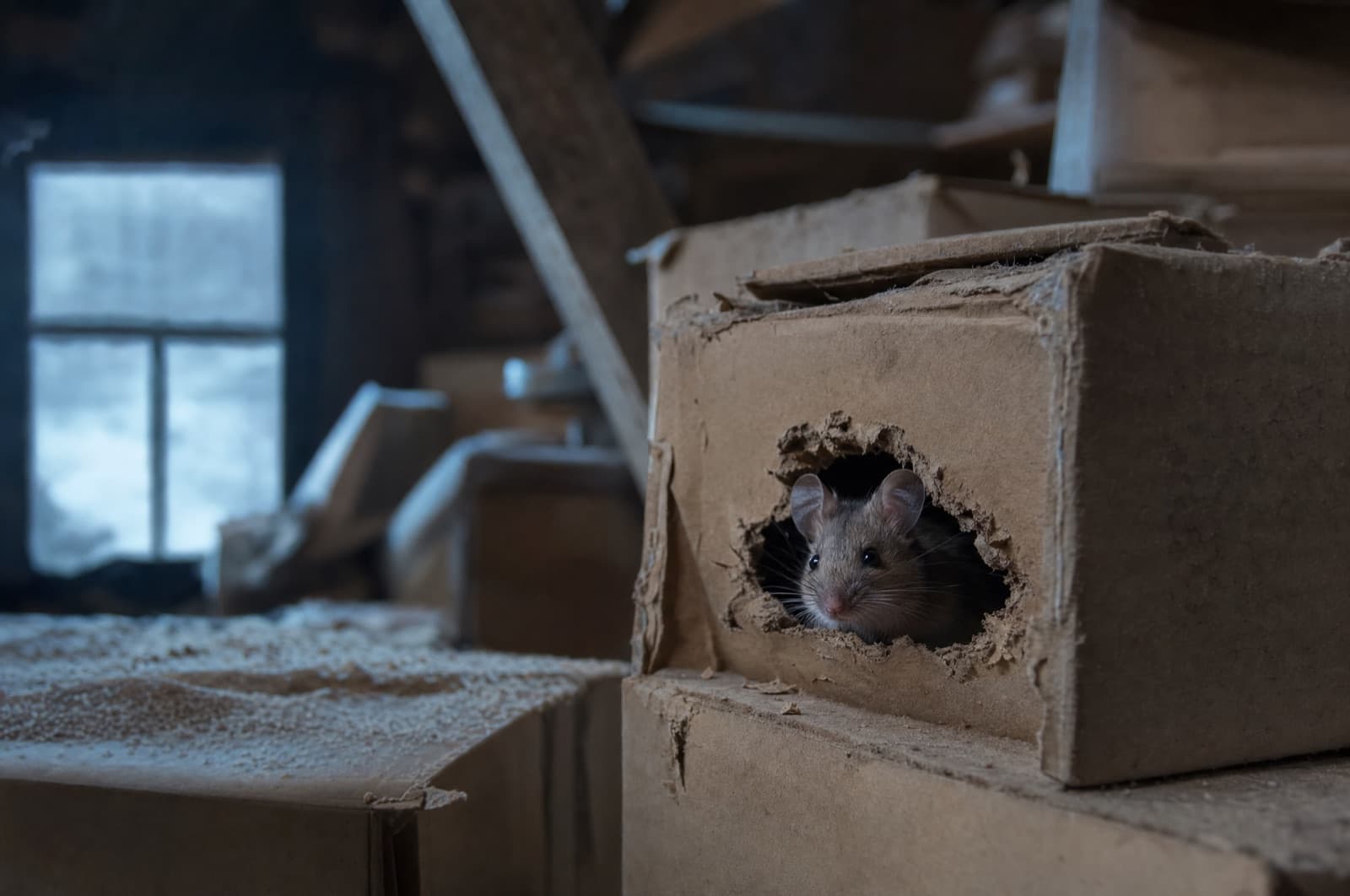
A house mouse in a gnawed cardboard storage box in a cold New Hampshire attic
Daniel Brady · NH-Licensed Pesticide Applicator · License #782664
Reviewed by Daniel Brady

What role does tree line or vegetation play in winter pest entry for homes?

Major risk factor — and the contact points are fully within your control
Major, and this is one of the better-documented risk factors in extension literature.Vegetation touching a house gives pests a direct physical route past ground-level defenses entirely — university extension guidance describes trees planted too close as acting like a highway for pests, and documents roof rats capable of jumping three feet vertically and more than four feet horizontally onto overhanging branches. Dense foundation plantings compound the problem by holding moisture against the siding and physically blocking any perimeter treatment from reaching the wall. You can't move a mature tree line, but every contact point — a branch on the roof, a shrub against the siding — is something you can trim back yourself.

At a glance

  • The verdict: Major risk factor — and the contact points are fully within your control
The honest answer

The short of it

The verdict
Major risk factor — and the contact points are fully within your control

Major, and unusually well-documented: any branch touching your roof is a bridge, and any shrub against your siding is a bypass around every ground-level defense you have.

Why your house

How much this factor matters

Branches, vines, or shrubs in physical contact with the structureMajor factor
Why

University of Florida IFAS Extension is direct about the mechanism: trees planted too close to a structure "act as a highway for pests," and its published bulletin states that roof rats specifically "can jump three feet in the air vertically and more than four feet horizontally," which is more than enough to bridge from an overhanging limb onto a roofline, attic vent, or soffit without ever touching the ground. Overhanging limbs create the same bridging opportunity for termites and ants moving toward the structure. Separately, shrubs and dense plantings against the siding let climbing insects bypass a ground-level treated perimeter band entirely, since the treatment can't reach a wall the plants are physically blocking. Vegetation in direct contact with siding also traps moisture against the building envelope, which independently creates the damp, decaying-wood conditions carpenter ants and rot-related pests seek — compounding the physical-bridge risk with a moisture risk in the same location.

Partly
You can't relocate a mature tree line, but every point of physical contact between vegetation and your house is fully within your control. Cut tree limbs back to keep several feet of clearance from the roofline, attic vents, and soffits. Trim shrubs to sit at least twelve to eighteen inches off the siding, and consider a "V-cut" at the base of foundation shrubs to open a visible, inspectable gap between the plant and the wall. Keep mulch shallow — two to three inches — and pulled back from direct contact with the foundation or siding. When planting new trees, especially fruit-bearing varieties that also attract other wildlife, place them well away from the house from the start rather than trimming around an existing mistake for years.

Assessed from: UF/IFAS Extension IN1397 Landscaping Methods to Prevent Pests

In depth

The full picture

01

Why contact matters more than proximity

A tree standing thirty feet from the house is a different risk than a tree with one limb resting on the roof. This risk factor is specifically about physical contact, not general proximity — a branch touching the roofline, a shrub pressed against the siding, vines climbing the exterior wall. Contact is what turns nearby vegetation into a bridge.

That distinction is why the fix is trimming, not removal. A mature tree at a reasonable distance doesn't need to come down; it needs its contact points with the structure cut back so nothing provides a direct route in.

02

What the documented jumping range actually means

The specific figures from UF/IFAS extension research are worth sitting with: roof rats can jump roughly three feet vertically and more than four feet horizontally. That means a branch doesn't need to touch the roof directly to matter — it needs to be within jumping range, which extends the effective danger zone well beyond simple physical contact.

This is why extension guidance recommends several feet of clearance, not just "not touching." A gap that looks safely separated to the eye can still be well within a roof rat's jumping range, which is the kind of detail that only shows up when the underlying research is cited directly.

03

The second problem: bypassing your ground-level defenses

Even setting aside rodents, dense shrubs against the siding create a separate issue: they let climbing insects — ants, some beetles — reach the wall without crossing any treated ground-level perimeter, because the plant material itself is the route up. A perimeter treatment applied around the yard simply can't reach a section of siding that's physically obscured by foliage.

The same plantings trap moisture against the envelope, creating the damp conditions carpenter ants and wood-decay organisms favor in the same spot the physical-contact risk already exists — two problems stacking in exactly the same location.

Key takeaways
5 points
  • Physical contact between vegetation and the structure — not just general proximity — is what turns a tree line into a documented pest bridge.
  • UF/IFAS research documents roof rats jumping roughly three feet vertically and more than four feet horizontally, extending the effective danger zone beyond simple contact.
  • Shrubs against siding let climbing insects bypass a ground-level perimeter treatment entirely, since the treatment can't reach a wall the plants are blocking.
  • Vegetation contact also traps moisture against the envelope, compounding the bridging risk with a separate decay/carpenter-ant risk in the same spot.
  • You can't move a mature tree line, but every contact point is trimmable: several feet of roofline clearance, 12-18 inches of shrub clearance, shallow mulch pulled off the foundation.
New Hampshire context

Tree cover across southern and central New Hampshire

Much of the region's residential landscape sits close to mature tree canopy, and many older New Hampshire properties have decades-old foundation plantings that have grown well past their original spacing. That combination makes the contact-point check described above especially relevant here, and worth doing before Manchester's first hard frost, typically October 19 to 29 (NOAA), when pest pressure toward the structure ramps up.

A fall walk around the perimeter — checking for any branch touching the roof, any shrub pressed against siding, and mulch depth at the foundation — pairs naturally with the sealing work covered elsewhere in this hub.

  • NH-licensed #782664

    Southern New Hampshire

  • Family-owned

    Since 2017

  • Honest routing

    Even when it isn’t us

We serve these communities

ManchesterNashuaConcordDerryBedfordSalemHudsonAmherst

Trim the contact points yourself. Call if something's already crossed.

Cutting back branches and shrubs is a homeowner-and-a-trade job. If a roofline or attic vent already shows signs of entry, that's ours to inspect.

Follow-up questions

Frequently asked

Sources & citations(3)
  1. UF/IFAS Extension — IN1397 Landscaping Methods to Prevent Pests

    Trees as a pest highway when planted too close; roof rats jump three feet vertically and more than four feet horizontally; V-cut shrub technique

    extensionverified 2026-07-16
  2. DOE Building America Solution Center (PNNL) — Reduce Pest Intrusion

    Vegetation management and moisture control as part of building-envelope pest exclusion

    govverified 2026-07-16
  3. NOAA — Manchester, NH freeze climatology

    Manchester first hard frost typically ~Oct 19-29 — the seasonal window for a fall perimeter and tree-line check

    govverified 2026-07-16

Written & reviewed by

Verified

Daniel Brady

NH-Licensed Pesticide Applicator · License #782664 (NHDAMF, RSA 430)

Daniel Brady is the New Hampshire–licensed applicator behind Anchor Pest Services, a family-owned pest control company serving the Manchester area since 2017.

Verify license

Last updated Jul 2026

Honest pest help for New Hampshire homes

We Can't Move Your Trees. We Can Check Where They Touch the House.

The trimming work is yours — a saw, a few afternoons, and a clear rule about clearance. What Anchor Pest Services can do is inspect the rooflines and vents those bridges lead to, and handle exclusion if something has already found its way across. Family-owned since 2017, NH license #782664, serving Manchester, Nashua, Concord and nearby towns.

  • Honest advice — we'll tell you which vegetation risk is yours to trim
  • NH-licensed applicators (#782664) — free inspection, same-day service
  • Rodent exclusion and winter pest control across southern and central New Hampshire

NH License #782664 · No obligation · We answer in person