
Skip to content
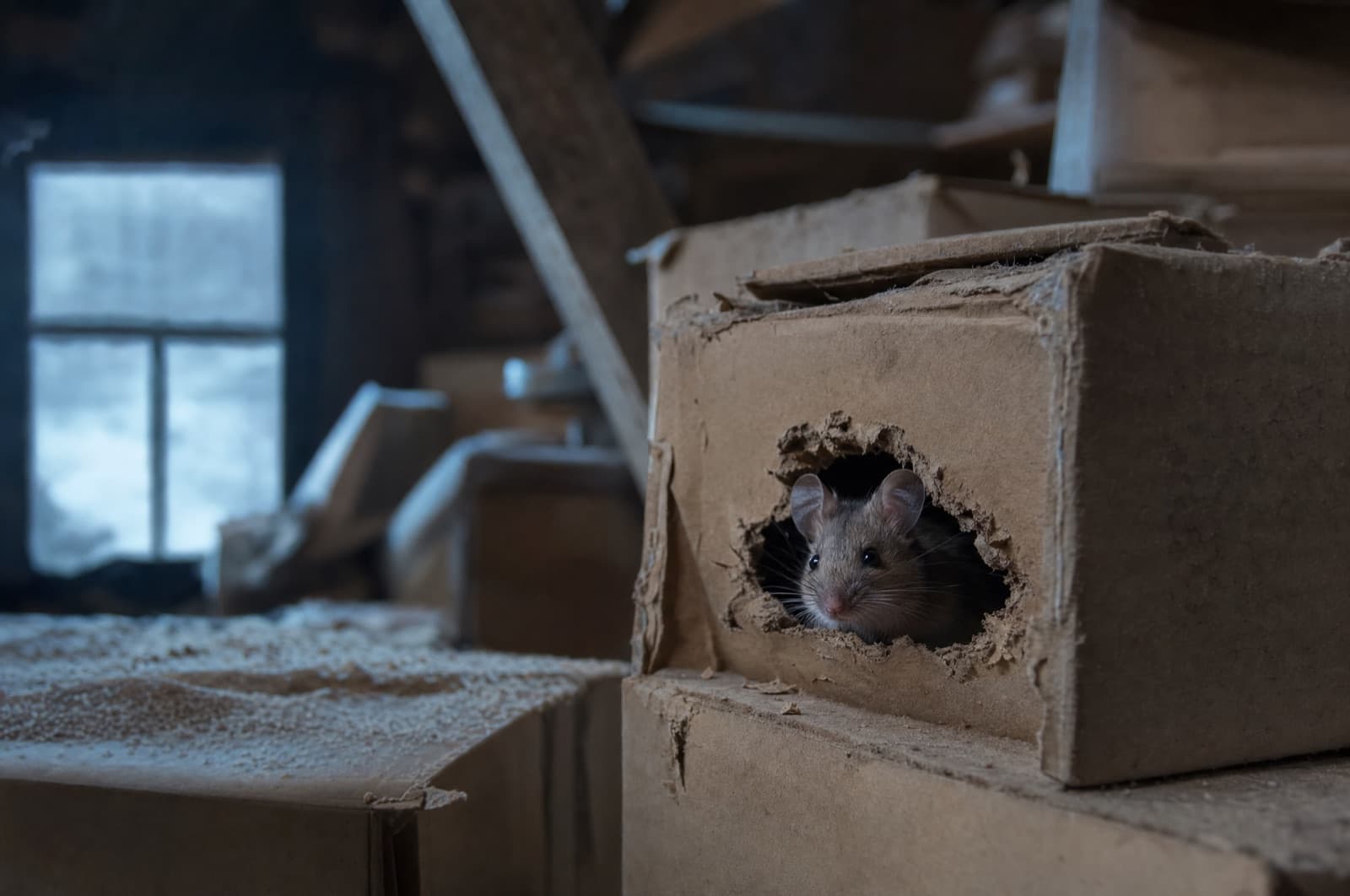
A house mouse in a gnawed cardboard storage box in a cold New Hampshire attic
Daniel Brady · NH-Licensed Pesticide Applicator · License #782664
Reviewed by Daniel Brady

Why do pests climb on the sunny side of houses in fall?

Yes — and it's visual contrast, not heat or light
Yes — but the pull isn't light, and for the lead species it isn't simply heat either.Asian lady beetles gather on south- and west-facing walls in fall because those sun-lit surfaces present a high-contrast silhouette against dark trim, gutters and window frames — the landing cue identified by peer-reviewed field research — while warmth explains when a flight happens on a given afternoon, not where it lands. Boxelder bugs, stink bugs and cluster flies show the same sun-wall pattern, though the exact cue driving each of those species hasn't been isolated the way it has for lady beetles. Once a wall has drawn them in, they probe it for cracks and slip inside to spend the winter in the wall void behind it — which is why the sunny side of a house is also the side most worth sealing first.

At a glance

  • The verdict: Yes — and it's visual contrast, not heat or light
The honest answer

The short of it

The verdict
Yes — and it's visual contrast, not heat or light

Overwintering insects aggregate on sun-warmed south and west walls because those surfaces present a sunlit, high-contrast silhouette against dark trim and gutters — warmth governs when they fly, not where they land, and light has nothing to do with it.

What actually happens

The busted assumption

Yes

What people assume

That these insects are drawn to porch lights or windows after dark, or that they climb at random and just happen to end up on one side of the house. Neither is true — but the driver isn't simply surface temperature either. The wall is chosen because it's a sunlit, high-contrast target against dark trim and gutters, not because of illumination after dark; surface warmth explains the timing of the afternoon flight, not the choice of wall.

What actually happens

Open-field research tracking the actual fall flight of the multicolored Asian lady beetle (Nalepa, Kennedy & Brownie, 2005, Environmental Entomology) found the landing cue is high visual contrast — dark-on-light linear silhouettes like painted trim, gutters, drainpipes and window frames against sunlit siding. The study is explicit that beetles are "not visually attracted to the color white per se," and it calls into question an earlier belief that they're simply drawn to bright, reflective surfaces. Warmth still matters, but for a different question: University of Illinois Extension documents that household overwintering insects concentrate on the walls and wall voids that "stay the warmest because they receive the most sunlight, usually the south and adjoining portions of the east and west walls" — that heat is what gets a fall flight moving on a given afternoon, not what decides where an airborne insect lands. Boxelder bugs, stink bugs and cluster flies show the same sun-wall pattern, but the visual-contrast landing cue has only been established for lady beetles specifically.

What it means for you
Once they've found a gap on that sun-facing wall and gotten inside, the story is mostly over for the season: they settle into a wall-void aggregation and go dormant, stirring only on unusually warm days — even a furnace-warmed interior wall can trigger the same reflex in January. So the small cluster of beetles on a winter windowsill usually isn't a new invasion; it's last fall's population waking up briefly. The practical takeaway for next year is to prioritize sealing the south and west walls specifically, since that's where the pressure concentrates — and the full fall-entry timing window, the point past which sealing stops helping for the season, belongs to /fall-invaders-faq rather than this page.

Established from: Nalepa, Kennedy & Brownie 2005 (Environmental Entomology); University of Illinois Extension; PMC (Koch, general biology)

In depth

The full picture

01

Visual contrast, not radiant heat — the actual mechanism

It's a reasonable guess that insects climbing toward the sun are chasing light. They aren't — and the fuller story isn't simply heat either, though heat plays a real supporting role. Field research on the multicolored Asian lady beetle — the species most homeowners are actually seeing in these clusters — tracked the actual fall flight in open-field conditions and found the landing cue is high visual contrast: dark-on-light linear silhouettes such as painted trim, gutters, drainpipes, window frames and the hard-edged shadows a house casts (Nalepa, Kennedy & Brownie, 2005, Environmental Entomology). The study is explicit that beetles are "not visually attracted to the color white per se," and it calls into question an earlier, widely repeated belief that they're simply drawn to bright, reflective surfaces.

Warmth still matters, but it answers a different question: not where they land, but when they fly. University of Illinois Extension documents that overwintering insects concentrate on the walls and wall voids that run warmest — in New Hampshire that's almost always the south wall and the sun-exposed portions of the east and west walls, since the low fall sun angle keeps those surfaces warm well into the afternoon even as air temperature drops. A warm afternoon after a cold night is what gets a fall flight moving; once beetles are airborne, it's the high-contrast silhouette on that same sunlit wall — not the heat itself — that pulls them in to land. The two facts point at the same walls for different reasons, which is why the sunny-side pattern is so consistent. Boxelder bugs, brown marmorated stink bugs and cluster flies mass on the same sun-exposed walls on warm fall afternoons, but the visual-contrast landing cue has only been established for lady beetles — the mechanism for the other three hasn't been isolated the same way.

02

What happens after they've made it inside

This is the part that matters for winter specifically, since the fall entry itself is a different page's territory. Once an overwintering insect has found a crack on that sun-warmed wall and gotten behind the siding, it settles into the wall void in a dormant, low-activity state for the rest of the season. It isn't reproducing in there — these species overwinter as adults and wait, they don't nest and multiply indoors.

What you'll actually notice through winter is sporadic activity on unseasonably warm days, or even just from a furnace-heated interior wall warming the void from the inside. That's the same warmth-triggered stirring that got them moving on warm fall afternoons in the first place, just running in miniature. It's also worth knowing what not to do: don't treat a wall void with an insecticide to "finish the job" once insects are already sheltering there for winter — dead insects inside a void draw carpet and larder beetles, which is a worse problem, since those species do damage wool, stored food and other organic material. Vacuuming up what you see indoors is the sound winter response.

03

Why this points at a fall problem, not a winter one

If the sunny-side pattern is real and predictable, the useful response is timing, and the timing window for that belongs to a different page. This hub's job here is the winter half of the story — what these insects do once they're in, and why the sunny side matters at all. The four-phase question of exactly when sealing those south- and west-facing gaps still works before the fall invasion, and when it's too late for the season, is answered in full by /fall-invaders-faq, which owns that gate. What's safe to say here: if you're reading this in winter with beetles already inside, sealing the sunny-side walls now won't remove what's already sheltering there — it protects next fall's population from getting the same head start.

Key takeaways
6 points
  • The sunny-side pattern is about visual contrast, not radiant heat and not light: peer-reviewed field research (Nalepa, Kennedy & Brownie, 2005) found lady beetles land on high-contrast, sunlit silhouettes on south- and west-facing walls.
  • Warmth still matters, but for timing, not location — a warm fall afternoon after a cold night is what gets a flight moving, not where it chooses to land.
  • That specific landing cue is established for Asian lady beetles; boxelder bugs, stink bugs and cluster flies show the same sun-wall behavior without the same mechanism being confirmed for them.
  • Once inside, they overwinter dormant in the wall void and only stir on unusually warm days — indoors or out.
  • Don't treat the void with insecticide once they're sheltering there — dead insects attract carpet and larder beetles.
  • The fall-entry timing gate (when sealing those walls still works) belongs to /fall-invaders-faq, not this page.
New Hampshire context

The sunny side of a New Hampshire house

Manchester's first hard frost lands around October 19 to 29 in a typical year (NOAA), and the weeks before that are exactly when the sunny-side pattern is at its strongest — low fall sun angle, cooling air, and a wall surface that's both sun-warmed and highly visible against dark trim, gutters and window frames. A colonial or cape-style house with unshaded southern exposure and contrasting trim is a textbook example of the mechanism at work.

By the time winter has set in, the entry has already happened for the season, and what's left is largely dormant. If you're seeing beetles or flies stirring on a warm January afternoon, that's this year's fall arrivals, not a new problem — and it's a useful cue to put the south and west walls at the top of next September's sealing list.

  • NH-licensed #782664

    Southern New Hampshire

  • Family-owned

    Since 2017

  • Honest routing

    Even when it isn’t us

We serve these communities

ManchesterNashuaConcordDerryBedfordSalemHudsonAmherst

The sunny side is the highest-yield wall to seal.

This is DIY timing work, best done before fall — /fall-invaders-faq covers exactly when. If rodents are what's actually getting in, that part is genuinely ours.

Follow-up questions

Frequently asked

Sources & citations(5)
  1. Nalepa, Kennedy & Brownie 2005 — Environmental Entomology 34(2):425–431, Role of Visual Contrast in the Alighting Behavior of Harmonia axyridis

    Open-field experiments during the actual fall flight found the landing cue is high visual contrast — dark-on-light silhouettes like trim, gutters and drainpipes on sunlit walls — not radiant heat; the study explicitly questions the earlier belief that beetles are drawn to bright, reflective surfaces

    academicverified 2026-07-17
  2. University of Illinois Extension — Dealing with Household Overwintering Insects

    South- and west-facing walls run warmest in fall and correlate with where overwintering insects gather; warmth governs the timing of the fall flight, not the landing cue itself

    extensionverified 2026-07-17
  3. PMC — Koch, biology and ecology of the multicolored Asian lady beetle

    General biology and overwintering aggregation behavior of Harmonia axyridis at buildings across North America

    academicverified 2026-07-17
  4. Ohio State University Extension (Ohioline) — Multicolored Asian Lady Beetle (ENT-44)

    Overwintering aggregation behavior triggered by temperature; do not spray wall voids

    extensionverified 2026-07-16
  5. UNH Cooperative Extension — Cluster Flies fact sheet

    Cluster fly overwintering in wall voids and attics, exclusion timing

    extensionverified 2026-07-16

Written & reviewed by

Verified

Daniel Brady

NH-Licensed Pesticide Applicator · License #782664 (NHDAMF, RSA 430)

Daniel Brady is the New Hampshire–licensed applicator behind Anchor Pest Services, a family-owned pest control company serving the Manchester area since 2017.

Verify license

Last updated Jul 2026

Honest pest help for New Hampshire homes

We'll Tell You Which Wall to Seal First.

Overwintering insects are mostly a DIY sealing job, timed right. Where Anchor Pest Services is truly worth calling is rodent exclusion, which is a real winter job in New Hampshire. Family-owned since 2017, NH license #782664, serving Manchester, Nashua, Concord and nearby towns.

  • Honest advice — we'll tell you when it's a DIY sealing job, not a service call
  • NH-licensed applicators (#782664) — free inspection, same-day service
  • Rodent exclusion and winter pest control across southern and central New Hampshire

NH License #782664 · No obligation · We answer in person