
Skip to content
APS
Anchor Pest Services Field Team · NH-Licensed Pest Control Operators (License #782664)
Reviewed by Tim Boyle

When to Call an Exterminator for Ants: The DIY-Failure Threshold for New Hampshire Homeowners

Depends on the species and which signs you see

Call an exterminator for ants immediately if you see any of these: large black ants indoors in January or February (UNH Extension: this means an indoor nest), frass piles at baseboards, audible rustling in walls, winged swarmers inside the house, or ant trails that persist more than 14 days after correctly applied bait. Also call today if tiny pale yellow ants appear in two or more rooms — that is almost certainly pharaoh ant, and every spray you apply makes the infestation 2–3 times larger [8]. DIY is appropriate only for a single identified trail with no structural signs and no winter activity.

At a Glance

  • Short Answer: Call a professional if you see any of 10 specific DIY-failure signals; DIY is appropriate only for a single-trail, single-species, warm-season sighting with no structural signs
  • Key Fact: Hansen (2008) found only 55% field success with best-practice DIY on carpenter ants — meaning 45% of homeowners who do everything right still end up needing a professional
  • NH Relevance: UNH Cooperative Extension is explicit: 'If you see large ants inside your house in January or February… winter activity typically means you have a nest inside your home' — the single highest-confidence escalation signal in NH
  • Action Needed: Run the 4-question decision tree below, check the 10 DIY-failure indicators, and escalate immediately if you hit any one of them
Key Statistics

When to Call an Exterminator for Ants: The DIY-Failure Threshold for New Hampshire Homeowners — The Numbers

55%

DIY field success rate (Hansen 2008) — 45% still escalate

10–15%

Foragers outside the nest — what sprays can reach (Illinois DPH)

Jan–Feb

Winter sighting = indoor nest (UNH Extension FS 62)

2–4 wks

Maximum window before escalating Tier 2 signs (p2 §8)

Deep Dive

The Full Picture

The decision to call an exterminator for ants is not binary — it depends on which ant species you have, what signs are present, and what your DIY history looks like. Three distinct escalation tiers emerge from the research: (1) DIY-appropriate situations where a 14-day non-repellent bait window is the correct first step, (2) DIY-failed situations where a professional should be called within 2–4 weeks, and (3) same-day emergencies where delay compounds damage or infestation costs. 2 The 4-question decision tree above produces one of four terminal verdicts — run it before reading further. 3
01

The 3-Tier Urgency Framework

The three urgency tiers provide a structural backbone for any ant escalation decision.
Read more2 Tier 1 MONITOR (60–90 day re-inspection interval): single forager in summer, no frass, no nocturnal activity, no winter sighting, and exterior trail leading toward yard or stump. Document the sighting, place a non-repellent bait on any trail, and re-inspect in 60–90 days. Tier 2 TREAT SOON (escalate within 2–4 weeks): frass present that re-forms within 72 hours of sweeping, multiple workers seen indoors at night in kitchen or bathroom, faint rustling sounds in walls, or a single hollow-sounding structural member when probed. Professional treatment at this tier runs $250–$500 with 30-day follow-up. 4 Tier 3 EMERGENCY (same- or next-day call): indoor winged swarmers from large black ants, any indoor large-black-ant activity in November through February, frass in multiple rooms or floors, audible rustling in load-bearing beams or joists, visible sagging or soft spots in structural members, or recurring infestation within 12 months. 2
01
02

The 10 DIY-Failure Indicators

Any single one of these 10 indicators is sufficient cause to escalate — you do not need multiple indicators to be present simultaneously.
Read more1 Indicator 1: large black ants indoors in January or February. UNH Extension is explicit: 'Winter activity typically means you have a nest inside your home. If that's the case, the UNH Cooperative Extension recommends you hire a professional' (Eaton & Maccini 2016). 5 Workers are physiologically inactive below 41°F — an indoor winter sighting means the colony is inside the heated building envelope. Indicator 2: ant trails persisting more than 14 days after starting correctly applied baits. Hansen (2008) showed effective baits collapse carpenter ant colonies in 2–3 weeks — persistent trails mean the wrong feeding-phase bait was used or the parent nest was not reached. 6 Indicator 3: winged swarmers indoors in spring. A mature colony producing reproductives is already 3–5 years old with 2,000+ workers. 1 Indicator 4: rustling or crinkling sounds in walls at night. This means an active satellite nest is established in the wall void, well beyond DIY bait reach without drilling. 2 Indicator 5: fresh frass piles at baseboards, windowsills, or basement corners. Active gallery excavation is ongoing — surface treatments cannot reach the gallery. 1 Indicator 6: ants in multiple rooms or multiple floors simultaneously. This means a parent-plus-satellite system is operating; 85–90% of the colony is hidden per the Illinois DPH 10–15% forager rule. 7 Indicator 7: DIY perimeter sprays appeared to work briefly, then ants reappeared in a new spot. Classic budding or scattering response — switching immediately to non-repellent professional treatment is the only recovery path. 1 Indicator 8: known moisture problem such as a recent leak, ice dam, or plumbing repair coinciding with large ant activity. UNH FS 62 confirms moisture-damaged wood is the primary carpenter ant attractant — DIY without eliminating the moisture source has near-zero long-term efficacy. 5 Indicator 9: smooth, sandpapered galleries when probing suspect wood. This is diagnostic of active carpenter ant excavation — repair costs are already accruing. 1 Indicator 10: more than one DIY treatment attempt in the past 12 months with ants returning each time. Recurring infestation within a year is the operational definition of DIY failure — the nest was never actually eliminated. 1
02
03

Why DIY Has a Hard Upper Limit

Hansen (2008) tested seven commercial DIY baits against Camponotus modoc colonies under field conditions and found a 55% success rate — the best achievable outcome with correct product selection and correct application.
Read more6 This means that even when a homeowner does everything right, 45% of cases still require professional follow-up. The biological reason is the Illinois DPH 10–15% forager rule: at any given time, only 10–15% of a carpenter ant colony is outside the nest foraging. 7 Surface-applied sprays and baits can only contact this foraging population. The remaining 85–90% — including queens, brood, and reserve workers — remain in the wall-void or in-wood nest, completely inaccessible to DIY products. Professional non-repellent fipronil at 0.06% (Termidor SC, Taurus SC) is transferred trophallactically back to the nest, reaching the queens and brood that DIY treatments never contact.
03
04

The Pharaoh Ant Exception: STOP All DIY Immediately

Pharaoh ant (Monomorium pharaonis) is the one species where DIY intervention — including well-intentioned over-the-counter ant sprays — actively makes the infestation worse.
Read moreFeng, Choe & Lee (2025) demonstrated experimentally that pyrethroid aerosols at low application rates significantly increase the probability of sociotomy in pharaoh ant colonies of all sizes: worker carcasses appear on the treated surface, but new satellite nests appear throughout the structure. 8 Each spray event can produce 2–3 additional satellite colonies, each with its own queens, extending the eradication timeline by 6–12 weeks per event. The diagnostic: tiny (1.5–2 mm) pale yellow or honey-amber ants, smaller than a sesame seed, appearing in two or more rooms. If this matches your situation, stop all spraying immediately and call for a professional coordinated IGR bait program. Klotz et al. (2008) and Feng et al. (2025) agree that bait-only IPM deployed simultaneously across all satellite locations is the only effective treatment pathway.
04
05

Per-Species Call Thresholds

Urgency is species-dependent, not just sign-dependent.
Read more4 Carpenter ant (Camponotus pennsylvanicus and the other four NH Camponotus species): Year-1 urgency 5/5. The colony will not self-resolve. Damage compounds at 3–5× per year — Year-1 treatment at $250–$500 versus Year-5 remediation at $4,000–$11,500+ represents an 8–23× return on early intervention. 11 Call within 2 weeks at minimum; same-day if frass, sounds, or winter sighting present. Pharaoh ant: urgency 5/5 institutional, 4/5 residential. Cost-of-delay multiplier of 2–3× per spray event makes this the species where calling sooner is most critical. 8 Odorous house ant: urgency 3/5. Sprays cause budding to approximately 30% more nests per Buczkowski & Bennett (2008) — not structurally damaging but the colony grows harder to eradicate with each spray. 9 Call if trails appear in two or more rooms or after-spray scattering is observed. Pavement ant: urgency 2/5. Standard perimeter IPM is effective; DIY is appropriate. Call only if the trail persists more than 14 days or appears in a second room. Citronella ant: urgency 1/5. Indoor presence is alates only; self-resolves in 1–2 weeks. Do not spray. Acrobat ant: urgency 3/5, rising to 4/5 in foam insulation — call if a wall nest is suspected.
05
06

The NH Winter-Sighting Rule

New Hampshire's climate makes the winter-sighting rule particularly diagnostic.
Read moreCarpenter ant workers enter physiological diapause below 41°F and cannot forage outdoors during January–February. 5 An indoor sighting in midwinter is therefore unambiguous: the colony has established a nest inside the heated building envelope, most likely in a wall void, sill plate, window header, or hollow beam. UNH Cooperative Extension Pest Fact Sheet 62 (Eaton & Maccini 2016) recommends immediate professional intervention: 'If you see large ants inside your house in January or February… winter activity typically means you have a nest inside your home. If that's the case, the UNH Cooperative Extension recommends you hire a professional.' 5 This rule does not transfer to southern US climates where carpenter ants forage year-round — it is NH-specific and applies to all five service counties.
06
07

When DIY Is Still the Right First Step

DIY is appropriate in one well-defined scenario: a single identified trail in one room, ant size 3–6 mm, no frass, no audible wall sounds, no winter activity, no wood damage signs, and no previous DIY attempts.
Read more3 In this narrow window, a correctly chosen non-repellent bait can work. For carpenter ants, indoxacarb gel and abamectin granules are the only two DIY products with peer-reviewed colony-elimination data. 4 For odorous house ants, a sugar-and-borate bait gel placed directly on the trail is the appropriate first step — do not spray. For pavement ants, a sweet bait plus exterior perimeter treatment is standard. Set a firm 14-day checkpoint: if the trail has not resolved by day 14, escalate per Tier 2. Do not continue DIY indefinitely — persistent DIY on a wall-void nest delays professional treatment while the colony grows and damage accrues.
07
08

Five 'Call Today' Combinations

The following five combinations from p5 §6.3 require same-day professional contact regardless of any other context: 4 (1) Frass pile plus large black ants — carpenter ant satellite confirmed, excavation actively ongoing.
Read more(2) Winged swarmers indoors plus same-week ant sightings — mature colony with reproductive output, already 3+ years established. (3) Audible wall sounds plus soft or springy wood — excavation in progress in a structural member. (4) Pale yellow tiny ants visible in two or more rooms — pharaoh ant, STOP spraying, call today. (5) Any ant trail plus an active plumbing leak — moisture-driven satellite nest is probable; same-week call prevents establishment. 4 These combinations bypass the decision tree — they are CALL-PRO-TODAY verdicts irrespective of DIY history.
08
09

What to Do Right Now, Before the Inspector Arrives

Before calling, capture one ant specimen by pressing clear tape over it onto a piece of white paper next to a ruler.
Read moreThis single step cuts inspection time significantly — the technician can confirm species ID before arriving. Photograph every location where ants have been seen, including trail routes. Measure and photograph any frass piles — volume is a proxy for colony size. Identify all moisture sources: under sinks, around windows, at sill plates, and anywhere there has been a recent leak or ice-dam damage. Document these before the visit and share them with the dispatcher when scheduling. 1 If you have already sprayed, be transparent about what products were used and when — this affects the inspector's assessment of whether budding has occurred and how many satellite locations need to be treated.
09

Bottom line — The escalation threshold is clear: any one of the 10 DIY-failure indicators, any single CALL-TODAY combination, or any winter sighting in January–February requires professional intervention. DIY is a valid first step only in the narrow scenario of a single trail, single species, no structural signs, and no previous failed treatment.

Self-Assessment Tool

How urgent is your situation?

Score your situation using the sign-by-sign severity matrix from p5 §6.1. Add up your points to find your urgency tier.

1

Which best describes what you've observed?

2

What is your DIY treatment history?

3

Do any of these structural signals apply?

NH Carpenter Ant Species

Carpenter ants aren't one species — they're four

Each NH ant species has a different escalation threshold. The same 'ant in the kitchen' observation carries urgency scores from 1 to 5 depending on which species it is and what additional signs are present.

Species 1

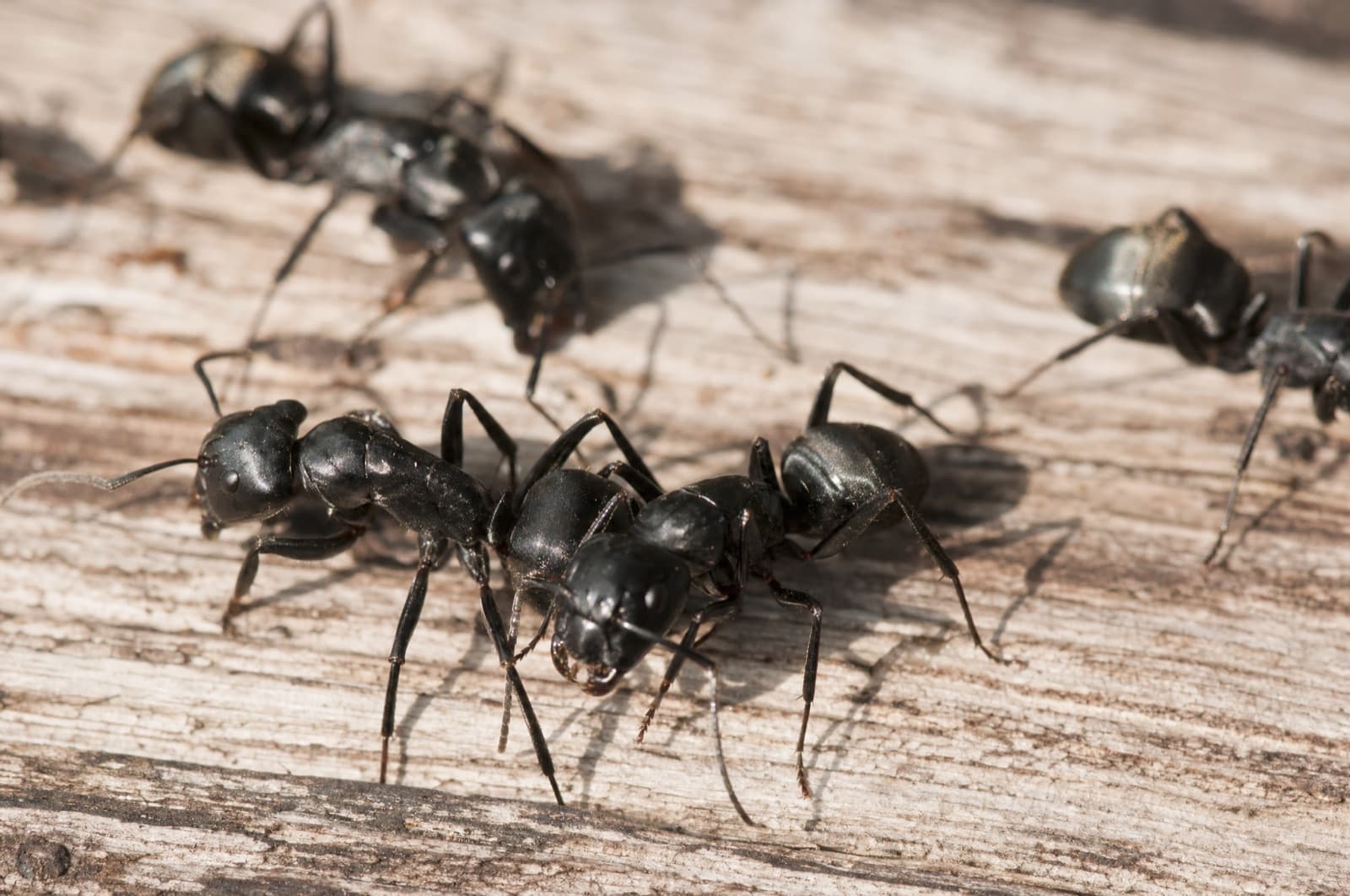
Eastern Black Carpenter Ant

Camponotus pennsylvanicus

Size
6–13 mm
Color
All matte black; polymorphic workers
Nest
Moisture-damaged wood (wall voids, sill plates, window headers, hollow trees)
Aggression
NH Prevalence

Distinguishing feature

Year-1 urgency 5/5. Damage compounds at 3–5× per year; colony will NOT self-resolve. UNH Extension: confirmed carpenter ant = call within 2 weeks at minimum, same-day if frass or sounds present. Cost-of-delay: Year-1 treatment $250–$500 vs Year-5 remediation $4,000–$11,500+.

Species 2

Pharaoh Ant

Monomorium pharaonis

Size
1.5–2 mm
Color
Pale yellow to honey-amber; dark gaster tip
Nest
Heated voids near moisture sources (water heaters, dishwashers, electrical outlets)
Aggression
NH Prevalence

Distinguishing feature

Year-1 urgency 5/5 institutional / 4/5 residential. STOP all spraying immediately — every spray event triggers budding, multiplying satellite nests 2–3×. Call today if pale yellow ants appear in 2+ rooms. Professional-only coordinated IGR bait is the only effective treatment (Feng, Choe & Lee 2025).

Species 3

Odorous House Ant

Tapinoma sessile

Size
2.4–3.3 mm
Color
Dark brown/black; no visible node; faint sheen
Nest
Polydomous supercolonies spanning multiple indoor and outdoor sub-nests; wall voids, insulation, under sinks
Aggression
NH Prevalence

Distinguishing feature

Year-1 urgency 3/5. Repellent sprays cause budding to ~30% more nests (Buczkowski & Bennett 2008); no structural damage but strong nuisance. Crush one for rotten-coconut ID. Call if trail appears in 2+ rooms or scattering observed after spray. Cost-of-delay: 1.5–2× per spray event.

Species 4

Pavement Ant

Tetramorium immigrans

Size
2.5–4 mm
Color
Dark brown to black; parallel striations (rugae) on head and thorax
Nest
Outdoor under pavement, foundations, sidewalks; occasional indoor wall voids near heat
Aggression
NH Prevalence

Distinguishing feature

Year-1 urgency 2/5. Cosmetic and contamination concerns only; responds well to standard perimeter IPM and sweet bait. Call only if trail persists >14 days after correctly applied bait or appears in a second room. Cost-of-delay: ~1× (stable population).

Species 5

Citronella Ant

Lasius claviger (and related species)

Size
3–4 mm (workers); 8–9 mm (queens)
Color
Yellow to light brown; workers emit citronella/lemon odor when crushed
Nest
Outdoor in soil, under slabs, around tree roots; indoor presence is alates only during swarm flights
Aggression
NH Prevalence

Distinguishing feature

Year-1 urgency 1/5. Outdoor colony; indoor presence is alates (winged reproductives) only — resembles termite alate to some homeowners. Self-resolves in 1–2 weeks. Do not spray — vacuum alates and seal foundation cracks. Call only if termite misidentification is suspected.

Species 6

Acrobat Ant

Crematogaster cerasi / C. lineolata

Size
2.5–4 mm
Color
Bicolored: reddish-brown head/thorax, dark gaster; raises heart-shaped abdomen when disturbed
Nest
Moist or decayed wood, foam board insulation, previously insect-damaged wood
Aggression
NH Prevalence

Distinguishing feature

Year-1 urgency 3/5; rises to 4/5 if found in foam insulation. A moisture indicator — their presence signals a water problem. Requires drill-and-dust if wall nest suspected; non-repellent bait ineffective for wall voids. Cost-of-delay: 1.5×/year if tied to active moisture damage.

NH Risk Heat Map

Carpenter ant pressure by NH county

Southern NH counties have baseline escalation pressures driven by housing age, moisture exposure, and proximity to forest. These baselines affect how aggressively you should respond to initial signs.

RockinghamExtreme riskHillsboroughExtreme riskMerrimackHigh riskStraffordHigh riskCheshireHigh riskManchester HQ
Low
Moderate
High
Extreme

Rockingham County

Extreme

Coastal Atlantic strip (Zone 6b) has the longest annual foraging window in NH; combined with dense suburban housing and proximity to coastal moisture, Rockingham leads the state in carpenter ant call volume. Single warm-season sighting warrants proactive inspection.

Hillsborough County

Extreme

Highest-density service county (Manchester, Nashua, Bedford, Derry). Pre-1950 housing common in Manchester's West Side and historic districts — balloon-frame construction with stud-bay voids is high-risk carpenter ant habitat. Any frass sighting in Manchester warrants same-week professional evaluation.

Merrimack County

High

Concord metro area; significant forested buffer zones adjacent to residential neighborhoods create year-round parent-colony reservoir. Interior Zone 5b–6a: ant season slightly shorter than Rockingham/Hillsborough but spring emergence rapid once temperatures cross 50°F.

Strafford County

High

Dover, Rochester, and Durham university district. High moisture exposure from Cocheco and Salmon Falls River watersheds increases moisture-damaged wood occurrence. College housing stock and older mill-town buildings have elevated structural risk.

Cheshire County

High

Oldest housing stock among service counties — 27.3% of units pre-1940 — meaning balloon-frame construction, plaster-on-lath wall cavities, and deteriorating wood members are disproportionately common. Per-home carpenter ant risk is the highest in the service area despite lower call volume.

Bottom line — In Hillsborough and Rockingham counties, the baseline is high enough that any indoor large black ant sighting warrants a proactive professional inspection rather than a DIY-first approach.

Visual Identification

6 DIY-Failure Signs You Can Photograph Before Calling

Each of these signs is a specific trigger from the 10 DIY-failure indicator list. If you observe any one of them, the decision tree produces a CALL-PRO-TODAY verdict.

Sign 1

Frass at an Electrical Outlet

Sawdust-like material at the base of a wall outlet or beneath a baseboard, especially when it contains tiny dark insect-body parts (legs, antennae), is the most definitive sign of an active carpenter ant satellite nest. The colony ejects excavated debris from kickout holes; reappearing piles within 72 hours of sweeping means active excavation is ongoing. This is a Tier 3 EMERGENCY — the nest is inside the wall cavity, well beyond any surface-applied DIY product.

Sign 2

Ants in New Room After Spraying

If you sprayed along a trail in the kitchen and three days later ants appear in the bathroom or laundry room, you have triggered budding or colony scattering. In pharaoh ants and odorous house ants, repellent pyrethroid sprays cause brood and secondary queens to relocate to new wall-void sites. In carpenter ants, the parent colony is unaffected by indoor surface treatment — a new satellite has simply activated. Additional spraying worsens both outcomes. Stop all DIY and call within the week.

Sign 3

Large Black Ant Indoors in January

A single large black carpenter ant found on a baseboard or countertop in January or February is the highest-confidence DIY-failure signal in New Hampshire. Workers are physiologically inactive below 41°F — they cannot forage outdoors at that temperature. An indoor sighting in winter can only mean the parent or satellite colony is inside the heated envelope of the home. UNH Cooperative Extension's recommendation is unambiguous: 'If that's the case, the UNH Cooperative Extension recommends you hire a professional.'

Sign 4

Pale Yellow Ants at a Bathroom Outlet

Tiny pale yellow or honey-colored ants — smaller than a sesame seed — trailing near a water heater, dishwasher, bathroom outlet, or heating pipe are almost certainly pharaoh ants. The critical warning: any aerosol or pyrethroid spray applied to this trail will trigger sociotomy, splitting the colony into 2–3 or more satellite nests within the structure. The more rooms you see them in, the more spray events have already occurred. STOP all DIY immediately and call for a professional coordinated bait deployment.

Sign 5

Winged Swarmer on a Windowsill

A winged carpenter ant found indoors on a windowsill or light fixture in spring — identifiable by large front wings clearly bigger than rear wings, elbowed antennae, and body over 13 mm — means the parent colony is at least 3–5 years old and large enough to produce reproductives. Mature colonies contain 2,000–3,000+ workers and have typically been excavating wood for multiple seasons before producing swarmers. This is a CALL-PRO-TODAY verdict regardless of whether you've seen frass.

Sign 6

Drywall Pinhole Cluster with Frass Dust

A cluster of tiny slit-like holes in drywall, particularly around window casings, door frames, or ceiling-wall joints, accompanied by fine sawdust-like material on the floor or sill below, indicates a carpenter ant colony has been excavating wall-void wood for multiple seasons. The holes are irregular and slit-shaped (2–3 mm), not perfectly round. This pattern typically indicates a Year 3 or later colony with 500–2,000 workers. Structural repair costs are likely already accruing.

Decision Tree

Should you call a pro?

Run through these four questions in order. Each answer routes you to the correct verdict — do not skip or override the output.

Have you actually SEEN live ants, or only signs (frass, sounds, wood damage, wings on windowsill)?

Treatment Effectiveness

How long does each method actually last?

Pavement ant — sweet bait + perimeter spray

$20–$40 · DIY

14–21 days

~80% DIY success rate for single-trail pavement ant in kitchen. Responds to standard perimeter pyrethroid spray unlike pharaoh or OHA. Escalate if trail persists >14 days.

Little black ant — dual sweet + grease bait

$25–$45 · DIY

14–21 days

~75% DIY success for single-trail little black ant. Dual sweet-and-grease bait matrix reaches different dietary phases. Escalate at 14-day mark if trail persists.

OHA single-room — non-repellent borate bait gel only

$25–$50 · DIY

6–10 weeks

~60% DIY success in a single room with non-repellent bait only. Repellent sprays contraindicated — trigger budding per Buczkowski & Bennett (2008). Escalate immediately if trail appears in second room or activity shifts after any spray.

Carpenter ant — indoxacarb gel + abamectin granules

$55–$140 · DIY

2–6 weeks

55% field success — the Hansen (2008) ICUP benchmark across 7 commercial baits on Camponotus modoc. This is the best achievable DIY result with correct product selection. 45% of homeowners who do everything right still end up needing professional treatment.

Pro — fipronil 0.06% non-repellent perimeter + interior bait

$250–$500 · Professional

6–12 months with 30-day follow-up

Professional-grade fipronil (Termidor SC / Taurus SC at 0.06%) is the only chemistry with documented colony-elimination efficacy for carpenter ants. Transferred trophallactically back to nest; kills colony including queens inaccessible to DIY surface treatments.

Pharaoh ant — professional coordinated IGR bait program

$300–$600+ · Professional

3–6 months

DIY has 0% success if sprays have already been applied (budding already triggered). Pro-only IGR bait (hydramethylnon or indoxacarb) deployed across all satellite locations simultaneously is the only recovery pathway. Each spray event before pro intervention extends eradication timeline by 6–12 weeks (Feng, Choe & Lee 2025).

Prevention Playbook

How to stop carpenter ants from coming back

1

Eliminate moisture first — repair leaking pipes, fix gutter drainage, and seal ice-dam entry points before ant season; UNH FS 62 confirms moisture-damaged wood is the primary carpenter ant attractant and DIY without fixing moisture has near-zero long-term efficacy

2

Seal foundation penetrations with silicone caulk or copper mesh before April — any gap at utility entry points, window casings, or pipe sleeves is a primary carpenter ant and pharaoh ant entry route

3

Remove firewood, lumber, and debris piles stored within 20 feet of the foundation — these are parent-colony habitat that converts to satellite-nest entry pressure as the season progresses

4

Inspect crawl space and basement sill plates in March before ant emergence — probe with a screwdriver for soft or hollow wood that indicates moisture damage and pre-existing galleries

5

Replace outdoor landscape lighting with yellow LED bulbs (wavelengths >550 nm) — white and blue-spectrum lights attract swarmer alates during May–July flight season and concentrate them at entry points

6

Trim tree limbs and shrubs away from the roofline by at least 18 inches — carpenter ants use branch-to-roof contact as a primary highway between outdoor parent colonies and interior satellites

Local Context

The NH Winter-Sighting Rule: Your Highest-Confidence Escalation Signal

UNH Cooperative Extension Pest Fact Sheet 62 (Eaton & Maccini 2016) is unambiguous: 'If you see large ants inside your house in January or February… winter activity typically means you have a nest inside your home. If that's the case, the UNH Cooperative Extension recommends you hire a professional.' Carpenter ant workers enter diapause and are physiologically unable to forage below 41°F — any indoor sighting in midwinter can only mean the colony has established a heated interior nest. This rule applies specifically to NH's climate and does not transfer to southern states where carpenter ants forage year-round.

Key Local Data

New Hampshire's median home build year is 1982, and approximately 22% of the housing stock predates 1950 — the precise age range where moisture-compromised framing and deteriorating sill plates create prime carpenter ant habitat in heated wall voids.

Common Questions

Frequently Asked

NH-Licensed Ant Exterminators

You've Already Waited Long Enough

If you've found this page, you've already tried DIY or you're seeing signs that don't resolve on their own. Our southern NH team delivers same- or next-day inspections with a written treatment plan and 30-day follow-up.

NH Pest Control License #782664 Family-owned and operating in Manchester since 2017 Free inspection with written report — no pressure estimate 30-day follow-up inspection included with every treatment