
Skip to content
APS
Anchor Pest Services Field Team · NH-Licensed Pest Control Operators (License #782664)
Reviewed by Tim Boyle

Ant Infestation Signs: How to Tell What Species You Have and How Bad It Is

Yes — 12 distinct signs, severity by species

Ant infestation signs in NH range from severity 1 (single scout, monitor only) to severity 5 (frass pile, audible wall sounds, indoor swarmers — call today). The five most common NH home species are carpenter ants (large >6 mm, structural risk, 5/5), odorous house ants (3 mm dark, coconut smell when crushed, polydomous trails, 3/5), pharaoh ants (1.5–2 mm pale yellow, multiple rooms, DIY sprays make worse — 5/5 in institutions), pavement ants (3 mm dark with rugose head grooves, 2/5), and acrobat ants (3 mm bicolored, raised gaster, 3/5). Argentine ants, tawny crazy ants, and fire ants are NOT established in NH [9]. Identify the species before treating — the wrong approach converts a manageable infestation into a multi-room problem.

At a Glance

  • Short Answer: 12 signs ranked by severity; the species determines whether DIY bait, STOP-spraying-call-pro, or same-day emergency call is the correct response
  • Key Fact: Tiny pale yellow ants in multiple rooms are likely pharaoh ants — DIY pyrethroid sprays experimentally increase colony splitting (sociotomy) at all colony sizes and all application rates [5]
  • NH Relevance: NH has 12 documented ant species; Argentine, tawny crazy, and fire ants are categorically NOT established in NH — most 'mystery ant' calls are pavement, OHA, or thief ants [9]
  • Action Needed: Identify the species by size, color, node count, and smell before treating — the wrong treatment costs more than no treatment
Key Statistics

Ant Infestation Signs: How to Tell What Species You Have and How Bad It Is — The Numbers

12

Documented infestation signs with severity scores

5

Most common NH home species

3–5×

Carpenter ant cost-of-delay multiplier per year

55%

DIY field success ceiling (Hansen 2008)

Deep Dive

The Full Picture

An ant infestation in an NH home involves one or more of five common species, each with distinct behavior, nest locations, and — critically — treatment requirements that are incompatible with each other 13. The 12 signs of ant infestation documented here are ranked by severity on a 1-to-5 scale adapted from the peer-reviewed decision logic in the NH household ant literature. The single most consequential error homeowners make is applying a repellent spray to a pharaoh ant or odorous house ant infestation — DIY pyrethroid aerosols at low application rates experimentally trigger colony splitting in pharaoh ants 5, and repellent disturbance triggers sub-nest relocation in OHA supercolonies 6. Neither of these species is appropriate for DIY spray treatment under any circumstances.
01

The 12 infestation signs ranked by severity

Starting from lowest severity: (1/5) Single ant sighting, no trail — routine outdoor forager, monitor 7 days.
Read more(2/5) Defined trail along one baseboard — identify species, bait or exterior spray. (2/5) Indoor swarmers small and yellow (citronella ant) — vacuum and seal, no structural risk. (2/5) Sidewalk or driveway soil mounds with ants — pavement ant exterior nest, DIY-appropriate. (3/5) Trails in multiple rooms with coconut/blue-cheese smell when crushed — OHA polydomous, bait only. (3/5) Bicolored 3 mm ants with raised gaster and foam debris — acrobat ant, moisture problem present. (4/5) Trail of large (>6 mm) ants — carpenter or Formica, inspect for nest immediately. (4/5) Trails in multiple rooms simultaneously with no frass or sound — polydomous OHA very likely, bait only. (4/5) Tiny pale yellow ants in multiple rooms — pharaoh ant probable, STOP all spraying. (4/5) Ant sightings shifting room to room after a DIY spray — budding response 56. (5/5) Frass pile (sawdust + insect parts) at any outlet or baseboard — carpenter ant active excavation, call today. (5/5) Audible rustling in walls at dusk — carpenter ant satellite, call today. (5+/5) Winged large black swarmers plus frass in same week — mature colony emergency 12.
01
02

Species recognition by size class

Size is the fastest field diagnostic.
Read moreUnder 2 mm pale yellow: pharaoh ant (12-segment antenna, 3-segment club) or thief ant (10-segment antenna, 2-segment club — the single most reliable separator [p5§1.6]). Bait preference separates the two: pharaoh ants accept both sweet and greasy baits; thief ants strongly prefer grease and protein. 2–3 mm dark, concealed petiole, coconut smell when crushed: odorous house ant — the most common NH nuisance ant. 2.5–4 mm dark, two visible nodes, parallel head grooves, outdoor mounds: pavement ant 10. 3 mm bicolored, raised heart-shaped gaster when disturbed: acrobat ant [p5§1.5]. 3–4 mm yellow, lemon/citronella smell when crushed: citronella ant — nuisance swarm from underground nest, not a structural pest. Over 6 mm, evenly rounded single-curve thorax, single-node petiole: carpenter ant. Over 6 mm, two-curved (notched) thorax in lateral profile: Formica field ant — not a structural pest [p5§1.9].
02
03

The pharaoh ant STOP-SPRAY warning — why it matters

Feng, Choe & Lee 5 experimentally demonstrated that pyrethroid aerosols at low application rates significantly increase the probability of sociotomy (colony splitting) in Monomorium pharaonis colonies of all sizes.
Read moreEssential-oil-based insecticides caused budding at all colony sizes and all application rates. In practice, homeowners who spray at a pharaoh ant trail convert one nest into multiple satellite nests, each with its own queen, extending the eradication timeline by months and increasing treatment complexity. Pharaoh ants in NH are found exclusively indoors — they cannot survive New England winters outdoors 4. Their typical NH habitat is heated multi-unit housing, hospitals, and food-service facilities; residential pharaoh ant in NH suggests proximity to a multi-unit building. Coordinated multi-unit bait treatment is often required.
03
04

Odorous house ant polydomy and the spray failure mechanism

Odorous house ants in urbanized NH settings exhibit extreme polygyny (multiple queens per colony), polydomy (multiple nest sites), and supercolonial structure where neighboring 'colonies' are actually one interconnected supercolony 7.
Read moreBuczkowski & Bennett 6 demonstrated that repellent pyrethroid sprays trigger rapid sub-nest relocation — workers mobilize brood and queens to new void locations within the supercolony's territory. The homeowner sees ants in new rooms within 2–3 days of spraying, interprets this as 'the spray worked and pushed them out,' and continues spraying — each spray event expanding the OHA footprint further. The correct approach is non-repellent bait (borate/sugar gel or fipronil gel) placed near entry points, transferred trophallactically to all queens simultaneously.
04
05

Carpenter ant cost-of-delay: the 3–5× annual multiplier

Carpenter ant infestations compound annually at 3–5× the cost per year if untreated [p5§6.5].
Read moreA Year 1 satellite colony is small (10–20 workers in the true Year 1) with no visible damage — treatment cost is $250–$500. A Year 3 colony has expanded to 500–2,000 workers across multiple satellite nests with galleries extending through joists or sill plates — repair costs $400–$1,200 in framing damage on top of treatment. Year 5+ colonies of 2,000–6,000+ workers with structural framing damage may require contractor involvement — total costs $4,000–$11,500+. The 8–23× ROI on early intervention is the most compelling reason not to 'monitor and wait' after a confirmed frass sighting 18.
05
06

7 signs that DIY treatment has failed

From the p5 §7 documented failure indicators: (1) Colony scattering after a spray — ants disappear from the original trail and reappear in 2+ new locations within 1–3 days 56.
Read more(2) New satellite nests appearing 2–4 weeks after DIY treatment — same budding mechanism. (3) Ant trails reappearing after 14 days — sub-lethal bait dose or repellent avoidance; brood was not killed and colony is rebuilding. (4) Sightings shifting rooms — room A to room B — budding or microclimate response. (5) New frass piles appearing after DIY spray — carpenter ant satellite forced to expand into new excavation site. (6) Increased ant numbers visible after spraying — repellent products force colony evacuation, mobilizing brood and queens to new sites where they are more visible. (7) Multiple species now visible — disturbance of dominant species releases competitive pressure on subdominant species.
06
07

NH species that are NOT established — what callers report vs. what they have

Argentine ants (Linepithema humile) are not established in NH — their eastern U.S.
Read morenorthern limit is approximately 35° N latitude, and NH winter soil temperatures below 5°C for more than 8.5 consecutive days cause colony collapse 9. When NH homeowners describe 'fast-moving, aggressive small dark ants in a wide trail' that is 'swarming everywhere,' the species is almost always OHA — which develops supercolonial structure in urbanized areas and can appear to behave identically to Argentine ants at the colony level. Tawny crazy ants (Nylanderia fulva) are restricted to Gulf states. Red imported fire ants (Solenopsis invicta) are far south of NH's climatic range. Ghost ants (Tapinoma melanocephalum) are tropical and appear only transiently in heated commercial settings in New England. When a pest professional confirms one of these species in NH, it almost always reflects a misidentification — the correct species is OHA, thief ant, or (for fire ant look-alikes) a native Solenopsis.
07
08

When to call a professional and what to expect

The call-pro-today threshold is met by any of the following: frass pile (any size), audible rustling in walls, indoor winged swarmers (large black), tiny pale yellow ants in multiple rooms, large (>6 mm) ants in the bathroom, or trail re-establishing within one week after caulking and baiting [p5§6.3].
Read moreA licensed NH inspector provides: species identification and colony distribution mapping, moisture audit of suspect structural members, written treatment plan with product names and methods, and a 30-day follow-up with documented verification benchmarks. Free inspections are the standard model among southern NH operators. 2026 treatment costs: $250–$500 moderate one-time, $800–$1,200+ severe 18.
08

Bottom line — Identify the species before treating. Five species in NH require five different treatment approaches — the wrong DIY method costs more than no treatment at all, and for pharaoh ants, spraying converts a manageable infestation into a multi-room problem.

Self-Assessment Tool

How urgent is your situation?

Answer 3 questions to triage your ant infestation. This tool covers all NH species — not just carpenter ants.

1

What do the ants look like? Select the best match.

2

Which of these additional signs have you noticed?

3

Have you tried any spray or bait treatment?

NH Carpenter Ant Species

Carpenter ants aren't one species — they're four

Five species account for the vast majority of ant infestations in NH homes. Identification determines treatment — using the wrong method (especially DIY spray for OHA or pharaoh ants) multiplies satellite nests rather than eliminating them.

Species 1

Pavement Ant

Tetramorium immigrans

Size
2.5–4 mm
Color
Uniform dark brown to nearly black; parallel rugose grooves on head and mesosoma; slightly paler legs
Nest
Soil under and along pavement, driveways, retaining walls, foundation slabs; occasional indoor nest in wall voids near heat sources
Aggression
NH Prevalence

Distinguishing feature

Parallel fingerprint-like grooves (rugae) on the head capsule and thorax — visible with a hand lens. Two visible petiolar nodes. Famous for spring 'sidewalk wars' between neighboring colonies. DIY-appropriate: perimeter non-repellent spray + granular outdoor bait. Does not trigger budding with sprays [10].

Species 2

Odorous House Ant

Tapinoma sessile

Size
2.4–3.3 mm
Color
Uniform dark brown to nearly black, slightly shiny; petiolar node concealed beneath overhanging gaster
Nest
Outdoors under stones, mulch, landscape timbers; indoors in wall voids near plumbing, bathroom subfloors, insulation, behind baseboards
Aggression
NH Prevalence

Distinguishing feature

Crush-and-smell test: rotten coconut or blue-cheese odor when a worker is crushed between fingers — the dominant volatile is 6-methyl-5-hepten-2-one, ~100× more abundant than other compounds [8]. Petiole concealed beneath gaster (no visible bump between thorax and abdomen). Polydomous supercolonial structure in urban NH [7]. STOP-SPRAY WARNING: repellent sprays trigger sub-nest relocation, expanding the infestation [6].

Species 3

Black Carpenter Ant

Camponotus pennsylvanicus

Size
6–13 mm (polymorphic)
Color
Uniformly matte black; evenly rounded single-curve thorax profile; single-node petiole
Nest
Moisture-damaged structural wood, dead trees, stumps; wall voids in moisture-compromised stud bays — #1 structural ant pest in NH per UNH FS 62 [1]
Aggression
NH Prevalence

Distinguishing feature

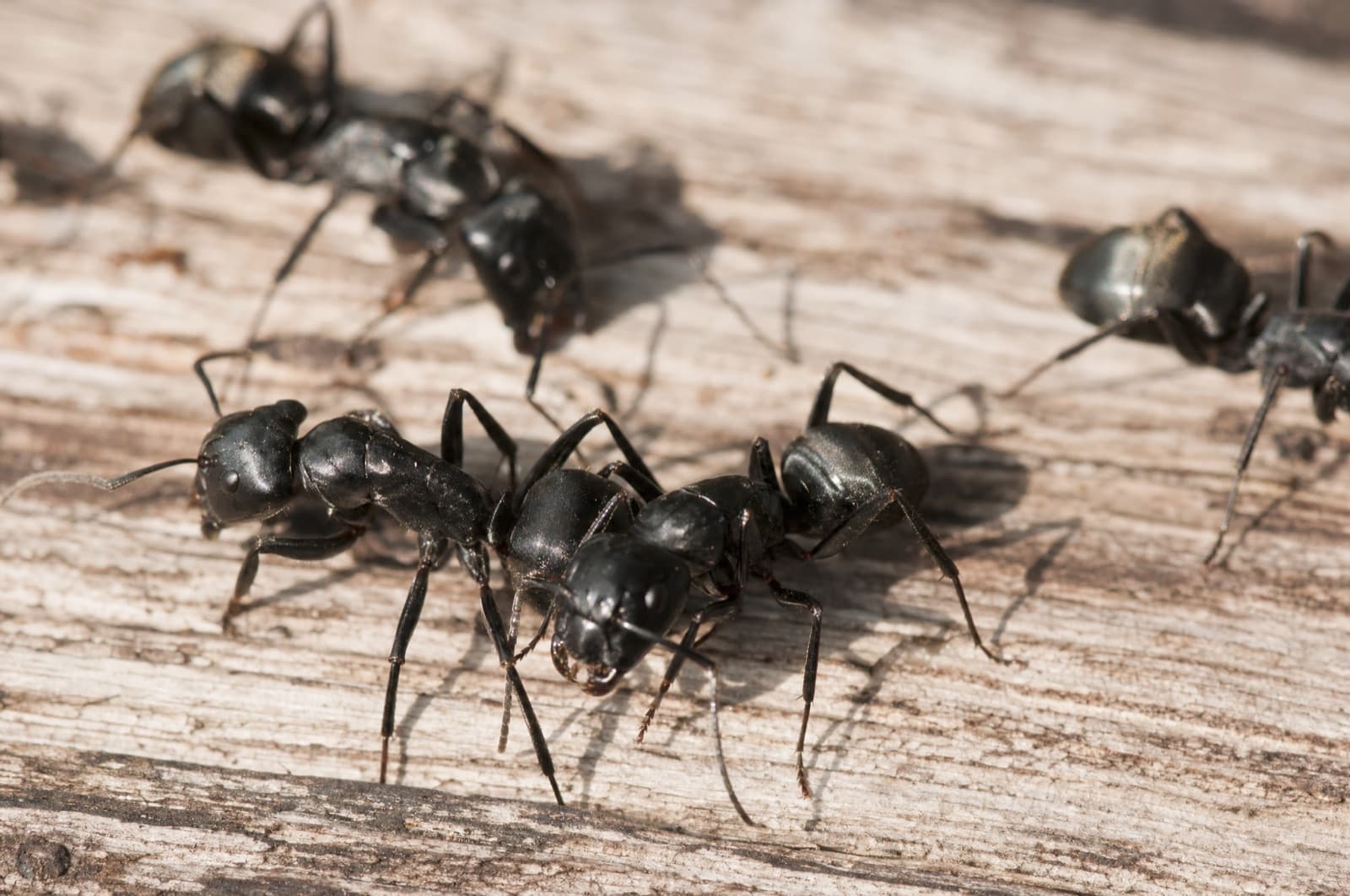
Largest common NH ant (6–13 mm). Evenly rounded thorax in lateral profile — if the thorax shows two humps or a notch, it is a Formica field ant, not a carpenter ant. Single-node petiole. Active ~15 minutes after sunset. Frass with insect body parts is diagnostic for active excavation. Winter indoor sighting = indoor nest, not a lost forager (UNH Maccini / Bodin 2016 [1][16]). Professional treatment strongly recommended.

Species 4

Pharaoh Ant

Monomorium pharaonis

Size
1.5–2 mm
Color
Pale yellow to light amber; slightly darker gaster tip; appears translucent
Nest
Strictly indoors in NH — wall voids near plumbing, electrical outlets, warm humid niches above 18°C. Concentrated in hospitals, multi-family housing, institutions [4]
Aggression
NH Prevalence

Distinguishing feature

STOP-SPRAY WARNING: DIY pyrethroid aerosols at low application rates significantly increase probability of colony splitting (sociotomy) in M. pharaonis colonies of all sizes [5]. 12-segment antenna with 3-segment club (vs. thief ant: 10-segment antenna, 2-segment club). Appears in persistent trails between heat sources — water heaters, hot-water pipes, electrical outlets. FDA 'Dirty 22' pathogen vector [11]. Call pro, do not spray.

Species 5

Acrobat Ant

Crematogaster cerasi

Size
2.5–3.5 mm
Color
Bicolored — head and gaster dark brown to black, mesosoma reddish-brown
Nest
Wall voids with foam insulation or water-damaged framing; old carpenter-ant galleries; arboreal — under bark, dead branches, hollow stems
Aggression
NH Prevalence

Distinguishing feature

Heart-shaped (cordate) gaster raised over the thorax in alarm posture when disturbed — the 'acrobat' behavior. Kicks out fine foam debris (not wood frass) at wall entry points. Bicolored body. Indicates moisture-damaged wood or foam insulation behind the wall. Pro drill-and-dust plus moisture remediation is the correct response.

Species 6

Thief Ant

Solenopsis molesta

Size
1.3–1.8 mm
Color
Pale yellow to honey-amber; similar to pharaoh ant but slightly smaller
Nest
Soil cracks, under stones, rotting wood, near other ant nests; indoors behind baseboards, in wall voids, beneath cabinets in kitchens
Aggression
NH Prevalence

Distinguishing feature

10-segment antenna with 2-segment club — the single most reliable separator from pharaoh ant's 12-segment antenna with 3-segment club [p5§1.6]. Strongly prefers grease and protein (peanut butter, bacon grease) over sugar — useful field diagnostic. Also on FDA 'Dirty 22' list [11]. DIY-appropriate with protein-based bait; confirm antenna segment count to avoid pharaoh ant misdiagnosis.

NH Risk Heat Map

Carpenter ant pressure by NH county

NH ant infestation pressure is not uniform — carpenter ant pressure follows housing age and moisture patterns, while pavement ant and OHA pressure follows urban density. Pharaoh ant activity is concentrated in heated multi-unit buildings.

HillsboroughExtreme riskRockinghamExtreme riskMerrimackHigh riskStraffordHigh riskCheshireHigh riskManchester HQ
Low
Moderate
High
Extreme

Hillsborough County

Extreme

Highest carpenter ant case volume in NH. Manchester and Nashua's pre-1960 housing drives structural infestations. OHA is the dominant small-ant pest in multi-unit properties. Pharaoh ant activity documented in Manchester multi-family housing [4].

Rockingham County

Extreme

Coastal humidity and dense tree cover drive extreme carpenter ant pressure. Salem, Derry, Auburn, and Hampton are highest-activity communities. Pavement ant is ubiquitous across the county's suburban corridors [10].

Merrimack County

High

Concord and surrounding towns carry high carpenter ant risk, especially in homes near the Merrimack River. OHA supercolonies are common in established residential areas with dense tree canopy [7].

Strafford County

High

Rochester and Dover wetland-adjacent properties face elevated carpenter ant pressure. Dover and Somersworth multi-unit housing has documented small-ant activity requiring coordinated building-level treatment [4].

Cheshire County

High

27.3% pre-1940 housing stock — highest among the five service counties — creates disproportionate carpenter ant risk from balloon-framed stud cavities. Keene's older housing has the longest track record of structural carpenter ant cases in the county.

Bottom line — If you live in Hillsborough or Rockingham County in a home built before 1970, assume elevated carpenter ant risk. If you live in any NH county in a multi-unit or heated building, pharaoh ant risk is relevant — and the consequence of a wrong DIY treatment is severe.

Visual Identification

Visual identification guide: 6 NH ant infestation signs

These are the most commonly photographed signs of ant infestations in NH homes — matched to species and severity.

Sign 1

Pavement ant mound at driveway edge

A small volcano-shaped soil mound at a driveway expansion joint, sidewalk edge, or patio crack — typically 2–4 cm across. Pavement ants push soil up through these cracks when constructing chambers below. Workers are 2.5–4 mm, dark brown, and display parallel rugae (fingerprint-like grooves) on the head. Severity 2/5 — nuisance but no structural damage [10].

Sign 2

Odorous house ant trail — multi-room pattern

A dense, fast-moving trail of small (2.4–3.3 mm) dark brown ants following a baseboard from one room toward another — kitchen to bathroom, or living room to bedroom. No frass, no sounds. Crush one ant: rotten coconut or blue-cheese odor confirms OHA. Do not spray — use non-repellent bait and watch for trail spreading to additional rooms [6].

Sign 3

Carpenter ant frass pile

Coarse sawdust-like debris mixed with dark insect body parts (legs, antennae, thorax fragments) piled at the base of a baseboard, outlet, or window trim. The insect parts distinguish carpenter ant frass from drywood termite frass, powderpost beetle dust, and construction sawdust. Any frass pile, no matter how small, rates 5/5 on the severity scale — call today [1][2].

Sign 4

Pharaoh ant trail at outlet — STOP-SPRAY warning

A dense, persistent trail of tiny (1.5–2 mm) pale yellow ants at an electrical outlet or along a hot-water pipe. If you see this pattern in more than one room, stop all spraying and call a professional. DIY pyrethroid aerosols at any application rate — including low rates — experimentally increase colony splitting in M. pharaonis colonies, multiplying satellite nests across the structure [5].

Sign 5

Acrobat ant alarm posture

A 3 mm bicolored ant (dark gaster, reddish-brown thorax) with its heart-shaped gaster raised up and over the thorax when disturbed — the characteristic 'acrobat' alarm posture. Acrobat ants kick out fine foam debris rather than wood frass at wall entry points. Their presence indicates moisture-damaged wood or excavated foam insulation behind the wall [3].

Sign 6

Indoor carpenter ant swarmers — 5/5 severity

Large (13–18 mm) winged black ants appearing indoors from late April through early July in NH indicate a mature colony with reproductive output — the colony has been established long enough to produce swarmers. Discarded wings on windowsills are equally diagnostic. This sign rates 5/5 on the severity scale and is a same-day or next-day call [1][2].

Decision Tree

Should you call a pro?

This 4-question branch is adapted from the p5 §8 decision logic for NH household ants. It routes homeowners to one of four verdicts: MONITOR, DIY-FIRST, DIY-FAILED-CALL-PRO, or CALL-PRO-TODAY.

Have you actually SEEN live ants, or only signs (frass, sounds, damage)?

Treatment Effectiveness

How long does each method actually last?

DIY repellent pyrethroid spray (indoor)

$8–$20 · DIY

2–4 hours knockdown only

Kills only foragers (10–15% of colony) [19]. Triggers budding in OHA and pharaoh ants [5][6]. Active ingredient avoidance develops in carpenter ants. Not recommended for any NH household ant infestation as primary treatment.

DIY non-repellent bait (sweet borate or indoxacarb gel)

$30–$50 · DIY

2–3 weeks

Effective for OHA and pavement ants when colony is accessible to foragers. Hansen 2008: 55% field success ceiling for carpenter ants across 7 bait types [13]. Season-matched: carpenter ants switch between protein (spring) and sweet (summer) feeding phases.

Pro one-time treatment (inspection + non-repellent perimeter + baiting)

$250–$500 · Professional

90 days

Exterior fipronil 0.06% perimeter + interior species-specific baiting. Pro colony elimination 80–95% when parent nest located [p4§2]. Includes 30-day follow-up. Standard for OHA, pharaoh, pavement, and acrobat ant infestations [15].

Pro quarterly plan (4 visits/year with free re-service)

$480–$840/year · Professional

12+ months

Re-infestation rate under 5% at 12 months vs 10–20% for single one-time treatments. Four seasonal visits with moisture audits, species monitoring, and free re-service between scheduled visits [p4§4].

Prevention Playbook

How to stop carpenter ants from coming back

1

Eliminate moisture sources within 30 days of detection — carpenter ants preferentially nest in wood above 15% moisture content; fixing plumbing drips, ice-dam leaks, and caulk failures removes the primary habitat requirement [1].

2

Control aphid populations on landscape plants adjacent to the foundation — OHA supercolonies use honeydew as a primary carbohydrate source, and eliminating outdoor honeydew reduces indoor foraging pressure significantly [7].

3

Seal all foundation penetrations with silicone caulk or fire-rated foam — plumbing and electrical penetrations through the sill plate are the top carpenter ant entry points documented by UNH Extension [1].

4

Store firewood at least 20 feet from the foundation on elevated racks — firewood piles are documented parent-colony locations for carpenter ants; close storage is the most common source of NH carpenter ant infestations [1][2].

5

Trim all tree branches and shrubs to maintain 12 inches of clearance from siding — branches touching the house are highways for OHA, carpenter ant, and acrobat ant foragers [7].

6

Identify ants before treating — capture one in a clear jar and photograph it against a ruler. Treating pharaoh ants with sprays converts one nest into multiple satellite nests; the cost of a wrong DIY treatment can exceed the cost of a professional service [5].

Local Context

NH's Ant Fauna: What's Here and What's Not

New Hampshire has 12 documented ant species that regularly appear in homes. The species composition matters for treatment: Argentine ants are NOT established in NH — their northern climatic limit is approximately 35° N latitude, and NH winter soil temperatures below 5°C for more than 8.5 consecutive days cause colony collapse [9]. Tawny crazy ants are restricted to the Gulf states. Red imported fire ants are far south of NH's climatic range. When an NH homeowner reports an 'unknown ant,' the species is almost always pavement ant, OHA, thief ant, or a small Formica — identifiable by the diagnostic matrix above.

Key Local Data

Approximately 22% of NH homes were built before 1950, and the median owner-occupied home was built in 1982 — housing age that correlates directly with elevated carpenter ant satellite risk from moisture-compromised framing [18].

Common Questions

Frequently Asked

Sources & References

Where this data comes from

  1. [1]
  2. [2]
  3. [3]
  4. [4]
  5. [5]
  6. [6]
  7. [7]
  8. [8]
  9. [9]
  10. [10]
  11. [11]
  12. [12]
  13. [13]
Multi-Species Ant Specialists

Species ID first. Treatment second. Every time.

We identify the species before recommending treatment — because the wrong approach for pharaoh ants or OHA costs more than no treatment at all. Free inspection, written plan, 30-day follow-up.

NH Licensed Pest Control Operators — License #782664 Free inspection includes species ID and written treatment plan 30-day follow-up on all treatments included Family-owned and Manchester-based since 2017