
Anchor Pest Services Field Team · NH-Licensed Pest Control Operators (License #782664)
|Reviewed by Tim Boyle
What are the signs of carpenter ants in your house?
Yes — there are 11 distinct, learnable signs
The most reliable signs of carpenter ants in a house are large black or red-and-black ants 6–13 mm long, small piles of sawdust-like frass with tiny insect parts mixed in, slit-like 2–3 mm 'kickout' openings in wood (not perfectly round — round holes are beetles or termites), and discarded wings on windowsills in spring. Carpenter ants are most active at night, so trails leading toward bathrooms, kitchens, or under windows after dark are diagnostic. In New Hampshire, the dominant species is Camponotus pennsylvanicus, and outdoor swarmer flights typically occur late May through early July; indoor swarmers in January–March almost always indicate an established nest inside the structure.
At a Glance
Short Answer: 11 learnable signs — frass, kickout holes, swarmers, and large black ants foraging at night are the most reliable
Key Fact: Carpenter ant frass contains insect body parts; termite frass (less common in NH) does not — this single test rules out termites
NH Relevance: Southern NH humid summers + cedar/pine framing make Camponotus pennsylvanicus the #1 structural ant pest from May through September
Action Needed: Confirm the species, find the parent colony (usually within 100m), and treat before the colony exceeds 2,000 workers
Field Identification Card
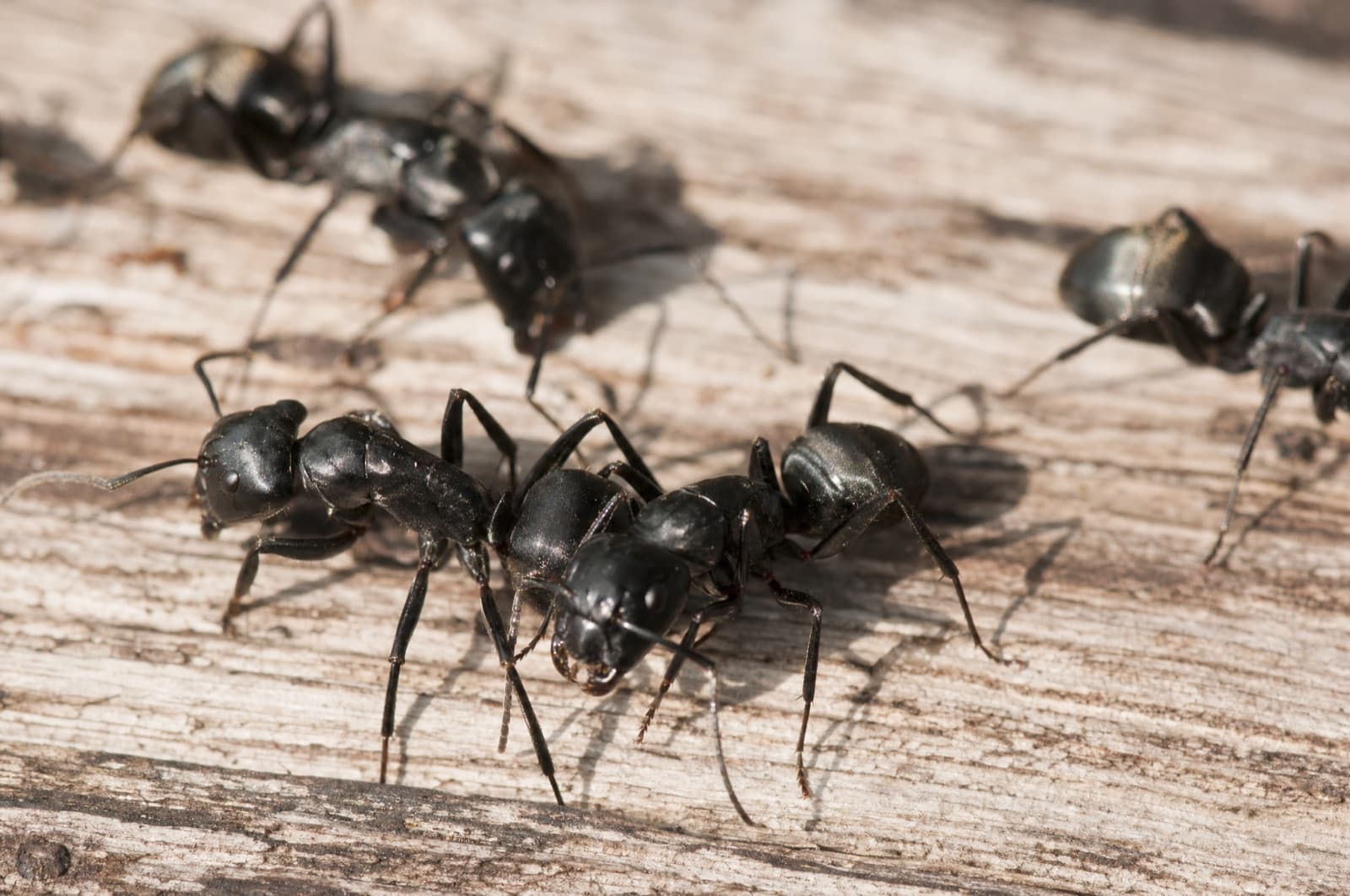
How to identify a carpenter ant worker
Camponotus pennsylvanicus (Black Carpenter Ant — most common in NH)
Anatomical DiagramSide view, labeled
Body Size
6–13 mm
Roughly the length of a grain of long rice — much larger than the 3 mm pavement and sugar ants most homeowners know
0510152025mm
Color
Workers are matte black; some species in NH (C. novaeboracensis) show reddish-brown thorax against black head and gaster
Diagnostic Features
1Single-node petiole (the bump between thorax and abdomen). Termites and pavement ants are different — this is the single most reliable diagnostic.
2Evenly rounded thorax in profile — no sharp humps or notches. If you see a notched thorax, it's a different ant.
3Elbowed (bent) antennae with a long first segment. Termite antennae are straight and bead-like.
4Heart-shaped head when viewed from above, with strong, visible mandibles used to excavate wood.
Key Statistics
What are the signs of carpenter ants in your house — The Numbers
13mm
Max worker length
11
Diagnostic signs to check
2,000+
Workers in a mature colony
3–6 yrs
Until visible damage
Side-by-Side Comparison
Carpenter Ant vs. Subterranean Termite
The most expensive mistake in DIY ant identification is confusing carpenter ants with termites. Both damage wood, but the treatments, urgency, and biology are completely different.
Subject A
Carpenter Ant
Camponotus pennsylvanicus
Body shape
Three distinct segments with a clearly pinched waist (petiole)
Antennae
Elbowed — sharp 90° bend after a long first segment
Wings (when present)
Two pairs of unequal size; front wings noticeably larger than hind
Very common throughout NH; #1 wood-destroying insect in the state
Typical treatment cost
$150–$450 for inspection + treatment (one-time)
Subject B
Subterranean Termite
Reticulitermes flavipes
Body shape
Uniform, tube-shaped body with no visible waist
Antennae
Straight, bead-like (looks like tiny pearls on a string)
Wings (when present)
Two pairs of equal size and shape; veins look like fishnet
What they do to wood
Eat wood. Pack tunnels with mud, never eject sawdust.
NH prevalence
Present in southern NH but uncommon; far less destructive than carpenter ants here
Typical treatment cost
$1,500–$3,500+ for full subterranean treatment
Bottom line — Frass on the floor = carpenter ants. Mud tubes on the foundation = termites. If you see one and not the other, you've already 95% solved the ID problem.
Deep Dive
The Full Picture
Carpenter ants leave a remarkably consistent trail of evidence. If you know what to look for, you can usually self-diagnose in under five minutes — and you can usually do it years before structural damage becomes visible. The 11 signs below are listed in rough order of diagnostic reliability 1.
01
1. Large, dark ants — usually 6–13 mm long
Workers of Camponotus pennsylvanicus measure 6–13 mm; minor workers are smaller, majors are the visible ones 2.Read moreIf the ants in your kitchen are noticeably bigger than what you remember from previous summers, that size jump is itself a sign. Tiny black ants in the kitchen are almost certainly pavement or sugar ants — a completely different (and far less destructive) pest.
01
02
2. Frass — sawdust mixed with insect parts
Carpenter ant frass is the single most reliable sign 3.Read moreWorkers eject galleries' debris through kickout holes, producing small piles of what looks like sawdust mixed with what appears to be cigarette ash or pepper flakes. The 'pepper' is fragments of dead ants and pupal cases — and that's what distinguishes carpenter ant frass from drywood termite frass, which contains no insect parts.
02
03
3. Kickout holes — slit-like 2–3 mm openings (not round)
Look in basement sill plates, around window trim, behind appliances, and under sinks.Read moreCarpenter ant kickout openings are slit-shaped and irregular, roughly 2–3 mm wide — sized just larger than a major worker. They are NOT round: perfectly circular holes indicate powderpost beetles (0.8–3.2 mm round) or drywood termites (<2 mm round), not carpenter ants. The slit + coarse fibrous frass with insect parts below is the diagnostic combination 3.
03
04
4. Discarded wings on windowsills (April–June)
Spring swarmer flights are when colonies reproduce 4.Read moreWinged reproductives leave the parent colony, mate, and shed their wings. Finding 5–20 identical translucent wings on a windowsill in May is almost diagnostic — and finding them indoors means the parent colony is also indoors.
04
05
5. Trails leading toward wood, water, or food
Carpenter ants follow pheromone trails.Read moreAfter dark, watch for single-file lines moving along baseboards, under cabinets, or up wall corners. Map where they go — the trail head is often within a few feet of the nest.
05
06
6. Hollow-sounding wood
Tap wooden trim, sill plates, and visible framing with the handle of a screwdriver.Read moreSound is your friend: solid wood resonates with a sharp thud; gallery-riddled wood sounds dull and slightly hollow. Compare adjacent areas to your ear's baseline.
06
07
7. Faint rustling sounds inside walls
Mature colonies (1,500+ workers) make audible sound — described by entomologists as 'cellophane rustling.' Best heard with an ear to the wall on a still night.Read moreNot every infestation will be loud enough to hear, but if you do hear it, the colony is well-established.
07
08
8. Moisture damage near the nest
Carpenter ants need moisture.Read moreHospitable nest sites are wet — leaky roof valleys, condensation around windows, plumbing leaks under sinks, moisture behind a chronically wet bathroom wall 5. Fixing the moisture problem is itself a major piece of any sustainable solution.
08
09
9. Visible damage when wood is opened
If you cut into infested wood, galleries look sanded smooth — like a piece of art.Read moreTermite galleries by contrast are rough and packed with mud. The texture difference is unmistakable once you've seen both.
09
10
10. Foraging at night, especially kitchens
Carpenter ants are crepuscular-nocturnal — most active from sundown through midnight.Read moreIf you flip a kitchen light at 11pm and see dozens of large black ants on counters or near the sink, you have an active foraging population 2.
10
11
11. Parent colony in nearby stumps, logs, or trees
Roughly 70% of indoor satellite nests have a parent colony within 100 meters of the home 6.Read moreInspect tree stumps, decaying logs, and dead branches close to the foundation. Finding the parent colony dramatically improves treatment outcomes — and is something a professional inspection should always look for.
11
Bottom line — If you've matched 3 or more of these 11 signs, you have an active infestation — almost certainly with at least one indoor satellite nest. Time matters: treatment is dramatically cheaper at Year 2 than at Year 5.
Damage Progression
What carpenter ants do to a home over time
Carpenter ant colonies grow predictably. The earlier you find them, the cheaper the fix.
Colony Size
10–20 workers
Damage Extent
Single excavated chamber the size of a quarter; no visible damage
Repair Estimate
$0
A mated dealate queen seals herself into moisture-damaged wood (typically a sill plate, deck post, window header, or attic rafter where wood moisture content is above ~15%) and metabolizes her flight muscles to feed the first brood [1]. The colony is fragile — most incipient queens fail at this stage — and detection is essentially accidental. No frass, no kickout slit yet.
Self-Assessment Tool
How urgent is your situation?
Answer 3 quick questions and we'll tell you whether to monitor, treat, or call a pro today.
1
How often are you seeing carpenter ants in the house?
2
Have you seen frass (sawdust-like piles with insect parts)?
3
What about wood damage signs?
NH Carpenter Ant Species
Carpenter ants aren't one species — they're four
New Hampshire hosts at least four Camponotus species — most homeowners never realize this, and pest companies often don't distinguish between them despite different treatment optimizations.
Species 1
Black Carpenter Ant
Camponotus pennsylvanicus
Size
6–13 mm
Color
Uniformly matte black
Nest
Moisture-damaged structural wood, dead trees
Aggression
NH Prevalence
Distinguishing feature
The default carpenter ant in NH. Uniformly black; large workers can reach 13 mm. The species behind 80%+ of NH structural carpenter ant cases.
Species 2
New York Carpenter Ant
Camponotus novaeboracensis
Size
6–11 mm
Color
Reddish-brown thorax, black head and gaster
Nest
Dead/dying hardwoods, occasionally homes
Aggression
NH Prevalence
Distinguishing feature
The two-tone coloration is unmistakable. Less likely to nest in structures than pennsylvanicus, but does cause damage when it does.
Species 3
Red Carpenter Ant
Camponotus ferrugineus
Size
5–10 mm
Color
Reddish-orange with darker abdomen
Nest
Mostly outdoor — logs, stumps, woodland soil
Aggression
NH Prevalence
Distinguishing feature
Mostly forest-dwelling. Rarely a structural pest in NH but a common find on forest hikes and woodland properties.
Species 4
Smaller Carpenter Ant
Camponotus nearcticus
Size
4–7 mm
Color
Dark brown to black
Nest
Twigs, branches, occasionally home siding
Aggression
NH Prevalence
Distinguishing feature
Smaller than the others — easily mistaken for pavement ants. Less destructive but can establish satellite nests in attics or eaves.
Colony Size Calculator
How big is your colony?
A rough heuristic for translating what you see into how many ants are actually in the colony. Use it for triage — not as a substitute for inspection.
Calibrated from: Adapted from Hansen & Klotz, 'Carpenter Ants of the United States and Canada' (Cornell University Press, 2005)
Ants/day
1–5
Interpretation
Likely scouts from a nearby outdoor colony. Most homeowners overreact to this stage.
Colony
<200 workers
Minimal
Ants/day
5–20
Interpretation
Established outdoor colony with foragers regularly entering. Satellite nest may be forming.
Colony
200–800 workers
Moderate
Ants/day
20–50
Interpretation
Likely satellite nest inside the structure. Frass piles should be visible somewhere if you look.
Colony
800–2,500 workers
Major
Ants/day
50+
Interpretation
Mature colony with multiple satellite nests. Structural risk is significant. Professional treatment required.
Colony
2,500–10,000+ workers
Severe
NH Risk Heat Map
Carpenter ant pressure by NH county
Carpenter ant pressure is not uniform across NH — humid southeastern counties with older wood-frame housing stock carry the highest risk.
Low
Moderate
High
Extreme
Hillsborough County
Extreme
Highest case volume statewide. Older wood-frame housing in Manchester and Nashua + humid summers = ideal conditions.
Rockingham County
High
Coastal humidity and dense tree cover make this NH's second hotspot. Salem, Derry, and Hampton see heavy seasonal pressure.
Merrimack County
High
Concord and surrounding towns have established populations. Older homes near the Merrimack River face elevated risk.
Strafford County
Moderate
Rochester and Dover see moderate carpenter ant activity, especially in homes near wetlands.
Cheshire County
Moderate
Lower density but high tree cover means most cases involve nearby parent colonies in stumps or woodpiles.
Bottom line — If you live in Hillsborough or Rockingham County and your home was built before 1990, assume carpenter ants are within 100 meters of your foundation. The question is whether they've found a moisture-damaged entry point.
Visual Identification
What each sign actually looks like
The 6 most reliable visual signs of carpenter ants in a NH home. Real photos coming in the next update; illustrations match what you'd see in person.
Sign 1
Frass piles
Small piles of what looks like sawdust mixed with tiny black insect parts. Always near a kickout hole. The presence of insect parts is what distinguishes carpenter ant frass from drywood termite frass.
Sign 2
Kickout holes
Tiny round openings (6–8 mm) that workers use to push excavated debris out of the gallery. Look in baseboards, around window trim, and on basement sill plates.
Sign 3
Smooth galleries
When wood is opened up, carpenter ant galleries look polished and smooth — almost sanded. Termite galleries are rough and packed with mud.
Sign 4
Foraging workers
Large (6–13 mm) black ants moving in single-file lines, especially at night. They favor sweets and protein — look for trails toward kitchens or pet bowls.
Sign 5
Swarmers (reproductives)
Winged carpenter ants appearing indoors April–June are diagnostic of an indoor nest. Discarded wings on windowsills are even more reliable.
Sign 6
Damaged wood
Wood that sounds hollow when tapped, visible cracks revealing dark galleries, or trim that flexes under finger pressure. Common in window frames, sill plates, and door jambs.
Decision Tree
Should you call a pro?
Three questions, branching paths. End on a clear recommendation in under 30 seconds.
Have you actually seen carpenter ants (large black ants 6+ mm) in the house?
Transparent Cost Calculator
What carpenter ant treatment actually costs
Most pest control sites refuse to publish prices. We do — calibrated against actual NH market rates for 2026. Plug in your situation, get a real range.
Home size
Infestation severity
Treatment type
Estimated cost
$115–$230
One-time treatment
Single inspection + targeted treatment. Best for confirmed light infestations.
Estimates are calibrated against 2026 southern NH market rates. Your exact quote depends on inspection findings — Anchor Pest Services provides free inspections with no obligation.
Treatment Effectiveness
How long does each method actually last?
DIY perimeter spray (over-the-counter)
$15–$30 · DIY
2–3 weeks
Kills visible foragers but rarely reaches the queen. Often scatters colony and makes pro treatment harder.
Borate bait stations (DIY, properly placed)
$25–$50 · DIY
4–6 weeks
Effective IF placed along active trails and given time. Slow but reaches the queen via trophallaxis.
Professional targeted treatment (one-time)
$150–$450 · Professional
6–12 months
Locates and treats parent + satellite nests directly. The standard treatment for confirmed indoor infestations.
Annual quarterly service plan
$400–$700/yr · Professional
Year-round
Preventive — best for properties with chronic carpenter ant pressure or older wood-frame homes.
Prevention Playbook
How to stop carpenter ants from coming back
1
Trim all tree branches, shrubs, and vines so nothing touches the house — these are the primary highways for foragers.
2
Eliminate moisture sources: fix leaks under sinks, in roof valleys, around windows. Carpenter ants need wet wood to nest.
3
Remove tree stumps, dead branches, and woodpiles within 50 feet of the foundation — these are the most common parent colony sites.
4
Seal cracks around utility penetrations, foundation corners, and window/door frames with caulk or expanding foam.
5
Store firewood off the ground and at least 20 feet from the house, ideally on a metal rack with airflow underneath.
6
Replace moisture-damaged sill plates and trim immediately — once wood softens, it's an open invitation.
Local Context
Why carpenter ants thrive in New Hampshire
NH's humid continental climate creates a near-perfect environment for Camponotus pennsylvanicus. Summer humidity routinely exceeds 70% from June through August, and the state's housing stock skews older — over 60% of NH single-family homes were built before 1990, when modern moisture barriers and continuous flashing weren't standard. Combine that with abundant softwood forest cover and a 4–6 month nesting window, and you have ideal carpenter ant conditions across the southern tier.
Key Local Data
Pest pros across southern NH report carpenter ants as the #1 wood-destroying insect call from May through October — more frequent than termites, powderpost beetles, and old-house borers combined.