
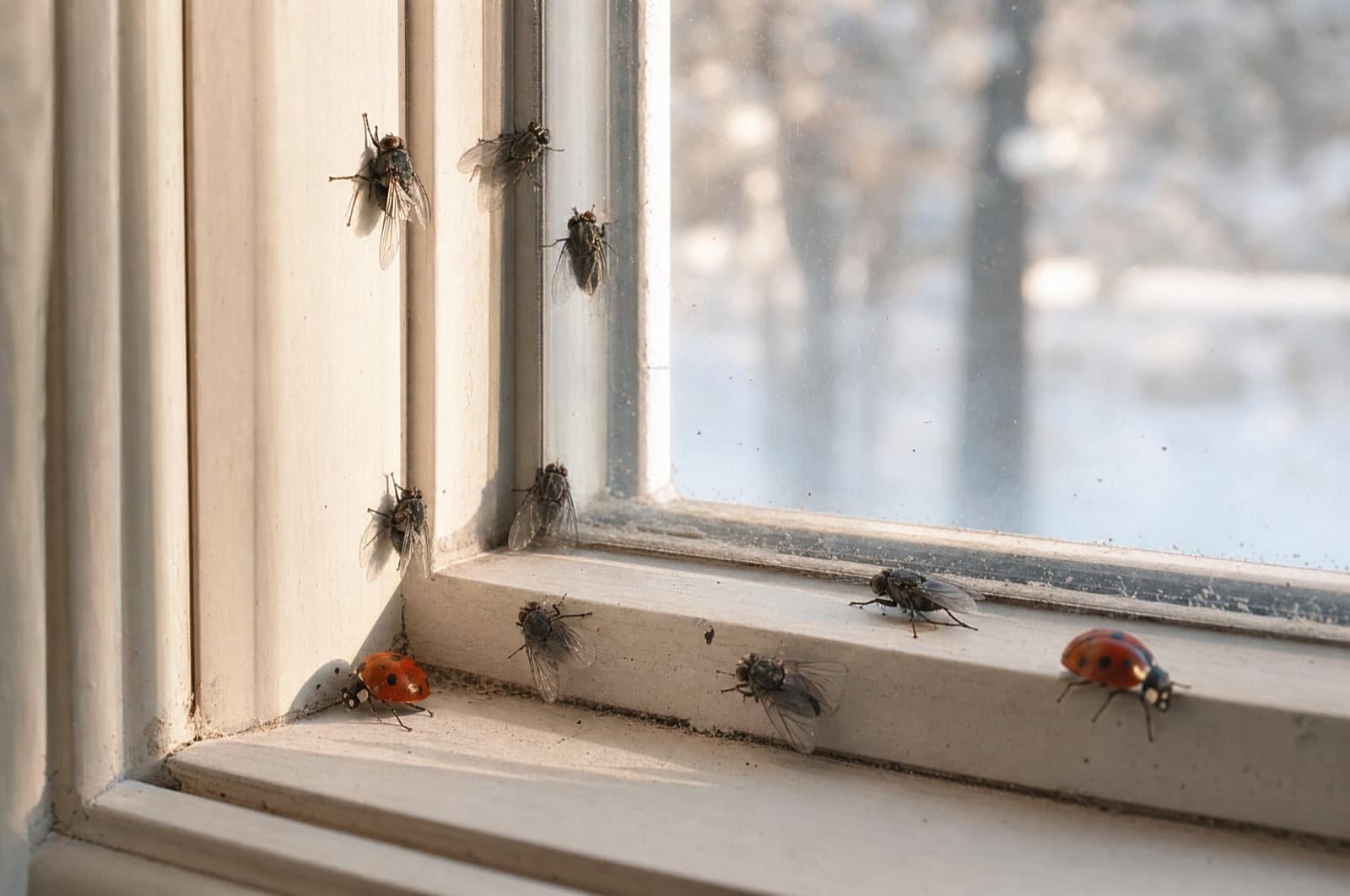
What Insects Become Active in Heated Homes?
Two distinct groups become active in a heated home: overwintering insects that simply wake from dormancy (cluster flies, lady beetles, boxelder bugs), and genuinely heat-loving species that thrive in warmth year-round (firebrats, and warmth-dependent pests like German cockroaches and pantry moths).
Mostly nuisance. The overwintering group is harmless once removed; firebrats and stored-product pests point to conditions — heat, moisture, infested food — worth correcting rather than an emergency.
At a glance
- The mechanism: Heat wakes them up
- Who fixes it: You
- The rest lives at: Fall Invaders FAQ — species identification
Two distinct groups become active in a heated home: overwintering insects that simply wake from dormancy (cluster flies, lady beetles, boxelder bugs), and genuinely heat-loving species that thrive in warmth year-round (firebrats, and warmth-dependent pests like German cockroaches and pantry moths).
Mostly nuisance. The overwintering group is harmless once removed; firebrats and stored-product pests point to conditions — heat, moisture, infested food — worth correcting rather than an emergency.
Heat doesn't spawn pests — it changes what you notice
The season and the building set the stage before the thermostat ever comes on. Here's the honest chain of events, spelled out.
What's really happening
For overwintering insects, dormancy breaks once harborage warms, and they move toward light and warmth. For firebrats, the relationship is different and stronger: they are genuinely heat-loving, thriving best above about 90°F, which is why they turn up near boilers, furnaces, heat vents, and hot-water pipes rather than merely waking there. Warmth-tolerant pests like German cockroaches breed continuously in a consistently heated building, and stored-product pests like the Indianmeal moth simply continue their life cycle undisturbed in a warm pantry.
Source:University of Maine Cooperative Extension— Silverfish and Firebrats — firebrats prefer temperatures of 90°F and higher, found near boilers, furnaces, hot-water tanks and pipes, heat vents
Is this an HVAC problem or a pest problem?
Who actually fixes it
You
For the overwintering group, vacuuming and pantry sanitation (discarding infested product, sealing food in airtight containers) handles the visible problem without chemicals.
German cockroach activity, or firebrats/stored-product pests that persist after cleanup → a pest_pro for identification and treatment; if firebrats persist because of a genuinely hot, humid mechanical room, addressing that condition may also involve an hvac_tech.
This hub owns the heating-system angle
General winter behavior, rodent control, and equipment-damage severity live in siblings that already earn them. Here's exactly where.
This page owns the 'active in the heated home' framing, including the firebrat-near-furnace angle that's genuinely specific to this hub. Species-by-species identification and the broader winter pest picture belong to our fall invaders and winter pest guides.
How this calibrates for NH
In New Hampshire's long heating season, mechanical rooms and utility spaces around furnaces and boilers stay warm enough — well into firebrats' preferred 90°F-plus range — to support year-round insect activity in that one spot even while the rest of the state sits far below freezing outside.
NH-licensed applicator #782664 (NHDAMF, RSA 430) · NEPMA member · family-owned since 2017.
Frequently asked
Sources(4)
- [1]University of Maine Cooperative Extension
Silverfish and Firebrats — firebrats prefer 90°F+; found near boilers/furnaces/heat vents/hot-water pipes
- [2]Virginia Cooperative Extension
Silverfish and Firebrats (ENTO-537) — firebrats prefer 86°F+; lay eggs only above 90°F
- [3]University of Maryland Extension
Indian Meal Moth — stored-product pest in pantries; homeowner sanitation
- [4]Purdue Extension
A Practical Guide to Cockroach Control (E-241) — German cockroach as a year-round indoor pest
Written & reviewed by
VerifiedDaniel Brady
NH-Licensed Pesticide Applicator · License #782664 (NHDAMF, RSA 430)
Daniel Brady is the New Hampshire–licensed applicator behind Anchor Pest Services, a family-owned pest control company serving the Manchester area since 2017.
Anchor Pest Services
Have a different pest question?
This one may be an HVAC call, not a pest job — but if you're facing something that is, we serve Southern New Hampshire with a free inspection and same-day service.
- NH-licensed applicator
- Same-day service
- Pet & family-conscious
NH License #782664 · No obligation · We answer in person