
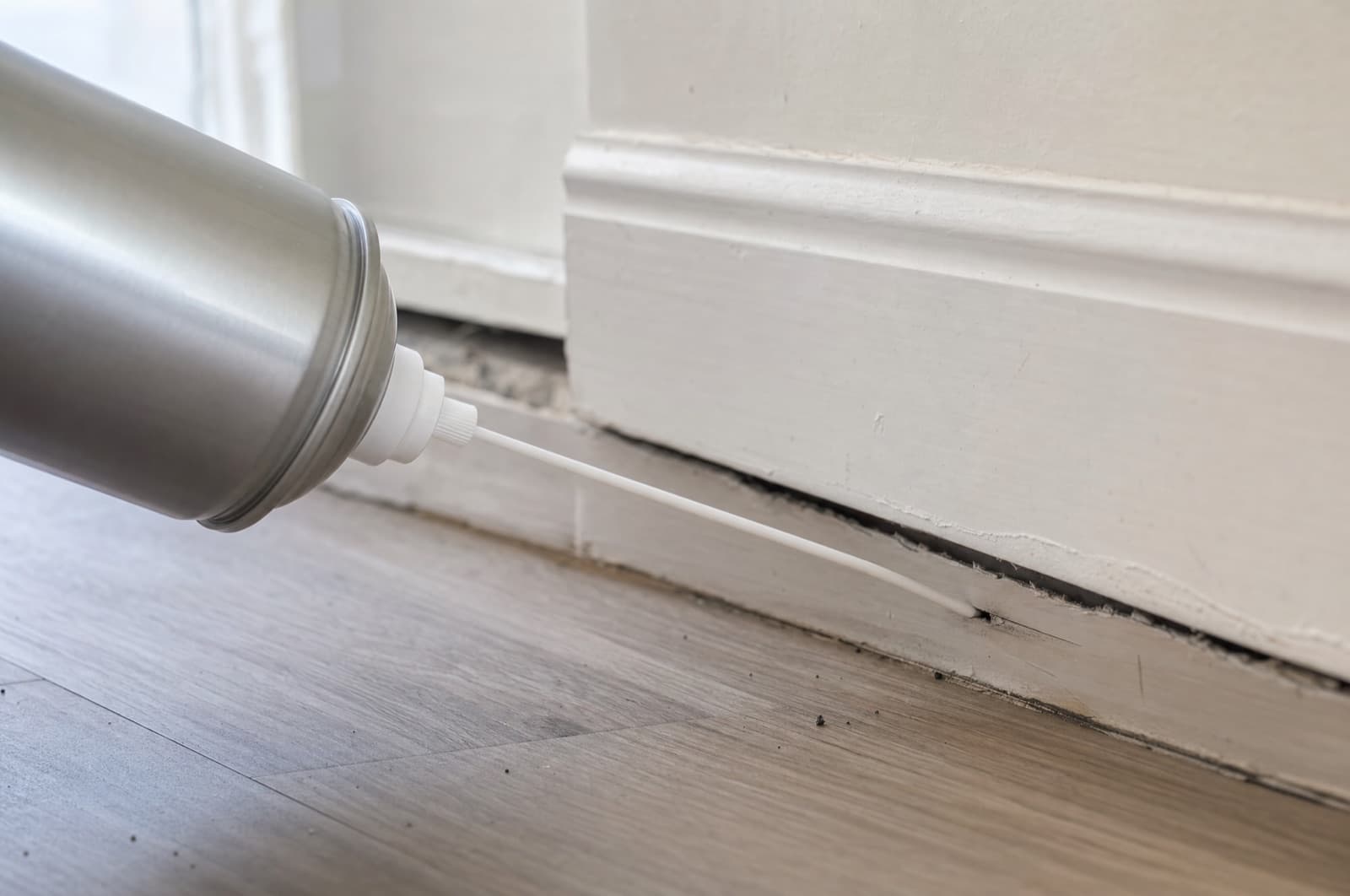
How to Use Ant & Roach Plus Germ Killer Spray by Hot Shot
At a glance
- Efficacy: Workhorse
- Best job: Killing visible ants and roaches on contact and treating harborage cracks, with a bonus one-time reduction of certain surface germs where insects crawled
- Format: Ready-to-use (RTU) water-based aerosol — no mixing; combines an insecticide with a separate surface-disinfectant claim (EPA Reg. No. 9688-317-8845)
- Technique: Easy technique
Does this product actually work?
A genuine workhorse for spot knockdown and crack treatment — and the 'germ killer' claim is a separate function that doesn't change that verdict either way.
This is a standard synthetic-pyrethroid contact aerosol with a phenolic disinfectant added on top — two genuinely separate jobs bundled into one can. Aimed into cracks and harborage, it kills visible ants and roaches fast, same as any comparable pyrethroid spray, and independent testing on this class of product shows under 20% mortality against German cockroaches on treated surfaces, so it carries the same infestation ceiling. The 'plus germ killer' claim is real but narrow — a 99.9% reduction of two named bacteria on hard, non-porous, non-food-contact surfaces, with no lasting sanitizing power — so don't let it inflate your expectations of the pest-control side, and don't use it as a substitute for an actual disinfectant cleaner.
Best for
Killing the ants and roaches you can see, treating the cracks and harborage they hide in, and getting a one-time germ reduction on the hard surfaces you treat.
Skip it for
Ending an established German cockroach infestation or a hidden ant colony, and for any use as a household disinfectant — the label is explicit that the germ claim has 'no residual sanitizer action.'
What it is — and what it's really for
The label is the law. Here's the honest read on the format, the one job it does well, and the job people wrongly buy it for.
The technique walkthrough
Where DIY succeeds or fails is in the placement, patience, and the small pro moves the label never mentions. Follow the label; these are the technique details on top of it.
Treat this as an insecticide first and a surface-germ bonus second — the correct crack-and-crevice technique is identical to any pyrethroid contact spray, and chasing the germ claim by over-applying just wastes the can.
Identify the harborage, not just the bug
Locate where ants and roaches are actually hiding — behind and under appliances, under sinks, along baseboards, cabinet corners, and cracks around pipes — before you spray anything.
Pro moveRoaches cluster near moisture and food; check under the sink, behind the fridge, and along baseboard gaps first.Common mistakeSpraying the open counter because you want the 'germ kill' effect there too — the label restricts the germ claim to hard, non-porous, non-food-contact surfaces, and a kitchen counter used for food prep isn't the right target either way.Shake well and hold the can correctly
Shake the can, then hold it upright about 12 inches from the surface you're about to treat.
Treat the crack, not the room
Aim the nozzle directly into cracks, crevices, and harborage surfaces — behind appliances, under sinks, baseboard gaps — spraying until slightly wet, never to runoff.
Pro moveA pinpoint bead into a baseboard gap does more than fogging a whole kitchen — crack-and-crevice placement is what actually reaches where roaches live, and it's also where the residual and the germ-reduction claim both apply.Let it dry undisturbed on non-porous surfaces
Both the insecticidal residual and the germ-reduction claim apply specifically to non-porous surfaces left undisturbed to dry — don't wipe treated cracks down right after spraying.
Common mistakeBelieving the germ claim means the surface is now sanitized for ongoing use — the label states there's 'no residual sanitizer action,' so treat it as a one-time reduction, not lasting hygiene.Ventilate, and keep it separate from any bait
Let the room ventilate and treated surfaces dry fully before normal use resumes.
Pro moveIf you're also baiting for ants or roaches, treat spray zones and bait zones as separate territory — never overlapping.Common mistakeSpraying near or over a gel bait or bait station — the repellent residue drives roaches and ants away from bait they'd otherwise carry back to the colony.
Do & don't
- Treat cracks, crevices, and harborage — not the open floor.
- Judge the insecticide and the germ claim as two separate results.
- Use a real disinfectant cleaner for ongoing surface hygiene.
- Keep bait and spray zones physically separate.
- Don't rely on it as your household disinfectant — the label says no residual sanitizer action.
- Don't fog an open room hoping to hit hidden pests.
- Don't spray over or near gel bait or bait stations.
- Don't treat food-prep or food-contact surfaces.
Where it works vs. where it fails
No product fixes everything. This is the honest boundary — the situations it genuinely handles, and the ones it simply won't.
Where it works
- A handful of visible ants or roaches need fast knockdown
- A specific crack, gap, or entry point needs spot-treating on a non-porous surface
- You want a one-time germ reduction on the same hard surface you're already spot-treating for pests
- Occasional invaders — a stray roach, cricket, or spider — show up indoors
Where it fails
- Nightly or daytime German cockroach sightings point to an established, reproducing population
- An ant trail keeps returning from a colony nesting outside or in a wall void
- You're expecting ongoing sanitizing power from a single application — the germ claim isn't residual
- The harborage is inside a wall void or other space the spray can't physically reach
Mistakes that waste the product
Using it as a general-purpose disinfectant spray
The label is explicit: the germ claim has 'no residual sanitizer action' and the product is 'not for primary use as a sanitizer' — treating it as your kitchen cleaner leaves surfaces under-sanitized.
Fogging the room instead of treating the harborage
Wastes the can, achieves little residual value where pests actually hide, and creates unnecessary occupant exposure.
Spraying over or near a gel bait or bait station
A repellent pyrethroid residue drives foragers away from bait before they can carry it back to the colony.
Treating only the roaches or ants you can see
Independent testing on comparable pyrethroid sprays found under 20% mortality against German cockroaches on treated surfaces — the reproducing population behind the wall is untouched regardless of the germ claim.
What to expect — and when
Judge the two claims on two different timelines: the pest knockdown is immediate and fading, the germ reduction is a one-time event at application.
Seconds to minutes
Direct hits on ants and roaches knock them down fast; the germ reduction on the treated non-porous surface also happens at this point.
First few days
Fewer visible pests crossing treated cracks and baseboards as the insecticidal residual keeps working — the germ effect does not renew itself.
Weeks 2-12
The insecticidal residual claim runs up to about 12 weeks on undisturbed non-porous surfaces; if roach or ant sightings continue well before that, the population is established and beyond what the can can finish.
When to stop DIY & call a pro
The added disinfectant claim changes nothing about the pest side — a contact spray still only touches insects in the open, not the colony or egg-laden harborage behind them. These are the honest signals the job has outgrown a spray:
Roach sightings continue after 2-3 weeks of correctly aimed, harborage-focused spraying
Independent testing on this class of product shows well under 20% mortality against German cockroaches on treated surfaces — an established population needs baiting or professional treatment, not more aerosol.
An ant trail keeps returning to the same spot after multiple treatments
Recurring activity points to a large colony or satellite nests the spray can't reach — only a small fraction of foragers ever cross a treated surface.
You see large black ants indoors or notice rustling or frass near moisture-damaged wood
Those point to carpenter ants nesting in structural wood — a wood-destroying pest that needs professional inspection, not a spot spray.
You're relying on the can for household sanitizing beyond the pest treatment
The label limits the germ claim to a one-time reduction on hard, non-porous, non-food-contact surfaces — it isn't a substitute for a real cleaning and disinfecting routine.
When correctly aimed spot-spraying isn't holding the line, Anchor's licensed NH technicians identify and treat the actual harborage, colony, or nest with targeted professional methods. Free inspection, same-day service across southern and central New Hampshire.
Still seeing roaches after spraying?
Is it safe for pets & kids?
The short version lives here; the full per-species verdict lives on this product's pet-safety page.
This is a pyrethroid aerosol with an added phenolic disinfectant — ventilate the room during and after use, and keep kids and pets out until treated surfaces are fully dry. Never treat a suspected exposure at home.
Re-entry: Keep children and pets out of the treated area until surfaces are fully dry and the room is ventilated.
German roaches and carpenter ants in NH homes
In southern and central New Hampshire, German cockroaches survive only inside heated structures, and carpenter ants — not fire ants or pharaoh ants, both of which are essentially absent here — are the state's dominant structural ant pest. A can like this is a fine spot tool for the odd roach behind the toaster or an ant trail on the counter, with the germ-kill claim as a minor bonus on the hard surface you treat. But nightly roach sightings or large black ants near moisture-damaged wood point to a bigger problem than any spray can solve. Anchor Pest Services treats the actual source across Manchester, Nashua, Concord, and the surrounding towns.
Service area
Southern New Hampshire
Anchor Pest Services · NH license #782664 · NEPMA member · family-owned since 2017.
Frequently asked
Sources & further reading(6)
- [1]Safety Data Sheet — Hot Shot Ant & Roach Plus Germ Killer2 (EPA Reg. No. 9688-317-8845)
Verified actives (prallethrin 0.025%, lambda-cyhalothrin 0.010%, o-phenylphenol 0.100%), EPA registration number, listed target pests, germ-reduction claim language
manufacturerverified 2026-07-14 - [2]Gordon et al., Journal of Economic Entomology (2024) — common consumer residual insecticides vs. German cockroach
Pyrethroid liquid/aerosol sprays killed under 20% of German cockroaches exposed to treated surfaces
academicverified 2026-07-14 - [3]University of Illinois Extension — 'DIY spray and aerosol products likely to fail in German cockroach control'
Consumer pyrethroid sprays likely to fail against established German cockroach populations
extensionverified 2026-07-14 - [4]UC IPM — Cockroaches (Home & Landscape)
Insecticide sprays alone will not eliminate cockroaches; repellent residues undercut bait programs
extensionverified 2026-07-14 - [5]NPIC — Pyrethrins & Pyrethroids General Fact Sheet
Pyrethroid chemical class behavior and mode of action
npicverified 2026-07-14 - [6]UNH Cooperative Extension — Carpenter Ants Fact Sheet
Carpenter ants nest in structural wood — a call-a-pro escalation, not a contact-spray target
extensionverified 2026-07-14
Written & reviewed by
VerifiedDaniel Brady
NH-Licensed Pesticide Applicator · License #782664 (NHDAMF, RSA 430)
Daniel Brady is the New Hampshire–licensed applicator behind Anchor Pest Services, a family-owned pest control company serving the Manchester area since 2017.
Last updated July 2026
Related products in this category
Same shelf, different jobs — the dot shows each product's honest efficacy verdict at a glance.
Professional Pest Control
When a Spray Can Isn't Enough
A contact aerosol kills what it touches, but it can't end an established roach or ant colony. Anchor Pest Services treats the actual source with targeted, licensed methods across southern and central New Hampshire. Family-owned since 2017, NH license #782664.
- Targeted source treatment, not just spot spraying
- NH-licensed applicators (#782664)
- Free inspection — same-day service across southern NH
NH License #782664 · No obligation · We answer in person
Your next step
- Book a NH pro
Cockroach Control
Book now - Book a NH pro
Pest Control Services
Licensed, family-owned pest control across southern NH.
Book now - What to do next
Is Hot Shot Ant & Roach Plus Germ Killer Spray Safe for Pets?
Read the answer - What to do next
Is Raid Ant & Roach Killer Spray Safe for Pets?
Read the answer - Also relevant
Is Hot Shot Ant & Roach Plus Germ Killer Spray Safe for Pets?
Read the answer - Also relevant
Chemical Control for Roaches, Silverfish, Crickets & Termites
Read the answer