
How to Use D-Force Insecticide Aerosol Spray by Waterbury
At a glance
- Efficacy: Workhorse
- Best job: Detailed crack-and-crevice and void treatments where a lasting deltamethrin residual is wanted in a specific, targeted area, including food-handling establishments
- Format: Ready-to-use professional aerosol with a straw for crack-and-crevice and void injection — originally registered under Waterbury, now manufactured under FMC/Envu; this is a spot/crack-and-crevice product, not a broadcast spray. No mixing.
- Technique: Moderate technique
Does this product actually work?
A genuine professional workhorse for crack-and-crevice and void residual work — situational as a standalone colony fix.
University extension guidance lists deltamethrin among the pyrethroids effective against cockroaches when applied correctly to cracks and crevices, and D-Force's straw-injection design is built for exactly that kind of precision void placement — a real edge over a broad-nozzle retail can, with a genuinely useful ~8-week residual claim. But it's still a surface residual: a colony sheltering outside the treated cracks, or a resistant/bait-preferring population, evades it the same way it evades any pyrethroid. Use it for what it does well — apartment and detailed void treatments — and pair it with baits and sanitation for real colony-level control.
Best for
Detailed crack-and-crevice and void placement where a lasting, roughly 8-week deltamethrin residual is wanted in a small, targeted area — including food-handling sites.
Skip it for
Broadcast use, or expecting the residual alone to eliminate an ant or roach colony.
What it is — and what it's really for
The label is the law. Here's the honest read on the format, the one job it does well, and the job people wrongly buy it for.
The technique walkthrough
Where DIY succeeds or fails is in the placement, patience, and the small pro moves the label never mentions. Follow the label; these are the technique details on top of it.
This is a moderate-difficulty professional tool centered on straw injection into cracks and voids — broadcasting it like a retail contact spray both wastes the product and violates the label.
Inspect and mark active harborage and entry points
Identify cracks, voids, and travel points before applying anything — behind baseboards and cabinets, around appliances, and at pipe penetrations.
Shake and attach the straw
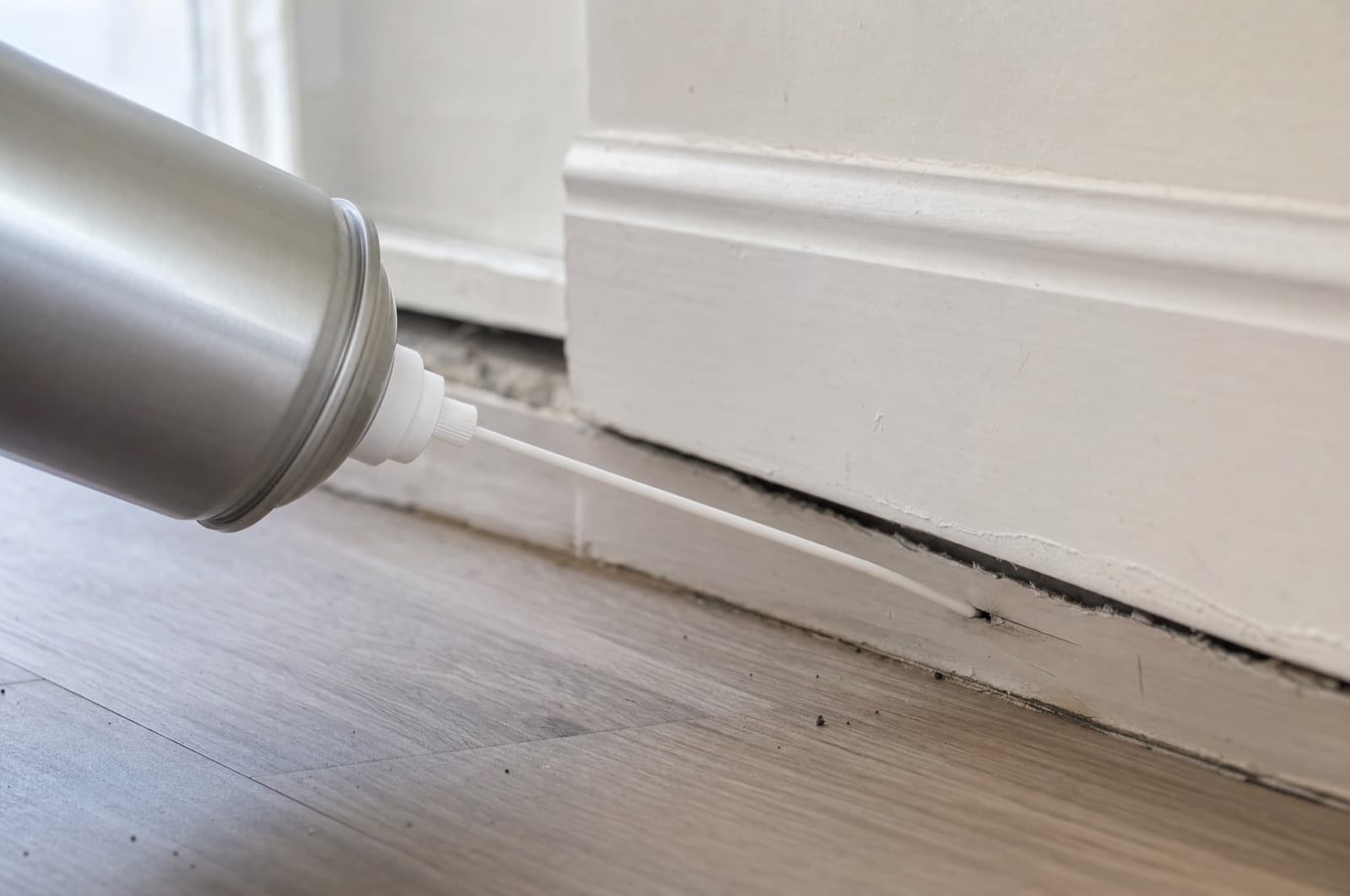
Shake the can and fit the straw for precise crack-and-crevice and void injection.
Inject into cracks, voids, and travel points
Direct the straw into cracks, behind baseboards/cabinets, and around appliances and pipe penetrations, moving along the crack at label pace.
Pro moveUse the straw to place residual inside the void where pests actually travel — that's where the ~8-week residual earns its keep, not on an open, visible surface.For surface spots, hold at label distance and apply lightly
For spot surface treatment, hold roughly 12-15 inches away and apply until slightly wet — not broadcast, not to runoff.
Common mistakeUsing it as a broadcast surface spray — the label restricts D-Force to spot and crack-and-crevice use, and broadcasting wastes product while scattering pests instead of controlling them.Let dry; keep applications targeted, not broadcast
Allow treated cracks and surfaces to dry fully; keep all applications confined to specific spots rather than general room treatment.
Do & don't
- Inject the straw into cracks, crevices, and voids at travel points.
- Confine every application to spot/crack-and-crevice use.
- Combine the residual with baits and sanitation for real colony control.
- Let treated areas dry fully before normal access resumes.
- Don't broadcast-spray open surfaces — the label restricts this to spot and crack-and-crevice use.
- Don't spray over or near bait placements.
- Don't rely on it alone against a colony — it's a surface residual, not a transferable bait.
- Don't oversaturate a crack past the point of coverage.
Where it works vs. where it fails
No product fixes everything. This is the honest boundary — the situations it genuinely handles, and the ones it simply won't.
Where it works
- Apartments and other detailed treatments need precise crack-and-crevice work
- Cracks and voids need a genuinely lasting (~8-week) deltamethrin residual
- Entry-point bands need residual reinforcement in a targeted, small area
- Stored-product pest harborage in pantry cracks needs spot treatment
Where it fails
- Large-area broadcast control is needed and the product is used off-label to try to deliver it
- The colony or reproducing population shelters somewhere the injected residual never reached
- It's relied on alone instead of paired with baiting for real ant or roach colony control
- The area is damp or exposed, which degrades the residual faster than a dry, undisturbed crack
Mistakes that waste the product
Broadcasting D-Force across open surfaces
The label restricts it to spot and crack-and-crevice use — broadcasting is off-label, wastes product, and typically scatters pests rather than controlling them.
Spraying over or near bait placements
The repellent residue drives ants and roaches away from bait before they can carry it back to the colony.
Ignoring the actual nest while treating visible cracks
Foragers keep coming from a colony or nest outside the treated area, so activity continues even with a perfectly applied residual.
What to expect — and when
This is a precision residual tool with a genuinely long window — judge it on how well the specific cracks and voids you treated hold up over weeks.
On contact
Insects that contact the fresh application are knocked down quickly.
Subsequent days and weeks
The residual keeps working on treated cracks and voids as pests cross them, with a claimed effective window of roughly 8 weeks.
If the colony or source is untreated
Activity plateaus or persists outside the treated cracks, since the residual only reaches what physically crosses it.
When to stop DIY & call a pro
Even a genuinely long-lasting professional residual has a ceiling. These are the honest signals the job needs a full licensed program:
Roach or ant activity persists after correctly placed crack-and-crevice and void treatment
A surface residual only reaches what crosses it — an established population needs an integrated baiting and treatment plan, not repeated residual in the same spots.
You see carpenter-ant frass, rustling in walls, or swarming termites indoors
The label flags swarming termites, but a crack-and-crevice residual cannot verify or eliminate a colony inside structural wood — that needs a professional inspection.
Bedbug activity is confirmed
Bedbugs typically require a coordinated, multi-method professional treatment beyond a single residual aerosol.
Activity spans multiple units in a shared building
Multi-unit infestations need a coordinated, licensed treatment plan rather than unit-by-unit spot spraying.
When precise crack-and-crevice residual work isn't holding the line on its own, Anchor's licensed NH technicians build the full baiting-plus-residual program that actually reaches the colony. Free inspection, same-day service across southern and central New Hampshire.
Void treatment still not holding the line?
Is it safe for pets & kids?
The short version lives here; the full per-species verdict lives on this product's pet-safety page.
This is a professional deltamethrin aerosol meant for cracks, crevices, and voids, not open living surfaces — keep kids and pets off treated areas until fully dry, typically around 20-30 minutes. Never treat a suspected exposure at home.
Re-entry: Keep children and pets off treated cracks and surfaces until the application has fully dried.
A pro-channel residual for NH's real structural pests
D-Force is most often reached for by NH landlords, property managers, and pest professionals doing detailed apartment or crack-and-crevice work, not a casual over-the-counter buy. Its label mentions swarming termites and carpenter ants, but it is not a termite or structural-nest treatment — carpenter ants remain New Hampshire's dominant structural ant alongside termites, and any suspected activity in structural wood needs a licensed inspection, not more residual in the same crack. Anchor Pest Services builds the full residual-plus-baiting program across Manchester, Nashua, Concord, and the surrounding towns.
Service area
Southern New Hampshire
Anchor Pest Services · NH license #782664 · NEPMA member · family-owned since 2017.
Frequently asked
Sources & further reading(5)
- [1]Envu — D-Force Insecticide product page
Verified active (deltamethrin 0.06%), crack-and-crevice/void residual format, up-to-8-week residual claim, food-handling use sites (facts only, not the efficacy verdict)
manufacturerverified 2026-07-14 - [2]FMC/Envu — D-Force Insecticide specimen label
Labeled target pests, spot/crack-and-crevice application directions, use-site restrictions
manufacturerverified 2026-07-14 - [3]NPIC — Deltamethrin General Fact Sheet
Deltamethrin pyrethroid class, contact/ingestion mode of action, formulation types
npicverified 2026-07-14 - [4]University of Maine Cooperative Extension — Pest Management Fact Sheet #5011 (Cockroaches)
Deltamethrin listed among pyrethroids effective against cockroaches when applied to cracks and crevices
extensionverified 2026-07-14 - [5]UNH Cooperative Extension — Carpenter Ants Fact Sheet
Carpenter ants nest in structural wood — a call-a-pro escalation, not a crack-and-crevice residual target
extensionverified 2026-07-14
Written & reviewed by
VerifiedDaniel Brady
NH-Licensed Pesticide Applicator · License #782664 (NHDAMF, RSA 430)
Daniel Brady is the New Hampshire–licensed applicator behind Anchor Pest Services, a family-owned pest control company serving the Manchester area since 2017.
Last updated July 2026
Related products in this category
Same shelf, different jobs — the dot shows each product's honest efficacy verdict at a glance.
Professional Pest Control
When Void Treatment Isn't Enough
Even a well-placed 8-week residual can't reach a colony sheltering elsewhere. Anchor Pest Services combines residual, bait, and inspection into one licensed program across southern and central New Hampshire. Family-owned since 2017, NH license #782664.
- Integrated residual-plus-bait treatment
- NH-licensed applicators (#782664)
- Free inspection — same-day service across southern NH
NH License #782664 · No obligation · We answer in person
Your next step
- Book a NH pro
Pest Control Services
Licensed, family-owned pest control across southern NH.
Book now - What to do next
Is D-Force Insecticide Aerosol Spray Safe for Pets?
Read the answer - What to do next
Is Cy-Kick Aerosol Insecticide Spray Safe for Pets?
Read the answer - Also relevant
Is D-Force Insecticide Aerosol Spray Safe for Pets?
Read the answer - Also relevant
Chemical Control for Roaches, Silverfish, Crickets & Termites
Read the answer - Related guide
How to Use Cy-Kick Aerosol Insecticide Spray by BASF
Read the answer