
How to Use Flying Insect Killer Aerosol by Black Flag
At a glance
- Efficacy: Situational
- Best job: Quickly knocking down a room full of flying insects you can close up and treat as a sealed space
- Format: Ready-to-use space-spray aerosol — sprayed upward into a closed room's air, not applied to a specific surface or crack
- Technique: Easy technique
Does this product actually work?
A genuine knockdown workhorse for flying insects in a room you can seal — with next to no residual, so it's a repeat-purchase relief valve, not a fix.
As a space spray, this does exactly one job well: seal the room, spray upward in a sweeping motion, and the flying insects in the air drop within minutes. What it doesn't do is protect the room afterward — tetramethrin and phenothrin-class pyrethroids are fast-acting and fast-degrading, so once you ventilate, the useful residual is essentially gone. If flies or gnats keep reappearing, the can isn't failing; an untreated breeding source or open entry point is refilling the room faster than any spray can prevent.
Best for
Fast knockdown of flies, gnats, and mosquitoes in a room you can close up and treat, then ventilate.
Skip it for
Preventing flying insects from coming back, or solving a recurring problem rooted in an open entry point, a drain, garbage, or standing water.
What it is — and what it's really for
The label is the law. Here's the honest read on the format, the one job it does well, and the job people wrongly buy it for.
The technique walkthrough
Where DIY succeeds or fails is in the placement, patience, and the small pro moves the label never mentions. Follow the label; these are the technique details on top of it.
The entire technique is sealing the room first — a space spray only works if the fog stays put long enough to actually contact flying insects.
Close the room
Shut windows and doors so the treated space is as sealed as possible — an open or breezy room lets the spray disperse before it contacts flying insects.
Common mistakeSpraying in a breezy or open room, or expecting it to prevent future flies. It's knockdown, not prevention.Remove or cover food and sensitive items
Remove or cover food and food utensils, and cover aquariums — fish are highly sensitive to airborne pyrethroid exposure.
Shake and spray upward in a sweeping motion
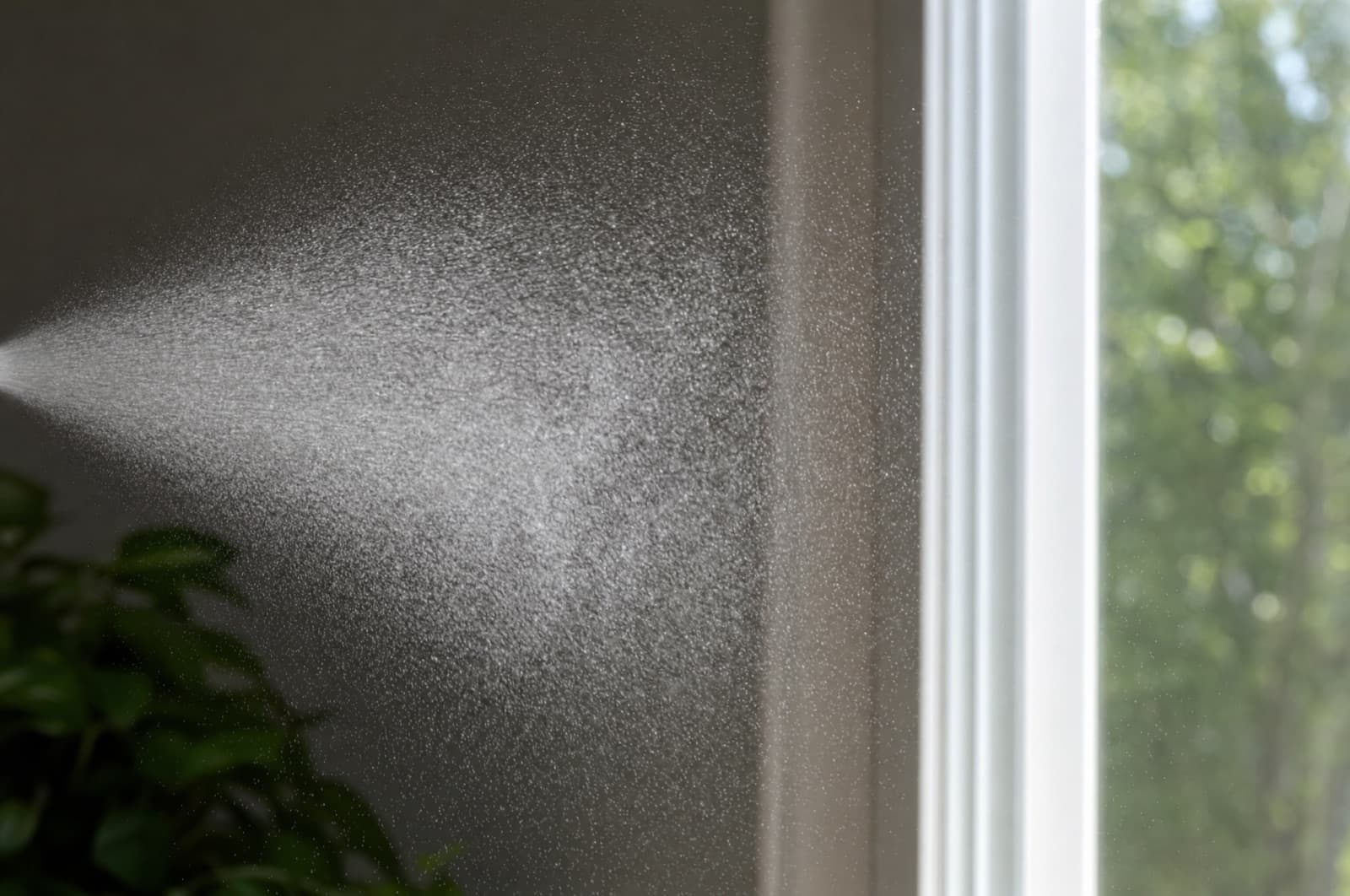
Shake the can, hold it upright, and spray upward into the center of the room with a slow sweeping motion for the label's specified duration.
Pro moveSeal the room first — a space spray only works if the fog stays put long enough to contact flying insects.Keep the room closed briefly
Leave the space closed for roughly 15 minutes per label so the treatment has time to contact flying insects in the air.
Ventilate and clean up
Ventilate the room thoroughly before re-entry, then sweep up and discard any fallen insects.
CautionKeep kids and pets out during and shortly after treatment; don't spray toward people, pets, or open food.
Do & don't
- Close the room before spraying
- Cover food and aquariums first
- Spray upward in a sweeping motion per label timing
- Ventilate thoroughly before re-entry
- Don't expect residual prevention once the room is ventilated
- Don't use it for a crawling-insect infestation
- Don't spray in an open, breezy, or occupied room
- Don't skip finding and fixing the actual source (screens, trash, standing water)
Where it works vs. where it fails
No product fixes everything. This is the honest boundary — the situations it genuinely handles, and the ones it simply won't.
Where it works
- A room full of flies, gnats, or mosquitoes needs fast knockdown right now
- The space can genuinely be closed and sealed during treatment
- You need quick relief before an event or activity in the room
- The flying-insect presence is a one-off or occasional nuisance, not a recurring source problem
Where it fails
- The room can't be sealed — open windows, doors, or airflow scatter the fog before it works
- Flying insects keep reappearing from an untreated breeding source (drains, garbage, standing water, houseplants)
- The actual problem is a crawling-insect infestation, not flying insects in the air
- It's being used as a substitute for fixing screens or entry points
Mistakes that waste the product
Spraying in an open room
The fog disperses before it can contact flying insects, wasting the can and achieving little knockdown.
Expecting lasting residual
Little meaningful residual exists after ventilation, so relying on it for ongoing protection leaves the room unprotected within hours.
Ignoring the breeding site or entry point
Flies and gnats keep returning because the source that's producing or admitting them was never fixed.
Using it on crawling pests
This is a flying-insect space spray, not a crack-and-crevice contact aerosol — it's not built or labeled for ants, roaches, or other crawling pests.
What to expect — and when
This is a fast-in, fast-out knockdown tool — judge it on the minutes it takes to clear a sealed room, not on whether flying insects stay away.
Minutes
Flying insects in a closed, treated room drop quickly — this is the product's genuine strength.
After ventilation
Protection is essentially gone once the space is aired out; there's little meaningful residual left behind.
Days afterward
New flying insects appear if the source or entry point isn't addressed — this isn't the product failing, it's the source refilling the room.
When to stop DIY & call a pro
A space spray solves the moment, not the pattern. These are the honest signals a recurring flying-insect problem has outgrown a can:
Recurring indoor fly or gnat activity traced to a hidden source
A drain, organic buildup in a void, or a structural gap can keep producing insects faster than repeated spraying can knock them down.
The 'flying insects' are actually a different small fly with a different fix
Fruit flies, fungus gnats, and drain flies look similar but come from different sources — misidentifying the pest means treating the wrong problem entirely.
The activity is actually a nesting stinging insect, not a nuisance fly
Wasps, hornets, and yellowjackets need a fundamentally different, higher-risk approach than a space spray for flies and gnats.
A structural moisture problem is feeding the source
Persistent moisture behind a wall or under a fixture can sustain a breeding population indefinitely until the moisture itself is fixed.
When a recurring flying-insect problem keeps coming back despite closed-room treatment, Anchor's licensed NH technicians find and treat the actual source — drain, void, or structural issue — with targeted professional methods. Free inspection, same-day service across southern and central New Hampshire.
Flying insects keep coming back?
Is it safe for pets & kids?
The short version lives here; the full per-species verdict lives on this product's pet-safety page.
This is a pyrethroid space spray — exit the room during treatment and keep kids and pets out until it's ventilated and surfaces are dry. Cover food and aquariums before spraying; fish are especially sensitive to airborne exposure.
Re-entry: Keep children and pets out during application and until the room is thoroughly ventilated.
Flying-insect pressure in New Hampshire homes
Cluster flies and other occasional-invader flying insects push into southern and central New Hampshire homes at fall ingress, and mosquitoes and gnats spike with warm-weather moisture. A closed-room space spray is a reasonable quick fix for a room that's suddenly full of flying insects, but recurring activity through a season usually points to an entry gap or a breeding source outside the room, not a reason for repeated spraying. Anchor Pest Services identifies and treats the actual source across Manchester, Nashua, Concord, and the surrounding towns.
Service area
Southern New Hampshire
Anchor Pest Services · NH license #782664 · NEPMA member · family-owned since 2017.
Frequently asked
Sources & further reading(4)
- [1]Black Flag — Labels and SDS
Directing to the current printed active-ingredient panel and EPA registration by SKU (Spectrum reformulates by SKU) — verify before use
manufacturerverified 2026-07-14 - [2]Black Flag Flying Insect Killer3 (Clean Fresh Scent) — Safety Data Sheet
Space-spray aerosol format and closed-room application directions (facts only)
manufacturerverified 2026-07-14 - [3]NPIC — d-Phenothrin (Sumithrin) Fact Sheet
d-Phenothrin/phenothrin-class pyrethroid behavior — fast knockdown, rapid environmental degradation
npicverified 2026-07-14 - [4]UNH Extension — Fungus Gnats Fact Sheet
Distinguishing fungus gnats from other small flying insects — misID changes the correct fix
extensionverified 2026-07-14
Written & reviewed by
VerifiedDaniel Brady
NH-Licensed Pesticide Applicator · License #782664 (NHDAMF, RSA 430)
Daniel Brady is the New Hampshire–licensed applicator behind Anchor Pest Services, a family-owned pest control company serving the Manchester area since 2017.
Last updated July 2026
Related products in this category
Same shelf, different jobs — the dot shows each product's honest efficacy verdict at a glance.
Professional Pest Control
When a Space Spray Isn't a Fix
A knockdown aerosol clears the room today, but it can't stop the next wave from an unaddressed source. Anchor Pest Services identifies and treats the actual source with targeted, licensed methods across southern and central New Hampshire. Family-owned since 2017, NH license #782664.
- Source identification, not just knockdown spraying
- NH-licensed applicators (#782664)
- Free inspection — same-day service across southern NH
NH License #782664 · No obligation · We answer in person
Your next step
- Book a NH pro
Pest Control Services
Licensed, family-owned pest control across southern NH.
Book now - What to do next
Is Flying Insect Killer Aerosol by Black Flag Safe for Pets?
Read the answer - What to do next
Is Black Flag Ant & Roach Killer Spray Safe for Pets?
Read the answer - Also relevant
Is Flying Insect Killer Aerosol by Black Flag Safe for Pets?
Read the answer - Also relevant
Chemical Fly Control: A Supplement, Not the Fix
Read the answer - Related guide
How to Use Ant & Roach Killer Spray by Black Flag
Read the answer