
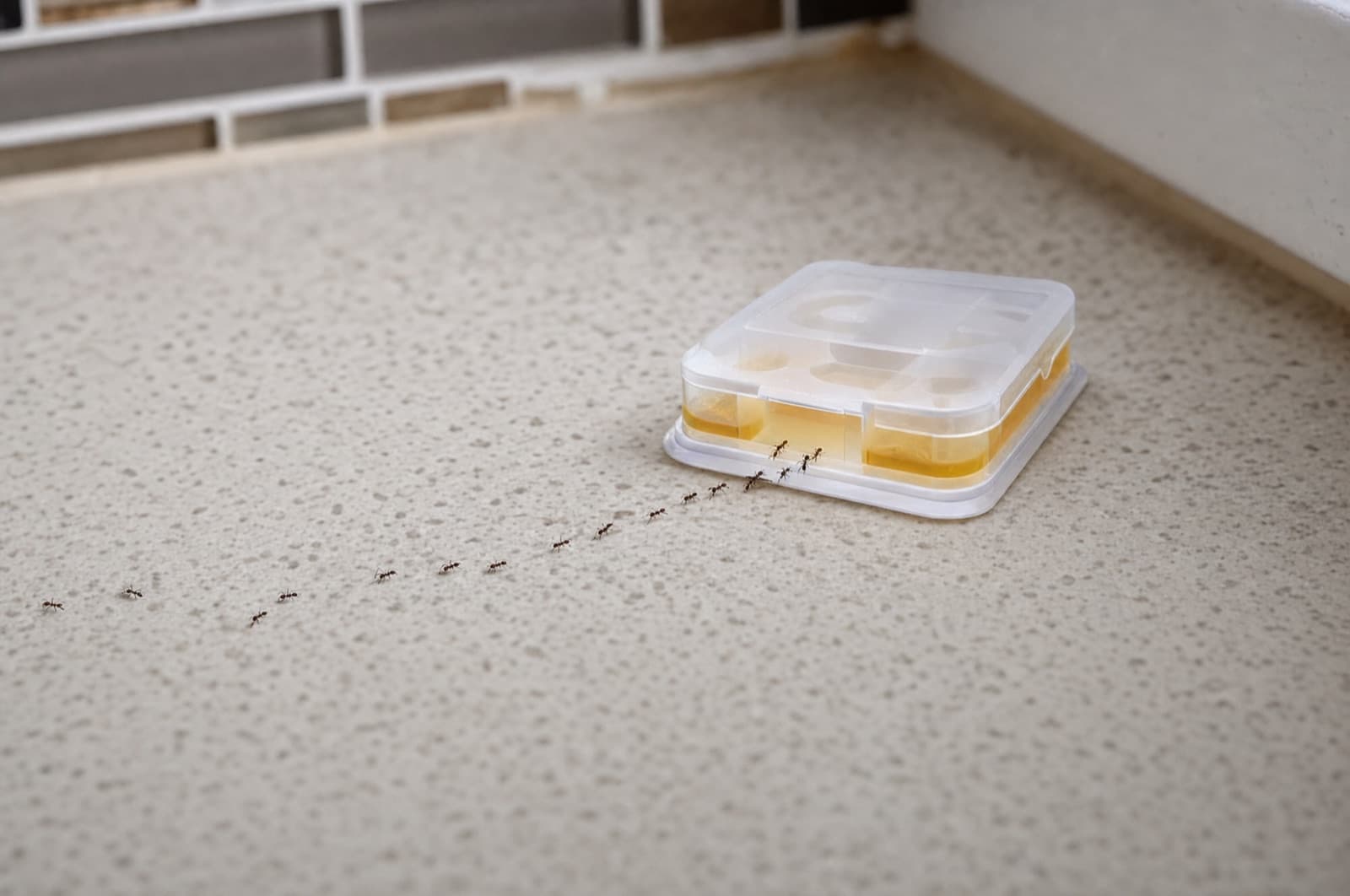
How to Use Terro Liquid Ant Baits (T300)
At a glance
- Efficacy: Workhorse
- Best job: Delivering a slow-acting borax dose into a sweet-feeding ant colony via the ants' own foraging trail
- Format: Pre-filled, sealed liquid bait stations — 6 stations per pack, no mixing (EPA Reg. No. 149-8)
- Technique: Easy technique
Does this product actually work?
A genuine workhorse for sweet-feeding household ants — if you can find the trail and resist the urge to spray it.
Placed directly on an active trail and left completely undisturbed, T300 reliably reaches the colony — including the queen — because foragers carry the liquid borax home before it kills them; UC Riverside field-trial data on properly formulated borate/sucrose baits found roughly an 80% reduction in ant numbers. It fails when placed off-trail, when a spray or cleaning disrupts the pheromone trail, on carpenter-ant nests, or on ants currently in a grease-seeking phase. This is a colony tool, not a same-day fix — 'more ants at first' is the bait working, not failing.
Best for
Odorous house, pavement, little black, and Argentine ants trailing indoors or at entry points while the colony is currently favoring sweets.
Skip it for
Carpenter ants (Terro's own label excludes them and directs you to a contact spray instead), grease-phase ants ignoring the sweet liquid, and fire ants (essentially absent from New Hampshire).
What it is — and what it's really for
The label is the law. Here's the honest read on the format, the one job it does well, and the job people wrongly buy it for.
The technique walkthrough
Where DIY succeeds or fails is in the placement, patience, and the small pro moves the label never mentions. Follow the label; these are the technique details on top of it.
T300 is one of the easiest products in this hub to place and one of the easiest to sabotage — nearly every failure traces back to impatience, not the bait itself.
Trace the trail before you place anything
Follow the visible ant line back toward its entry point or the busiest stretch of trail — that's where the station goes, not just 'somewhere near where ants were seen.'
Pro moveCheck under sinks, along baseboards, and around window and door frames — trails concentrate at these entry points.Common mistakePlacing a station in a random corner of the kitchen because that's where an ant was noticed once, rather than on the trail ants are actually using.Snap the tab and place stations flat, right on the trail
Snap open the stations and lay them flat directly on or immediately beside the active trail, at entry points, and along baseboards.
Pro moveUse all six stations — more placements mean more foragers find bait faster, especially outdoors where several entry points may be active at once.Common mistakeUsing just one station 'to see if it works' — a single placement dramatically slows colony-level uptake.Remove competing food
Clean up crumbs, spilled sugar, juice, and pet food nearby so the bait is the most attractive food source available.
CautionClean around the trail, not on it — wiping the trail line itself erases the pheromone path ants are following.Do not touch, move, or spray the stations once ants are feeding
Leave placements completely undisturbed while ants are actively feeding. Do not spray insecticide, wipe with cleaner, or vacuum near the trail.
Common mistakeSpraying a contact insecticide on the trail during the first-days surge, thinking more ants means the bait isn't working — this kills foragers before they carry bait home and is the #1 mistake with this product.Let the surge run its course
Expect noticeably more ants at the bait in the first few days as foragers recruit nestmates to the food source. This is the bait working.
Pro moveNote the date you placed the stations so you judge progress on a realistic 1-2 week timeline instead of a same-day one.Refill or replace before a station runs dry
Check stations periodically; an empty reservoir stops contributing to the colony dose even if it worked perfectly while full.
Common mistakeLeaving a dried-out station in place for weeks, assuming the job is done, while the colony rebuilds.
Do & don't
- Place stations directly on or beside the active trail
- Use all the stations in the pack, not just one
- Remove competing food and moisture near (not on) the trail
- Be patient through the first-days activity surge
- Keep stations out of reach of pets and children
- Don't spray or wipe the trail — it breaks the pheromone path
- Don't kill visible foragers at the bait
- Don't expect overnight results
- Don't use it on carpenter ants — it's the wrong tool
- Don't leave an empty station in place expecting it to keep working
Where it works vs. where it fails
No product fixes everything. This is the honest boundary — the situations it genuinely handles, and the ones it simply won't.
Where it works
- An active sweet-ant trail is visible and identifiable
- The target is odorous house, pavement, little black, Argentine, or similar sweet-feeding ants
- You can tolerate a days-to-two-week timeline without switching to a spray
- Multiple stations are placed at real entry points and trail segments
Where it fails
- No active trail can be found — only scattered scouts
- The trail gets disturbed by cleaning, spraying, or heavy foot traffic
- The target is carpenter ants (Terro's own label excludes them)
- Ants are in a grease/protein-feeding phase and ignoring the sweet liquid
- The colony is very large or has multiple satellite nests beyond homeowner-scale baiting
Mistakes that waste the product
Spraying or wiping the trail during the activity surge
Kills foragers before they carry bait back and destroys the pheromone trail the whole strategy depends on.
Placing only one station
Fewer placement points mean fewer foragers encounter the bait, slowing colony-level uptake.
Leaving competing food out nearby
Ants will feed on easier food sources instead of the bait, stalling the program.
Expecting results in a day or two
Judging the product on a same-day timeline and abandoning it for a spray misreads how the borax mechanism works.
Using T300 on carpenter ants
Terro's own label excludes carpenter ants — the bait isn't formulated for a structural nest and won't clear it.
What to expect — and when
Judge this product on colony-level decline over days to two weeks, not on how many ants you see tomorrow.
First few hours to days
Visibly MORE ants at the bait as foragers recruit nestmates — this is the bait working, not a worsening infestation.
Days 3-7
Foraging activity at the bait typically starts to decline as the colony is dosed.
Up to 2 weeks
Terro's own label states complete control 'may take up to two weeks' — larger or multi-queen colonies can take longer.
When to stop DIY & call a pro
Open liquid-bait wells work beautifully on a small sweet-feeding trail and poorly once the colony is large, split, or off sugar. These are the honest signals it's time to bridge to a licensed technician:
Trails persist past about 2 weeks of correctly placed, undisturbed baiting
Persistent activity despite correct technique usually means a colony larger than homeowner-scale baiting can clear.
You see large black ants, especially indoors in winter, or hear rustling in walls
Those are carpenter-ant indicators — a structural pest T300 isn't formulated for that needs professional inspection.
Activity reappears at multiple points around the structure
That can signal a large colony or multiple satellite nests beyond a single baiting program.
Trails keep returning at the same interior entry point despite repeated exterior baiting
An unaddressed exterior colony or entry pathway needs targeted, professional treatment to close for good.
When correct, patient baiting still isn't holding the line, Anchor's licensed NH technicians identify the species and the nest and treat the actual source. Free inspection, same-day service across southern and central New Hampshire.
Trails still active after two weeks of correct baiting?
Is it safe for pets & kids?
The short version lives here; the full per-species verdict lives on this product's pet-safety page.
Borax is a low-toxicity active relative to many synthetic insecticides in this hub, but the liquid reservoir isn't harmless if a pet or curious toddler accesses it directly. The practical precaution is placement, not avoidance.
Re-entry: Place and keep stations out of reach of pets and children — under appliances, in cabinet corners, or behind furniture rather than on open floor.
Trail timing in New Hampshire
Southern and central New Hampshire's sweet-feeding nuisance ants — odorous house and pavement ants especially — push indoors as trails warm in spring and again as they seek shelter in fall, which is when a trail is easiest to find and bait. Carpenter ants, common in NH's wooded lots, are the one local ant this product explicitly isn't for; if you're seeing large black ants or debris near a nest site, that's Anchor's call, not T300's. Anchor Pest Services serves Manchester, Nashua, Concord, and the surrounding towns.
Service area
Southern New Hampshire
Anchor Pest Services · NH license #782664 · NEPMA member · family-owned since 2017.
Frequently asked
Sources & further reading(7)
- [1]EPA Registered Product Label — Terro Ant Killer II / Liquid Ant Baits (T300), EPA Reg. No. 149-8
Verified active (borax 5.40%), sealed pre-filled station format, labeled ant species list, carpenter-ant exclusion
epa_labelverified 2026-07-14 - [2]Klotz, Greenberg & Venn, 'Liquid Boric Acid Bait for Control of the Argentine Ant,' J. Econ. Entomol. 91(4):910-914 (1998)
Field trial finding ~80% reduction in ant numbers with a 0.5% boric acid / 25% sucrose bait
academicverified 2026-07-14 - [3]UC Statewide IPM Program — Ants (Home & Landscape)
Slow-acting bait mechanism, colony/queen-level control vs. forager-only sprays
extensionverified 2026-07-14 - [4]NC State Extension — Tips for Effective Ant Baiting
Patience with slow-acting baits; do not disturb or spray baited ants
extensionverified 2026-07-14 - [5]UNH Cooperative Extension — Carpenter Ants Fact Sheet
Carpenter ants as a NH structural pest requiring a different approach than sweet liquid bait
extensionverified 2026-07-14 - [6]NPIC — Boric Acid General Fact Sheet
Borate mode of action as a stomach poison; efficacy sensitivity to concentration and moisture
npicverified 2026-07-14 - [7]Terro — Liquid Ant Baits (T300) product page
Station format, placement directions, labeled species list (facts only, not the efficacy verdict)
manufacturerverified 2026-07-14
Written & reviewed by
VerifiedDaniel Brady
NH-Licensed Pesticide Applicator · License #782664 (NHDAMF, RSA 430)
Daniel Brady is the New Hampshire–licensed applicator behind Anchor Pest Services, a family-owned pest control company serving the Manchester area since 2017.
Last updated July 2026
Related products in this category
Same shelf, different jobs — the dot shows each product's honest efficacy verdict at a glance.
Professional Pest Control
When Patient Baiting Still Isn't Enough
Liquid bait genuinely reaches a colony a spray can't — but a large, multi-satellite, or carpenter-ant colony can outgrow what a homeowner-scale program clears. Anchor Pest Services treats the actual source with targeted, licensed methods across southern and central New Hampshire. Family-owned since 2017, NH license #782664.
- Targeted colony/nest treatment, not just more bait
- NH-licensed applicators (#782664)
- Free inspection — same-day service across southern NH
NH License #782664 · No obligation · We answer in person
Your next step
- Book a NH pro
Ant Pest Control
Book now - Book a NH pro
Pest Control Services
Licensed, family-owned pest control across southern NH.
Book now - What to do next
Is Terro Liquid Ant Baits (T300) Safe for Pets?
Read the answer - What to do next
Is Terro Multi-Surface Ant Baits (T334) Safe for Pets?
Read the answer - What to do next
Is Terro Liquid Ant Bait Stations (T360) Safe for Pets?
Read the answer - Also relevant
Is Terro Liquid Ant Baits (T300) Safe for Pets?
Read the answer