
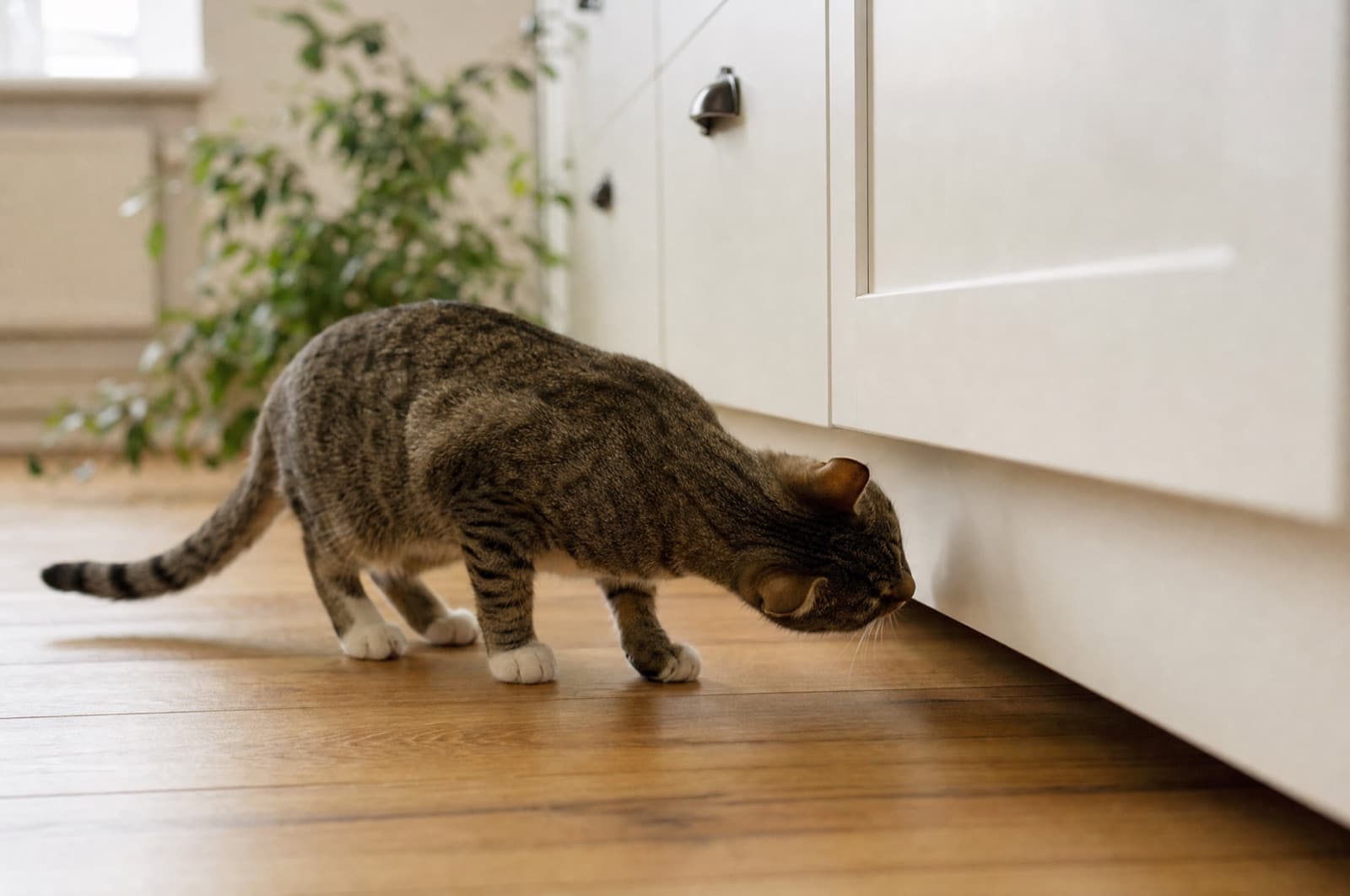
Is Demand CS Insecticide Concentrate by Syngenta Safe for Pets?
At a Glance
- Product: Demand CS Insecticide Concentrate by Syngenta · Syngenta
- Active ingredient: Lambda-Cyhalothrin 9.7% (concentrate strength; heavily diluted before application)
- Re-entry: Re-entry after visibly dry; the microencapsulated deposit is designed for extended residual control (up to roughly 90 days).
- Cat owners: Cats differ — read the cat card below
The short, honest answer
The score rolls up every per-species verdict below, weighted by the honest exposure that matters — a chewed-open tube, not a hidden dab — and is checked against the EPA label and veterinary toxicology.
A professional-strength pyrethroid concentrate meant for diluted, licensed application — not a homeowner-safe product in its concentrate form.
Demand CS is a 9.7% lambda-cyhalothrin microencapsulated ("CS") professional concentrate, EPA Reg. No. 100-1066, diluted heavily (as little as 0.5 fl oz per 1–2.5 gallons of water) before application. Once diluted, dried, and correctly placed, dogs generally tolerate it; cats and fish do not get the benefit of the doubt — the label explicitly says cats should not contact wet surfaces, and the product is extremely toxic to fish and aquatic invertebrates. The microencapsulation extends how long the dried deposit stays bioactive, which matters for repeated pet contact, not just the initial wet period.
General information, not veterinary advice. For a suspected exposure, contact your veterinarian or a pet-poison hotline. Verdict checked 2026-07-13 against the EPA label and veterinary toxicology.
It's not one answer — it's one per animal
Cats, birds, and fish routinely differ sharply from dogs. That contrast is the whole point of this scorecard, and no manufacturer page draws it.
- DogsCaution
- CatsAvoid
- Small mammalsCaution
- BirdsCaution
- FishAvoid
Should not contact wet surfaces; generally tolerated once dry
Syngenta's own consumer-safety material states dogs should not contact spray or surfaces still wet. Once dry, the diluted microencapsulated deposit has what the manufacturer describes as a favorable safety profile, but pyrethroid-class caution still applies.
Syngenta consumer-safety MSDS
Should not contact wet surfaces at all — keep off the dried deposit too
The manufacturer's own material explicitly says cats should not contact wet surfaces. Combined with cats' limited ability to metabolize any pyrethroid, and the fact that microencapsulation is designed to extend how long the dried deposit stays bioactive, cats should be kept off treated surfaces well beyond the initial dry time.
Syngenta consumer-safety MSDS; Merck Veterinary Manual
Keep off treated surfaces until dry and avoid repeated contact
Small-bodied pets have higher relative exposure per pound; the extended-residual microcapsule deposit means ongoing contact should be limited, not just the initial wet period.
Syngenta consumer-safety MSDS
Should not contact wet application; low dietary risk once dry
Syngenta's material states birds should not contact wet application. Dietary toxicity for this pyrethroid class is generally low, but keep cages away from spray mist during and shortly after application.
Syngenta consumer-safety MSDS
Extremely toxic to fish and aquatic invertebrates
The EPA label states this product is extremely toxic to fish and aquatic invertebrates. Never let diluted spray, rinse water, or runoff reach an aquarium, pond, or waterway.
EPA label 100-1066
What's in it — and what it does to pets
A synthetic pyrethroid (IRAC Group 3A) that overstimulates the insect nervous system; formulated here as microencapsulated slow-release capsules that extend residual control. In pets, cats remain the class-level sensitive species due to limited liver glucuronidation; the compound is extremely toxic to fish and aquatic invertebrates.
Syngenta consumer-safety MSDS; EPA label 100-1066
How to use it safely around pets
This is a professional concentrate diluted before spraying — not a ready-to-use consumer product. Its microencapsulation is designed for extended residual control, which shapes the pet-safety picture as much as the initial wet period does.
Dilution and application belong to a licensed applicator
This 9.7% concentrate is mixed at rates as low as 0.5 fl oz per 1–2.5 gallons of water before spraying — professional dilution and placement materially reduce household exposure versus untrained use.
Remove pets before application
Move pets, small-mammal enclosures, and fish tanks that can't be covered out of the treatment area before spraying.
Keep dogs, cats, and birds off wet surfaces
The manufacturer states dogs, cats, and birds should not contact spray or surfaces still wet. Allow full drying before any pet re-enters the treated area.
Limit repeated contact with the dried microcapsule deposit
Because the CS technology is engineered for extended residual life (up to about 90 days), discourage cats and small mammals from repeatedly licking or resting on treated bands during that window.
Do not allow dogs, cats, or birds to contact spray or surfaces still wet; once dry, still limit cats' and small mammals' repeated contact with the treated band.
Re-entry after visibly dry; the microencapsulated deposit is designed for extended residual control (up to roughly 90 days).
Professional dilution and placement by a licensed applicator materially reduce exposure risk compared to untrained handling of this concentrate.
This is a professional-strength concentrate — let a licensed applicator handle it
Anchor's NH-licensed technicians dilute and place Demand CS-class products precisely, keeping pets out of the exposure equation.
Symptoms to watch for
A sign, its urgency, and what to do — never a diagnosis. When in doubt, the emergency panel below is one tap away.
- Mild
Transient skin tingling or paresthesia on contact
- Moderate
Hypersalivation
- Moderate
Vomiting
- Moderate
Paw flicking or ear twitching
- Serious
Tremors
- Serious
Incoordination
Act now — call a vet or a pet-poison line
Do not induce vomiting unless told to
If your pet ate, licked, or walked through this product, act now — bring the product label or EPA registration number when you call. This page is general information, not veterinary advice — for a suspected exposure, contact your veterinarian or ASPCA Animal Poison Control (888-426-4435) right away.
What each situation calls for
Your pet contacted wet or freshly diluted product
Wipe residue from paws and fur with a damp cloth, then contact your vet or a pet poison hotline. Do not induce vomiting unless instructed.
Your cat shows drooling, twitching, or tremors after contact
Treat as urgent — call your vet or ASPCA Animal Poison Control immediately and bring the product label or EPA registration number.
Diluted spray or rinse water reached an aquarium or pond
Do not add anything to the water; contact a vet or aquatic specialist and a pet poison hotline right away, since this product is extremely toxic to fish.
In the next 60 seconds
- Get your pet away from the treated area and any wet product.
- Gently wipe residue off paws and fur to limit grooming ingestion.
- Do NOT induce vomiting unless a veterinarian or poison expert tells you to.
- Have the product name and EPA registration number ready.
- Call your veterinarian or one of the hotlines below.
ASPCA Animal Poison Control
(888) 426-4435
24/7; a consultation fee may apply
Pet Poison Helpline
(855) 764-7661
24/7; a per-incident fee applies
Northern New England Poison Center
(800) 222-1222
24/7 human poison control — for household/child exposure context; call a vet or the pet lines above for pet guidance
Safer pet-friendly alternatives
Honest options that reduce or remove pet-toxicity — no affiliate hype, real caveats included.
Professional application by Anchor Pest Services
SaferLicensed professional service
This is a professional concentrate designed for licensed dilution and targeted placement — Anchor's applicators handle mixing and placement so pets and family members never contact the concentrate directly.
A service, not a product — ask for a pet-safety-focused placement plan.
Mechanical exclusion + sealing
SaferNon-chemical
Sealing entry points reduces the pest pressure that drives repeat professional treatments, with zero pet toxicity.
Best paired with, not a full substitute for, active pest control.
Habitat and moisture reduction
SaferNon-chemical
Removing conditions that attract target insects lowers how much product is needed over time.
Won't resolve an existing infestation on its own.
Targeted baiting in stations
SaferEnclosed, out of pet reach
Confines any active ingredient to a sealed station instead of an open sprayed surface.
Best for ants/roaches specifically; not a substitute for a full perimeter program.
Professional-grade pest control in New Hampshire
Demand CS is a professional concentrate, and in New Hampshire applying pesticides for hire requires a commercial applicator licensed and certified by the NH Department of Agriculture, Markets & Food (NHDAMF) Division of Pesticide Control under RSA 430 — getting the dilution rate, category certification, and record-keeping right is a licensed-applicator responsibility, not a homeowner task. Anchor's technicians hold that NH licensing (License #782664) and treat with pet-conscious, targeted placement across Manchester, Nashua, Concord, and the surrounding southern New Hampshire communities.
NH-licensed applicator #782664 (NHDAMF, RSA 430) · NEPMA member · family-owned since 2017.
Service Area Map
Southern New Hampshire
Frequently asked questions
Sources(6)
- [1]EPA Registered Product Label — Demand CS (Reg. No. 100-1066)
Lambda-cyhalothrin 9.7% concentration, "extremely toxic to fish and aquatic invertebrates" statement
epa_labelverified 2026-07-13 - [2]Syngenta PMP — Demand CS product/label page
IRAC Group 3A classification, dilution rates (facts only, not the verdict)
manufacturerverified 2026-07-13 - [3]Syngenta Demand CS consumer-safety MSDS
"Dogs, cats, birds should not contact wet surfaces," microcapsule deposit safety profile (facts only, not the verdict)
manufacturerverified 2026-07-13 - [4]Merck Veterinary Manual — Pyrethrin and Pyrethroid Toxicosis
Feline pyrethroid sensitivity mechanism
veterinaryverified 2026-07-13 - [5]VCA Animal Hospitals — Pyrethrin/Pyrethroid Poisoning in Cats
Clinical signs and management
veterinaryverified 2026-07-13 - [6]MSPCA-Angell — Pyrethrin Toxicity in Cats
Feline glucuronidation deficiency
veterinaryverified 2026-07-13
Written & reviewed by
VerifiedDaniel Brady
NH-Licensed Pesticide Applicator · License #782664 (NHDAMF, RSA 430)
Daniel Brady is the New Hampshire–licensed applicator behind Anchor Pest Services, a family-owned pest control company serving the Manchester area since 2017.
Last updated 2026-07-13
Pet-Safe Professional Pest Control
Professional Concentrates Belong With a Professional Applicator
Demand CS is not a homeowner ready-to-use spray. Anchor Pest Services dilutes and places professional-grade product safely across southern and central New Hampshire. Family-owned since 2017, NH license #782664.
- Licensed dilution and targeted placement
- NH-licensed applicators (#782664)
- Free inspection — same-day service across southern NH
NH License #782664 · No obligation · We answer in person
Your next step
- Book a NH pro
Rodent Control in New Hampshire
Mice and rats move indoors every fall. We trap, seal entry points and keep them out.
Book now - Book a NH pro
Pest Control Services
Licensed, family-owned pest control across southern NH.
Book now - What to do next
How to Use Demand CS Insecticide Concentrate by Syngenta
Read the answer - Also relevant
Chemical Control for Roaches, Silverfish, Crickets & Termites
Read the answer - Also relevant
Chemical Spider Control: Why Sprays Mostly Don't Work
Read the answer - Related guide
Is Suspend SC Insecticide Concentrate by Bayer Safe for Pets?
Read the answer