
How to Use Demand CS Insecticide Concentrate by Syngenta
At a glance
- Efficacy: Workhorse
- Best job: Laying a durable residual band, especially on porous exterior surfaces (brick, block, concrete), that outlasts a plain retail spray
- Format: Professional dilutable concentrate (capsule suspension/CS, microencapsulated) — mix-your-own, not ready-to-use; typically diluted in a gallon of water at the label rate
- Technique: Moderate technique
Does this product actually work?
A genuine pro-grade workhorse for durable residual — mixed right, it outlasts retail sprays on porous surfaces, but it still won't reach a colony.
Demand CS's microencapsulation is a real, independently documented advantage on porous surfaces — Etang et al. (2011) found knockdown held near 100% on wood through 26 weeks, holding up far better than a plain spray before declining on concrete and mud. But it's still a residual barrier, not a colony treatment: it kills foragers and exposed insects on contact over hours to days, not the nest behind them, and the label itself says it doesn't deliver instant knockdown. Mixed accurately and applied as a coarse, continuous band, it's a genuine workhorse; guessed at, it underperforms both retail sprays and its own reputation.
Best for
Durable exterior and interior residual bands, especially on porous surfaces like brick, block, and weathered concrete, when mixed to the exact label rate.
Skip it for
Expecting instant kill, or treating a nest or colony that needs baiting or dusting instead of a surface band.
What it is — and what it's really for
The label is the law. Here's the honest read on the format, the one job it does well, and the job people wrongly buy it for.
The technique walkthrough
Where DIY succeeds or fails is in the placement, patience, and the small pro moves the label never mentions. Follow the label; these are the technique details on top of it.
This is a moderate-difficulty product precisely because the whole advantage lives in getting the dilution and agitation right — sloppy mixing turns a pro-grade concentrate into an underperforming spray.
Measure precisely
Measure the concentrate to the exact label rate — don't eyeball it. Under-dosing leaves no real barrier; over-dosing wastes product, risks runoff, and violates the label.
Common mistakeEyeballing the dilution 'to be safe' — guessing the mix is the single most common way DIYers ruin a professional concentrate.Mix and agitate
Add product to a partly filled tank, then top with water, and agitate thoroughly to suspend the capsules before you start spraying.
Pro moveIf tank-mixing with an IGR or another product, add Demand CS last and re-agitate periodically through the job.Apply a coarse, targeted band
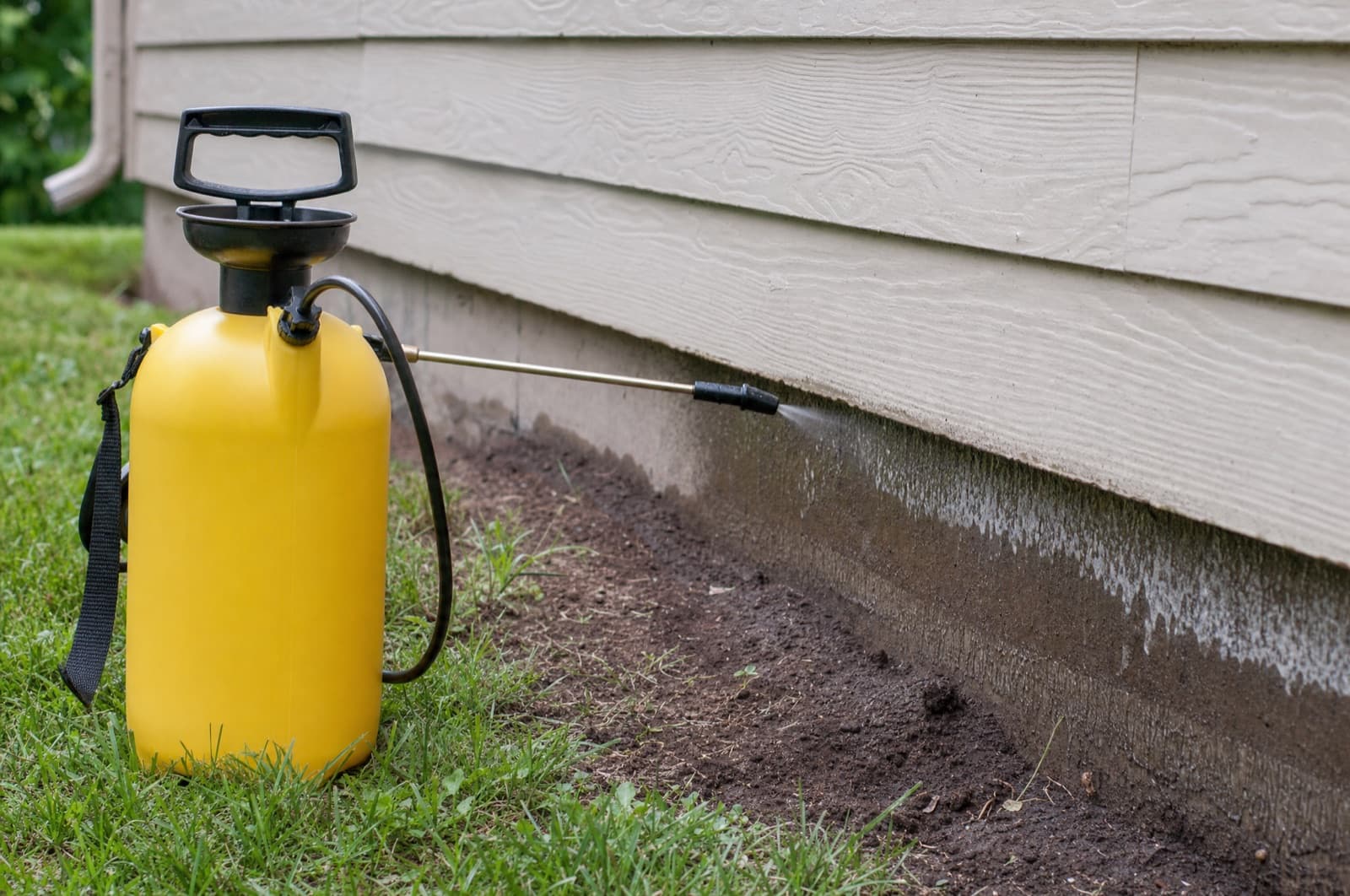
Apply a coarse, low-pressure, continuous band to targeted surfaces and harborage — foundation, entry points, cracks and crevices — not a broadcast fog over open areas.
Pro movePrioritize porous exterior surfaces (brick, block, weathered concrete) — that's exactly where the CS microcapsules outperform a cheaper spray.Keep it agitated through the job
Re-agitate the tank if you pause for more than a few minutes — the capsules settle, and an unagitated tank delivers a weaker mix toward the end of the job.
Common mistakeSpraying the last gallon straight from a settled tank — coverage becomes uneven exactly where you finish.Respect reapplication limits
Observe the label's reapplication interval and any annual/area application limits; don't reapply reactively just because you saw a bug.
CautionKeep it out of storm drains and water — lambda-cyhalothrin is extremely toxic to fish and aquatic invertebrates.
Do & don't
- Measure to the label rate every time
- Keep the mix agitated so capsules stay suspended
- Apply as a targeted coarse band, not a broadcast fog
- Prioritize porous exterior surfaces where it outperforms retail sprays
- Respect the label's application limits
- Don't over-concentrate 'for good measure'
- Don't broadcast beyond labeled sites
- Don't let it enter drains or water
- Don't expect instant knockdown
- Don't let the tank sit unagitated mid-job
Where it works vs. where it fails
No product fixes everything. This is the honest boundary — the situations it genuinely handles, and the ones it simply won't.
Where it works
- You need a durable residual band on porous exterior surfaces like brick, block, or concrete
- The mix is measured accurately and kept agitated throughout application
- You're treating harborage and entry points as a targeted band, not broadcasting
- You need longer residual life than a retail RTU spray typically offers
Where it fails
- You need instant, same-day knockdown of visible insects — the label itself says it doesn't provide that
- There's a colony or nest the surface band can't reach
- German cockroaches with documented pyrethroid resistance are the target
- The dilution was guessed rather than measured, or the tank went unagitated
Mistakes that waste the product
Eyeballing the dilution
Guessing wastes the product's entire advantage — too weak underperforms, too strong wastes money and risks a label violation and runoff.
Letting the capsules settle
An unagitated tank delivers progressively weaker, uneven coverage as you work through the job.
Fine misting instead of a coarse band
A fine mist drifts instead of depositing where insects actually walk, wasting product and leaving poor pickup.
Treating it as a knockdown spray
The label itself notes no instant knockdown — expecting visible dead insects immediately leads to disappointment and over-application.
Broadcasting over open areas
This is a targeted structural and harborage product, not a lawn spray — broadcasting wastes product and can be off-label.
What to expect — and when
This is a residual tool with a delayed kill and a genuinely long tail — judge it on sustained suppression, not on what you see in the first hour.
Hours to 1-2 days
Insects that pick up the capsules on treated surfaces die — not instantly, but reliably, as the label's 'no instant knockdown' note implies.
Days 3-14
New activity on treated surfaces drops noticeably as the residual band does its job.
Weeks to months (surface-dependent)
Independent testing found near-total knockdown held on wood through 26 weeks, while concrete/mud surfaces declined starting around week 11-20 — reapply sooner on porous, high-exposure surfaces.
When to stop DIY & call a pro
Demand CS is genuinely pro-grade, and several of its uses are label-restricted to commercial applicators. These are the signals the job belongs to a licensed technician:
You're unsure of the correct dilution or use site for your specific pest problem
Mixing and coverage errors waste a professional concentrate and can violate the label — accuracy is the entire advantage, and it's easy to get wrong without training.
Cockroaches persist despite correctly mixed, evenly applied treatment
German cockroaches carry widespread pyrethroid resistance; a residual band alone often can't overcome it without baiting or dusting alongside it.
You find carpenter ants, frass, or a suspected nest in structural wood
A surface residual band doesn't reach an in-wall colony — that needs inspection and often void treatment.
You need it applied at a use site the consumer-available formulation doesn't cover
Demand CS's professional label lists commercial use sites that require licensed application.
Anchor's NH-licensed technicians are trained and equipped to mix and apply pro-grade concentrates like Demand CS at the correct rate, on the correct surfaces, and to pair it with baiting or dusting where a residual band alone won't finish the job. Free inspection, same-day service across southern and central New Hampshire.
Mixing accuracy is where DIY usually goes wrong
Is it safe for pets & kids?
The short version lives here; the full per-species verdict lives on this product's pet-safety page.
Lambda-cyhalothrin is a pyrethroid and is extremely toxic to fish and aquatic invertebrates, so keep it well away from storm drains, ponds, and standing water during mixing and application. Around pets and kids, the practical precaution is staying off the treated area until it's fully dry.
Re-entry: Keep children and pets off treated surfaces until the application is fully dry.
Pro-grade residual across New Hampshire's seasons
Southern and central New Hampshire's ant and occasional-invader pressure builds through the warm months and again at fall ingress, and a microencapsulated concentrate's longer hold on porous exterior surfaces like brick and concrete genuinely pays off across that stretch. Because several of its uses are professional-label only, Anchor Pest Services applies Demand CS at the correct rate and site across Manchester, Nashua, Concord, and the surrounding towns rather than homeowners sourcing and mixing it themselves.
Service area
Southern New Hampshire
Anchor Pest Services · NH license #782664 · NEPMA member · family-owned since 2017.
Frequently asked
Sources & further reading(3)
- [1]EPA Pesticide Product Label System — Demand CS, Reg. No. 100-1066
Verified active (lambda-cyhalothrin 9.7%), microencapsulated capsule-suspension format, 'no instant knockdown' label language
epa_labelverified 2026-07-14 - [2]Syngenta Professional Pest Management — Demand CS product/label page
Dilution/mixing directions, use sites, tank-mix guidance (facts only, not the efficacy verdict)
manufacturerverified 2026-07-14 - [3]Etang et al., Malaria Journal (2011) — residual efficacy of microencapsulated lambda-cyhalothrin
Surface-dependent residual: near-100% knockdown on wood through 26 weeks, decline on concrete/mud by weeks 11-20
academicverified 2026-07-14
Written & reviewed by
VerifiedDaniel Brady
NH-Licensed Pesticide Applicator · License #782664 (NHDAMF, RSA 430)
Daniel Brady is the New Hampshire–licensed applicator behind Anchor Pest Services, a family-owned pest control company serving the Manchester area since 2017.
Last updated July 2026
Related products in this category
Same shelf, different jobs — the dot shows each product's honest efficacy verdict at a glance.
Professional Pest Control
Pro-Grade Products Deserve Pro-Grade Application
Demand CS rewards precision and punishes guesswork. Anchor Pest Services mixes, agitates, and applies it at the correct rate and site across southern and central New Hampshire. Family-owned since 2017, NH license #782664.
- Accurate, licensed mixing and application
- NH-licensed applicators (#782664)
- Free inspection — same-day service across southern NH
NH License #782664 · No obligation · We answer in person
Your next step
- Book a NH pro
Pest Control Services
Licensed, family-owned pest control across southern NH.
Book now - What to do next
Is Demand CS Insecticide Concentrate by Syngenta Safe for Pets?
Read the answer - What to do next
Is Suspend SC Insecticide Concentrate by Bayer Safe for Pets?
Read the answer - Also relevant
Is Demand CS Insecticide Concentrate by Syngenta Safe for Pets?
Read the answer - Also relevant
Chemical Ant Control: Why Bait Beats Spray
Read the answer - Related guide
How to Use Suspend SC Insecticide Concentrate by Bayer
Read the answer