
Is Combat Max 12-Month Roach Killing Bait Safe for Pets?
At a Glance
- Product: Max 12-Month Roach Killing Bait by Combat · Combat
- Active ingredient: Fipronil 0.05%
- Re-entry: Ongoing: keep every station out of pet reach for the full time it's in use, not just right after placement.
- Cat owners: Cats differ — read the cat card below
The short, honest answer
The score rolls up every per-species verdict below, weighted by the honest exposure that matters — a chewed-open tube, not a hidden dab — and is checked against the EPA label and veterinary toxicology.
Low-risk while the station stays sealed — the danger is a chewed-open station.
Combat Max 12-Month Roach Killing Bait (EPA Reg. No. 64240-32) delivers a small dose of fipronil, 0.05%, inside a child-resistant plastic station with roach-sized entry holes. Intact and placed out of reach, the enclosed dose is low-risk; the real hazard is a dog or cat prying the station open and eating the bait matrix directly. Place stations deep in voids pets can't access, never break one open, and keep the EPA registration number on hand in case of exposure.
General information, not veterinary advice. For a suspected exposure, contact your veterinarian or a pet-poison hotline. Verdict checked 2026-07-13 against the EPA label and veterinary toxicology.
It's not one answer — it's one per animal
Cats, birds, and fish routinely differ sharply from dogs. That contrast is the whole point of this scorecard, and no manufacturer page draws it.
- DogsCaution
- CatsCaution
- Small mammalsAvoid
- BirdsCaution
- FishAvoid
Low-risk intact — dogs are the most likely to chew a station open
The fipronil load per station is small and sealed, but dogs are the pets most often reported chewing bait stations open and swallowing the matrix inside. Fipronil can cause neurologic signs at sufficient exposure. Place stations where a dog physically cannot reach or gnaw on the housing.
Merck Veterinary Manual — fipronil toxicosis; EPA PPLS Combat label 64240-32
Less likely to eat the bait, but can knock stations loose
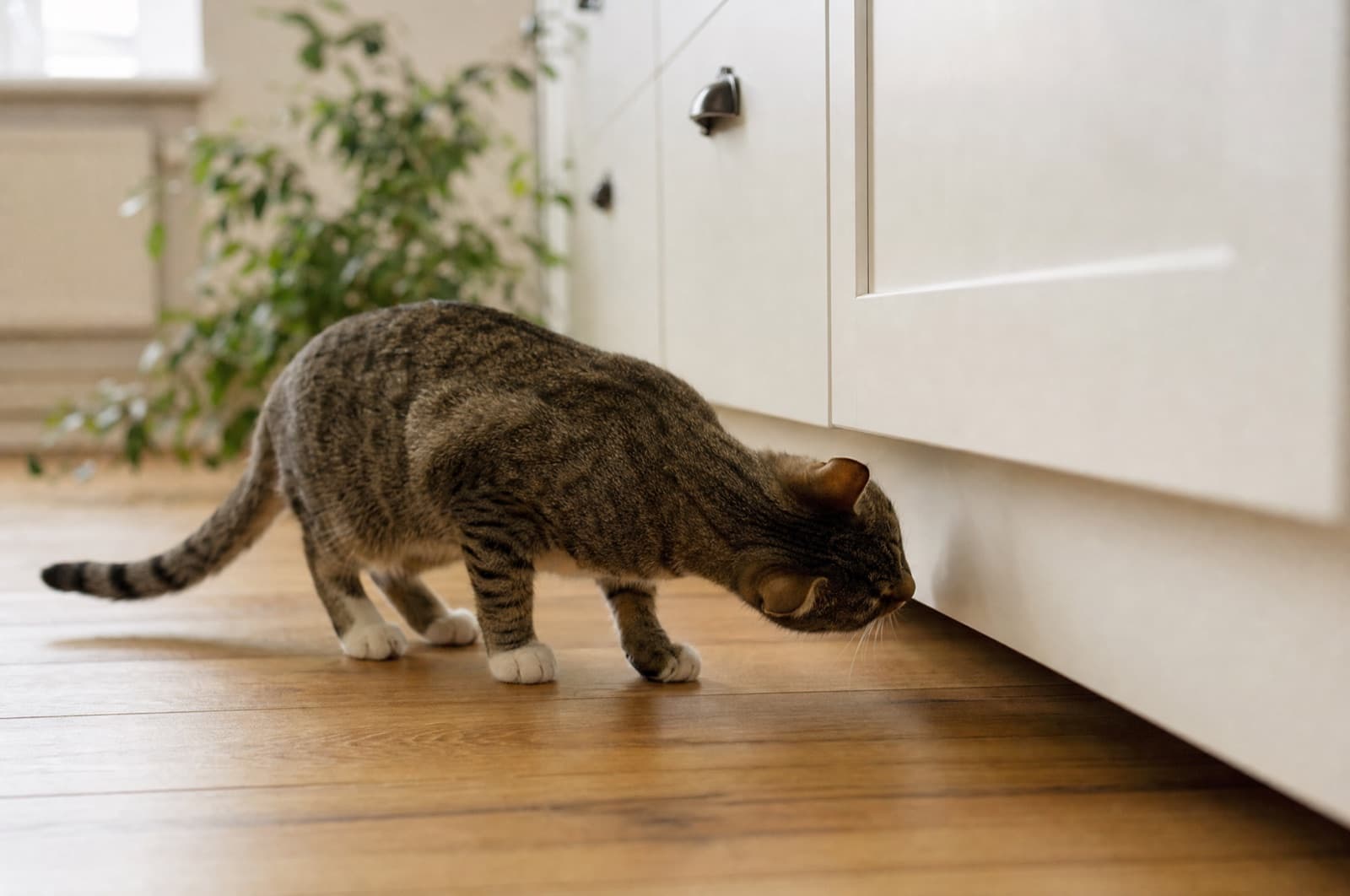
Cats are less inclined to chew plastic than dogs, but a batted-around or cracked station still risks ingestion of the fipronil bait matrix. Keep stations anchored or tucked behind fixed cabinetry a cat can't dislodge.
Merck Veterinary Manual — fipronil toxicosis
Keep entirely out of reach
Pet rodents and rabbits are small-bodied and inquisitive; a station within their enclosure or free-roam area is an unacceptable risk regardless of the low per-station dose.
Merck Veterinary Manual — fipronil toxicosis
Keep free-flying birds away from stations
NPIC notes fipronil is highly toxic to upland game birds on an acute oral basis. A pet bird shouldn't have access to a station or any spilled bait matrix.
NPIC — Fipronil General Fact Sheet
Never rinse stations or dispose of bait near water
Fipronil is highly to very highly toxic to marine and freshwater fish and invertebrates. Never wash out or discard a station near an aquarium, drain, or waterway.
NPIC — Fipronil General Fact Sheet
What's in it — and what it does to pets
A phenylpyrazole that disrupts insect nervous-system signaling; in pets, sufficient exposure can cause drooling, vomiting, agitation or lethargy, muscle tremors, and incoordination, with seizures in severe cases. Most reported pet fipronil cases involve dogs and cats licking or ingesting the bait matrix directly, not incidental contact with an intact station.
Merck Veterinary Manual — Phenylpyrazole (Fipronil) Toxicosis in Animals; NPIC Fipronil Fact Sheet
How to use it safely around pets
This is a permanent enclosed placement, not a spray — the safe-use question is entirely about where the station sits, not drying time.
Place in a void pets can't reach
Set stations flat deep under sinks, behind or under heavy appliances, or inside cabinets that stay closed — anywhere a dog or cat physically cannot get to or gnaw on the housing.
Never break a station open
The plastic housing is the entire safety margin. Don't cut, crush, or pry one open to check it, and don't let kids or pets treat it as a toy.
Count stations set vs. removed
Track how many stations you place and confirm the same number when you remove or replace them, so a missing station is caught immediately.
Keep the packaging
Retain the box or a photo of the EPA registration number (64240-32) so a vet or poison hotline can identify the exact product if exposure occurs.
There's no "drying time" for an enclosed bait station — the rule is permanent inaccessibility, not a wait-and-return window.
Ongoing: keep every station out of pet reach for the full time it's in use, not just right after placement.
If a station is ever found chewed, cracked, or missing, treat it as an active exposure risk and call a hotline.
Rather not manage bait-station security yourself?
Anchor's licensed NH technicians place roach bait in true voids pets can't reach and check it on a schedule.
Symptoms to watch for
A sign, its urgency, and what to do — never a diagnosis. When in doubt, the emergency panel below is one tap away.
- Moderate
Drooling or hypersalivation
- Moderate
Vomiting
- Moderate
Agitation or lethargy
- Serious
Muscle tremors
- Serious
Incoordination
- Emergency
Seizures
Seek emergency veterinary care immediately
Act now — call a vet or a pet-poison line
Do not induce vomiting unless told to
If your pet chewed open this station or may have swallowed the bait matrix, act now — bring the station or a photo of the EPA registration number when you call. This page is general information, not veterinary advice — for a suspected exposure, contact your veterinarian or ASPCA Animal Poison Control (888-426-4435) right away.
What each situation calls for
You find a station chewed open or missing
Assume ingestion is possible. Gather any remaining pieces and the packaging, then call your vet or a pet poison hotline right away, even before symptoms appear.
Your pet is drooling, tremoring, or seems agitated after being near a station
Do not induce vomiting unless a professional tells you to. Call your vet or ASPCA Animal Poison Control with the EPA registration number (64240-32) in hand.
In the next 60 seconds
- Move your pet away from the station and any remaining bait matrix.
- Do NOT induce vomiting unless a veterinarian or poison expert tells you to.
- Collect the station pieces and note the EPA registration number (64240-32).
- Count remaining stations to confirm how many, if any, are missing.
- Call your veterinarian or one of the hotlines below.
ASPCA Animal Poison Control
(888) 426-4435
24/7; a consultation fee may apply
Pet Poison Helpline
(855) 764-7661
24/7; a per-incident fee applies
Northern New England Poison Center
(800) 222-1222
24/7 human poison control — for household/child exposure context; call a vet or the pet lines above for pet guidance
Safer pet-friendly alternatives
Honest options that reduce or remove pet-toxicity — no affiliate hype, real caveats included.
Non-toxic glue board monitoring
SaferMechanical / adhesive (no toxicant)
Glue boards catch roaches with an adhesive surface and contain no fipronil or other insecticide, removing the chewed-open-station risk entirely.
Monitors and reduces roach activity rather than eliminating an established infestation, and pets can still stick a paw or whisker to the glue.
Mechanical exclusion + sanitation
SaferNon-chemical
Sealing entry points, fixing moisture issues, and removing food sources cuts off why roaches are coming in — zero pet-toxicity.
Slower than baiting and needs consistency; best paired with targeted, secured baiting.
Havahart live-catch cage trap
SaferMechanical (rodent-focused)
For a co-occurring rodent problem, a live-catch trap has no chemical toxicant at all — the only risk is entrapment, not poisoning.
Built for rodents, not roaches; won't address the insect problem this product targets.
Professional gel/bait placement (Anchor Pest Services)
SaferLicensed professional service
A licensed applicator places bait in true voids pets can't reach and inspects placements regularly, instead of leaving station security entirely up to the homeowner.
A service, not a product — ask for pet-aware placement.
Pet-safe roach control in New Hampshire
Because New Hampshire winters are too cold for cockroaches to survive outdoors, an NH roach problem is almost always the German cockroach living indoors in heated structures — and in Manchester's and Nashua's older multi-family housing it readily spreads between units through shared walls and utility chases, which is why a single apartment's stations rarely settle a building-wide problem. Anchor Pest Services provides licensed, pet-conscious treatment across Manchester, Nashua, Concord, and the surrounding towns, coordinating whole-structure work where DIY stations fall short.
NH-licensed applicator #782664 (NHDAMF, RSA 430) · NEPMA member · family-owned since 2017.
Service Area Map
Southern New Hampshire
Frequently asked questions
Sources(3)
- [1]EPA PPLS — Combat Source Kill Max Roach Killing Bait Label (Reg. No. 64240-32)
Verified active (fipronil 0.05%), station format, EPA registration number
epa_labelverified 2026-07-13 - [2]NPIC — Fipronil General Fact Sheet
Fipronil toxicity to birds and fish, class-level pet risk
npicverified 2026-07-13 - [3]Merck Veterinary Manual — Phenylpyrazole (Fipronil) Toxicosis in Animals
Clinical signs, dog/cat exposure pattern
veterinaryverified 2026-07-13
Written & reviewed by
VerifiedDaniel Brady
NH-Licensed Pesticide Applicator · License #782664 (NHDAMF, RSA 430)
Daniel Brady is the New Hampshire–licensed applicator behind Anchor Pest Services, a family-owned pest control company serving the Manchester area since 2017.
Last updated 2026-07-13
Pet-Safe Professional Pest Control
Skip the Chewed-Open-Station Risk
DIY bait stations put station security entirely on you. Anchor Pest Services treats roach problems with targeted, pet-aware placement across southern and central New Hampshire. Family-owned since 2017, NH license #782664.
- Pet-conscious targeted placement
- NH-licensed applicators (#782664)
- Free inspection — same-day service across southern NH
NH License #782664 · No obligation · We answer in person
Your next step
- Book a NH pro
Cockroach Control
Book now - Book a NH pro
Pest Control Services
Licensed, family-owned pest control across southern NH.
Book now - Next step
Are Cockroaches Active at Night? NH Roach Timing Guide
Read the answer - What to do next
How to Use Max 12-Month Roach Killing Bait by Combat
Read the answer - Also relevant
Chemical Control for Roaches, Silverfish, Crickets & Termites
Read the answer - Also relevant
Mechanical Control for Roaches, Crickets & Everyday Pests
Read the answer