
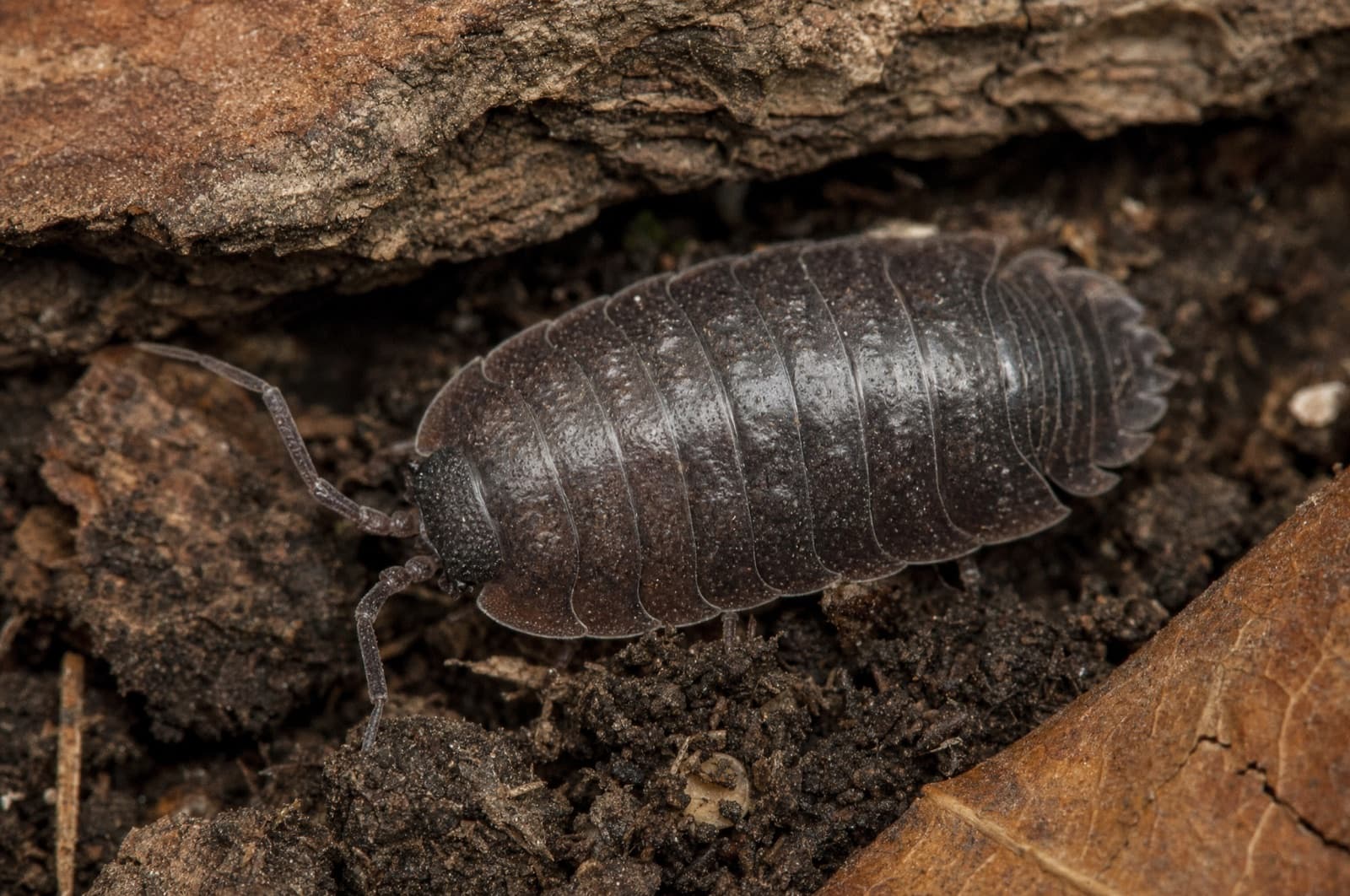
Woodlice in New Hampshire — Pillbug & Sowbug ID & Control
Also called woodlice · pillbug · sowbug · roly-poly · slater · armadillo bug
"Woodlouse" is the umbrella name for the small, armored land crustaceans most NH residents call pillbugs and sowbugs. They are not insects — they are isopods more closely related to crabs than beetles. Harmless, moisture-dependent, and unable to survive dry interiors, they are a perimeter-moisture symptom. The fast sort: rolls into a ball = pillbug; can't roll, has two rear tails = sowbug.
- What it is
- Land crustacean (isopod), not an insect
- University of Kentucky Entomology; UF/IFAS
- Two main types
- Pillbug (rolls into a ball) and sowbug (can't roll, has two rear tails)
- Missouri Dept. of Conservation
- Size
- ~¼–½ in (to ~18–19 mm)
- Missouri Dept. of Conservation; University of Kentucky Entomology
- Legs
- Seven pairs (14 legs)
- University of Kentucky Entomology
- Dangerous?
- No — harmless decomposer
- University of Kentucky Entomology
- Indoor survival
- Dies — dries out without perimeter moisture
- University of Kentucky Entomology
Woodlouse: the umbrella name for pillbugs and sowbugs
'Woodlouse' (plural: woodlice) is the umbrella name for the small, armored, gray land crustaceans that most people in NH call pillbugs (roly-polies) or sowbugs. The first useful fact: they are crustaceans, not insects — more closely related to crabs and shrimp than to beetles or ants. They breathe through gill-like structures and need moisture to survive. They are completely harmless: no biting, no stinging, no disease, and they are beneficial decomposers of decaying plant matter in the garden.
The damp story is shared by both types: they live in damp soil, mulch, and leaf litter, and only wander indoors from the perimeter — where they dry out and die. A woodlouse found inside is a humidity symptom, not an infestation. The fast field sort: if it rolls into a perfect ball, it's a pillbug; if it stays flat and has two small rear tails, it's a sowbug. Either answer points to the same fix — dry the foundation perimeter.
How to identify a woodlouse
Woodlice are small, armored, gray crustaceans with seven pairs of legs — the extra leg pairs (compared to an insect's six legs total) immediately confirm it is not an insect. The two most common types in NH homes are the pillbug (rolls into a ball) and the sowbug (cannot roll, has two rear tail-points). Both are always found in damp habitats.
Woodlouse
- Scientific name
- Order Isopoda (principally Armadillidium vulgare — pillbug; Porcellio scaber / Oniscus asellus — sowbugs)
- Family
- Armadillidiidae (pillbugs); Porcellionidae / Oniscidae (sowbugs)
- Size
- ~¼–½ in (to ~18–19 mm)
- Coloration
- Dark gray to brownish-gray; smooth convex armored plates; may be slightly mottled
- Habitat
- Damp soil, under leaves, rocks, logs, and mulch; garden beds and damp foundation perimeters
- Active season
- Spring through fall, nocturnal
- Diet
- Decaying plant matter (detritivore); beneficial decomposers
- Reproduction
- Females carry eggs and young in a brood pouch (marsupium)
- Lifespan
- ~2–3 years
Introduced from Europe (Old World); cosmopolitan worldwide. Both pillbug and sowbug types are common throughout New Hampshire.
The tells — key ID features
- Small, gray-to-brown, armored 'armadillo-like' segmented body — the familiar woodlouse silhouette.
- Seven pairs of legs (14 total) — not six, confirming it is a crustacean, not an insect.
- Two pairs of antennae (one pair short and reduced).
- ~¼–½ inch; always found in damp habitats.
- Pillbug type: rolls into a complete ball when disturbed, no rear tails.
- Sowbug type: cannot roll, has two short pointed rear tail-points (uropods).
Size, to scale
~¼–½ in (to ~18–19 mm)
About the size of a pencil eraser — small, armored, and gray.
Pillbug (one type of woodlouse)
How to tell — Rolls into a complete ball — see /pests/pillbug for the full pillbug profile.
Sowbug (one type of woodlouse)
How to tell — Cannot roll into a ball; has two short rear tail-points — see /pests/sowbug for the full sowbug profile.
Pill millipede
How to tell — Pill millipedes also roll into a ball but are uncommon in NH, have many more leg pairs and body segments, and are typically longer. The common NH roller is the pillbug.
Signs of a problem
Woodlice signal their presence by location and behavior — look for them in damp spots and note whether the bug rolls or runs when disturbed.
Small gray armored bugs under mulch, flowerpots, logs, or damp boards at the foundation
What it means — Woodlouse harborage in damp perimeter material — both pillbug and sowbug types use the same moist harborage.
Woodlice found indoors near basement walls, doorways, or crawl-space entries
What it means — Moisture entry from the damp perimeter through door gaps or foundation cracks.
Many woodlice in the garden, compost, or under rotting wood
What it means — Normal and beneficial — they are decomposers in healthy moist soil, not a garden problem.
Dead or desiccated woodlice found inside the home
What it means — They entered from the perimeter but could not survive dry indoor conditions — confirms moisture entry.
The real risks, calibrated
Woodlice are harmless to people, pets, and home structures. Their sole significance indoors is what they tell you about foundation moisture.
Bite, sting, or disease
Low riskOnset: N/A
Woodlice do not bite, sting, or carry disease transmissible to people or pets. No health risk.
Minor seedling or soft-fruit feeding
Low riskOnset: Outdoors in growing season
Occasional minor feeding on very tender seedlings or soft fruit touching the soil; rarely significant.
Indoor survival
Low riskOnset: Upon entering a dry interior
Woodlice dry out and die indoors — they cannot breed or establish an indoor infestation.
Foundation-moisture indicator
Low riskOnset: Ongoing perimeter presence
A woodlouse population at the foundation perimeter signals persistently damp conditions worth correcting.
DIY — what works, what backfires
The fix is the same for all woodlice (pillbugs and sowbugs): dry the foundation perimeter and seal entry gaps. Interior spraying is unnecessary — they cannot survive inside.
What actually works
- Pull mulch, leaf litter, and ground cover back at least 6 inches from the foundation wall to remove damp harborage.
- Fix grading and drainage so water slopes away from the house rather than pooling at the foundation.
- Seal door sweeps, foundation cracks, and crawl-space vents — these are the entry routes.
- Sweep or vacuum any indoor woodlice; they will die indoors without moisture.
- Reduce damp harborage under porches, decks, and low-growing foundation plantings.
What backfires
- Don't treat indoor woodlice as an infestation — they cannot survive or breed inside.
- Don't pile damp mulch, leaf litter, or firewood against the foundation.
- Don't spray indoors — the perimeter moisture is the problem, not the woodlouse inside.
Woodlice in New Hampshire gardens and homes
Across Manchester, Nashua, Concord, and the wider southern NH service area, woodlice (pillbugs and sowbugs) are a common presence in gardens and around damp, mulched or leaf-littered foundations. New Hampshire's stone-foundation homes and shaded foundation beds are particularly hospitable. They wander indoors during wet spells, entering through door sweeps, foundation cracks, and crawl-space gaps. They cannot survive dry indoor conditions and die inside — which is why finding dead ones indoors is itself a perimeter-moisture clue.
Peak season
Spring through fall, most active in warm wet weather
You might actually have
- Pillbugs (rolls into a ball — one type of woodlouse; see /pests/pillbug)
- Sowbugs (can't roll, has rear tails — the other type; see /pests/sowbug)
- Springtails (also a moisture indicator — tiny hopping specks near sinks and drains)
We serve these communities
- NH-licensed applicator · #782664
- Same-day service
- Family-owned since 2017
Service Area Map
Southern New Hampshire
When to call a pro for woodlice
If woodlice are consistently entering the home despite perimeter moisture management, a licensed technician can address foundation moisture and exclusion comprehensively — and confirm whether drainage issues, foundation seepage, or crawl-space moisture are the underlying driver.
When to call a pro
- Persistent indoor sightings through multiple seasons despite removing damp harborage.
- Suspecting foundation drainage issues or crawl-space moisture beyond standard fixes.
- Large seasonal influxes during wet spring or fall weather.
Maintain clear foundation perimeter
Keep mulch, leaf litter, and ground cover at least 6 inches away from the foundation wall year-round. This is the most effective single step for all woodlice (pillbugs and sowbugs) in NH.
Fix grading and extend downspouts
Slope ground away from the foundation and discharge downspouts several feet from the house to prevent moisture from accumulating at the base of the wall.
Seal all entry gaps
Replace worn door sweeps, seal foundation cracks, and screen crawl-space vents. Woodlice enter through surprisingly small gaps, so thorough sealing matters.
Not sure it's a woodlouse?
A licensed NH technician can confirm the species and tell you honestly whether it's a DIY fix or a job for a pro — free inspection, same-day service across Southern New Hampshire.
Frequently asked questions
Sources(5)
- [1]University of Kentucky Entomology — Sowbugs and Pillbugs
crustacean classification, seven leg pairs, gill breathing, indoor survival, no health risk
extensionverified 2026-06-30 - [2]Missouri Dept. of Conservation — Pillbugs and Sowbugs
roll test, two rear tails, size, coloration
govverified 2026-06-30 - [3]UF/IFAS — Pillbug (EENY630)
isopod biology, European introduction, crustacean classification
extensionverified 2026-06-30 - [4]Animal Diversity Web — Armadillidium vulgare
species profile, reproduction, lifespan, pillbug biology
academicverified 2026-06-30 - [5]UNH Cooperative Extension — Insect Identification
NH presence and moisture-first guidance
extensionverified 2026-06-30
Written & reviewed by
VerifiedDaniel Brady
NH-Licensed Pesticide Applicator · License #782664 (NHDAMF, RSA 430)
Daniel Brady is the New Hampshire–licensed applicator behind Anchor Pest Services, a family-owned pest control company serving the Manchester area since 2017.
Last updated 2026-06-30

New Hampshire pest control
Dealing with woodlouses in your home?
Anchor Pest Services identifies and handles woodlouse problems across southern and central New Hampshire. Family-owned since 2017, NH license #782664.
- NH-licensed applicators (#782664)
- Same-day service · free inspection
- Family-owned since 2017
Your next step
- Fall guide
Fall Pest Control in New Hampshire
What matters before frost: the fall invader window, mice at the foundation, and what to seal first.
Read the answer - What to do next
How to Get Rid of Woodlice
Read the answer - Related guide
Sowbugs in New Hampshire — ID, Pillbug Lookalike & Control
Read the answer - Related guide
Pillbugs (Roly-Polies) in New Hampshire — ID & Control
Read the answer