
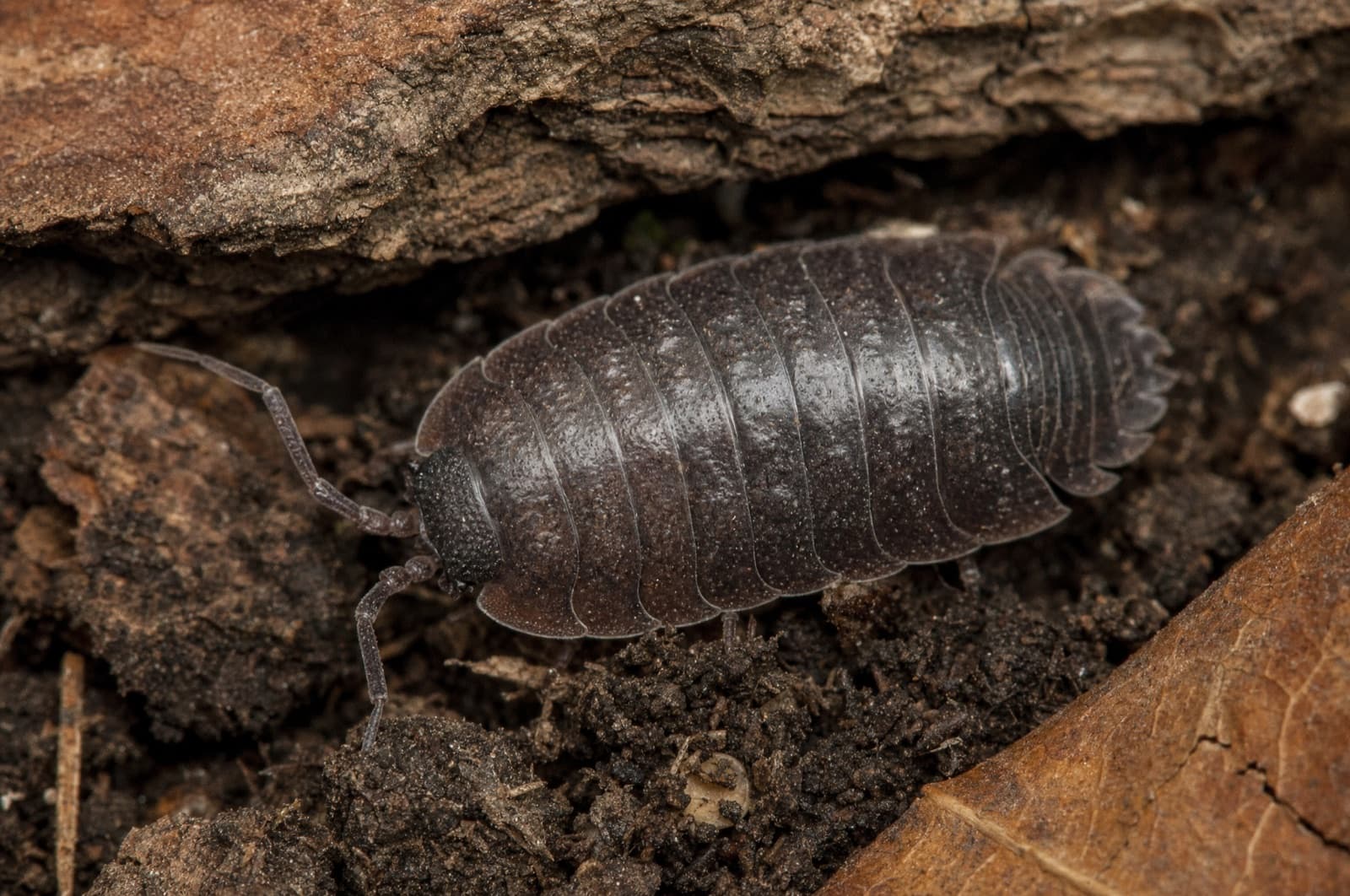
How to Get Rid of Woodlice
At a glance
- Difficulty: Beginner
- Time: A weekend to address moisture and mulch/debris near the foundation; ongoing sweeping of strays
- Cost: Low — a dehumidifier, caulk, and a rake
- Success: High once the moisture source is fixed — woodlice can't establish indoors without dampness
Can you DIY Woodlouse?
The verdict on Woodlouse DIY
A beginner-friendly DIY — fix the dampness and woodlice leave on their own.
"Woodlouse" is a common name (used especially in Europe) for terrestrial isopods — land crustaceans, not insects — that breathe through gill-like structures and need moisture to survive. They're harmless decomposers that wander indoors from damp areas and die within a day or two without it. There's no infestation to eliminate with pesticide; the fix is drying out and blocking the moisture and harborage that drew them in.
The 5 DIY methods — honestly graded
Every approach graded for this species, in IPM order — prevention first, chemistry late. Pick a method to see how it works, the steps, and what it actually takes.
Prevention / Exclusion
Works wellMoisture and harborage reduction is the real fix — this is the dominant lever for this species, not pesticide.
Woodlice can only survive where humidity is high enough to keep their gill-like respiratory structures moist. Removing damp harborage and sealing entry points removes both their habitat and their route indoors.
Best for: Solving the root cause, not just the symptom
Cut the moisture
Ventilate crawl spaces and basements, fix leaking pipes and gutters, and run a dehumidifier in persistently damp areas.
TipTarget basement/crawl-space relative humidity below roughly 50%.Move harborage off the foundation
Pull mulch, leaf litter, and firewood at least several inches away from the foundation, and seal foundation cracks and gaps.
Tools & materials
Why DIY falls short here
Not scare tactics — the specific, proportionate reasons a home attempt can stall for this species.
Treating the bug, not the dampness
Sprays or repeated sweeping fail to stop the problem while the moisture source that drew woodlice in the first place remains unaddressed.
Ignoring the outdoor population
Many woodlice indoors signals a large, healthy damp population living just outside your walls — indoor cleanup alone won't shrink that source.
Mulch touching the foundation
Mulch or leaf litter piled against the house acts as a bridge that funnels woodlice directly to foundation gaps, undoing sealing efforts.
How risky is it, really?
An honest read — most nuisance species are genuinely low risk, and we say so.
Woodlice are harmless — they don't bite, sting, spread disease, or damage the structure. Indoors, they're best understood as a moisture indicator, not a threat to your health or home.
- Bite, sting, or disease transmissionRare
Not documented — woodlice have no mouthparts capable of biting people and carry no known disease risk
University of Florida IFAS Extension
- Structural or property damageRare
They feed on decaying organic matter, not sound wood or building materials
Missouri Department of Conservation
- Large indoor numbers signaling a moisture problemOccasional
A practical flag worth investigating (leaks, poor drainage, crawl-space humidity), even though the woodlice themselves are harmless
University of Florida IFAS Extension
Can't Find the Moisture Source?
A hidden leak or drainage problem can be hard to track down on your own. Anchor Pest Services offers a full moisture and exclusion assessment across southern and central New Hampshire. Family-owned since 2017, NH license #782664.
Call a pro when…
- Woodlice persist after your own moisture and exclusion fixes
- You suspect a hidden leak or drainage problem you can't locate
- You want a full building-envelope moisture and exclusion assessment
General Pest Control
You rarely need a pro for woodlice — this is a moisture-and-mulch job. The exception is a persistent, hard-to-locate moisture source (a hidden leak, poor grading, or crawl-space humidity you can't resolve yourself).
Keep them out
- Keep basement/crawl-space humidity below roughly 50%
- Move mulch, leaf litter, and firewood away from the foundation
- Fix leaks and improve drainage away from the house
Woodlice in New Hampshire
Woodlice, sowbugs, and pillbugs are closely related terrestrial isopods and common names overlap regionally — "woodlouse" is the broader umbrella term. In New Hampshire's humid basements and crawl spaces, they're most active in the wetter shoulder seasons (spring and fall) when outdoor moisture is high, wandering in from damp mulch beds and foundation soil.
Peak season
Spring and fall, during high-moisture periods
First-frost anchor
Manchester first hard frost ~Oct 19 (50%) / Oct 29 (80%), NOAA 1991–2020
Make sure it's a Woodlouse
Two quick detours worth taking — confirm the ID, then learn what drew it in so it doesn't come back.
Frequently asked
Sources & further reading(2)
- [1]University of Florida IFAS Extension — Terrestrial Isopods (IN1099)
Biology, harmless status, moisture dependency, control recommendations
extensionverified 2026-07-13 - [2]Missouri Department of Conservation — Pillbugs and Sowbugs (Land Isopods)
Species overlap and identification, decomposer role
govverified 2026-07-13
Written & reviewed by
VerifiedDaniel Brady
NH-Licensed Pesticide Applicator · License #782664 (NHDAMF, RSA 430)
Daniel Brady is the New Hampshire–licensed applicator behind Anchor Pest Services, a family-owned pest control company serving the Manchester area since 2017.
Last updated July 2026
Other species you can tackle
Same category — the dot shows each one's DIY verdict at a glance (green = friendly, amber = doable with care, red = call a pro).
Professional Pest Control
Can't Find the Moisture Source?
A hidden leak or drainage problem can be hard to track down on your own. Anchor Pest Services offers a full moisture and exclusion assessment across southern and central New Hampshire. Family-owned since 2017, NH license #782664.
- Moisture-source diagnosis
- NH-licensed applicators (#782664)
- Free inspection — same-day service across southern NH
NH License #782664 · No obligation · We answer in person
Your next step
- Book a NH pro
Pest Control Services
Licensed, family-owned pest control across southern NH.
Book now - What to do next
Woodlice in New Hampshire — Pillbug & Sowbug ID & Control
Read the answer - What to do next
Sowbugs in New Hampshire — ID, Pillbug Lookalike & Control
Read the answer - What to do next
Pillbugs (Roly-Polies) in New Hampshire — ID & Control
Read the answer - Also relevant
Woodlice in New Hampshire — Pillbug & Sowbug ID & Control
Read the answer - Also relevant
Household Pest Prevention: Seal, Store, and Time It Right
Read the answer