
Dog Still Scratching After Tick Removal: What to Check and Do
Checking the site is yours to do — but if the scratching is intense, spreading, or getting worse, that crosses into a vet question, not a pest-control one.
Mild, brief irritation after a tick bite is common and self-limiting. You check it gently and give it a few days; you don't treat it as an emergency unless it's clearly getting worse.
At a glance
- Whose desk: Your hands
- Urgency: Routine monitoring
- The rest lives at: Ticks & fleas FAQ
Whose job is this, really?
Pet-parasite questions belong to three genuinely different owners. Here's the desk that actually owns this one — even when the honest answer is 'not us.'
Checking the site is yours to do — but if the scratching is intense, spreading, or getting worse, that crosses into a vet question, not a pest-control one.
Mild, brief irritation after a tick bite is common and self-limiting. You check it gently and give it a few days; you don't treat it as an emergency unless it's clearly getting worse.
What this means for your pet — and when to act
Health-conservative by construction: when in doubt, this escalates. Read the trigger for what moves you up a band.
Watch the site — most post-removal itching settles on its own
A small firm nodule or mild itch at a tick bite is a normal part of healing as the skin reacts to the bite, and it typically resolves within a few days without treatment.
The scratching is intense, lasts beyond a few days, or comes with a spreading rash, swelling, pus, hair loss, or a hot and painful lump — that pattern suggests infection or an inflammatory reaction and is a same-day or next-day call to your veterinarian.
Route to your veterinarian — not Anchor, not a web page.
What to check — and what it means
Persistent scratching after a tick removal has a few different possible causes — this sorts the common, harmless ones from the ones that need a vet:
A small firm nodule or bump that stays for several days but isn't growing or changing color
Means: Common, usually benign healing reaction — keep watching, no action needed yet.
Redness, warmth, pus, or a spreading area around the bite
Means: Possible local infection — call your vet soon.
A hard fragment under the skin that feels like a splinter
Means: Likely a retained mouthpart — leave it alone to resolve, don't dig at it.
Generalized itching all over, not just at the bite site
Means: May point to a separate allergic or flea issue rather than the tick bite itself — worth mentioning to your vet.
Fever, lethargy, or lameness alongside the scratching
Means: A systemic sign — this is a veterinary question, not a home-care one.
The safe technique, step by step
Before assuming the worst, do a calm, methodical re-check of the site and the rest of your dog.
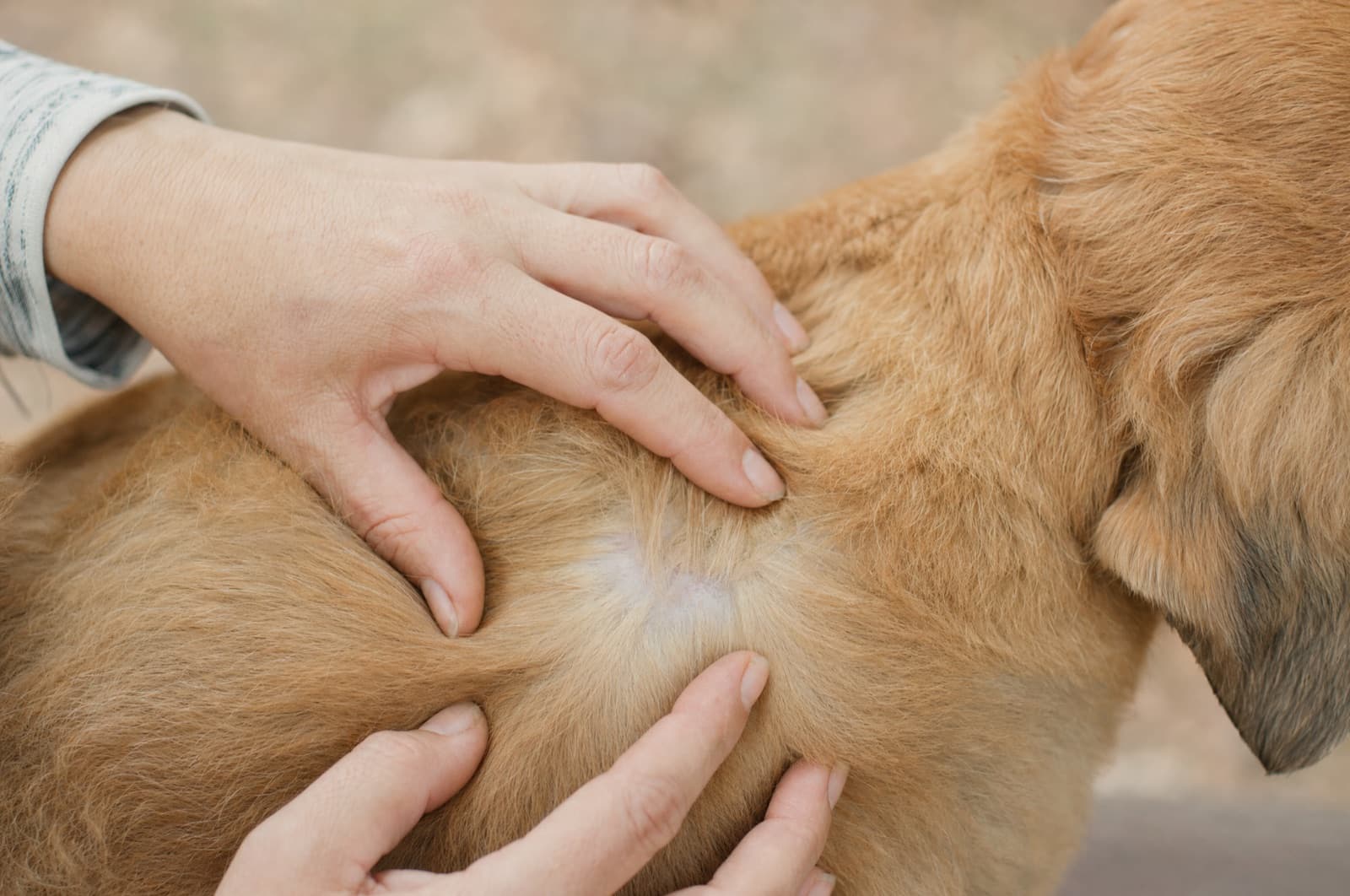
Part the fur at the original bite site and look closely rather than just feeling through the coat.
A small firm nodule that persists for several days as the skin heals is common and usually benign.
Check for redness, warmth, oozing, or an area that has grown larger than it was right after removal.
This pattern points toward a local infection rather than normal healing.
Feel for a retained mouthpart fragment acting like a splinter under the skin.
If present and not easily lifted out, leave it — CDC and Merck both say it resolves on its own.
Re-check the rest of your dog for a second attached tick you may have missed, especially the usual hot spots.
Continued scratching sometimes means a different tick is still attached elsewhere, not that the removed one is a problem.
Clean the area gently with a pet-safe antiseptic or soap and water if it looks irritated.
Do not apply human medications, creams, or steroids without veterinary direction.
- Do not dig at a retained mouthpart with a needle or tweezers repeatedly — this causes more irritation than leaving it alone.
- Do not apply human topical medications, antibiotic ointments, or steroid creams without checking with your veterinarian first.
This hub owns pet-specific prevention
The general biology, the mosquito Q&A, the pet-product safety — those live in siblings that already earn them. Here's exactly where.
General tick/flea prevention lives in our ticks & fleas FAQ. Persistent or worsening scratching, or any systemic sign, is a veterinarian's call — Anchor does not diagnose skin reactions or prescribe treatment.
How this calibrates for NH
New Hampshire's long tick season means a dog can pick up more than one tick on a single outing, so continued scratching sometimes means a second attached tick was missed rather than a problem with the one already removed — re-check the usual hot spots (ears, collar line, toes, groin, tail base) before assuming the worst.
NH-licensed applicator #782664 (NHDAMF, RSA 430) · NEPMA member · family-owned since 2017.
Frequently asked
Sources(3)
- [1]CDC
After a Tick Bite / Preventing Ticks on Pets — local reaction vs. infection
- [2]Merck Veterinary Manual
Tick removal and skin-reaction guidance for dogs
- [3]UNH Cooperative Extension
New Hampshire tick prevalence and hot-spot checking
Written & reviewed by
VerifiedDaniel Brady
NH-Licensed Pesticide Applicator · License #782664 (NHDAMF, RSA 430)
Daniel Brady is the New Hampshire–licensed applicator behind Anchor Pest Services, a family-owned pest control company serving the Manchester area since 2017.
Your next step
Anchor Pest Services
Have a different pest question?
This one may be your vet's call, not a spray — but if you're facing something that is a pest job, we serve Southern New Hampshire with a free inspection and same-day service.
- NH-licensed applicator
- Same-day service
- Pet & family-conscious
NH License #782664 · No obligation · We answer in person