
Mud Daubers in New Hampshire — ID, Mud Nests & Sting Risk
Quick facts
- Size: 24–28 mmBlack-and-yellow mud dauber (Sceliphron caementarium); only US Sceliphron with yellow-marked legs; Wikipedia / en.wikipedia.org
- Sociality: Solitary — no colony, no nest defenseEach female builds and provisions her own mud cells; UMN Extension
- Sting: Essentially never stingsUMN Extension verbatim: 'Not aggressive, stings are rare' — no defensive behavior around nest
- Prey: Paralyzed spiders, including black widows where presentWikipedia / Sceliphron caementarium; UMN Extension
Size
24–28 mm
Black-and-yellow mud dauber (Sceliphron caementarium); only US Sceliphron with yellow-marked legs; Wikipedia / en.wikipedia.org
Sociality
Solitary — no colony, no nest defense
Each female builds and provisions her own mud cells; UMN Extension
Sting
Essentially never stings
UMN Extension verbatim: 'Not aggressive, stings are rare' — no defensive behavior around nest
Prey
Paralyzed spiders, including black widows where present
Wikipedia / Sceliphron caementarium; UMN Extension
The wasp that hunts black widows — and almost never bothers people
If you've found a cluster of rough, gritty mud cells plastered on your garage wall, shed siding, barn beam, or eave overhang, you are looking at the work of a mud dauber — almost certainly the black-and-yellow mud dauber (Sceliphron caementarium), the most common solitary wasp in southern and central New Hampshire. The good news, and the thing most pest-control pages bury: this wasp is among the most harmless insects you will ever find on your property.
Mud daubers are solitary. That single word changes everything. Unlike paper wasps or yellowjackets, there is no colony here, no queen to protect, no workers to mobilize in defense. Each female builds her own mud nest alone, stocks it with paralyzed spiders as food for her larvae, seals it, and flies away. University of Minnesota Extension puts it plainly: 'Not aggressive, stings are rare. Does not harm buildings where they build their nests.' The wasp is gone. The nest is an empty clay container. You can scrape it off the wall at any time, with no protective gear, and nothing bad will happen.
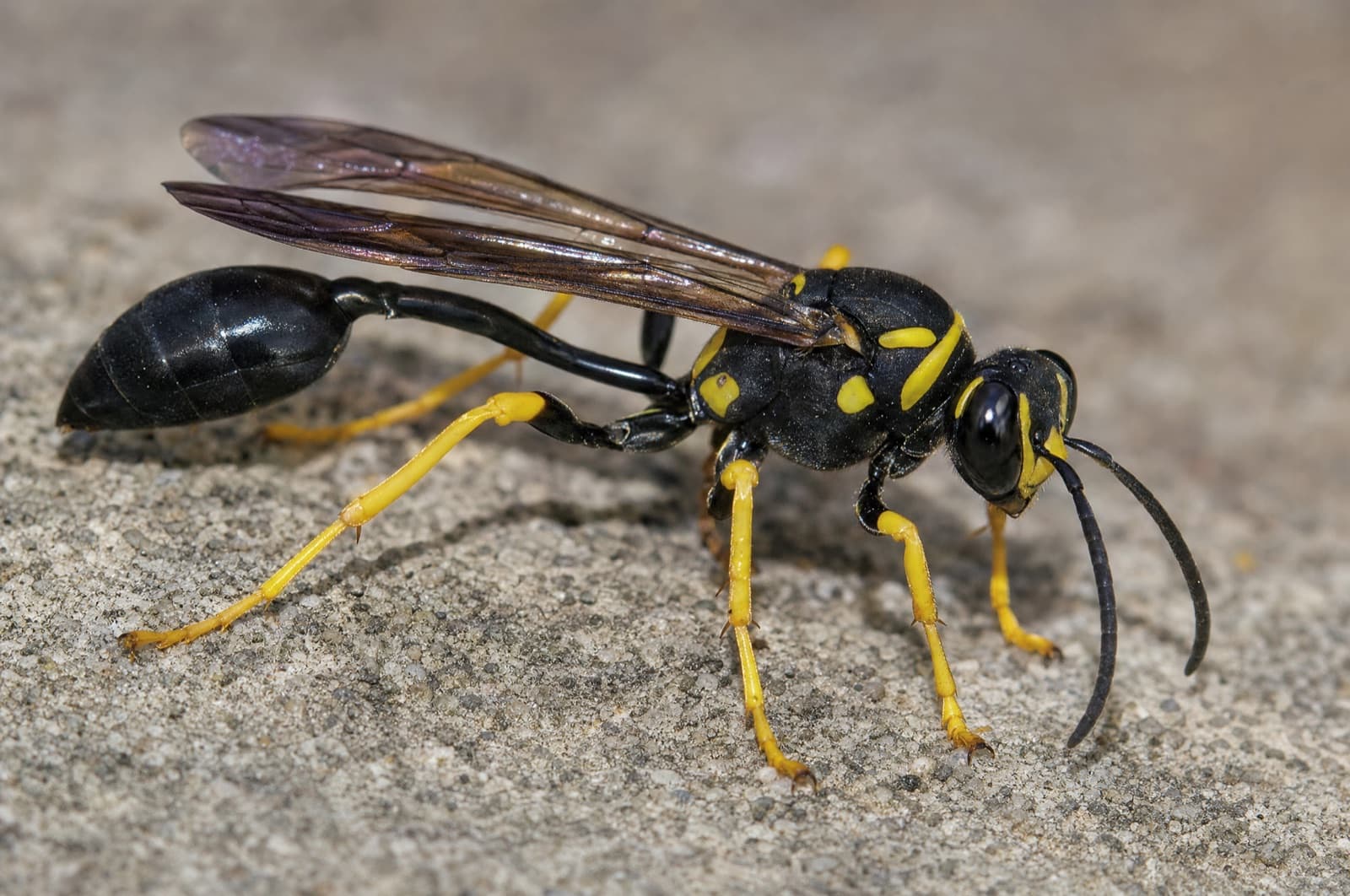
The black-and-yellow mud dauber earns a second look for another reason: it hunts spiders, including black widows in regions where they occur, making it a genuine beneficial predator. That distinctive thread-waisted silhouette — long petiole connecting thorax to abdomen, yellow legs, tawny wings — is a signal that you have a spider-control specialist on your property, not a threat.
New Hampshire also has a second mud dauber species, the organ-pipe mud dauber (Trypoxylon politum), but BugGuide contributed-data shows zero NH records for this species; it is at the northern edge of its range and sparse to absent here. The black-and-yellow mud dauber is the one NH homeowners see. This page covers how to identify both, how to read a mud nest, and when — if ever — you need to do anything about it.
Mud daubers in southern and central New Hampshire
The black-and-yellow mud dauber is a well-established, HIGH-prevalence resident across southern and central New Hampshire. You will find its mud-cell clusters on barn siding in Milford and Bristol, on garage walls in Manchester and Nashua, under bridge overhangs in Concord, on cedar siding in Bedford and Derry, and on practically any sheltered south-facing wall across Rockingham, Hillsborough, Merrimack, and Strafford counties. UNH Cooperative Extension notes solitary mud daubers as a common part of the NH stinging-insect picture — and one that almost never poses a sting risk. Mud daubers are active all summer. Females build and provision mud cells from late spring through late summer, provisioning each cell with multiple paralyzed spiders before sealing it and moving on. Unlike the social paper wasps and yellowjackets whose colonies collapse at hard frost, individual mud daubers simply complete their season's provisioning and the next generation overwinters as pupae inside sealed mud cells. The organ-pipe mud dauber (Trypoxylon politum) is occasionally listed for the northeastern US, but BugGuide contributed-data shows zero New Hampshire records for this species, compared to one in Massachusetts, one in Rhode Island, and six in New York. We report this honestly: organ-pipe mud daubers are sparse to likely absent in New Hampshire. What you see on your NH wall is the black-and-yellow species.
Species present in NH
- Black-and-yellow mud dauber (Sceliphron caementarium)
- Organ-pipe mud dauber (Trypoxylon politum) — sparse/likely absent in NH
We serve these communities
First-frost anchor: Manchester first hard frost ~Oct 19 (50%) / Oct 29 (80%) per NOAA 1991–2020 normals — mud dauber adults are done provisioning well before frost
UNH Cooperative Extension includes mud daubers in its NH stinging-insect guidance (Resource000532) and frames solitary wasps as non-aggressive species that almost never sting unless directly handled.
- NH-licensed applicator · #782664
- Same-day service
- Family-owned since 2017
Service Area Map
Southern New Hampshire
How to identify mud daubers — and tell their mud nests from paper wasp nests
The mud dauber's body tells you immediately that you are dealing with a solitary species — built nothing like the stocky, defensive yellowjacket. Three field marks separate it from every other common NH wasp.
Black-and-yellow mud dauber
Also called: Mud wasp, Dirt dauber
- Scientific name
- Sceliphron caementarium
- Family
- Sphecidae
- Sociality
- Solitary
- Size
- 24–28 mm
- Coloration
- Black thread-waisted body with yellow legs (the only US Sceliphron with yellow-marked legs) and yellow thorax markings; long petiole (approximately half the abdomen length) creating the signature 'thread waist'; tawny/amber wings; overall slender silhouette
- Range
- Common throughout New Hampshire — HIGH statewide prevalence; native to eastern North America; the mud dauber NH homeowners see
- Nest style
- Clustered oval mud cells plastered to sheltered vertical surfaces — walls, barn beams, eaves, under bridge overhangs, masonry. Rough, gritty texture. Each sealed cell contains paralyzed spiders and one egg
- Beneficial role
- Major spider predator, including black widows where present; minor pollinator as an adult
Sting risk
Essentially never — UMN: 'stings are rare'
Nest defense
None — solitary, no colony to protect
Season
Active all summer provisioning mud cells (June–August peak)
Waist (petiole)
The defining feature: an extremely elongated, thread-like connection between the thorax and abdomen — often as long as half the abdomen itself. This 'thread waist' is far more pronounced than on any social wasp and is visible from several feet away. A chunky waist = social wasp; a thread waist = solitary mud dauber or digger wasp.
Legs
Bright yellow — the single fastest color cue. Sceliphron caementarium is the only US Sceliphron species with yellow-marked legs. Combined with the thread waist, yellow legs confirm identification instantly.
Body (overall)
Black with yellow thorax markings; smooth, non-hairy surface. Overall impression is very slender and elongated compared to paper wasps or yellowjackets. Wings are tawny/amber and translucent, held flat at rest.
Abdomen
Elongated and tapered, attached to the petiole at the narrow thread. The abdomen and petiole together make up most of the wasp's length. No envelope or papery comb — the nest is entirely separate, made of mud on a nearby surface.
Common look-alikes
Eastern yellowjacket (Vespula maculifrons)
How to tell: Yellowjackets are compact and chunky with no visible waist constriction — the opposite of a mud dauber's thread waist. Yellowjacket nests are paper (chewed wood pulp) — either a gray enclosed envelope nest, an underground burrow colony, or a hidden wall-void nest. Mud dauber nests are mud — rough, gritty tubes or clusters on a wall or beam. Yellowjackets are aggressively defensive; mud daubers will fly past you without interest. The nest material alone (mud vs. paper) is definitive.
Blue mud dauber (Chalybion californicum)
How to tell: The blue mud dauber is a close relative with a metallic steel-blue or blue-black body instead of the black-and-yellow coloration of Sceliphron. It often reuses and renovates Sceliphron mud nests rather than building new ones, so if you see a metallic-blue thread-waisted wasp at an existing mud nest, it may be Chalybion. Both are equally harmless and docile — the distinction is primarily academic for NH homeowners.
Organ-pipe mud dauber (Trypoxylon politum)
How to tell: Shiny black overall (no yellow markings) with pale hind-leg tips and metallic-blue wings. Its nests are long parallel tubes arranged like pipe-organ pipes rather than the clustered oval cells of Sceliphron. In New Hampshire, Trypoxylon is sparse to likely absent (0 BugGuide NH records). If the mud nest you see consists of parallel tubes rather than clusters, it may be Trypoxylon — but it is equally harmless either way.
Two mud dauber species: which one is in New Hampshire?
Prevalence based on UNH Cooperative Extension survey data.
| Species | Size | NH status | Prevalence | Typical nest |
|---|---|---|---|---|
Black-and-yellow mud dauber Sceliphron caementarium | 24–28 mm | Native | HIGH | Clustered oval mud cells on sheltered walls, eaves, barn beams — rough gritty texture |
Organ-pipe mud dauber Trypoxylon politum | 13–25 mm | Native | LOW | Parallel mud tubes resembling pipe-organ pipes on vertical surfaces |
Frequently asked
Sources & further reading (8)
- [1]University of Minnesota Extension — Mud Daubers
extension · Verbatim: 'Not aggressive, stings are rare. Does not harm buildings where they build their nests.' Mud dauber docility and identification · verified Jun 2026
- [2]University of Maryland Extension — Mud Daubers
extension · Mud dauber docility ('not aggressive'), ID cues, solitary lifestyle, no nest defense · verified Jun 2026
- [3]Wikipedia — Sceliphron caementarium (Black-and-yellow mud dauber)
encyclopedia · Size 24–28 mm; only US Sceliphron with yellow-marked legs; spider provisioning including black widows; native range · verified Jun 2026
- [4]Wikipedia — Organ pipe mud dauber (Trypoxylon politum)
encyclopedia · Organ-pipe nest description (parallel tubes); range (southeastern Canada to eastern US); male guards nest while female hunts · verified Jun 2026
- [5]BugGuide — Trypoxylon politum (Organ-pipe mud dauber) occurrence data
encyclopedia · NH data-gap confirmation: 0 New Hampshire records vs MA 1, RI 1, NY 6 — organ-pipe mud dauber sparse/likely absent in NH · verified Jun 2026
- [6]UNH Cooperative Extension — Controlling Wasps, Bees and Hornets Around Your Home
extension · NH solitary-wasp context; mud daubers as non-aggressive component of NH stinging-insect picture; after-dark treatment guidance for social wasps · verified Jun 2026
- [7]Northern New England Poison Center
medical · 24/7 poison control for NH/ME/VT; 1-800-222-1222; anaphylaxis guidance · verified Jun 2026
- [8]NOAA / The Old Farmer's Almanac — NH Frost Dates (Manchester, 1991–2020 normals)
gov · Manchester first hard frost ~Oct 19 (50%) / Oct 29 (80%); NOAA 1991–2020 normals · verified Jun 2026
Written & reviewed by
VerifiedDaniel Brady
NH-Licensed Pesticide Applicator · License #782664 (NHDAMF, RSA 430)
Daniel Brady is the New Hampshire–licensed applicator behind Anchor Pest Services, a family-owned pest control company serving the Manchester area since 2017.
Last updated Jun 2026
Anchor Pest Services
Wasps gone — and they stay gone.
Same-day service across Southern New Hampshire. NH-licensed #782664, family-owned since 2017. We handle ground, wall, and aerial nests with EPA-registered products and an approximately 30-day re-treat guarantee.
- NH-licensed applicator
- Same-day service
- Pet & family-conscious
NH License #782664 · No obligation · We answer in person