
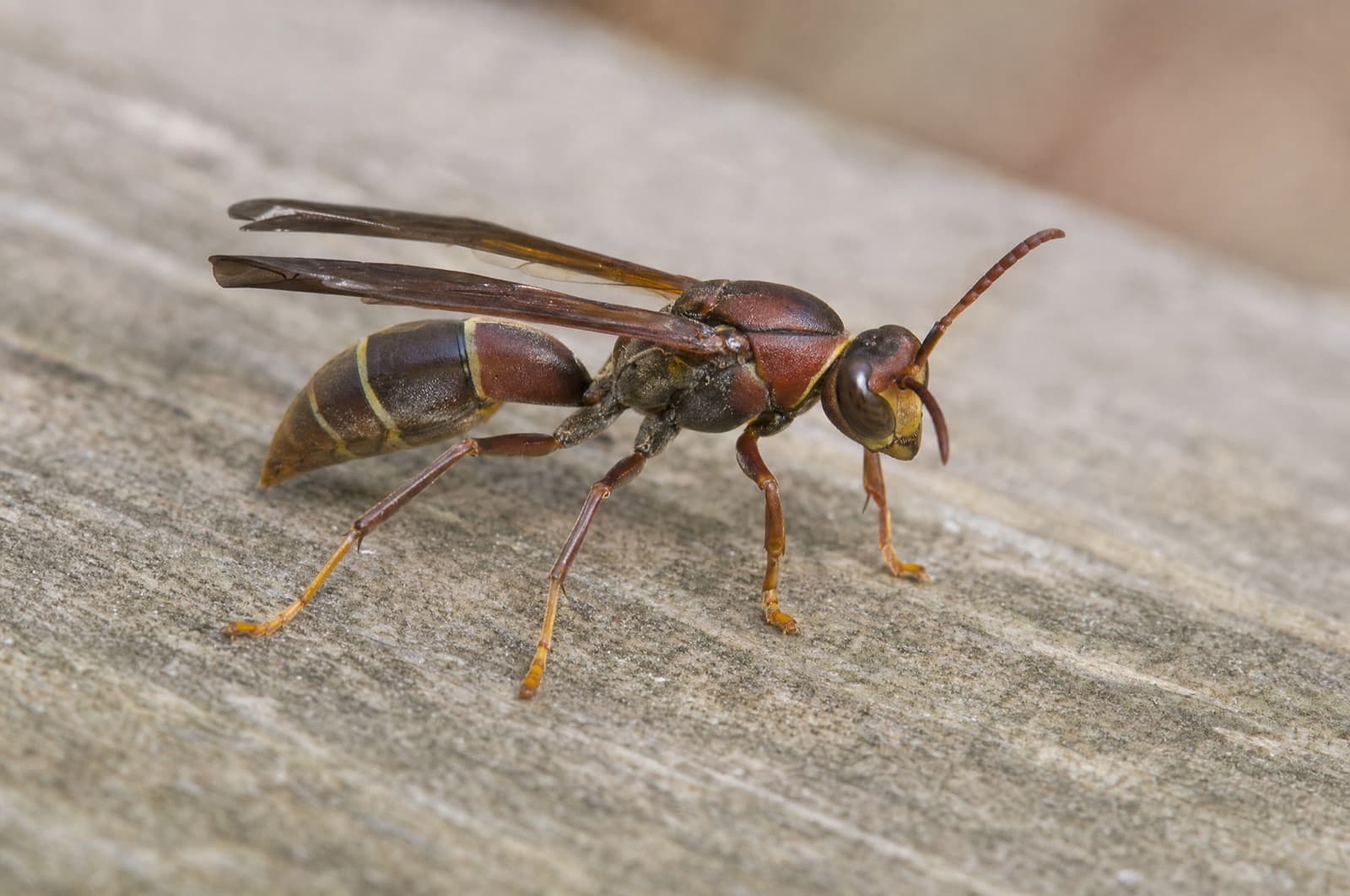
Paper Wasps in New Hampshire — ID, Sting, Nest & Removal
Quick facts
- Sting pain: Schmidt 3.0Described as 'caustic and burning… like spilling a beaker of hydrochloric acid on a paper cut' — higher than a yellowjacket (2.0); Britannica
- Size — native: 15–21 mmNorthern paper wasp (Polistes fuscatus); Animal Diversity Web / animaldiversity.org
- Size — invasive: 12–18 mmEuropean paper wasp (Polistes dominula); Penn State Extension / animaldiversity.org
- Invasive tell: Orange antennaeNo other social wasp in North America has orange antennae; Penn State Extension / Cornell CALS
Sting pain
Schmidt 3.0
Described as 'caustic and burning… like spilling a beaker of hydrochloric acid on a paper cut' — higher than a yellowjacket (2.0); Britannica
Size — native
15–21 mm
Northern paper wasp (Polistes fuscatus); Animal Diversity Web / animaldiversity.org
Size — invasive
12–18 mm
European paper wasp (Polistes dominula); Penn State Extension / animaldiversity.org
Invasive tell
Orange antennae
No other social wasp in North America has orange antennae; Penn State Extension / Cornell CALS
Two paper wasps call New Hampshire home — and only one has orange antennae
If you've found a flat, open honeycomb of gray paper cells hanging under your eave, soffit, porch railing, grill lid, or mailbox, you are looking at a paper wasp nest — and in New Hampshire you almost certainly have one of two species: the native northern paper wasp (Polistes fuscatus) or the invasive European paper wasp (Polistes dominula). Most ranking pages on the internet conflate them into one, but telling them apart matters, because their nesting habits and the places they choose differ in ways that affect where you find them and how often.
The single fastest field diagnostic: look at the antennae. European paper wasps have bright orange or reddish antennae. No other social wasp in North America does. If the antennae are black — as they are on yellowjackets, bald-faced hornets, and the native northern paper wasp — you are likely looking at a native or one of the other social wasps. That one visual cue sorts two-thirds of paper-wasp identification questions on the spot.
Both species are social wasps with small colonies (typically 10–30 workers at peak) that defend their nest actively when threatened. Their sting rates a 3.0 on the Schmidt sting pain index — notably higher than a yellowjacket's 2.0 — and unlike honey bees, paper wasps have a smooth stinger and can sting repeatedly. They are also genuinely beneficial: paper wasps are major predators of caterpillars and soft-bodied garden insects, earning them a place in the 'leave alone if possible' category when the nest is out of foot traffic.
When the nest is over a doorway, on a child's playset, or in any spot people routinely pass within a meter or two, that is a different calculus. This page covers everything you need to identify both NH paper wasps, understand how serious their sting is, and decide whether your nest warrants a call to a licensed professional.
Paper wasps in southern and central New Hampshire
Both the native northern paper wasp and the invasive European paper wasp are well established across southern and central New Hampshire — in Manchester, Nashua, Concord, Derry, Bedford, Salem, Hudson, and the surrounding Rockingham, Hillsborough, Merrimack, and Strafford county area. The native species is the paper wasp UNH Extension describes as 'a common New Hampshire species'; the European paper wasp has been spreading through the Northeast since its accidental introduction near Boston in 1978 and is now established in the state. Penn State Extension documents that in Michigan, European paper wasps have completely replaced northern paper wasps in some areas, and the same competitive pressure is evident in parts of New England. The NH colony calendar is governed by temperature and frost. Overwintered foundresses emerge once air temperatures exceed roughly 50°F — in southern NH that typically means late April through May. The colony expands through June and July, reaches peak size and defensiveness in August and early September (when cookout season and nest size overlap most dangerously), and collapses at the first hard frost. For Manchester and the southern tier of Anchor's service area, that first hard frost falls around October 19 (50% probability) or October 29 (80%), per NOAA 1991–2020 normals — roughly two to three weeks later than Concord or Keene. Manchester-area homeowners can realistically expect active paper-wasp colonies into late October. Foundresses overwinter in sheltered spots — inside wall voids, attics, behind siding and shutters, and under loose bark — which is why sluggish wasps appear indoors on warm fall days. Nests are NOT reused; every spring starts fresh with a single overwintered queen.
Species present in NH
- Northern paper wasp (Polistes fuscatus)
- European paper wasp (Polistes dominula)
We serve these communities
First-frost anchor: Manchester first hard frost ~Oct 19 (50%) / Oct 29 (80%) per NOAA 1991–2020 normals
UNH Cooperative Extension describes the northern paper wasp as 'a common New Hampshire species' and notes that mated females overwinter 'inside building walls, in attics, or under loose bark' — Resource000532.
- NH-licensed applicator · #782664
- Same-day service
- Family-owned since 2017
Service Area Map
Southern New Hampshire
How to identify paper wasps in New Hampshire — native vs. invasive
Paper wasps are slender, smooth-bodied wasps built very differently from the stocky yellowjacket. Three field marks will ID them in seconds — even in mid-flight.
Northern paper wasp
Also called: Brown paper wasp, Umbrella wasp
- Scientific name
- Polistes fuscatus
- Family
- Vespidae — subfamily Polistinae
- Sociality
- Social (colony)
- Size
- 15–21 mm
- Coloration
- Dark reddish-brown body with narrow yellow bands; cinnamon-toned abdominal markings; black antennae; long legs that dangle visibly in flight; brown wings
- Range
- Native throughout New Hampshire — the dominant native paper wasp, HIGH statewide prevalence; described by UNH Extension as 'a common New Hampshire species'
- Nest style
- Open, downward-facing single-layer paper comb on a short stalk (the 'umbrella'); attached to eaves, soffits, rafters, porch ceilings, and sheltered wood surfaces; NO outer envelope
- Sting
- Schmidt 3.0 — 'caustic and burning, distinctly bitter aftertaste, like spilling a beaker of hydrochloric acid on a paper cut' (Schmidt / Britannica); higher than a yellowjacket (2.0); can sting repeatedly
- Beneficial role
- Major predator of caterpillars and soft-bodied insects; minor pollinator
Colony size
~10–30 workers at peak
Social but smaller colonies than yellowjackets
Nest season
Founded late April–May; peaks August–September; collapses at frost
Males sting?
No — males lack stingers
Antennae
Black on the native northern paper wasp (Polistes fuscatus); bright orange or reddish on the invasive European paper wasp (Polistes dominula). Orange antennae are the single fastest tell for P. dominula — no other social wasp in North America has them.
Waist (petiole)
Conspicuously narrow and elongated — a long 'thread' connecting thorax and abdomen. This is noticeably more pronounced than on yellowjackets, which look chunky by comparison.
Legs
Long and slender; hang visibly below the body in flight ('dangling legs'). The single easiest flight-mode ID cue versus yellowjackets, which tuck their legs.
Abdomen
Tapered and elongated. Native northern paper wasp: dark reddish-brown with narrow yellow bands and cinnamon markings. European paper wasp: black with more extensive bright yellow bands — resembles a yellowjacket body at a glance, but antennae and leg behavior give it away.
Wings
Brown and translucent; held folded lengthwise at rest. Span roughly equal to body length. No metallic sheen.
Common look-alikes
Eastern yellowjacket (Vespula maculifrons)
How to tell: Yellowjackets are stockier and more compact with legs tucked against the body in flight; paper wasps are slender with dangling legs. Yellowjacket nests are enclosed in a papery envelope or hidden underground / in wall voids — never the open umbrella comb of a paper wasp. European paper wasps can fool you on color alone (both black-and-yellow), so always check legs in flight and nest structure.
Bald-faced hornet (Dolichovespula maculata)
How to tell: Bald-faced hornets are larger (12–19 mm), black-and-white rather than yellow-banded, and build a large enclosed gray football-shaped aerial nest with a single bottom entrance. Paper wasp nests are always open, flat, and smaller. Bald-faced hornets are taxonomically a yellowjacket relative, not a true hornet — see /bald-faced-hornet/ for depth.
European paper wasp vs. northern paper wasp
How to tell: Check the antennae first: orange or reddish = European paper wasp (Polistes dominula); black = northern paper wasp (Polistes fuscatus). Body color also differs: European paper wasp is black with bright yellow markings and orange legs; northern paper wasp is predominantly reddish-brown with narrower yellow bands. Both build the same open umbrella comb, but the European species also nests readily inside man-made cavities.
European hornet (Vespa crabro)
How to tell: European hornets are much larger — workers ~25 mm, queens to 35 mm — brown-and-yellow (not reddish-brown or black-and-yellow like paper wasps), and are frequently seen flying at night, attracted to lights. They build large enclosed paper nests in tree cavities, wall voids, and attics. NH's only true hornet — see /bald-faced-hornet/ for hornet depth.
Native vs. invasive paper wasp in New Hampshire
Prevalence based on UNH Cooperative Extension survey data.
| Species | Size | NH status | Prevalence | Typical nest |
|---|---|---|---|---|
Northern paper wasp Polistes fuscatus | 15–21 mm | Native | HIGH | Open umbrella comb under eaves, soffits, porch ceilings, barn rafters |
European paper wasp Polistes dominula | 12–18 mm | Invasive | Reported in NH | Umbrella comb; readily uses man-made cavities — pipes, grills, soffits, electrical boxes |
Frequently asked
Sources & further reading (12)
- [1]Britannica — Schmidt Sting Pain Index
encyclopedia · Paper wasp Schmidt 3.0 value and verbatim description; yellowjacket 2.0 · verified Jun 2026
- [2]Wikipedia — Schmidt Sting Pain Index
encyclopedia · Index history, species values, only bullet ant / tarantula hawk / warrior wasp at 4.0 · verified Jun 2026
- [3]Penn State Extension — European Paper Wasp
extension · Polistes dominula 1978 Boston/Cambridge introduction by G.C. Eickwort; orange antennae uniqueness; replacement of natives in Michigan; earlier worker production · verified Jun 2026
- [4]Animal Diversity Web — Polistes fuscatus
academic · Northern paper wasp size 15–21 mm; native range; biology · verified Jun 2026
- [5]Cornell CALS NYS IPM — Identifying Bees and Wasps
extension · Paper wasps warn without stinging; antenna coloration as ID cue; males lack stingers · verified Jun 2026
- [6]UNH Cooperative Extension — Controlling Wasps, Bees and Hornets Around Your Home
extension · Northern paper wasp as 'a common New Hampshire species'; NH overwintering sites (wall voids, attics, loose bark); after-dark treatment guidance · verified Jun 2026
- [7]Ohio State BYGL — Be Alert to European Paper Wasps
extension · Polistes dominula spread; earlier nesting season; cavity-nesting preference; 'paper wasps clad in yellowjacket clothing' · verified Jun 2026
- [8]Wikipedia — European Paper Wasp (Polistes dominula)
encyclopedia · P. dominula produces workers ~1 week earlier; co-foundress behavior; colony founding; nests not reused · verified Jun 2026
- [9]Wikipedia — Polistes fuscatus
encyclopedia · Northern paper wasp biology; single foundress per nest; nests not reused · verified Jun 2026
- [10]Baker & Potter 2020 — Invasive paper wasp turns urban pollinator gardens into ecological traps
academic · Polistes dominula as under-recognized predator of monarch butterfly larvae · verified Jun 2026
- [11]NOAA / The Old Farmer's Almanac — NH Frost Dates (Manchester / Concord, 1991–2020 normals)
gov · Manchester first hard frost ~Oct 19 (50%) / Oct 29 (80%); Concord late Sept–early Oct; NOAA 1991–2020 normals · verified Jun 2026
- [12]Northern New England Poison Center
medical · 24/7 poison control for NH/ME/VT; 1-800-222-1222 · verified Jun 2026
Written & reviewed by
VerifiedDaniel Brady
NH-Licensed Pesticide Applicator · License #782664 (NHDAMF, RSA 430)
Daniel Brady is the New Hampshire–licensed applicator behind Anchor Pest Services, a family-owned pest control company serving the Manchester area since 2017.
Last updated Jun 2026
Anchor Pest Services
Wasps gone — and they stay gone.
Same-day service across Southern New Hampshire. NH-licensed #782664, family-owned since 2017. We handle ground, wall, and aerial nests with EPA-registered products and an approximately 30-day re-treat guarantee.
- NH-licensed applicator
- Same-day service
- Pet & family-conscious
NH License #782664 · No obligation · We answer in person