
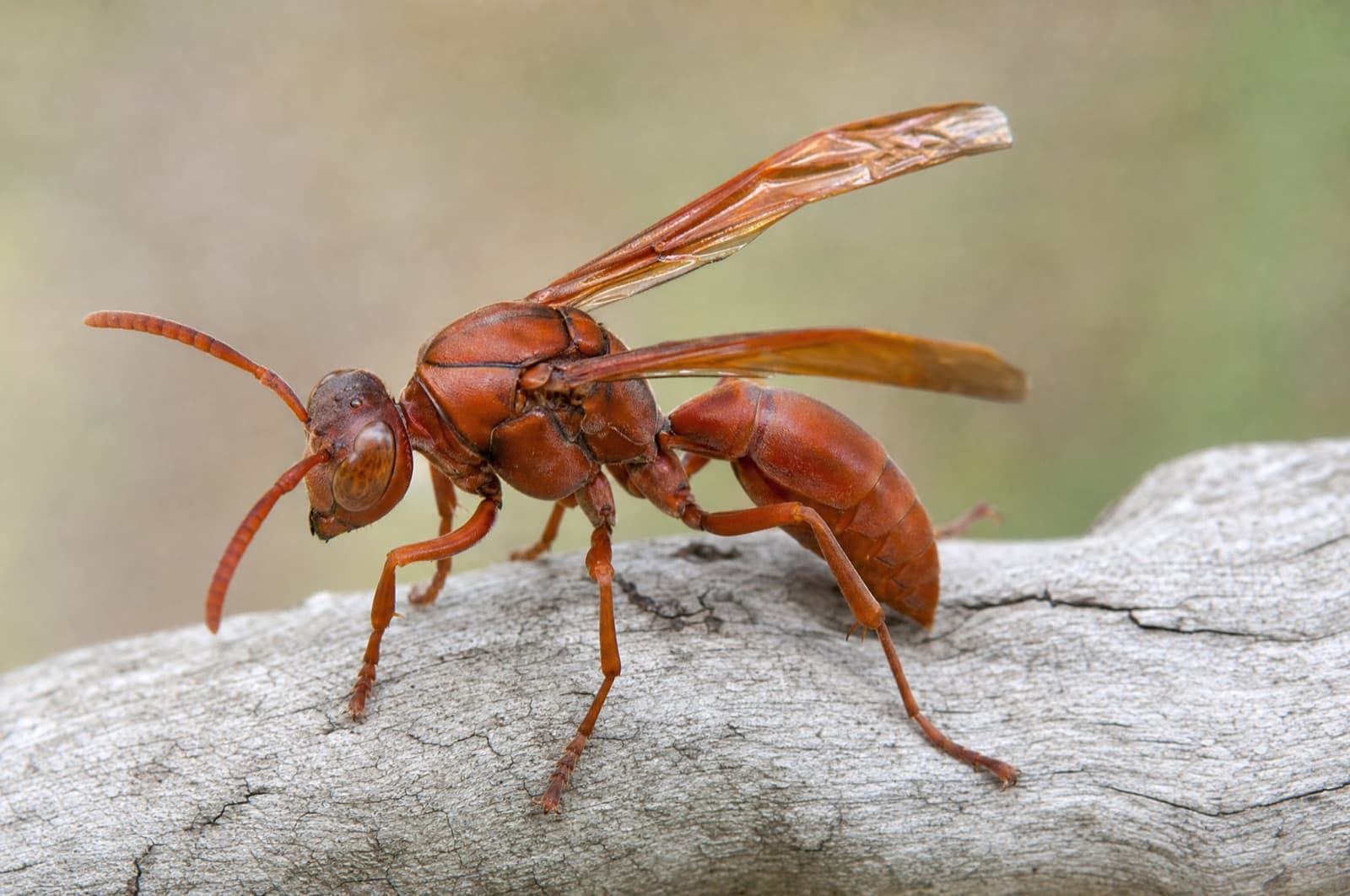
Red Wasp — ID, Sting & Will You See One in New Hampshire?
Quick facts
- True red wasp: Polistes carolina (Southern US)A Southeastern/south-central paper wasp, not a NH species; Wikipedia / UF/IFAS EENY640
- NH presence: Effectively absentNH sits north of its core range; reliable NH records are lacking
- What you see in NH instead: Northern paper wasp (P. fuscatus) or European paper wasp (P. dominula)Cornell CALS NYS IPM
- Size: 25–32 mmOne of the largest US paper wasps; some sources cite 20–25 mm for workers — Wikipedia / en.wikipedia.org/wiki/Polistes_carolina
True red wasp
Polistes carolina (Southern US)
A Southeastern/south-central paper wasp, not a NH species; Wikipedia / UF/IFAS EENY640
NH presence
Effectively absent
NH sits north of its core range; reliable NH records are lacking
What you see in NH instead
Northern paper wasp (P. fuscatus) or European paper wasp (P. dominula)
Cornell CALS NYS IPM
Size
25–32 mm
One of the largest US paper wasps; some sources cite 20–25 mm for workers — Wikipedia / en.wikipedia.org/wiki/Polistes_carolina
Is the red wasp in New Hampshire? No — and here is what you actually have
If you searched 'red wasp' because you spotted a reddish, paper-wasp-shaped insect on your New Hampshire porch, eave, or grill, this page will give you a straight answer before you go any further: the true red wasp — Polistes carolina and its close relative Polistes rubiginosus — is a Southeastern and south-central United States species. It is uncommon to effectively absent in New Hampshire, and you almost certainly did not see one.
What NH homeowners actually encounter when they see a reddish paper wasp is the native northern paper wasp (Polistes fuscatus), which has a reddish-brown body with narrow yellow bands, or — less often — the invasive European paper wasp. Both species are genuine New Hampshire residents. Their ID, sting risk, and nest behavior are covered in full on our paper wasp page (link below). This page covers what the true southern red wasp is, how to identify it nationally, why its sting is painful, and why the verdict for New Hampshire is an honest 'not here.'
That directness is the point. Most 'red wasp' pages online write generic national content that implies the species is everywhere. For a NH homeowner, that framing just adds confusion. The reddish wasp on your New Hampshire house has a name and a solution — it is just not Polistes carolina.
How to identify a red wasp — and what the reddish wasp in New Hampshire actually is
Red wasps share the same slender Polistes build as all paper wasps — narrow waist, long dangling legs, open umbrella comb. The key visual distinction from most other wasps is the nearly solid rust-red body with minimal banding.
Red wasp (Southern red paper wasp)
Also called: Carolina paper wasp, Red paper wasp
- Scientific name
- Polistes carolina (also P. rubiginosus, formerly P. perplexus)
- Family
- Vespidae — subfamily Polistinae
- Sociality
- Social (colony)
- Size
- 25–32 mm (one of the largest US paper wasps; some sources cite 20–25 mm for workers)
- Coloration
- Nearly uniform reddish-brown or rust-colored (ferruginous) body; very little yellow or black banding; dark purplish-black wings; long dangling legs typical of all Polistes paper wasps
- Range
- Southeastern and south-central United States — from New York, Ohio, and Pennsylvania south to Florida, west to Arkansas, Illinois, Kansas, and eastern Texas. Most abundant in the Deep South. Effectively absent in New Hampshire, which sits north of its core range.
- Nest style
- Open, downward-facing single-layer umbrella paper comb on a stalk, built in sheltered spots such as under eaves, in shrubs, and in wood structures — same architecture as all Polistes paper wasps
- Sting
- Schmidt 3.0 — 'caustic and burning, distinctly bitter aftertaste, like spilling a beaker of hydrochloric acid on a paper cut' (Schmidt / Britannica); higher than a yellowjacket (2.0); can sting repeatedly
- Beneficial role
- Predator of caterpillars and soft-bodied garden insects; contributes to natural pest control in its native southeastern range
Body coloration
Uniform reddish-brown to rust-red (ferruginous) — the defining feature. Unlike the native NH paper wasp (P. fuscatus), which is reddish-brown with visible yellow bands, or the European paper wasp (P. dominula), which is black-and-yellow, P. carolina has very little contrasting banding. The 'all red' appearance is the fastest ID cue.
Wings
Dark purplish-black — notably darker than the brown/amber wings of most NH paper wasps. At rest, wings fold lengthwise along the body.
Waist (petiole)
Conspicuously narrow and elongated — the hallmark of all Polistes paper wasps. More pronounced than on yellowjackets or hornets.
Legs
Long and slender; hang visibly below the body in flight ('dangling legs'). This is the in-flight ID cue shared by all paper wasps and distinguishes them from stocky, legs-tucked yellowjackets.
Common look-alikes
Northern paper wasp (Polistes fuscatus) — the NH look-alike
How to tell: The native northern paper wasp is the reddish-brown wasp NH homeowners almost always mistake for a 'red wasp.' P. fuscatus has a dark reddish-brown body but shows visible narrow yellow bands on the abdomen and cinnamon abdominal markings — it is not the solid rust-red of P. carolina. It also has black antennae. If you are in New Hampshire, the reddish paper wasp on your eave is P. fuscatus — see the paper wasp page for full ID and removal guidance.
European paper wasp (Polistes dominula) — the NH cavity nester
How to tell: The European paper wasp is black with bright yellow markings and distinctive orange or reddish antennae — the only North American social wasp with orange antennae. Its body is not reddish-brown; it looks more like a yellowjacket. It is commonly found in NH on soffits, grills, pipes, and man-made cavities. Orange antennae = European paper wasp; reddish-brown body = northern paper wasp. Neither is the Southern red wasp.
Polistes rubiginosus (coarse-backed red wasp)
How to tell: P. rubiginosus is the sister species to P. carolina — both are rust-red Southern paper wasps. P. rubiginosus has a coarser, more textured dorsal surface on the abdomen compared to P. carolina's finer surface. Both are absent in New Hampshire and are southeastern species. LSU AgCenter documents the distinction for the Deep South region where both occur.
Frequently asked
Sources & further reading (10)
- [1]Wikipedia — Polistes carolina
encyclopedia · P. carolina size 25–32 mm; range NY/OH/PA south to FL, west to TX/NE; dark purplish-black wings; two southern red species · verified Jun 2026
- [2]UF/IFAS Featured Creatures — Polistes carolina (EENY640)
extension · P. carolina range; 'most commonly associated with the eastern and south-central United States'; Deep South abundance · verified Jun 2026
- [3]LSU AgCenter — Red Paper Wasps
extension · Two southern red wasp species: P. carolina (fine-backed) vs P. rubiginosus (coarse-backed) · verified Jun 2026
- [4]PLOS ONE — Nest foundress number in Polistes carolina
academic · Approximately 80% of P. carolina nests founded by a single foundress · verified Jun 2026
- [5]Cornell CALS NYS IPM — Identifying Bees and Wasps
extension · NH reddish wasps are almost always P. fuscatus (native northern paper wasp), not P. carolina; antenna coloration as ID cue · verified Jun 2026
- [6]Britannica — Schmidt Sting Pain Index
encyclopedia · Paper wasp (all Polistes) Schmidt 3.0; verbatim description 'caustic and burning…' · verified Jun 2026
- [7]Wikipedia — Schmidt Sting Pain Index
encyclopedia · Index history; paper wasp 3.0; yellowjacket 2.0; only bullet ant / tarantula hawk / warrior wasp at 4.0 · verified Jun 2026
- [8]UNH Cooperative Extension — Controlling Wasps, Bees and Hornets Around Your Home
extension · Northern paper wasp (P. fuscatus) as 'a common New Hampshire species'; NH overwintering biology · verified Jun 2026
- [9]Penn State Extension — European Paper Wasp
extension · Polistes dominula orange antennae unique among NA social wasps; invasive spread in Northeast; P. fuscatus vs P. dominula ID · verified Jun 2026
- [10]Northern New England Poison Center
medical · 24/7 poison control for NH/ME/VT; 1-800-222-1222 · verified Jun 2026
Written & reviewed by
VerifiedDaniel Brady
NH-Licensed Pesticide Applicator · License #782664 (NHDAMF, RSA 430)
Daniel Brady is the New Hampshire–licensed applicator behind Anchor Pest Services, a family-owned pest control company serving the Manchester area since 2017.
Last updated Jun 2026
Anchor Pest Services
Wasps gone — and they stay gone.
Same-day service across Southern New Hampshire. NH-licensed #782664, family-owned since 2017. We handle ground, wall, and aerial nests with EPA-registered products and an approximately 30-day re-treat guarantee.
- NH-licensed applicator
- Same-day service
- Pet & family-conscious
NH License #782664 · No obligation · We answer in person