
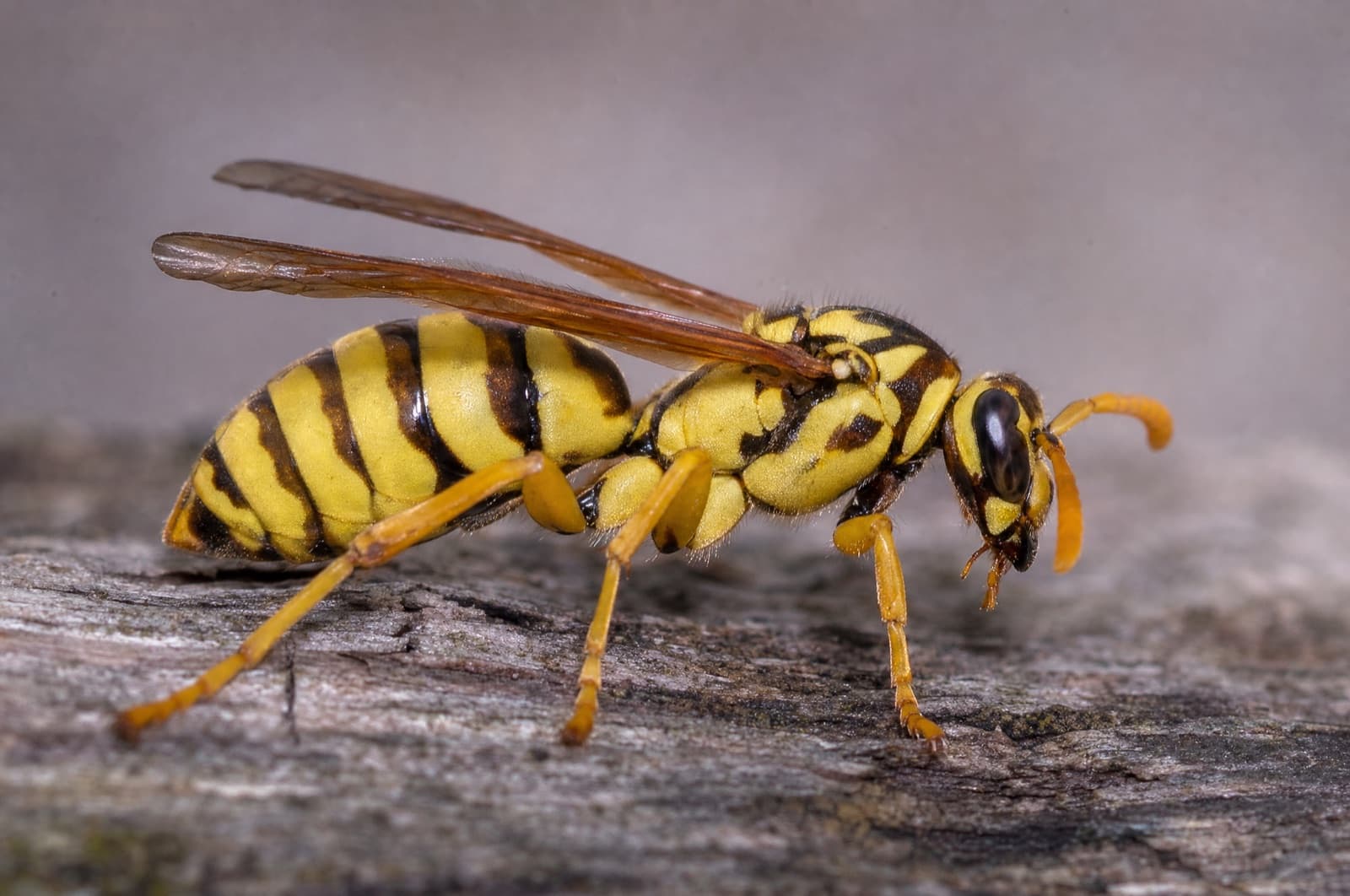
Executioner Wasp — World's Worst Sting & Why It's Not in the US
Quick facts
- What it is: Tropical paper wasp (Polistes carnifex)Vespidae — subfamily Polistinae; a paper wasp, not a hornet
- Range: Mexico to Argentina — Neotropical onlyNot established in the continental United States; Wikipedia / en.wikipedia.org/wiki/Polistes_carnifex
- In NH or the US?: No — not established in the continental US or New HampshireOnly extraordinarily rare strays outside its native range
- Size: 24–27 mm typical; max ~33 mmLargest Neotropical Polistes; Wikipedia / en.wikipedia.org/wiki/Polistes_carnifex
What it is
Tropical paper wasp (Polistes carnifex)
Vespidae — subfamily Polistinae; a paper wasp, not a hornet
Range
Mexico to Argentina — Neotropical only
Not established in the continental United States; Wikipedia / en.wikipedia.org/wiki/Polistes_carnifex
In NH or the US?
No — not established in the continental US or New Hampshire
Only extraordinarily rare strays outside its native range
Size
24–27 mm typical; max ~33 mm
Largest Neotropical Polistes; Wikipedia / en.wikipedia.org/wiki/Polistes_carnifex
Not in New Hampshire. Not in the United States. Here's the real story.
If you searched for the executioner wasp, you almost certainly found a viral video of wildlife YouTuber Coyote Peterson allowing one to sting him — and a cascade of headlines calling it the most painful sting on Earth, or even a '4.0' on the Schmidt index. Before anything else: the executioner wasp is a tropical species from Central and South America, and you will not encounter it in New Hampshire or anywhere in the continental United States. That verdict is unambiguous, not a close call.
Polistes carnifex is a paper wasp — not a hornet, and emphatically not the 'murder hornet' (Vespa mandarinia), which is an entirely different insect from a different genus. The murder hornet itself was declared eradicated from Washington State and the entire United States on December 18, 2024, after three years without a confirmed detection. Neither insect belongs to North American ecosystems north of Mexico.
The '4.0 Schmidt' claim attached to the executioner wasp is popular online but appears nowhere in Schmidt's published research. Justin Schmidt's original 1983 work rated only the bullet ant (Paraponera clavata) at 4.0; the 1990 paper added the tarantula hawk (Pepsis grossa) and warrior wasp (Synoeca septentrionalis) at that level. No credible entomological source lists Polistes carnifex. Fact Animal, reviewing the evidence, notes that the precise '4.0' claim 'doesn't seem to be backed up anywhere.' The sting is painful — Coyote Peterson's reaction makes that clear — but 'painful and viral' is not the same as 'assigned a peer-reviewed pain value.'
What this page covers: accurate biology of the executioner wasp, an honest look at what its sting reputation is and is not, a clear disambiguation from the murder hornet, and — most usefully for anyone in New Hampshire — a direct link to the paper wasps you actually do have in our area.
What is the executioner wasp — and is it here?
The executioner wasp has the classic build of a large Polistes paper wasp: a slender, elongated body with a conspicuously narrow waist (petiole), long legs that dangle in flight, and yellow-and-dark banding. It is not the thickset, blunt-headed silhouette of a hornet. For comparison, the northern giant hornet — the 'murder hornet' — has a distinctly oversized orange head and a body that can exceed 45 mm. The executioner wasp at 24–27 mm looks like what it is: a large tropical paper wasp.
Executioner wasp
Also called: Carnifex paper wasp
- Scientific name
- Polistes carnifex
- Family
- Vespidae — subfamily Polistinae
- Sociality
- Social (colony)
- Size
- 24–27 mm typical; max ~33 mm (largest Neotropical Polistes)
- Coloration
- Yellow body with brown or blackish bands; yellow antennae with a dark base; resembles a large paper wasp rather than a hornet — open umbrella comb, not an enclosed nest
- Range
- Neotropical — Mexico to Argentina; not established in NH or the continental United States. Extraordinarily rare accidental strays near the US–Mexico border only.
- Nest style
- Open downward-facing umbrella paper comb under eaves or branches — same basic architecture as North American Polistes paper wasps, but not found in NH
- Sting
- Painful, but no peer-reviewed Schmidt index value has been published for this species. The widely cited '4.0+' claim is anecdotal, originating from a viral Coyote Peterson sting video — not from Schmidt's published research. The only Schmidt 4.0 species are the bullet ant, tarantula hawk, and warrior wasp.
- Beneficial role
- Predator of insects in its native Neotropical habitat — performs the same caterpillar-hunting role as other paper wasps
In NH / US?
No — tropical species, absent from the continental US
Cannot establish in New England's climate
Is it a hornet?
No — it is a paper wasp (Polistes), not a hornet
Hornets belong to genera Vespa and Dolichovespula
Schmidt value
None published in peer-reviewed literature
Wikipedia / Britannica Schmidt index listings
Body size
24–27 mm typical, with the largest individuals reaching approximately 33 mm — the largest paper wasp in the Neotropical region. For scale, a US quarter is 24.26 mm in diameter.
Coloration
Yellow with brown or blackish bands. The antennae are yellow with a dark base — distinctly different from the orange antennae of the European paper wasp (Polistes dominula) or the fully black antennae of the native northern paper wasp (Polistes fuscatus).
Waist (petiole)
Narrow and elongated, as in all Polistes paper wasps. Not the thick, barrel-chested build of a hornet.
Nest
Open downward-facing umbrella comb — the same paper-wasp architecture found in Polistes fuscatus and Polistes dominula nests in New Hampshire. No outer papery envelope. Not found in NH or the US.
Common look-alikes
Northern giant hornet ('murder hornet') — Vespa mandarinia
How to tell: Entirely different insect. The murder hornet is a true hornet (genus Vespa) with a conspicuously large orange head, a body up to ~45 mm, and a thick, wasp-waisted silhouette nothing like a paper wasp. It also built enclosed social paper nests — not the open Polistes umbrella comb. Critically, the northern giant hornet was declared eradicated from Washington State and the entire United States on December 18, 2024. It was never found in New Hampshire or New England. The executioner wasp and the murder hornet are not the same animal and share no special relationship beyond both being stinging Hymenoptera.
Northern paper wasp — Polistes fuscatus (the NH species you actually have)
How to tell: The native NH paper wasp is 15–21 mm, dark reddish-brown with narrow yellow bands and black antennae, and builds open umbrella combs under eaves and soffits across southern and central New Hampshire. It is common, it is here, and its sting rates Schmidt 3.0. If you are in NH looking at a paper wasp, this is the far more likely candidate. See /wasp-species/paper-wasp for full ID guidance.
European paper wasp — Polistes dominula (invasive, also common in NH)
How to tell: The invasive European paper wasp is 12–18 mm, black with bright yellow markings, and has distinctive orange antennae — unique among North American social wasps. It builds open umbrella combs readily in man-made cavities. It arrived near Boston in 1978 and is now medium-to-high prevalence in NH and increasing. Like the native paper wasp, it rates Schmidt 3.0. If you see a paper wasp in NH with orange antennae, this is your species — not the executioner wasp.
Frequently asked
Sources & further reading (8)
- [1]Wikipedia — Polistes carnifex
encyclopedia · Executioner wasp Neotropical range (Mexico to Argentina); body size 24–27 mm max ~33 mm; largest Neotropical Polistes; common name from Latin carnifex; yellow with brown/black bands · verified Jun 2026
- [2]Wikipedia — Schmidt Sting Pain Index
encyclopedia · Only bullet ant, tarantula hawk, and warrior wasp assigned 4.0; no listing for Polistes carnifex; index history and peer-reviewed entries · verified Jun 2026
- [3]Britannica — Schmidt Sting Pain Index
encyclopedia · Paper wasp (Polistes) Schmidt 3.0 — 'caustic and burning'; index framing and verified species values · verified Jun 2026
- [4]Fact Animal — Executioner Wasp
encyclopedia · Assessment that the '4.0' Schmidt claim for the executioner wasp 'doesn't seem to be backed up anywhere'; viral vs. peer-reviewed distinction · verified Jun 2026
- [5]WSDA / USDA — Northern Giant Hornet Eradicated (December 18, 2024)
gov · Murder hornet (Vespa mandarinia) declared eradicated from Washington State and the entire US on Dec 18, 2024; never found in NH or New England · verified Jun 2026
- [6]Penn State Extension — European Paper Wasp
extension · The real NH paper wasps — Polistes dominula biology, 1978 Boston introduction; pivot from executioner wasp to species NH residents actually encounter · verified Jun 2026
- [7]UNH Cooperative Extension — Controlling Wasps, Bees and Hornets Around Your Home
extension · Northern paper wasp (Polistes fuscatus) as common NH species; NH paper wasp biology and control; the actual species NH residents encounter · verified Jun 2026
- [8]Northern New England Poison Center
medical · 24/7 poison control for NH/ME/VT; 1-800-222-1222; anaphylaxis emergency resource · verified Jun 2026
Written & reviewed by
VerifiedDaniel Brady
NH-Licensed Pesticide Applicator · License #782664 (NHDAMF, RSA 430)
Daniel Brady is the New Hampshire–licensed applicator behind Anchor Pest Services, a family-owned pest control company serving the Manchester area since 2017.
Last updated Jun 2026
Anchor Pest Services
Wasps gone — and they stay gone.
Same-day service across Southern New Hampshire. NH-licensed #782664, family-owned since 2017. We handle ground, wall, and aerial nests with EPA-registered products and an approximately 30-day re-treat guarantee.
- NH-licensed applicator
- Same-day service
- Pet & family-conscious
NH License #782664 · No obligation · We answer in person
Your next step
- Next step
What happens if you leave a wasp nest in place?
Read the answer - What to do next
Chemical Wasp & Hornet Control: Aerosols, Timing & Allergy Safety
Read the answer - Also relevant
Wasp vs Hornet — How to Tell Them Apart (New Hampshire Guide)
Read the answer - Also relevant
Paper Wasp — Quick ID for New Hampshire Homeowners
Read the answer - Related guide
Wasp vs Hornet — How to Tell Them Apart (New Hampshire Guide)
Read the answer - Related guide
Great Black Wasp — What It Is & Whether It Stings in NH
Read the answer