
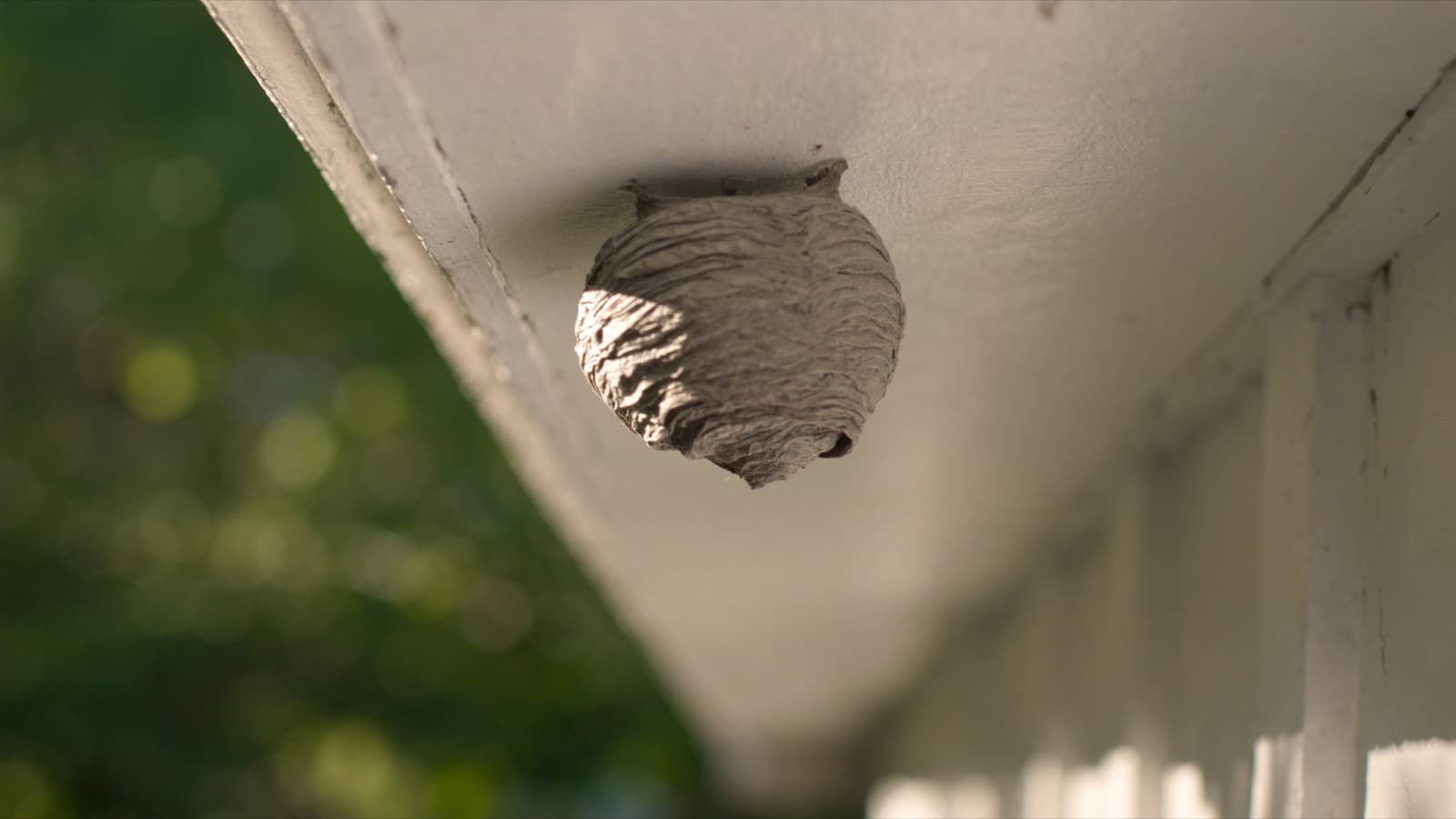
Can Neglected Nests Cause Damage to My House?
At a Glance
- The call: An old, finished wasp nest isn't itself a structural threat — the real secondary risk is a carpet-beetle problem it can seed. Full damage guidance lives elsewhere.
- Your nest: Any species, in October
Should you do this? It depends entirely on which nest
The generic question has no generic answer. Your nest is one row below — the others are the argument that this page isn't just selling you a “no.”
One question, six honest answers — one per nest.
- Mud dauber (solitary)
Solitary — no colony to defend, essentially no swarm response. Not on the router's danger end at all.
Go - Paper wasp — small, exposed, early-season nest
Low-to-moderate risk before workers hatch and while the nest is reachable — gear and timing genuinely earn their keep here.
Go with gear - Yellowjacket (aerial, ground, or unknown)
Large, coordinated colony defense; ground nests add vibration triggers and concealment.
No-go - Bald-faced hornet
Large aerial colony, aggressive when disturbed, often high off the ground.
No-go - European hornet
Concealed cavity nests plus nighttime activity defeat the usual safe-timing rule other species allow.
No-go - Any species, in OctoberYour nest
By the time a sustained hard freeze has come through, the colony is already finished and the nest will never be reused.
Do nothing
“Is it safe to remove a wasp nest?” has no answer. “Is it safe to remove THIS nest?” has six.
Derived from: /top-diy-methods per-species verdicts (mud-dauber diy_friendly, paper-wasp doable_with_care, yellowjacket / bald-faced-hornet / European hornet pro_recommended) + /winter-pests-shift/wasps (colony dies at a sustained hard freeze; the nest is never reused).
The full picture
What an old nest is, and isn't
A paper-wasp or yellowjacket nest is built from wood fiber the colony chews and mixes with saliva, producing a papery material that isn't structurally load-bearing and doesn't consume or weaken the wood of a house the way, say, a wood-destroying insect would. In southern New Hampshire a colony finishes for the year once the first sustained hard freeze arrives — around Manchester (USDA zone 5b–6a) that typically follows the average first 32°F freeze near October 19 by a few weeks — after which an inactive nest sitting under an eave or in a corner is largely inert.
The real secondary risk: carpet beetles
Abandoned bee and wasp nests are a documented harborage for dermestid, or carpet, beetles — their larvae feed on the dead brood, cast skins, and general debris left behind in an old nest, and once established there, they can migrate into a home and damage fabric, stored food, or other organic material. This is the genuinely relevant 'neglect' risk, and it's a reason not to leave an old in-wall or attic nest indefinitely, even though the wasps themselves are gone.
Where the structural damage question actually lives
In-wall nests can raise moisture and decay questions tied to how the nest was built and where, which is a genuine structural topic — but it's a separate one from this hub's job, and we don't derive a damage verdict here. Our dedicated resource on pest-related structural damage and risk covers that ground fully; this page's role is just to place the old-nest question correctly, not re-answer it.
The honest line — An old, finished wasp nest isn't itself a structural threat — the real secondary risk is a carpet-beetle problem it can seed. Full damage guidance lives elsewhere.
Key takeaways
- An old, finished wasp nest is not itself a significant structural threat to a house.
- The real secondary risk is dermestid (carpet) beetles using the old nest's debris as a breeding site.
- In-wall nests raise separate moisture/decay questions that are a structural topic in their own right.
- Full structural-damage guidance lives on our dedicated damage-and-risks resource, not here.
Where to go next
Identification, sting treatment, per-species DIY viability, and nest-reuse facts each live on the hub that owns them. We route, we don't rebuild.
DIY viability by species
The router's source of truth — which nests are DIY-able.
Go thereIdentify the species
Tell the wasps, hornets, and lookalikes apart.
Go thereSting & allergy treatment
What to do about a sting or a reaction.
Go thereNest reuse & winter
The colony dies at frost; the nest is never reused.
Go thereDamage & structural risk
Nests in walls and siding — the real risk.
Go there
Worried about an old nest and a possible secondary pest problem?
A licensed technician can check for carpet-beetle activity while removing an old nest, if you'd rather not do it yourself.
Frequently asked questions
Sources(3)
- [1]University of Maryland Extension — Social Wasps: Yellowjackets, Hornets and Paper Waspsextensionverified 2026-07-17
- [2]UNH Cooperative Extension — Bees, Wasps and Hornetsextensionverified 2026-07-17
- [3]Virginia Tech Extension — Yellowjackets, Hornets and Paper Wasps (ENTO-49)extensionverified 2026-07-17
Written & reviewed by
VerifiedDaniel Brady
NH-Licensed Pesticide Applicator · License #782664 (NHDAMF, RSA 430)
Daniel Brady is the New Hampshire–licensed applicator behind Anchor Pest Services, a family-owned pest control company serving the Manchester area since 2017.
Last updated 2026-07-17
No emergency here
Old nest, low urgency — we can still take it off your hands
For structural damage questions specifically, our damage-and-risks resource has the full picture.
- Family-owned since 2017
- NH License #782664, category F1 (RSA 430, NHDAMF)
- Member, NEPMA