
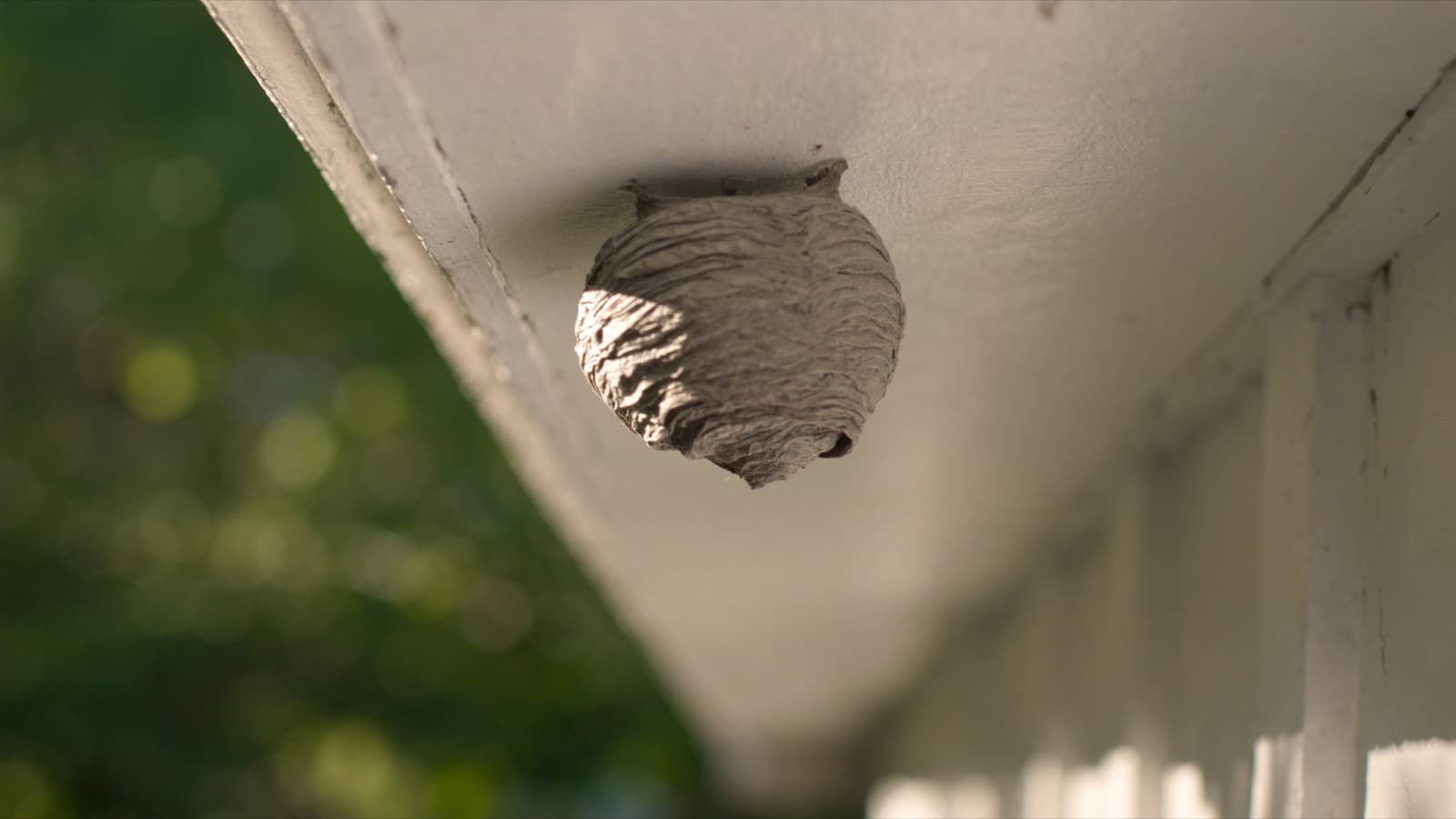
Do Hornets Return to Old Nesting Locations After Removal?
At a Glance
- The call: No, not the same colony to the same nest — that colony is annual and ends for the season regardless of removal. A new queen may still find the same general area appealing next year.
- Your nest: Bald-faced hornet
Should you do this? It depends entirely on which nest
The generic question has no generic answer. Your nest is one row below — the others are the argument that this page isn't just selling you a “no.”
One question, six honest answers — one per nest.
- Mud dauber (solitary)
Solitary — no colony to defend, essentially no swarm response. Not on the router's danger end at all.
Go - Paper wasp — small, exposed, early-season nest
Low-to-moderate risk before workers hatch and while the nest is reachable — gear and timing genuinely earn their keep here.
Go with gear - Yellowjacket (aerial, ground, or unknown)
Large, coordinated colony defense; ground nests add vibration triggers and concealment.
No-go - Bald-faced hornetYour nest
Large aerial colony, aggressive when disturbed, often high off the ground.
No-go - European hornet
Concealed cavity nests plus nighttime activity defeat the usual safe-timing rule other species allow.
No-go - Any species, in October
By the time a sustained hard freeze has come through, the colony is already finished and the nest will never be reused.
Do nothing
“Is it safe to remove a wasp nest?” has no answer. “Is it safe to remove THIS nest?” has six.
Derived from: /top-diy-methods per-species verdicts (mud-dauber diy_friendly, paper-wasp doable_with_care, yellowjacket / bald-faced-hornet / European hornet pro_recommended) + /winter-pests-shift/wasps (colony dies at a sustained hard freeze; the nest is never reused).
The full picture
Why the old nest and colony are finished either way
Social wasp colonies are annual. Only newly mated queens survive winter at all, overwintering alone in leaf litter, loose bark, or similar shelter — every worker, and the old queen, die off once the weather turns. There is no fixed number of weeks that guarantees this: a single light frost is often not enough, and well-insulated ground or wall-void nests can survive several frosts before a colony is actually finished. What reliably ends the colony is a sustained hard freeze, air temperatures well down into the twenties Fahrenheit for a real stretch. Around Manchester (USDA hardiness zone 5b–6a) the ordinary first 32°F freeze averages near October 19 (National Weather Service climate normals), and the deeper sustained freeze that actually finishes a colony typically follows that by some weeks, later in autumn. This applies to bald-faced hornets and European hornets the same way it applies to yellowjackets and paper wasps — none of them survive as a colony into the next year, and none of them reuse the nest structure itself, removed or not.
What actually can happen the following spring
A single mated queen that survived winter separately may found a brand-new nest from scratch nearby, sometimes at a very similar spot, because whatever made the original location appealing — height, shelter, concealment for a European hornet's cavity-nesting habit — is still true. This is a new, unrelated hornet making an independent choice, not evidence that hornets 'remember' or return to a specific old nest.
What removal does and doesn't accomplish
Removing an old hornet nest doesn't prevent a new one from appearing nearby next season, since that decision belongs to a new queen responding to the location's general appeal, not to the presence of the old structure. It does eliminate any secondary risks tied to the old nest itself and satisfies a reasonable wish to be rid of it, but it isn't a guarantee against a new nest at a similar spot the following year.
The honest line — No, not the same colony to the same nest — that colony is annual and ends for the season regardless of removal. A new queen may still find the same general area appealing next year.
Key takeaways
- Hornet colonies are annual — the colony that built a nest does not survive into the next year.
- The exact nest is never reused by hornets or any other wasp.
- A new queen may choose a similar nearby location next spring, independent of the old nest's presence.
- Removal doesn't prevent a new nest nearby next season, though it addresses the old structure itself.
Where to go next
Identification, sting treatment, per-species DIY viability, and nest-reuse facts each live on the hub that owns them. We route, we don't rebuild.
DIY viability by species
The router's source of truth — which nests are DIY-able.
Go thereIdentify the species
Tell the wasps, hornets, and lookalikes apart.
Go thereSting & allergy treatment
What to do about a sting or a reaction.
Go thereNest reuse & winter
The colony dies at frost; the nest is never reused.
Go there
Concerned about a similar nest reappearing?
If the same spot keeps attracting hornets year after year, a licensed technician can help address the location itself.
Frequently asked questions
Sources(4)
- [1]University of Maryland Extension — Social Wasps: Yellowjackets, Hornets and Paper Waspsextensionverified 2026-07-17
- [2]Penn State Extension — Getting Rid of Paper Wasps, Yellowjackets and Other Stinging Insectsextensionverified 2026-07-17
- [3]UNH Cooperative Extension — Bees, Wasps and Hornetsextensionverified 2026-07-17
- [4]NOAA National Weather Service — Gray/Portland, ME Forecast Office climate normals
Manchester, NH average first fall 32°F freeze near October 19
govverified 2026-07-17
Written & reviewed by
VerifiedDaniel Brady
NH-Licensed Pesticide Applicator · License #782664 (NHDAMF, RSA 430)
Daniel Brady is the New Hampshire–licensed applicator behind Anchor Pest Services, a family-owned pest control company serving the Manchester area since 2017.
Last updated 2026-07-17
The season already handled this one
This colony is finished — no need to chase it further
If a new nest shows up next spring, that's a fresh decision, and we're here when it is.
- Family-owned since 2017
- NH License #782664, category F1 (RSA 430, NHDAMF)
- Member, NEPMA