
Do Sprays Adequately Target the Colony's Queen?
At a Glance
- The call: An aerosol spray kills wasps it directly contacts. On a concealed nest, that often means the spray never reaches the queen or brood at the core.
The short of it
An aerosol spray kills wasps it directly contacts. On a concealed nest, that often means the spray never reaches the queen or brood at the core.
The full picture
Why contact sprays work differently depending on nest type
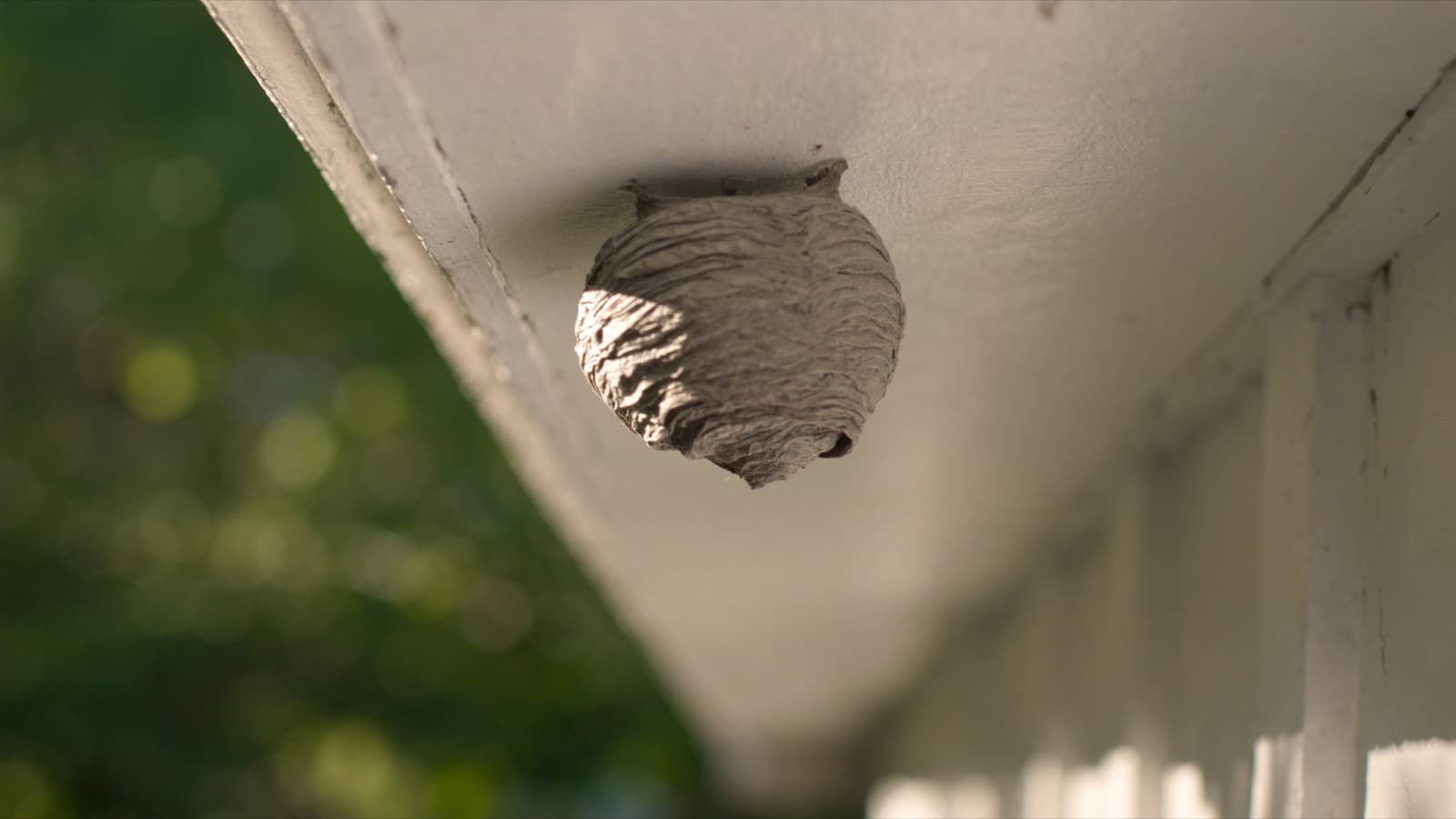
An aerosol spray is a contact-kill tool: it works on whatever it physically touches. For a small, exposed paper-wasp nest — the kind sitting under an eave in full view — a direct jet spray can reach most or all of the colony, queen included, in one treatment. For a concealed nest, whether that's underground, inside a wall void, or in an attic, the spray simply can't get past the entrance to the actual comb where the queen and brood are. Michigan State University Extension notes plainly that aerosols generally can't reach the nest core in these situations.
Why fewer wasps flying around doesn't mean the queen is gone
A drop in visible activity at a concealed nest's entrance after spraying can look like success, but it may only mean the workers encountered near the opening were killed while the queen, protected deeper in the structure, continued laying eggs. That's part of why a nest that seemed "treated" can show renewed activity days later — the core of the colony was never actually reached.
What reaches a concealed colony more reliably
Penn State Extension notes that insecticide dusts, which foraging or returning workers carry into the nest themselves, tend to reach a concealed colony's core more effectively than a surface spray aimed at an entrance hole. For a nest that's genuinely concealed or defended, that's part of why this hub and /top-diy-methods route the situation to a professional rather than a repeat-spray approach.
The honest line — An aerosol spray kills wasps it directly contacts. On a concealed nest, that often means the spray never reaches the queen or brood at the core.
Key takeaways
- Aerosol sprays are contact-kill tools — they kill what they physically reach, not the whole nest automatically.
- A small, exposed paper-wasp nest can usually be fully treated with a direct spray, queen included.
- Concealed ground, wall-void, or attic nests often keep the queen and brood untouched even when entrance activity drops.
- Reduced visible activity after spraying is not reliable proof the queen or colony is dead.
- Insecticide dusts carried in by workers generally reach a concealed nest's core more effectively than a spray.
Where to go next
Identification, sting treatment, per-species DIY viability, and nest-reuse facts each live on the hub that owns them. We route, we don't rebuild.
DIY viability by species
The router's source of truth — which nests are DIY-able.
Go thereIdentify the species
Tell the wasps, hornets, and lookalikes apart.
Go thereSting & allergy treatment
What to do about a sting or a reaction.
Go thereNest reuse & winter
The colony dies at frost; the nest is never reused.
Go there
Sprayed once and activity came back?
That's a common sign the queen was never reached. Anchor can treat the actual core of the nest.
Frequently asked questions
Sources(3)
- [1]Michigan State University Extension — Getting Rid of Wasp Nests
Aerosol sprays often fail to reach the core of a concealed nest
extensionverified 2026-07-17 - [2]Penn State Extension — Getting Rid of Paper Wasps, Yellowjackets and Other Stinging Insects
Insecticide dusts carried in by workers reach concealed nest cores more effectively than sprays
extensionverified 2026-07-17 - [3]Cornell IPM — Yellowjackets and baldfaced hornets
Eastern yellowjacket (Vespula maculifrons) as the common Northeast/New Hampshire yellowjacket, nesting in concealed cavities
extensionverified 2026-07-17
Written & reviewed by
VerifiedDaniel Brady
NH-Licensed Pesticide Applicator · License #782664 (NHDAMF, RSA 430)
Daniel Brady is the New Hampshire–licensed applicator behind Anchor Pest Services, a family-owned pest control company serving the Manchester area since 2017.
Last updated 2026-07-17

When spraying isn't enough
A quiet entrance doesn't mean a dead queen
If activity has returned after a DIY spray attempt, a licensed technician can treat the nest's actual core.
- Family-owned since 2017
- NH License #782664, category F1 (RSA 430, NHDAMF)
- Member, NEPMA