
How Close Should I Stay When Spraying or Removing a Wasp Nest?
At a Glance
- The call: Roughly ten feet or more, off to the side rather than underneath, is real guidance — but it only makes removal safe for the nests this hub already says are DIY-eligible.
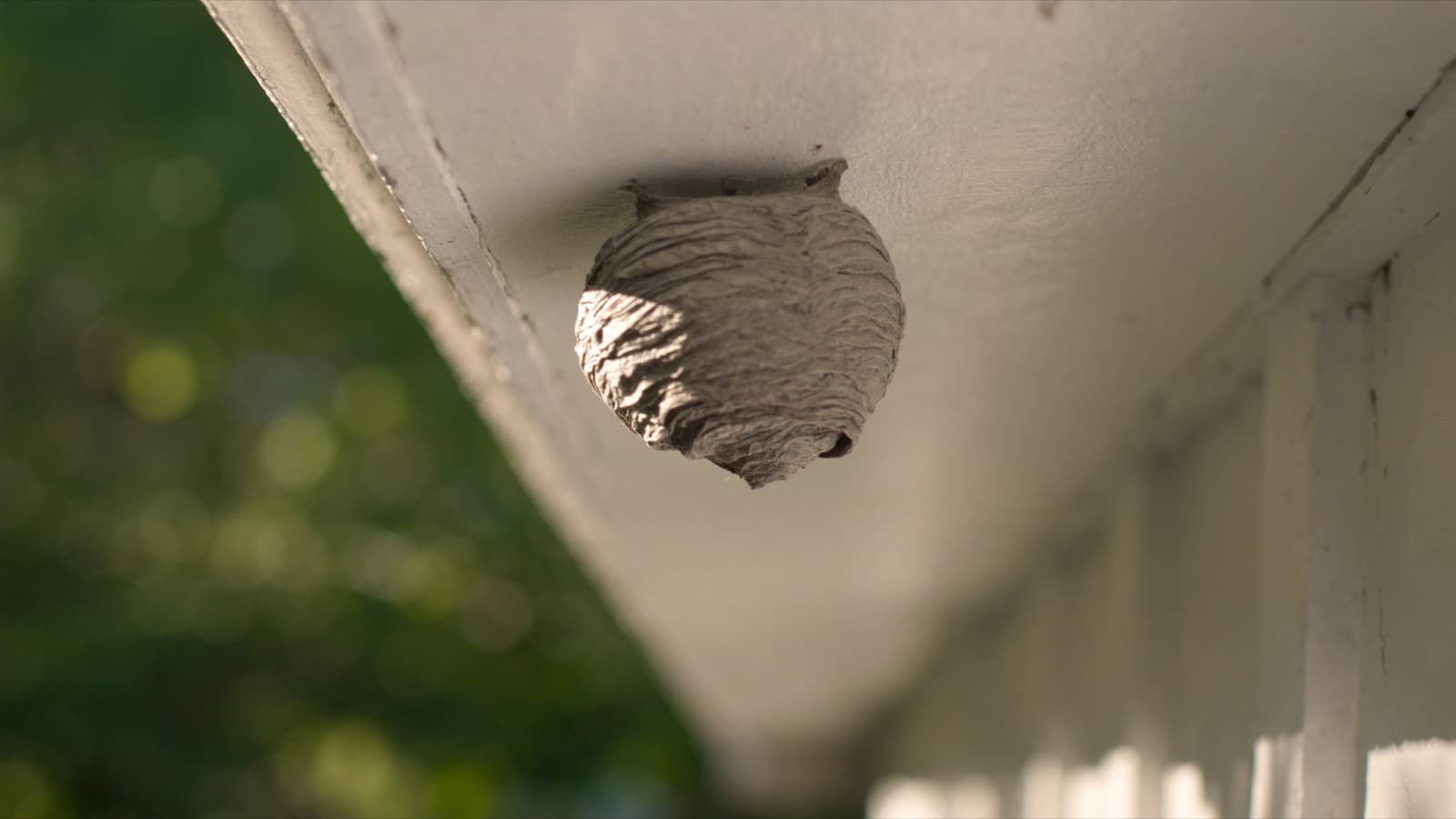
- Your nest: Paper wasp — small, exposed, early-season nest
Should you do this? It depends entirely on which nest
The generic question has no generic answer. Your nest is one row below — the others are the argument that this page isn't just selling you a “no.”
One question, six honest answers — one per nest.
- Mud dauber (solitary)
Solitary — no colony to defend, essentially no swarm response. Not on the router's danger end at all.
Go - Paper wasp — small, exposed, early-season nestYour nest
Low-to-moderate risk before workers hatch and while the nest is reachable — gear and timing genuinely earn their keep here.
Go with gear - Yellowjacket (aerial, ground, or unknown)
Large, coordinated colony defense; ground nests add vibration triggers and concealment.
No-go - Bald-faced hornet
Large aerial colony, aggressive when disturbed, often high off the ground.
No-go - European hornet
Concealed cavity nests plus nighttime activity defeat the usual safe-timing rule other species allow.
No-go - Any species, in October
By the time a sustained hard freeze has come through, the colony is already finished and the nest will never be reused.
Do nothing
“Is it safe to remove a wasp nest?” has no answer. “Is it safe to remove THIS nest?” has six.
Derived from: /top-diy-methods per-species verdicts (mud-dauber diy_friendly, paper-wasp doable_with_care, yellowjacket / bald-faced-hornet / European hornet pro_recommended) + /winter-pests-shift/wasps (colony dies at a sustained hard freeze; the nest is never reused).
The full picture
The actual number, and why it exists
Cooperative-extension guidance recommends a jet-style spray that reaches ten feet or more, and specifically advises standing to the side of an aerial nest rather than directly beneath it, since that's the direction defending wasps most often come from. This is standing distance, not a chemical instruction — it's the same kind of practical guidance a professional relies on, and it's real information worth using correctly.
Where distance genuinely does the job
For a solitary mud dauber, this guidance barely matters — there's no colony to provoke a coordinated response, so the whole question of standing distance is close to moot. For a small, exposed, early-season paper-wasp nest, distance plus basic gear plus correct timing is exactly the combination that makes DIY removal reasonable; this is the one case on this hub where 'how close should I stay' has a genuinely satisfying, actionable answer.
Where distance stops being the answer
A mature yellowjacket, bald-faced hornet, or European hornet colony can mount a coordinated defense from hundreds to thousands of workers, recruited by an alarm pheromone the instant the nest is disturbed — and that response isn't reliably solved by adding more feet between you and the nest, especially for underground or in-wall nests where the colony's reach and concealment are the real problem. For those, distance is one part of a job that ultimately needs a professional, not the deciding factor on its own.
The honest line — Roughly ten feet or more, off to the side rather than underneath, is real guidance — but it only makes removal safe for the nests this hub already says are DIY-eligible.
Key takeaways
- For DIY-eligible nests, extension guidance is roughly ten feet or more, standing to the side rather than underneath.
- For a solitary mud dauber, standing distance is close to irrelevant — there's no colony response to guard against.
- For a small, early-season paper-wasp nest, distance plus gear plus timing is what makes removal reasonable.
- For a defended yellowjacket, hornet, or unidentified colony, no distance alone makes removal safe.
Where to go next
Identification, sting treatment, per-species DIY viability, and nest-reuse facts each live on the hub that owns them. We route, we don't rebuild.
DIY viability by species
The router's source of truth — which nests are DIY-able.
Go thereIdentify the species
Tell the wasps, hornets, and lookalikes apart.
Go thereSting & allergy treatment
What to do about a sting or a reaction.
Go thereNest reuse & winter
The colony dies at frost; the nest is never reused.
Go there
Not sure your nest qualifies for the DIY distance rule?
Distance only helps if the nest is already a reasonable one to remove yourself. Let us confirm which kind you have.
Frequently asked questions
Sources(3)
- [1]UNH Cooperative Extension — Bees, Wasps and Hornetsextensionverified 2026-07-17
- [2]University of Kentucky Entomology — Wasp and Bee Control (ENTFACT-620)extensionverified 2026-07-17
- [3]Penn State Extension — Getting Rid of Paper Wasps, Yellowjackets and Other Stinging Insectsextensionverified 2026-07-17
Written & reviewed by
VerifiedDaniel Brady
NH-Licensed Pesticide Applicator · License #782664 (NHDAMF, RSA 430)
Daniel Brady is the New Hampshire–licensed applicator behind Anchor Pest Services, a family-owned pest control company serving the Manchester area since 2017.
Last updated 2026-07-17
Before you touch it
Confirm the nest before you trust the distance
For a defended colony, no standing distance replaces a licensed technician.
- Family-owned since 2017
- NH License #782664, category F1 (RSA 430, NHDAMF)
- Member, NEPMA