
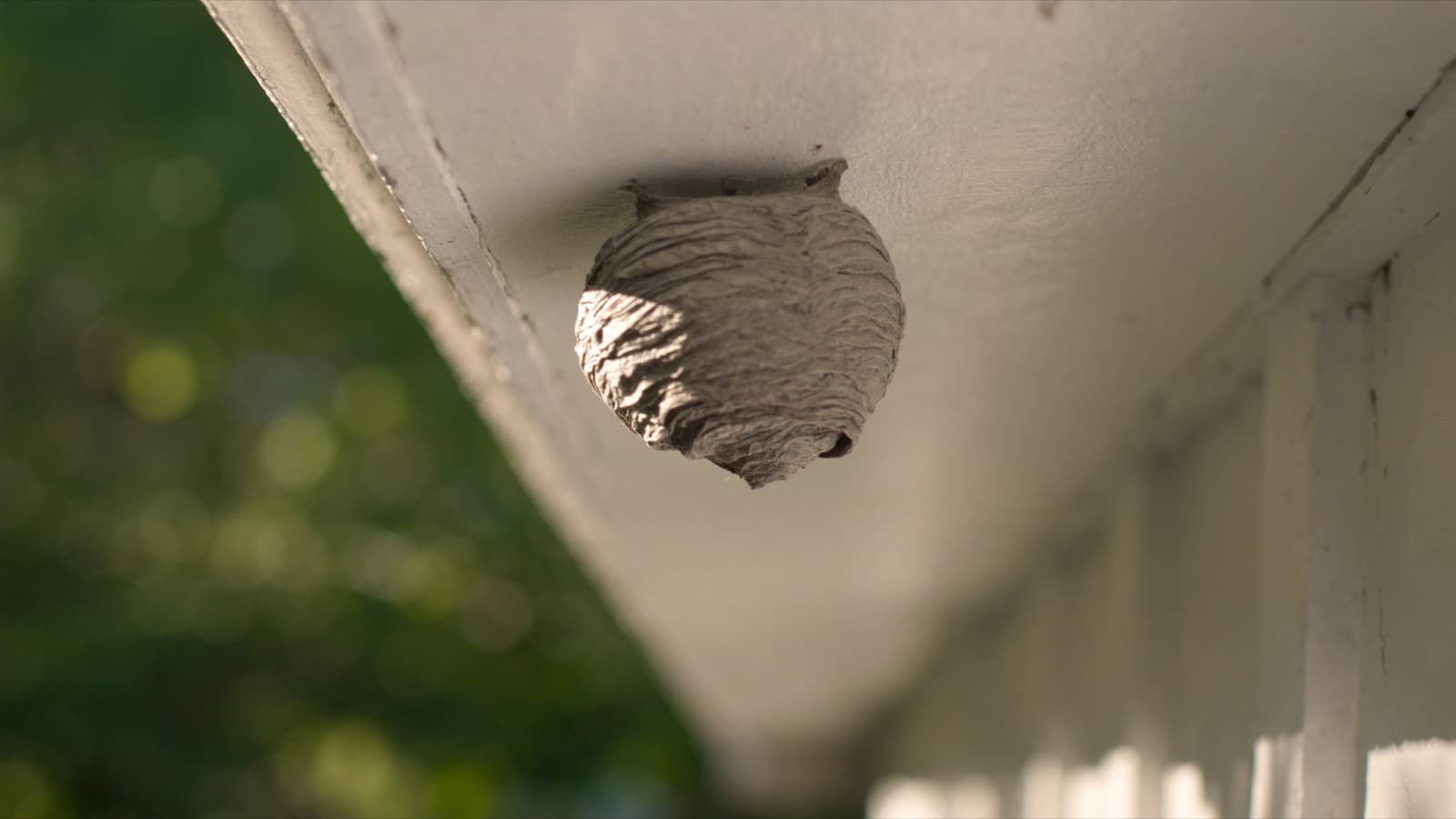
What Benefits Do Wasps Offer, and Should Some Nests Be Left Undisturbed?
At a Glance
- The call: Wasps are real predators and pollinators, not just a nuisance. A nest with no real contact path for people or pets is honestly better left undisturbed than removed.
- Your nest: depends entirely on which nest — see the router
Should you do this? It depends entirely on which nest
The generic question has no generic answer. Your nest is one row below — the others are the argument that this page isn't just selling you a “no.”
One question, six honest answers — one per nest.
- Mud dauber (solitary)
Solitary — no colony to defend, essentially no swarm response. Not on the router's danger end at all.
Go - Paper wasp — small, exposed, early-season nest
Low-to-moderate risk before workers hatch and while the nest is reachable — gear and timing genuinely earn their keep here.
Go with gear - Yellowjacket (aerial, ground, or unknown)
Large, coordinated colony defense; ground nests add vibration triggers and concealment.
No-go - Bald-faced hornet
Large aerial colony, aggressive when disturbed, often high off the ground.
No-go - European hornet
Concealed cavity nests plus nighttime activity defeat the usual safe-timing rule other species allow.
No-go - Any species, in October
By the time a sustained hard freeze has come through, the colony is already finished and the nest will never be reused.
Do nothing
“Is it safe to remove a wasp nest?” has no answer. “Is it safe to remove THIS nest?” has six.
Derived from: /top-diy-methods per-species verdicts (mud-dauber diy_friendly, paper-wasp doable_with_care, yellowjacket / bald-faced-hornet / European hornet pro_recommended) + /winter-pests-shift/wasps (colony dies at a sustained hard freeze; the nest is never reused).
The full picture
The ecological case, and it's a real one
A peer-reviewed synthesis reviewing more than 500 academic papers on stinging wasps found they provide substantial, quantifiable ecosystem services: as predators, they control soft-bodied insect pests that would otherwise damage crops and gardens, a service valued in the hundreds of billions of dollars globally when combined with other insect predators; as pollinators, wasps were documented visiting nearly a thousand plant species, some of which depend on them entirely. Cooperative-extension sources echo this directly, describing wasps as valuable predators of caterpillars and other soft-bodied insects and suggesting a hands-off approach where a colony poses no real threat.
When 'leave it alone' is the honest answer
A nest is a genuine leave-it-alone case when it's truly out of the way — high in a tree, in the back corner of a property, in a shed or structure nobody uses — and there's no realistic path for people, pets, or regular activity to bring anyone close enough to disturb it. Cooperative-extension guidance explicitly lists 'wait and do nothing' as a legitimate option in exactly this situation, and by fall, this is also the answer the season itself will enforce once the colony dies off on its own.
When it stops being defensible
The beneficial-role argument does not override real sting risk. A nest near a door, walkway, mailbox, play area, or mowing path; a household with small children, pets, or a known sting allergy; or a large, concealed, underground, or in-wall colony are all situations where leaving it alone is not the honest call, regardless of how ecologically valuable the wasps are. The benefit is real, but it's a factor to weigh, not a trump card.
The honest line — Wasps are real predators and pollinators, not just a nuisance. A nest with no real contact path for people or pets is honestly better left undisturbed than removed.
Key takeaways
- Wasps are documented predators of soft-bodied garden and crop pests, providing real, valued pest control.
- Wasps are also pollinators, visiting hundreds of plant species, some dependent on them.
- A genuinely out-of-the-way nest, with no realistic contact path, is an honest case for leaving it alone.
- Near doors, walkways, play areas, or with allergy risk in the household, this reasoning does not apply.
Where to go next
Identification, sting treatment, per-species DIY viability, and nest-reuse facts each live on the hub that owns them. We route, we don't rebuild.
DIY viability by species
The router's source of truth — which nests are DIY-able.
Go thereIdentify the species
Tell the wasps, hornets, and lookalikes apart.
Go thereSting & allergy treatment
What to do about a sting or a reaction.
Go thereNest reuse & winter
The colony dies at frost; the nest is never reused.
Go there
Not sure if your nest is truly out of the way?
If there's any real chance of contact, a quick assessment is worth more than a guess.
Frequently asked questions
Sources(4)
- [1]Brock, Cini & Sumner 2021, Biological Reviews — Ecosystem Services Provided by Aculeate Waspsacademicverified 2026-07-17
- [2]University College London — Wasps Are Valuable to Ecosystems, Economy and Human Healthacademicverified 2026-07-17
- [3]Penn State Extension — Master Gardener: Wasps, Beneficial Insects and Pollinatorsextensionverified 2026-07-17
- [4]UNH Cooperative Extension — Bees, Wasps and Hornetsextensionverified 2026-07-17
Written & reviewed by
VerifiedDaniel Brady
NH-Licensed Pesticide Applicator · License #782664 (NHDAMF, RSA 430)
Daniel Brady is the New Hampshire–licensed applicator behind Anchor Pest Services, a family-owned pest control company serving the Manchester area since 2017.
Last updated 2026-07-17
Before you touch it
Sometimes the right answer is doing nothing
If it's genuinely out of the way, we'd rather tell you that than sell you a visit you don't need.
- Family-owned since 2017
- NH License #782664, category F1 (RSA 430, NHDAMF)
- Member, NEPMA