
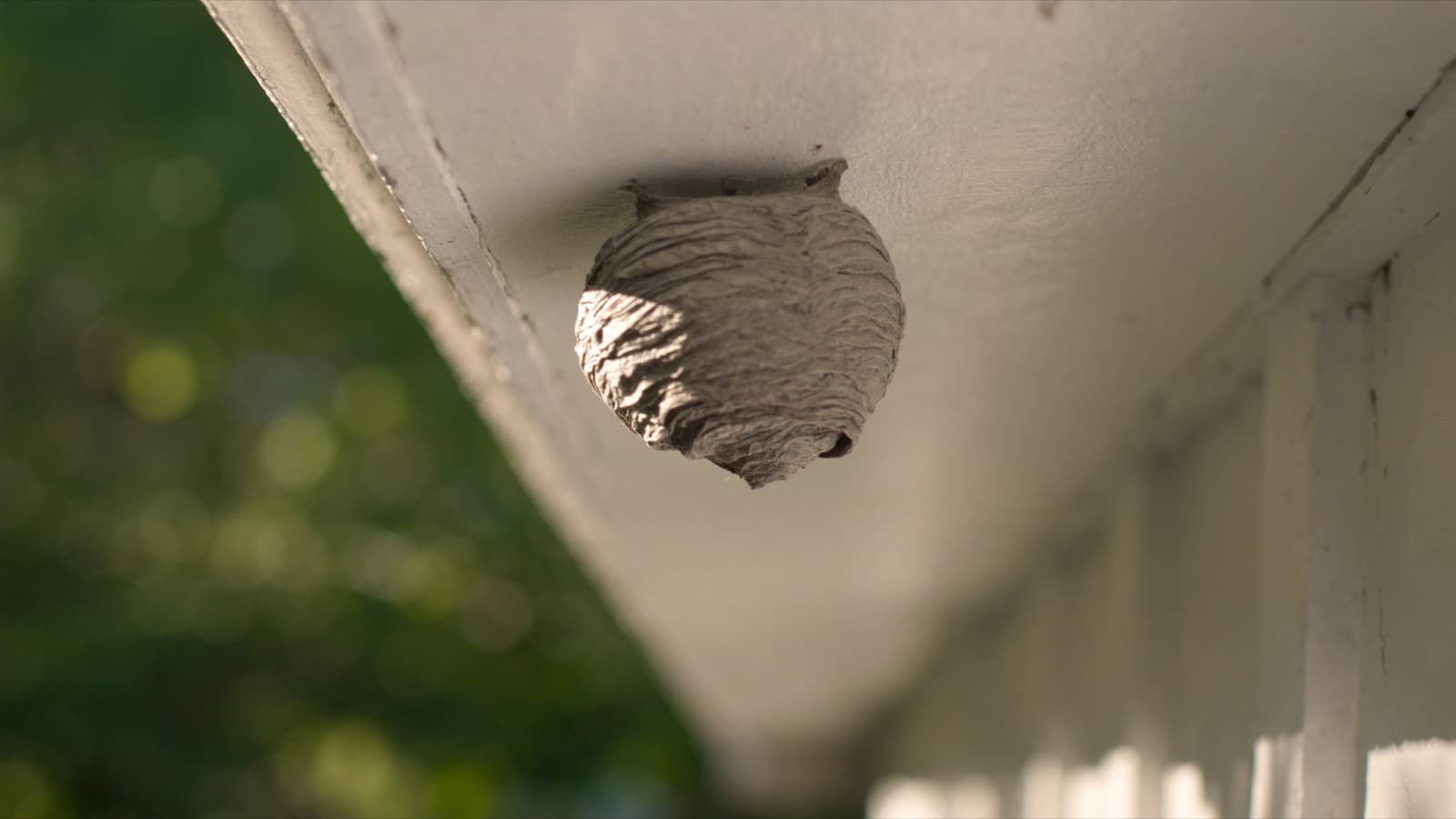
What Should I Do If I Unexpectedly Disturb a Wasp’s Nest?
At a Glance
- The call: Retreat immediately in a straight line, don't swat, and get indoors. Deciding what the nest is happens later, from a safe distance.
- If it goes wrong: stop, retreat, then use the call-now list
If you are mid-incident, start here
Retreat immediately in a straight line, don't swat, and get indoors. Deciding what the nest is happens later, from a safe distance.
Northern New England Poison Center
1-800-222-1222- Walk away quickly and calmly in a straight line — running erratically or swatting can prolong the encounter.
- Cover your face and neck with your hands or clothing as you retreat.
- Get indoors, or into a closed vehicle, as soon as possible.
- Do not go back to identify or investigate the nest right away — that decision can wait until you're safely clear.
- Trouble breathing, or swelling of the lips, tongue, throat, or face — call 911.
- Hives or swelling spreading anywhere beyond the sting sites themselves — call 911.
- Dizziness, fainting, a weak or racing pulse, or vomiting after a sting — call 911.
- More than roughly ten stings in one incident, even if you feel fine right now — get evaluated; the toxic load from that many stings is a real risk on its own, separate from allergy.
We cannot tell from a description online whether a reaction is turning into anaphylaxis. Any systemic symptom — breathing, swelling away from the sting site, fainting — is a call to 911, not a wait-and-see, and we never suggest a dose of anything.
Sting treatment lives on Yellowjackets GuideThe full picture
Why retreat comes before identification
An accidentally disturbed nest — often underground, since ground vibration from mowing or foot traffic is a well-documented trigger — can mean multiple wasps responding at once, recruited by an alarm pheromone released at the disturbance. Figuring out whether it's a mud dauber, a paper wasp, or a yellowjacket colony does not matter in the first few seconds; getting distance does. Identification, once you're safe, belongs on our /wasp-species hub, not in the moment.
What not to do
Don't swat, don't stand still to assess the situation, and don't jump into water — wasps will hover and wait rather than lose track of a target. Don't go back toward the area to see what happened; that decision, and any decision about removing the nest, belongs to a calmer moment covered on this hub's other removal-safety pages.
Once you're actually clear
Check yourself and anyone with you for stings, and watch for the warning signs listed in the panel above over the next 30-60 minutes. If it's just one or two stings with local pain and swelling, that's the ordinary case; anything systemic is a 911 call. Full sting-treatment guidance lives on our /yellowjackets hub.
The honest line — Retreat immediately in a straight line, don't swat, and get indoors. Deciding what the nest is happens later, from a safe distance.
Key takeaways
- Retreat immediately in a straight line — don't swat, don't stand still, don't go back.
- Underground and concealed nests are the ones most often disturbed by accident (mowing, trimming, foot traffic).
- Identification and removal decisions come later, from a safe distance — not in the moment.
- Watch for systemic symptoms once you're clear and call 911 for any of them.
Where to go next
Identification, sting treatment, per-species DIY viability, and nest-reuse facts each live on the hub that owns them. We route, we don't rebuild.
DIY viability by species
The router's source of truth — which nests are DIY-able.
Go thereIdentify the species
Tell the wasps, hornets, and lookalikes apart.
Go thereSting & allergy treatment
What to do about a sting or a reaction.
Go thereNest reuse & winter
The colony dies at frost; the nest is never reused.
Go there
Found a nest you didn't know was there?
An accidental disturbance, especially underground, is often a sign of a colony that's a professional job, not a DIY one.
Frequently asked questions
Sources(3)
- [1]CDC/NIOSH — Stinging Insect Safetygovverified 2026-07-17
- [2]Alabama Cooperative Extension System — Outdoor Stinging Insectsextensionverified 2026-07-17
- [3]Virginia Tech Extension — Yellowjackets, Hornets and Paper Wasps (ENTO-49)extensionverified 2026-07-17
Written & reviewed by
VerifiedDaniel Brady
NH-Licensed Pesticide Applicator · License #782664 (NHDAMF, RSA 430)
Daniel Brady is the New Hampshire–licensed applicator behind Anchor Pest Services, a family-owned pest control company serving the Manchester area since 2017.
Last updated 2026-07-17
Once you're safe
Let us identify and handle what you found
If a nest surprised you once, it's worth knowing exactly what it is before anyone gets near it again.
- Family-owned since 2017
- NH License #782664, category F1 (RSA 430, NHDAMF)
- Member, NEPMA