
Where Are Wasp, Yellowjacket, or Hornet Nests Typically Located?
At a Glance
- The call: Yellowjackets favor concealed ground and wall-void sites; paper wasps build in the open under eaves; bald-faced hornets nest aerially; European hornets prefer hollow cavities.
The short of it
Yellowjackets favor concealed ground and wall-void sites; paper wasps build in the open under eaves; bald-faced hornets nest aerially; European hornets prefer hollow cavities.
The full picture
Concealed sites: yellowjackets
Yellowjackets are drawn to protected cavities more than open exposure — an old rodent burrow underground is a common starting point, and gaps in siding, soffits, or foundations that lead into a wall void or similar structural space are just as attractive. In New Hampshire the yellowjacket most homeowners encounter is the eastern yellowjacket (Vespula maculifrons), which Cornell IPM describes as a predominantly subterranean nester common throughout the Northeast. This preference for concealment is a large part of why yellowjacket nests are harder to detect early and harder to treat completely than an exposed nest of another species.
Exposed sites: paper wasps and bald-faced hornets
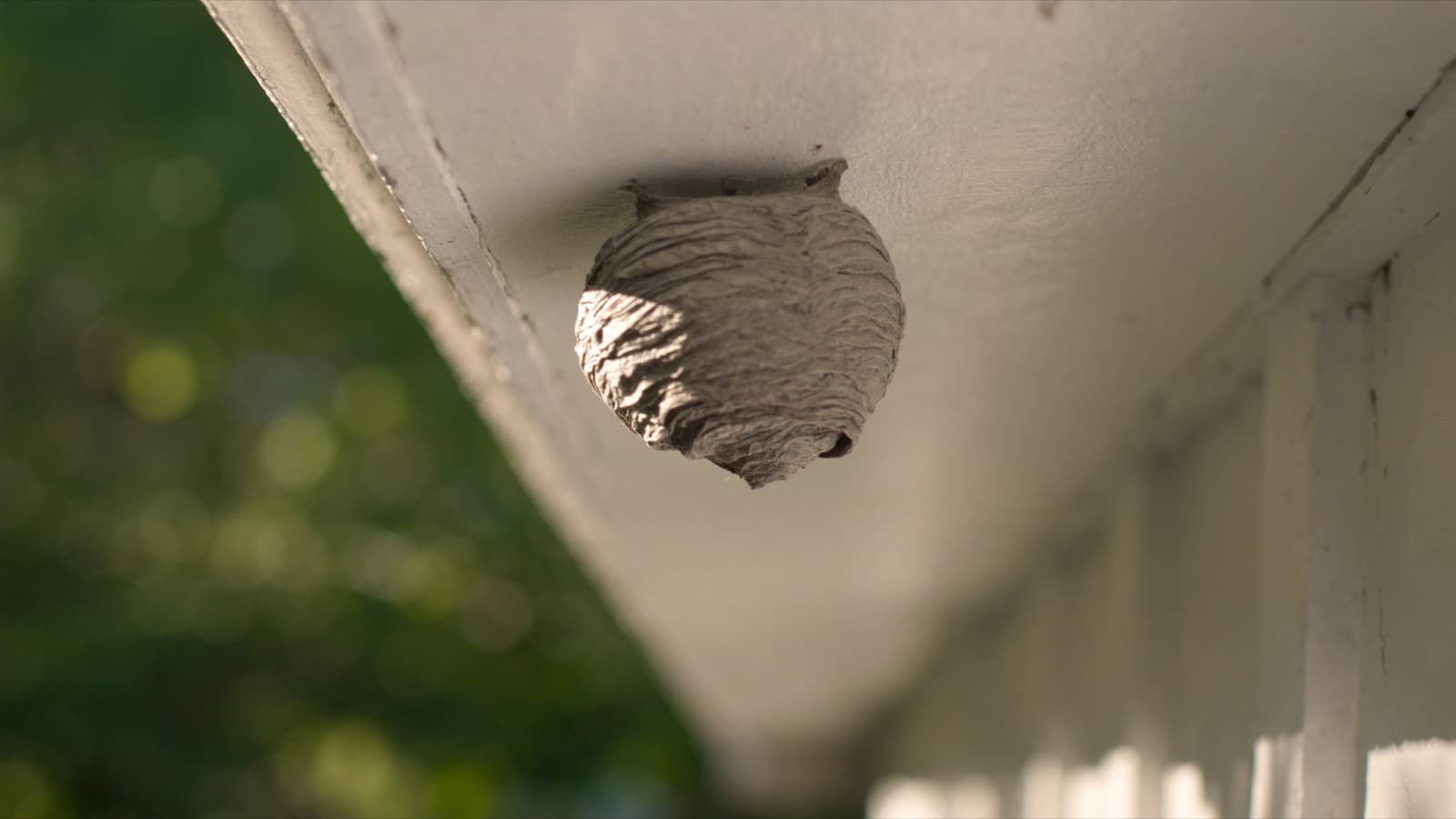
Paper wasps build small, open combs without an outer covering, commonly under eaves, on porch ceilings, or along railings and fence posts — visible structures that are relatively easy to spot and, when small and early-season, relatively manageable to treat. Bald-faced hornets build a different kind of aerial nest: large, fully enclosed in a paper envelope, usually suspended from a tree branch or attached high on a structure, which combines visibility with an access and fall-risk problem of its own.
The European hornet's different pattern
European hornets favor hollow trees and cavities in walls, closer in concealment to yellowjackets than to the open nests paper wasps build. They're also unusual among the species covered on this hub for remaining active after dark, which changes some of the standard safe-timing guidance that applies to daytime-only species. Location alone is a strong clue to species, but confirming it visually is a job for /wasp-species, not this page.
The honest line — Yellowjackets favor concealed ground and wall-void sites; paper wasps build in the open under eaves; bald-faced hornets nest aerially; European hornets prefer hollow cavities.
Key takeaways
- Yellowjackets favor concealed sites: ground burrows and wall or structural voids.
- Paper wasps build small, open, exposed combs under eaves, porch ceilings, and railings.
- Bald-faced hornets build large, enclosed aerial nests, often high in trees or on structures.
- European hornets prefer hollow trees and wall cavities and are active at night as well as by day.
- Nest location is one of the strongest early clues to species, ahead of confirming appearance directly.
Where to go next
Identification, sting treatment, per-species DIY viability, and nest-reuse facts each live on the hub that owns them. We route, we don't rebuild.
DIY viability by species
The router's source of truth — which nests are DIY-able.
Go thereIdentify the species
Tell the wasps, hornets, and lookalikes apart.
Go thereSting & allergy treatment
What to do about a sting or a reaction.
Go thereNest reuse & winter
The colony dies at frost; the nest is never reused.
Go there
Not sure which type of location you're dealing with?
Anchor can confirm the species and location together and tell you what it means for removal.
Frequently asked questions
Sources(3)
- [1]UNH Cooperative Extension — Controlling Wasps, Bees and Hornets Around Your Home
Nesting-site preferences across yellowjackets, paper wasps, bald-faced hornets, and European hornets
extensionverified 2026-07-17 - [2]University of Maryland Extension — Social Wasps: Yellowjackets, Hornets and Paper Wasps
Ground/cavity nesting for yellowjackets vs. exposed nesting for paper wasps
extensionverified 2026-07-17 - [3]Cornell IPM — Yellowjackets and baldfaced hornets
Eastern yellowjacket (Vespula maculifrons) common in the Northeast; predominantly subterranean nesting
extensionverified 2026-07-17
Written & reviewed by
VerifiedDaniel Brady
NH-Licensed Pesticide Applicator · License #782664 (NHDAMF, RSA 430)
Daniel Brady is the New Hampshire–licensed applicator behind Anchor Pest Services, a family-owned pest control company serving the Manchester area since 2017.
Last updated 2026-07-17
Location is the first clue
Where it's nesting tells you a lot before you even see it
A licensed technician can confirm species and location together rather than guessing from one alone.
- Family-owned since 2017
- NH License #782664, category F1 (RSA 430, NHDAMF)
- Member, NEPMA