
Why Are Yellowjackets Often More Difficult to Eliminate Than Other Wasps?
At a Glance
- The call: Concealed nests, much larger colonies, coordinated defense, and a commercial trap lure tuned to the wrong species all stack together — that's why yellowjackets are the hardest on this hub.
The short of it
Concealed nests, much larger colonies, coordinated defense, and a commercial trap lure tuned to the wrong species all stack together — that's why yellowjackets are the hardest on this hub.
The full picture
Concealment defeats the standard tools
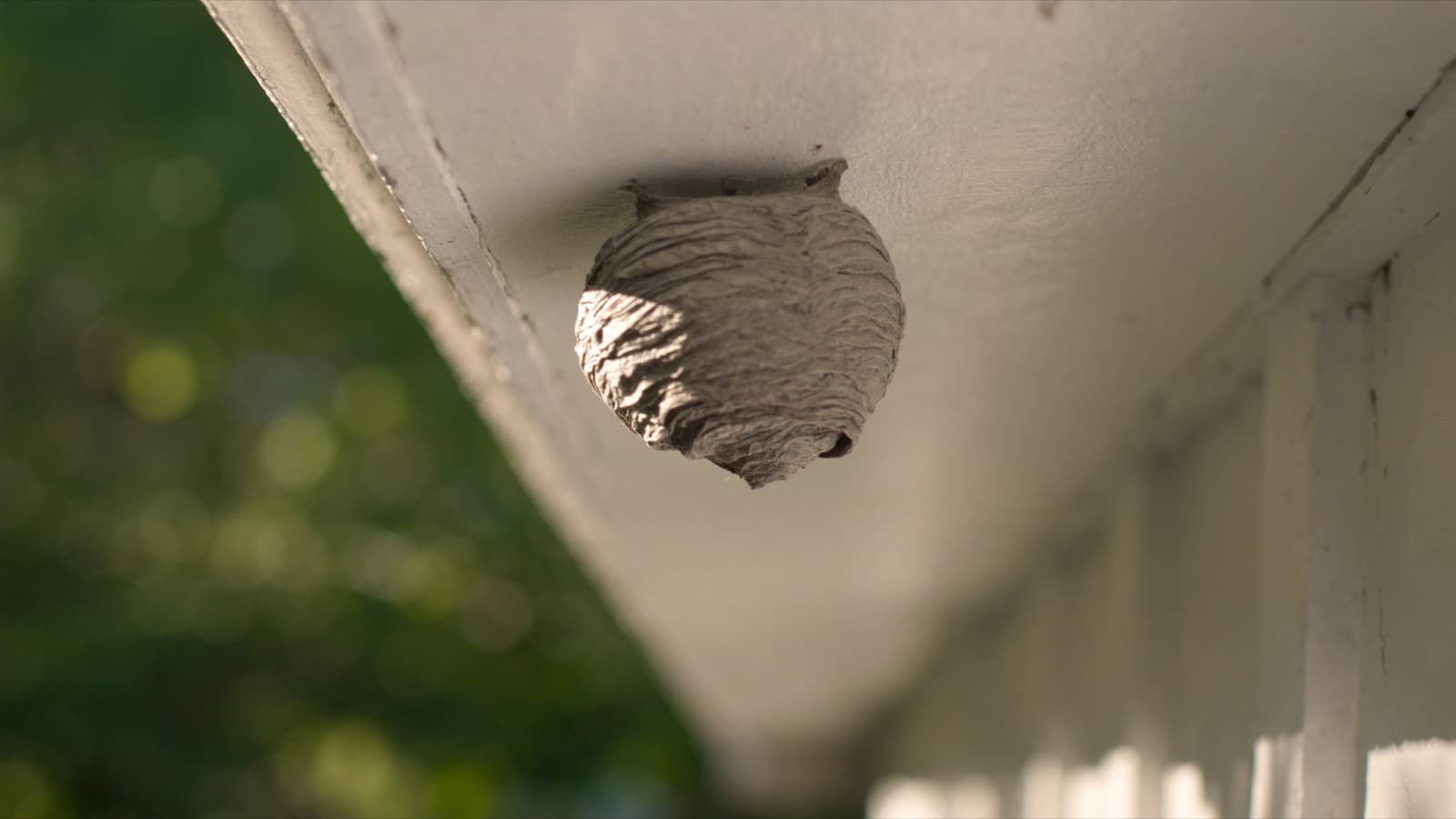
A concealed ground or wall-void nest can't be reached with a direct surface spray the way an exposed paper-wasp nest can. Michigan State University Extension notes aerosol treatments generally can't reach the actual nest core in these situations, which means the standard first-line DIY approach for other species simply doesn't apply the same way here.
Scale changes the physical risk
Cornell IPM notes eastern yellowjacket (Vespula maculifrons) colonies — a species common across the Northeast, including New Hampshire — can build to roughly 2,000 to 3,000 workers, dwarfing a solitary mud dauber or a modest early-season paper-wasp nest. More workers means a larger simultaneous response is possible if the colony is disturbed, since social wasps recruit nestmates through an alarm-pheromone signal rather than defending individually — a documented, peer-reviewed behavior, not folk exaggeration.
The trap-lure mismatch specific to New Hampshire
On top of the biological factors, the most common commercial trap lure, heptyl butyrate, was developed against the western yellowjacket. NC State Extension notes it performs poorly against eastern-U.S. yellowjackets, and UNH Cooperative Extension directly advises against relying on these traps for northeastern species like the eastern yellowjacket common here. A tool that works reasonably well in the West underperforms in New Hampshire specifically, compounding the other three factors.
The honest line — Concealed nests, much larger colonies, coordinated defense, and a commercial trap lure tuned to the wrong species all stack together — that's why yellowjackets are the hardest on this hub.
Key takeaways
- Concealed ground or wall-void nests defeat standard surface sprays that work on exposed nests.
- Eastern yellowjacket colonies, common in the Northeast, can reach roughly 2,000 to 3,000 workers — far more than a mud dauber or small paper-wasp nest.
- Social wasps recruit nestmates through a documented alarm-pheromone response, enabling a coordinated group defense.
- The standard commercial trap lure is tuned to the western yellowjacket and underperforms against the eastern-U.S. yellowjackets common in New Hampshire.
- These four factors combine, which is why yellowjackets are rated a professional job on /top-diy-methods rather than a DIY species.
Where to go next
Identification, sting treatment, per-species DIY viability, and nest-reuse facts each live on the hub that owns them. We route, we don't rebuild.
DIY viability by species
The router's source of truth — which nests are DIY-able.
Go thereIdentify the species
Tell the wasps, hornets, and lookalikes apart.
Go thereSting & allergy treatment
What to do about a sting or a reaction.
Go thereNest reuse & winter
The colony dies at frost; the nest is never reused.
Go there
Dealing with a confirmed yellowjacket colony?
The factors that make this species harder to eliminate are exactly why Anchor treats it as a professional job.
Frequently asked questions
Sources(4)
- [1]NC State Extension — Yellowjackets in the Landscape
Heptyl butyrate lure tuned to the western yellowjacket, underperforming against eastern-U.S. species
extensionverified 2026-07-17 - [2]Cornell IPM — Yellowjackets and baldfaced hornets
Eastern yellowjacket (Vespula maculifrons) common in the Northeast; colonies reaching roughly 2,000–3,000 workers
extensionverified 2026-07-17 - [3]UNH Cooperative Extension — Controlling Wasps, Bees and Hornets Around Your Home
Caution against relying on yellowjacket traps for northeastern U.S. species
extensionverified 2026-07-17 - [4]McCann, Moeller & Starks (2015), Journal of Hymenoptera Research — Alarm Pheromone Nest Defense in Vespine Wasps
Peer-reviewed documentation of coordinated alarm-pheromone nest defense in social wasps
academicverified 2026-07-17
Written & reviewed by
VerifiedDaniel Brady
NH-Licensed Pesticide Applicator · License #782664 (NHDAMF, RSA 430)
Daniel Brady is the New Hampshire–licensed applicator behind Anchor Pest Services, a family-owned pest control company serving the Manchester area since 2017.
Last updated 2026-07-17
Four factors, one recommendation
This is the species this hub takes most seriously
A licensed technician can address the concealment, scale, and defense response a DIY attempt usually can't.
- Family-owned since 2017
- NH License #782664, category F1 (RSA 430, NHDAMF)
- Member, NEPMA