
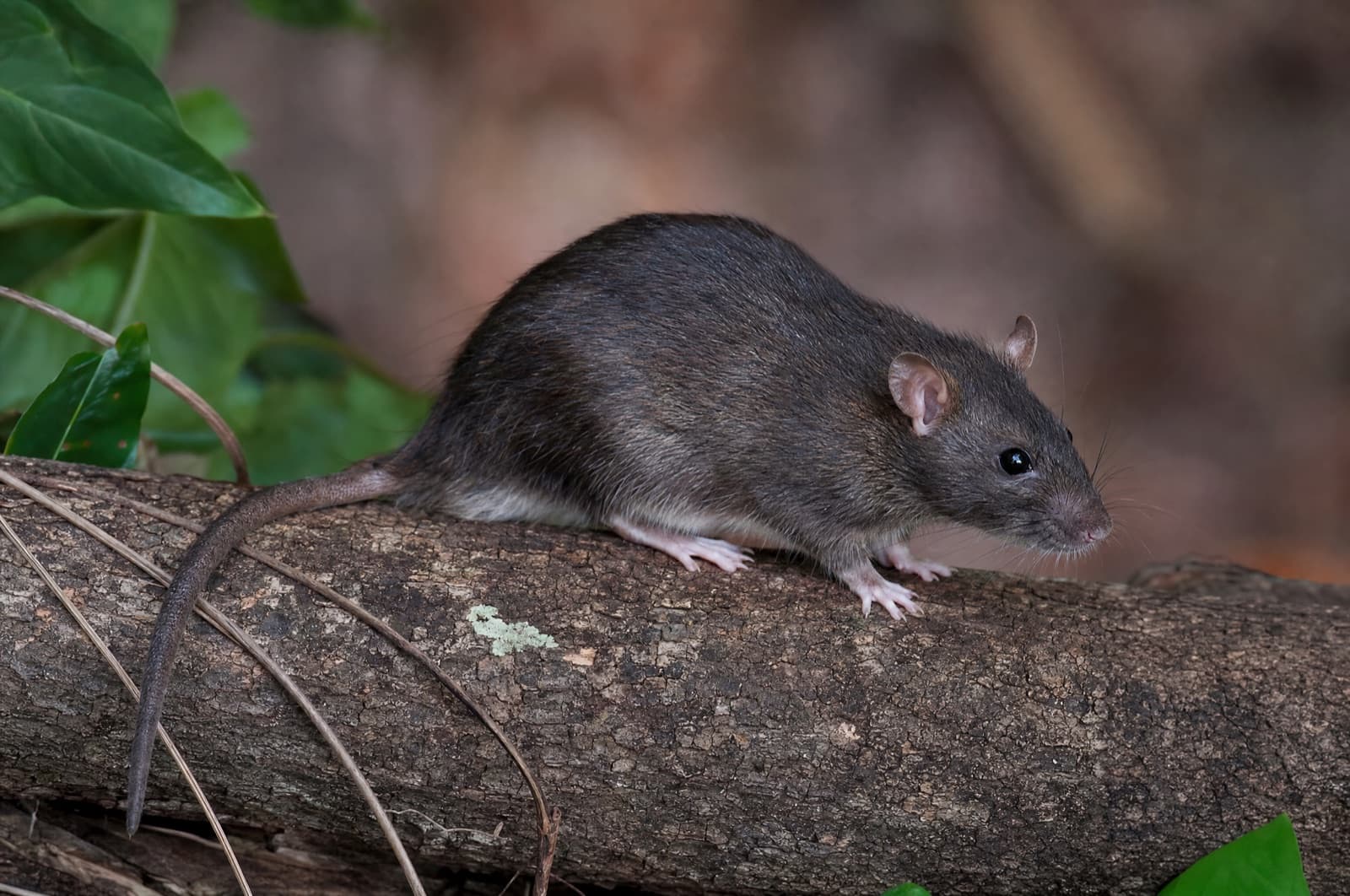
What Attracts Black Rats to Your House?
At a glance
- Short answer: Black rats aren't established in New Hampshire — what you're seeing is almost certainly a Norway rat.
- The verdict: You didn't attract it — you carried it in
The attractant verdict
Four possible answers to why this species turned up. Three stay unlit — and that's the argument: the honest answer could have been any of them, and for this species it wasn't.
Black rats aren't established in New Hampshire — what you're seeing is almost certainly a Norway rat.
Our own previous page said black rats are ‘drawn to your home mainly due to the availability of food, water, and shelter’ — as if this species were a routine visitor to New Hampshire homes. It isn't. That framing quietly implied a New Hampshire population that current range data doesn't support.
Nothing about a New Hampshire house attracts a black rat, because the species is not established this far north. Rattus rattus is a warm-climate specialist — common along the Gulf Coast, the lower East Coast, and the West Coast — and has been out-competed and displaced from cooler regions by the larger, more cold-tolerant Norway rat (Rattus norvegicus), which is the rat New Hampshire actually has. A verified black rat this far outside its range is typically explained by cargo or shipped goods carrying it in, not by anything the house did.
“You almost certainly do not have a black rat. New Hampshire's rat is the Norway rat — we say ‘not established’ rather than ‘never recorded,’ because a rare cargo-carried specimen can't be ruled out, but it is not what's in your walls.”
Why it's here, in full
Why our own old page had the wrong animal in mind
The black rat, or roof rat (Rattus rattus), is a warm-climate species common along the Gulf Coast, the lower Atlantic coast, and the Pacific Coast, including Hawaii. It has a strong preference for warmth and struggles in cold, and it has been displaced from most of the cooler and inland United States by the Norway rat (Rattus norvegicus) — the larger, more cold-tolerant species that actually lives in New Hampshire. That means the ‘black rat’ our own legacy page described attracting to a New Hampshire home almost certainly wasn't one. We say the species is not established here, rather than never recorded, because an isolated specimen carried in on a shipment or moving truck can't be ruled out — but that is the exception, not the pattern the old page implied.
What you actually have, and where the food question lives
If you're finding rat activity in a New Hampshire home, the far more likely explanation is the Norway rat — a burrowing, ground-level rat that nests near foundations, in basements, and around woodpiles, and that is genuinely common throughout the state. The signs below (droppings, gnaw marks, grease trails, noise) apply to it, not to the black rat. The specific question of what food draws rats and mice indoors is answered in depth at /mice-and-rats-faq, which ranks the actual food sources involved; this page's job is only to correct which species you're dealing with.
How to tell it's actually this species
Real signs only — a species with four honest tells gets four, and stops. Where a sign is weak on its own, we say so.
Dark, capsule-shaped droppings along baseboards or in cabinets — in New Hampshire, this points to a Norway rat, not a black rat
Could be something else: Droppings alone don't distinguish rat species and can resemble mouse droppings at a glance, just larger.
Fresh gnaw marks on wood, wiring, or stored food packaging
Greasy rub marks along a regularly traveled wall or beam, left by a rat's coat oils
Scratching or gnawing noises inside walls or a crawlspace, usually after dark
Could be something else: Similar noises can come from squirrels, other rodents, or even old pipes settling.
Want black rats gone?
This page only answers why it's here. Every removal step for this exact species — what to seal, what to set, what actually works — lives on its own dedicated guide.
Two questions, two pages
Here: why it turned up at all — the honest answer, blame removed.
There: the step-by-step removal guide for this exact species.
Key takeaways
- Black rats (roof rats) are not established in New Hampshire.
- The rat you actually have in NH is almost always the Norway rat.
- Rat food questions are answered at /mice-and-rats-faq, not here.
- Removal is a different question — see /top-diy-methods/black-rat.
Not sure what you're actually dealing with?
This page is about why it showed up (or didn't). Removal, once you know what it is, is covered at /top-diy-methods/black-rat.
Frequently asked
Sources(2)
- [1]UC Statewide IPM Program — Rats
Roof rat vs. Norway rat biology and habitat differences (climbing/arboreal vs. ground-burrowing)
extensionverified 2026-07-17 - [2]Feng, A.Y.T. & Himsworth, C.G. — The secret life of the city rat, Urban Ecosystems (2014)
Comparative ecology of Rattus norvegicus and Rattus rattus, including climate-driven range differences
academicverified 2026-07-17
Written & reviewed by
VerifiedDaniel Brady
NH-Licensed Pesticide Applicator · License #782664 (NHDAMF, RSA 430)
Daniel Brady is the New Hampshire–licensed applicator behind Anchor Pest Services, a family-owned pest control company serving the Manchester area since 2017.
Last updated Jul 2026
We'll tell you honestly what you have
Free inspection, straight answer
Same-day inspections across southern and central New Hampshire. If it isn't what you think it is, we'll say so.
- Family-owned in Manchester since 2017
- NH commercial applicator #782664, category F1
- We will tell you when the answer is do nothing
NH License #782664 · No obligation · We answer in person
Your next step
- Next step
How to Use the Tomcat Rat Snap Trap
Read the answer - What to do next
Black Rat in New Hampshire — Is It Even Here?
Read the answer - Also relevant
How to Get Rid of Black Rats
Read the answer - Also relevant
Black Rat in New Hampshire — Is It Even Here?
Read the answer - Also relevant
How to Get Rid of Black Rats
Read the answer - In your area
Where Do Rats Go In The Winter?
Read the answer