
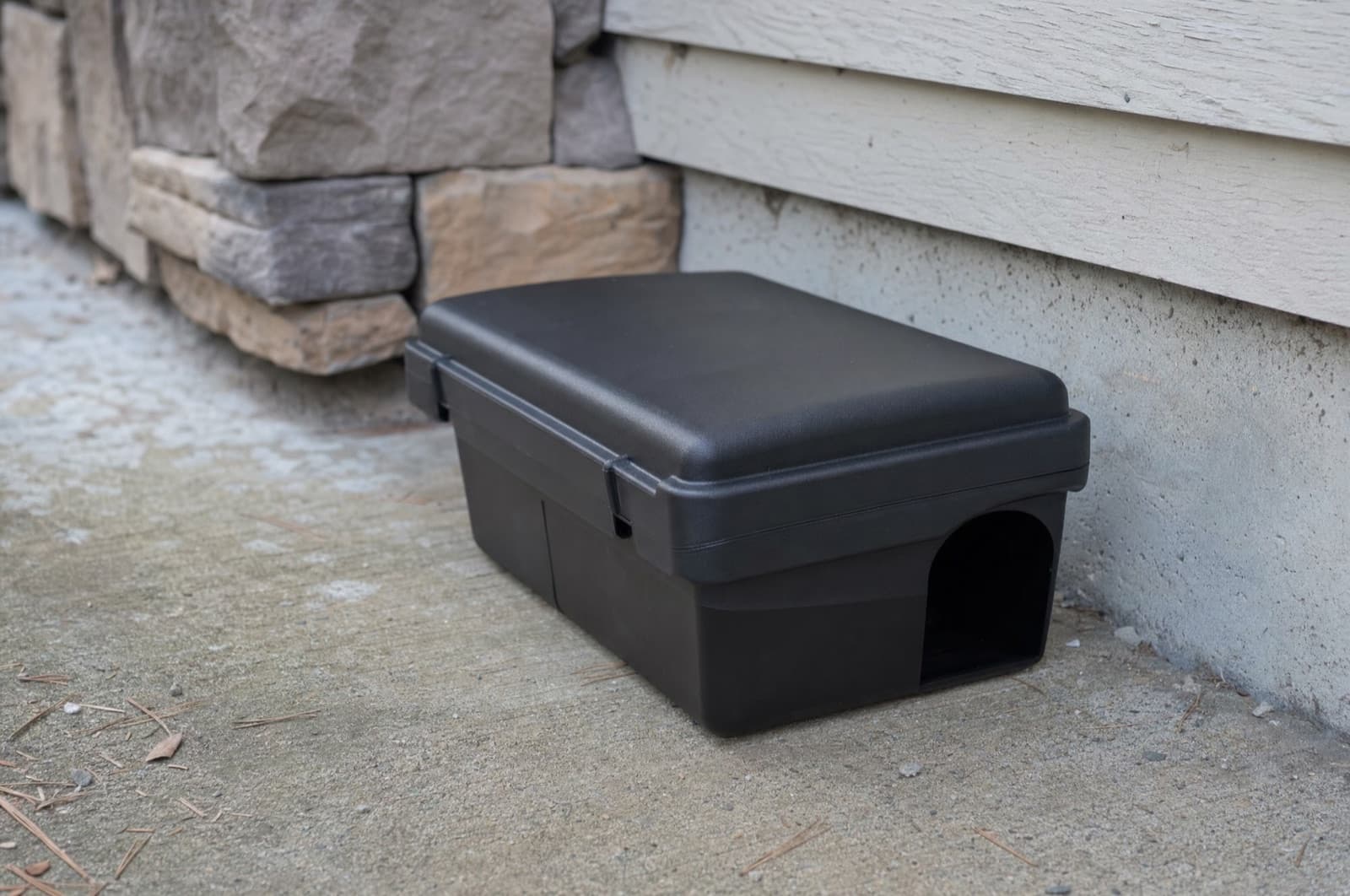
How to Use the Tomcat Rat Snap Trap
At a glance
- Efficacy: Workhorse
- Best job: Killing a small number of rats where a patient, pre-baited placement strategy is used
- Format: Rat-sized spring-loaded snap trap with a removable bait cup and an integrated tie-down feature for securing to pipes, rafters, or beams — a mechanical kill device with no toxicant
- Technique: Moderate technique
Does this product actually work?
A genuine workhorse for rats — but only if you have the patience to pre-bait it first.
Rats are strongly neophobic — they will avoid a new object appearing in their runway for days, sometimes weeks, which is exactly why this trap ships with a removable bait cup built for pre-baiting. Left unset and baited until rats are feeding freely, then armed, this trap performs as a genuine workhorse for a localized rat problem. Set live on day one without that patience, it very often 'fails' — not because the mechanism is weak, but because a wary rat detoured around it. Its other honest limit: any confirmed rat activity inside a structure is widely treated as a call-a-pro signal in its own right, because rats reproduce and spread faster than homeowner-scale trapping alone typically resolves.
Best for
A small number of rats where a patient, pre-baited approach is used before the trap is ever armed.
Skip it for
Anyone expecting a same-night result, or a rat population large enough that homeowner-scale trap density and inspection can't realistically keep pace.
What it is — and what it's really for
The label is the law. Here's the honest read on the format, the one job it does well, and the job people wrongly buy it for.
The technique walkthrough
Where DIY succeeds or fails is in the placement, patience, and the small pro moves the label never mentions. Follow the label; these are the technique details on top of it.
This is a moderate-difficulty product specifically because the mechanism is simple but the psychology of a wary rat isn't — patience is the technique.
Identify the runway and secure the trap
Locate rat runways — along walls, pipes, rafters, or beams marked by droppings, gnaw marks, or grease smears — and use the trap's tie-down feature to affix it to that surface so it can't be dragged off.
Pro moveRats travel elevated routes (pipes, rafters, beams) as often as floor-level walls — check both when scouting placements.Load the removable bait cup
Add peanut butter or a similar high-affinity bait to the removable cup — it's specifically designed so you can pre-bait before ever arming the trap.
Leave the trap unset for several days
Place the baited, unset trap on the runway and leave it there — don't arm it yet. Rats are strongly neophobic and will often avoid a new object entirely for the first several days.
Common mistakeSetting the trap live immediately: a wary rat detects the new object, avoids it, and may become 'trap-shy' after a near-miss, making it even harder to catch later.Confirm feeding, then set it live
Once the bait is reliably disappearing — evidence rats are feeding without hesitation — arm the trap in the same location.
Pro moveLeave traps unset and baited until the bait disappears reliably before ever setting them; patience is what actually defeats neophobia, not a better bait.Use multiple traps and check daily
Deploy several traps along different runways rather than relying on one, and check and reset daily.
CautionThe rat-sized bar strikes with significantly more force than a mouse trap — keep fingers, pets, and children clear, and wear gloves when handling.Pair with sanitation and exclusion
Remove competing food sources and seal entry points — rats can enter through openings roughly a half-inch across, about the size of a quarter.
Do & don't
- Pre-bait unset for several days before arming.
- Secure the trap with the tie-down on runways, including pipes and rafters.
- Use multiples across different runways.
- Check and reset daily.
- Wear gloves and keep the bar clear of fingers and pets.
- Don't set it live on day one and expect a quick catch.
- Don't place it in the open away from a confirmed runway.
- Don't give up after one near-miss — relocate and re-pre-bait instead.
- Don't skip exclusion once catches begin.
- Don't treat confirmed in-structure rat activity as a simple DIY job.
Where it works vs. where it fails
No product fixes everything. This is the honest boundary — the situations it genuinely handles, and the ones it simply won't.
Where it works
- The rat population is small and localized, traceable to specific runways (walls, pipes, rafters)
- You're willing to pre-bait unset for several days before arming the trap
- Traps are secured via the tie-down and deployed in multiples
- The household also addresses competing food and works on exclusion
Where it fails
- The trap is set live immediately without pre-baiting — neophobic rats simply avoid it
- The infestation is heavier or established — homeowner-scale trap density and inspection depth genuinely can't match a professional program
- It won't fix the entry point — sealing quarter-sized (roughly half-inch) gaps is required or new rats keep replacing trapped ones
- Any confirmed rat activity inside a structure is itself commonly treated as a strong call-a-pro signal, not a routine DIY job
Mistakes that waste the product
Setting the trap live before pre-baiting
Rat neophobia means a newly armed trap in their runway is frequently avoided for days, and a near-miss can create lasting trap-shyness.
Placing it away from a confirmed runway
Rats travel established routes along walls, pipes, and rafters — an unevidenced placement is rarely encountered.
Giving up after one failed attempt
A single near-miss can make a rat permanently wary of that specific trap and location.
Skipping exclusion
Without sealing entry points, new rats keep replacing the ones trapped, and the problem never actually resolves.
What to expect — and when
This is a slow-start, patience-dependent tool — judge it on the pre-baiting phase first, catches second.
First several days
Little to no activity is normal while the trap sits unset and baited — this is the neophobia-defeating phase, not a failure.
Once bait is reliably taken
Arming the trap at this point typically produces catches within a night or two.
Ongoing
Catches should taper off with correct multi-trap placement and exclusion; continued activity signals a bigger population or an open entry point.
When to stop DIY & call a pro
Rat activity carries a lower DIY ceiling than mice. These are the signals to bring in a professional:
Any evidence of rats inside the structure, even a single confirmed sighting
Rats reproduce quickly and are notoriously difficult to fully resolve with homeowner-scale trapping alone — this is treated as a strong call-a-pro signal in its own right, not just a threshold after weeks of DIY.
Catches stall after correct pre-baiting and multi-trap placement
Persistent avoidance despite correct technique usually means the population or the entry-point problem exceeds what homeowner trap density can match.
Droppings, gnawing, or grease trails appear in multiple rooms or elevated runways (attic, rafters)
That spread points to an established colony with multiple access points, needing inspection depth beyond a homeowner's reach.
You can't identify or seal the entry gaps
Trapping controls rats already inside, but without exclusion, new rats keep replacing them — professional inspection finds access points homeowners often miss.
Rats are one of the clearest DIY-ceiling calls in this cluster. Anchor's licensed NH technicians bring professional trap density, a full exclusion inspection, and a monitoring program that a homeowner's placement genuinely can't match. Free inspection, same-day service across southern and central New Hampshire.
Seeing rats, not just mice?
Is it safe for pets & kids?
The short version lives here; the full per-species verdict lives on this product's pet-safety page.
This is a mechanical, non-toxic device — there's no poisoning risk. The rat-sized bar strikes with meaningfully more force than a mouse trap and can injure fingers or a curious pet, so placement and handling matter more here than with a standard mouse trap.
Re-entry: Keep the trap out of reach of pets and children, and always approach and reset it with the bar facing away from your hand.
Rat activity timing in New Hampshire
Norway rats are more common in the urban and commercially dense parts of southern New Hampshire, and like mice, they push toward structures as temperatures drop in the fall. Because rat trapping demands a multi-day pre-baiting patience window, starting placement before cold weather forces a decision — rather than reacting to an active infestation in December — gives correct technique the time it needs to work. Anchor Pest Services handles rat trapping and the exclusion work it depends on across Manchester, Nashua, Concord, and the surrounding towns.
Service area
Southern New Hampshire
Anchor Pest Services · NH license #782664 · NEPMA member · family-owned since 2017.
Frequently asked
Sources & further reading(4)
- [1]Motomco (Tomcat parent brand) — Using Tomcat Traps & Glue Boards
Product format, tie-down feature, and removable bait cup facts
manufacturerverified 2026-07-14 - [2]Colonial Pest Control — Rats Are Neophobic
Rat neophobia and the case for pre-baiting before setting traps live
independentverified 2026-07-14 - [3]PCT Online — Capturing Smart Rats Requires Common Sense and New Ideas
Professional trapping practice and trap-shyness avoidance technique
independentverified 2026-07-14 - [4]Xcluder — How to Seal Entry Points
Quarter-sized entry-gap exclusion guidance for rats
independentverified 2026-07-14
Written & reviewed by
VerifiedDaniel Brady
NH-Licensed Pesticide Applicator · License #782664 (NHDAMF, RSA 430)
Daniel Brady is the New Hampshire–licensed applicator behind Anchor Pest Services, a family-owned pest control company serving the Manchester area since 2017.
Last updated July 2026
Related products in this category
Same shelf, different jobs — the dot shows each product's honest efficacy verdict at a glance.
Professional Pest Control
Rats Are One of the Clearest Call-a-Pro Signals
Rat populations reproduce fast and are skilled at avoiding homeowner-scale trapping after a near-miss. Anchor Pest Services brings professional trap density, exclusion, and inspection across southern and central New Hampshire. Family-owned since 2017, NH license #782664.
- Professional trap density + exclusion inspection
- NH-licensed applicators (#782664)
- Free inspection — same-day service across southern NH
NH License #782664 · No obligation · We answer in person
Your next step
- Book a NH pro
Rodent Control
Book now - Book a NH pro
Pest Control Services
Licensed, family-owned pest control across southern NH.
Book now - What to do next
Is Tomcat Refillable Bait Station for Rats Safe for Pets?
Read the answer - Also relevant
Is the Tomcat Rat Snap Trap Safe for Pets?
Read the answer - Also relevant
Mechanical Rodent Control: Snap Traps + Exclusion That Works
Read the answer - Related guide
How to Use the Tomcat Press 'N Set Mouse Trap
Read the answer