
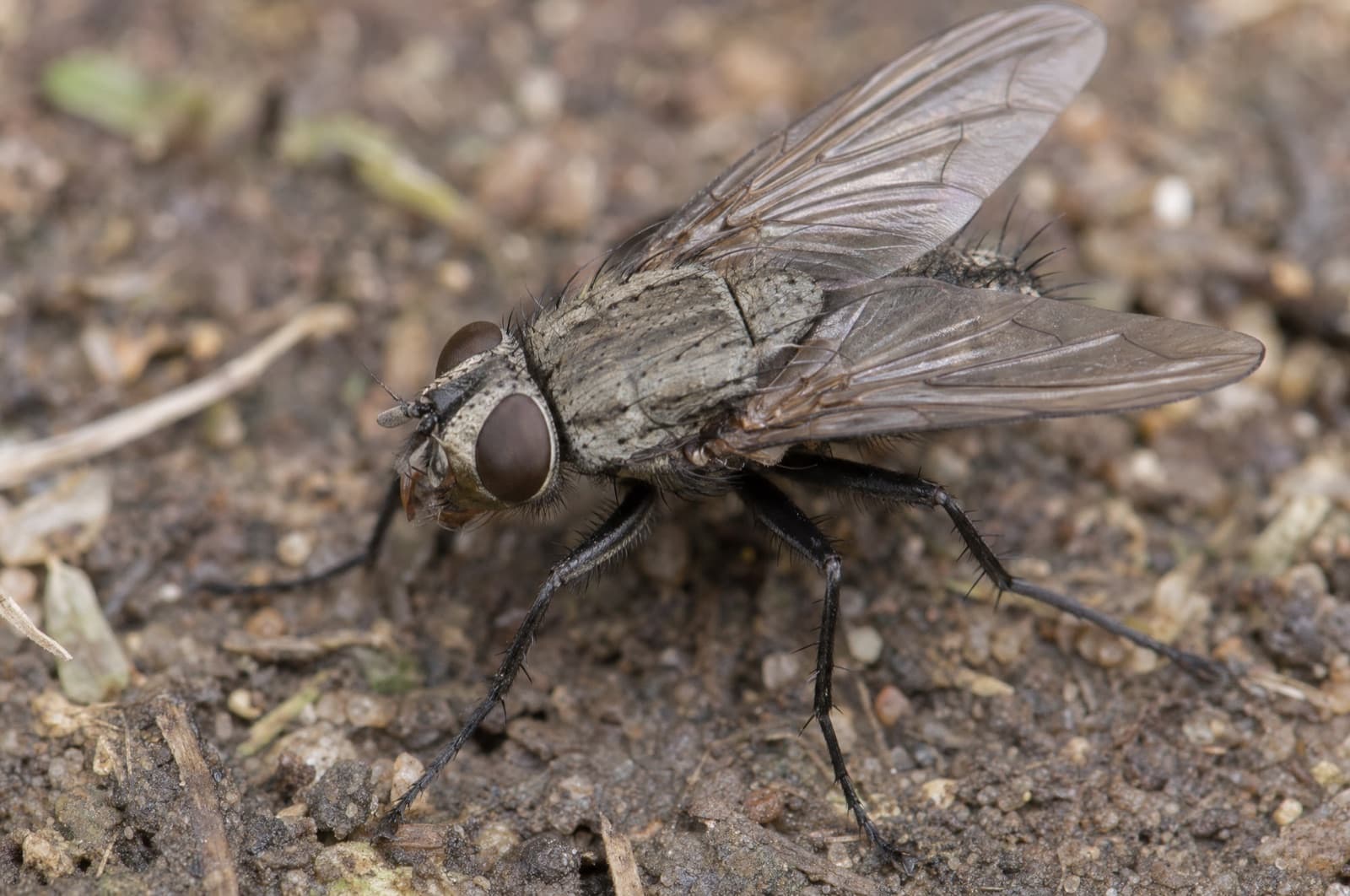
What Attracts Cluster Flies to Your House?
At a glance
- Short answer: Cluster flies aren't coming for your garbage. Their larvae parasitize earthworms outdoors — your attic is only a roost, never a nursery.
- The verdict: The belief is wrong
11 to 14 days
How long a cluster fly larva develops inside a parasitized earthworm before pupating in the soil
University of Connecticut
27 to 39 days
Full egg-to-adult life cycle, completed entirely outdoors — never in the house
University of Connecticut
The attractant verdict
Four possible answers to why this species turned up. Three stay unlit — and that's the argument: the honest answer could have been any of them, and for this species it wasn't.
Cluster flies aren't coming for your garbage. Their larvae parasitize earthworms outdoors — your attic is only a roost, never a nursery.
Our own previous page said cluster flies are "drawn to houses... due to their search for warmth and suitable places to hibernate," which gets the shelter-seeking half roughly right but uses the wrong word for what the flies actually do, and says nothing about the genuinely surprising fact that these flies have no connection to garbage or indoor food at all.
A search for a dry, protected overwintering site in fall, after a summer spent breeding entirely outdoors — as larvae that parasitize earthworms in soil, not anywhere near a house. The structure is a shelter they enter afterward, unrelated to what they ate or bred on.
“It was never your garbage. The whole life cycle happens in the soil, on earthworms — the attic is just where they wait out winter.”
Earthworm populations in nearby soil, lawns, and gardens. Cluster fly larvae are obligate internal parasites of earthworms: females lay eggs in soil cracks near earthworm burrows, and larvae develop inside an earthworm over roughly 11 to 14 days before pupating in the soil, with the full life cycle taking about 27 to 39 days.
It means the common belief that cluster flies are drawn by garbage, food debris, or filth indoors is not just imprecise but entirely wrong — this species has no biological relationship with any of that. The only outdoor factor that matters is earthworm-friendly soil nearby; the only indoor factor is a dry space to spend the winter once the last summer generation is done breeding.
Calibrated from: University of Connecticut Home & Garden Education Center — Cluster Flies, https://homegarden.cahnr.uconn.edu/factsheets/cluster-flies/
Why it's here, in full
Not a filth fly — the whole life cycle is about earthworms
Cluster flies belong to a genus whose larvae are obligate parasites of earthworms, a life cycle documented by the University of Connecticut Home & Garden Education Center: females lay eggs in cracks in garden or lawn soil, larvae hatch and parasitize an earthworm for 11 to 14 days, and the whole cycle from egg to adult takes 27 to 39 days, with several generations completing over a summer. None of that happens anywhere near a house, and none of it involves garbage, human food, or decaying matter of any kind — this species simply isn't a filth fly the way a house fly is.
Our old page's original phrasing described the flies as seeking warmth and a suitable winter refuge, using the word reserved for mammal dormancy rather than the correct insect term — flies do not hibernate; the accurate word is dormancy. That phrasing didn't claim a garbage connection outright, but it also didn't correct the common assumption that flies clustering on a house must be drawn by food or trash nearby. They aren't.
The attic is a roost, not a nursery — and it isn't hibernation
Once the last generation of the summer matures, adult cluster flies stop breeding and start searching for a dry, protected place to spend the winter, often resting on sun-warmed exterior walls before working their way into cracks, attics, and wall voids. That space is purely a winter roost — flies don't lay eggs there, don't develop there, and have no food source there. It's also worth naming a word error directly: cluster flies do not hibernate — hibernation is a controlled, physiological process specific to mammals, while insects instead enter dormancy, and this species can be roused from that dormancy by household heat on a warm winter day, which is why clusters sometimes appear active indoors in the middle of winter even though nothing new has arrived or bred.
How to tell it's actually this species
Real signs only — a species with four honest tells gets four, and stops. Where a sign is weak on its own, we say so.
Large numbers of slow-moving, dark gray flies with a checkered back gathering on a sunny exterior wall in fall
Flies clustering in secluded areas — wall voids, attics, or window frames — sometimes numbering in the thousands, especially during warm winter spells
Could be something else: This reflects an established overwintering population being roused by warmth, not fresh breeding or an active food source indoors.
A moist lawn or garden with a healthy earthworm population near the house
Could be something else: Earthworm-rich soil is a habitat indicator, not itself proof of an indoor cluster fly problem.
Flies re-appearing each fall and again on mild days through winter, in the same rooms or window areas
Want cluster fly gone?
This page only answers why it's here. Every removal step for this exact species — what to seal, what to set, what actually works — lives on its own dedicated guide.
Two questions, two pages
Here: why it turned up at all — the honest answer, blame removed.
There: the step-by-step removal guide for this exact species.
Key takeaways
- It was never your garbage. The whole life cycle happens in the soil, on earthworms — the attic is just where they wait out winter.
- It doesn't feed or breed indoors — it's only there for winter shelter.
- What actually matters: the outdoors nearby, shelter.
- If it's already inside, removal is a different question — see /top-diy-methods/cluster-fly.
Getting cluster flies in your attic or windows each fall?
This page is about why they showed up. Exclusion and removal options are covered at /top-diy-methods/cluster-fly.
Frequently asked
Sources(2)
- [1]University of Connecticut Home & Garden Education Center — Cluster Flies
Cluster fly larvae as obligate earthworm parasites; life cycle timing; no connection to garbage or indoor food
extensionverified 2026-07-17 - [2]UNH Cooperative Extension — Cluster Flies
Cluster flies entering structures to overwinter in New Hampshire
extensionverified 2026-07-17
Written & reviewed by
VerifiedDaniel Brady
NH-Licensed Pesticide Applicator · License #782664 (NHDAMF, RSA 430)
Daniel Brady is the New Hampshire–licensed applicator behind Anchor Pest Services, a family-owned pest control company serving the Manchester area since 2017.
Last updated Jul 2026
It was never about your garbage
Dealing with cluster flies every fall or winter?
Same-day inspections across southern and central New Hampshire — we'll help identify entry points, honestly.
- Family-owned in Manchester since 2017
- NH commercial applicator #782664, category F1
- We will tell you when the answer is do nothing
NH License #782664 · No obligation · We answer in person
Your next step
- What to do next
Cluster Flies in New Hampshire — Why They're in Your House in Winter
Read the answer - Also relevant
How to Get Rid of Cluster Flies
Read the answer - Also relevant
Do cluster flies reproduce inside homes?
Read the answer - Also relevant
Do cluster flies contaminate food?
Read the answer - Also relevant
How do I spot cluster flies in my attic?
Read the answer - Related guide
What home remedies deter cluster flies?
Read the answer