
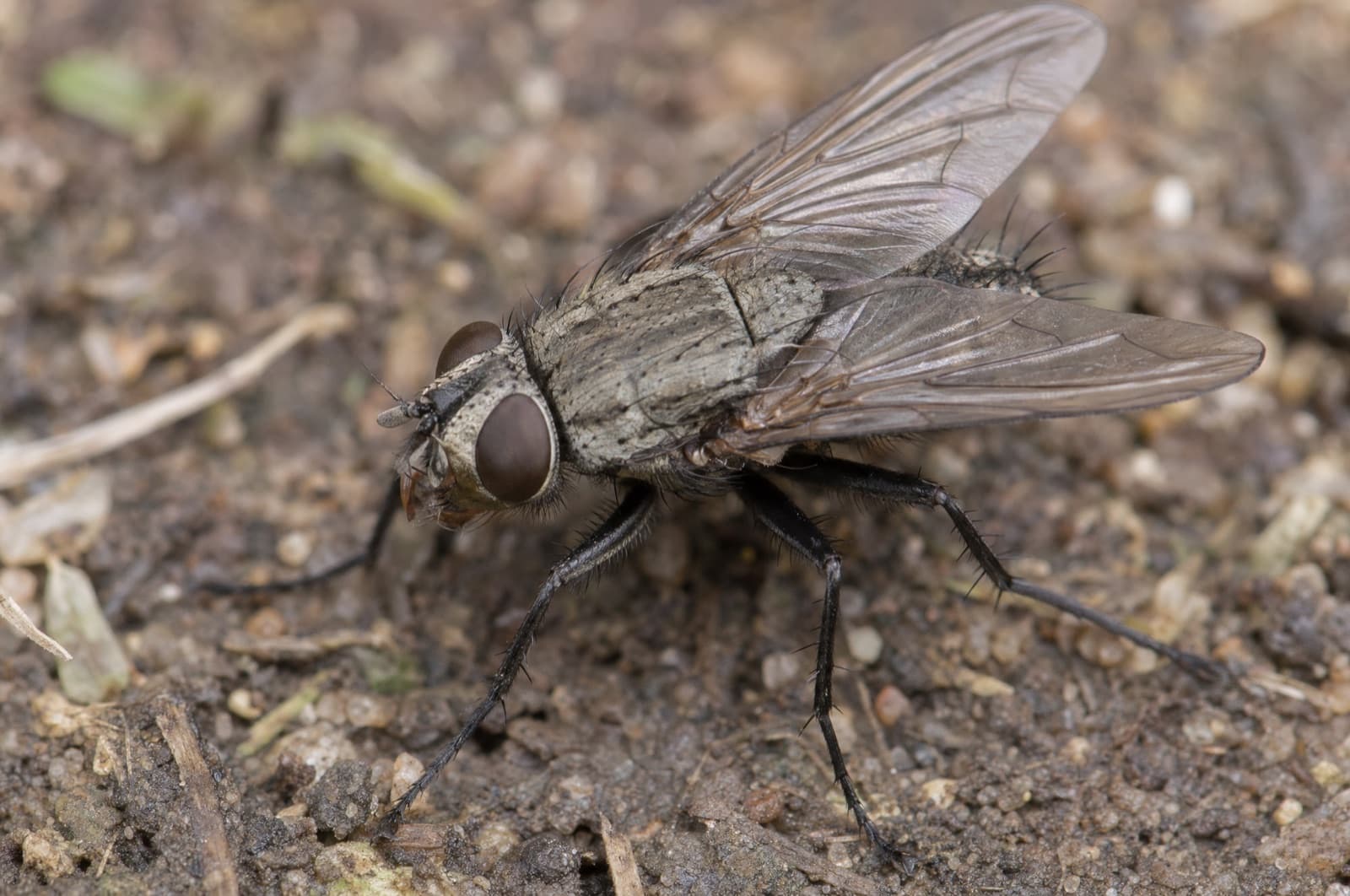
Cluster Flies in New Hampshire — Why They're in Your House in Winter
Also called Attic fly · Loft fly
Cluster flies are fall occasional invaders — not filth flies. Their larvae parasitize earthworms in your lawn; the adult flies overwinter in wall voids and attics, then emerge sluggishly on warm winter and early-spring days to cluster at sunny windows. They are harmless and do not contaminate food. Cleaning your kitchen does nothing. The only fix is exclusion before they get in — ideally before early September.
- What it is
- A fall occasional invader — NOT a filth fly
- Colorado State Extension
- Species
- Pollenia rudis
- family Polleniidae (formerly placed near Calliphoridae)
- Size
- 3/8–1/2 in
- larger and darker than a house fly; Colorado State Extension
- Larvae
- Parasitize earthworms in the lawn
- UNH Extension; Colorado State Extension; CT Agricultural Experiment Station
- Breeds indoors?
- No — overwinters in diapause
- does not reproduce inside the structure; Colorado State Extension
- Seal-up deadline
- Before ~September 10
- UNH Extension
Why are there flies at my window in the middle of winter?
Cluster flies (Pollenia rudis, family Polleniidae) are one of the most misunderstood flies in New Hampshire — and the misunderstanding drives a lot of wasted effort. They are not filth flies. They do not breed in your kitchen, your garbage, or any food source. Colorado State Extension states plainly that cluster flies 'are not a type of filth fly that develops in carrion, decaying plant matter or garbage' — their larvae are parasites of earthworms out in the lawn.
What they do is this: adults push into wall voids, attic spaces, and other sheltered spots in the fall, enter a dormant state (diapause), and overwinter there. On warm winter days and in early spring, they wake up and work their way toward light — ending up sluggishly bumbling at sunny windows, apparently trying to get back outside. This is why you see them in January or February despite having done nothing to attract flies.
UNH Extension specifically notes that these large sluggish flies 'often invade New Hampshire homes in fall and turn into wintertime pests,' noticeable on warm winter days at windows. Because they are not a filth fly, sanitation is irrelevant. The only lever is exclusion: seal exterior gaps and screen attic vents before the fall push — UNH advises before approximately September 10.
How to identify a cluster fly
Four features separate cluster flies from house flies and from the metallic blow/bottle flies they might be loosely grouped with: golden thoracic hairs, larger sluggish body, overlapping wings at rest, and the fall-to-winter timing indoors.
Cluster fly
- Scientific name
- Pollenia rudis
- Family
- Polleniidae (historically placed near Calliphoridae; modern taxonomy separates them)
- Size
- 3/8–1/2 in (larger than a house fly)
- Coloration
- Dull grayish-brown; distinctive golden/yellowish tangled hairs on the thorax
- Habitat
- Larvae in lawns/fields (in earthworm hosts); adults overwinter in attics, wall voids, and sheltered gaps.
- Active season
- Invade fall; emerge on warm winter and early-spring days; summer activity outdoors
- Diet
- Larvae: parasitic on earthworms. Adults: feed minimally during overwintering; some flower nectar outdoors.
- Reproduction
- Up to 4 generations per summer (UNH Extension); larvae are obligate earthworm parasitoids.
- Lifespan
- Adults overwinter in diapause; do not reproduce indoors.
Common throughout the northeastern United States and New Hampshire; introduced from Europe.
The tells — key ID features
- Golden/yellowish tangled hairs on the thorax — the single best ID tell vs. the house fly.
- Slightly larger and darker than a house fly, moving sluggishly.
- Wings overlap at rest — house fly wings do not overlap.
- Clusters at sunny windows and in attic spaces on cool days.
- Bumbling, slow movement compared to the quick, erratic house fly.
Size, to scale
3/8–1/2 in
Noticeably bigger than a house fly — roughly a cooked grain of rice and then some
Common house fly
How to tell — House fly is smaller, faster, has four sharp dark thoracic stripes (not golden hairs), and wings do not overlap at rest. House flies are active filth flies; cluster flies are seasonal invaders. If it is quick and buzzing around food or garbage, it is a house fly.
Blow / bottle fly
How to tell — Blow and bottle flies have a brilliant metallic blue/green/bronze sheen. Cluster flies are dull grayish-brown — no metallic sheen at all.
Signs of a problem
Cluster fly signs follow a predictable seasonal pattern tied to temperature, not to any food or sanitation condition in the home.
Sluggish, large flies clustering at sunny windows on warm winter days
What it means — Classic cluster fly emergence from within the walls or attic — the overwintering adults are waking and seeking light to exit.
Clusters of flies in the attic or in wall voids
What it means — The overwintering harborage — this is where the flies are spending the cold season in diapause.
More flies appearing each warm day despite removing yesterday's
What it means — Flies are emerging from inside the structure, not breeding there — a large overwintering population is present in the walls or attic.
Large flies appearing on sunny exterior walls in fall (September–October)
What it means — The fall entry push — flies are gathering on sun-warmed siding before entering gaps to overwinter. This is the window to seal.
The real risks, calibrated
Cluster flies are harmless. This is the most important fact on this page — anti-fearmonger framing is warranted.
Nuisance only — no health risk
Low riskOnset: During overwintering season
Cluster flies do not bite, do not contaminate food the way filth flies do, and carry no known disease risk to humans. They are a nuisance, not a health hazard.
Minor spotting and odor in heavy infestations
Low riskOnset: Over the winter season
Very large overwintering masses may leave minor spotting (excrement) on window sills or attic surfaces and produce a faint sweetish odor.
DIY — what works, what backfires
Cluster fly control is about exclusion before they get in — not about sanitation, not about spraying after they are already inside the walls. Here is what actually works.
What actually works
- Seal cracks in siding, around windows, door frames, and utility penetrations before early-to-mid September — UNH Extension advises before approximately September 10, ahead of the fall entry push.
- Screen attic and gable vents with fine mesh before early September to block the primary overwintering route.
- Vacuum sluggish cluster flies from windows and surfaces — use a vacuum with a bag, and empty the bag outdoors immediately to prevent them from escaping back into the house.
- On warm fall days, inspect sunny exterior walls for fly congregation — this tells you exactly where the entry gaps are while you still have time to seal them.
What backfires
- Don't rely on cleaning or sanitation — cluster fly is not a filth fly; your kitchen has nothing to do with their presence, and cleaning won't reduce them.
- Don't spray the interior once flies are already inside the walls — spraying rooms does not reach the overwintering population in voids; it only kills those that have already emerged.
- Don't expect a fix this winter — if cluster flies are already in the walls, interior treatment helps little; the real solution is planning exclusion for next fall.
- Don't confuse the daily re-emergence with breeding indoors — cluster flies do not reproduce inside your home; the daily appearance is from the overwintering population waking up, not from new egg laying.
Cluster flies in New Hampshire homes
UNH Extension identifies cluster flies as a common New Hampshire fall invader that becomes a wintertime window pest. They are found statewide across NH in homes with accessible wall voids, attic spaces, or gaps in siding and window frames. The fall entry push begins as temperatures cool in September, well ahead of Manchester's first hard frost (typically mid-to-late October per NOAA 1991–2020 normals). Seal-up work must be completed before early September to be effective — after they are inside the walls, interior treatment is difficult and exclusion that fall season is already lost.
Peak season
Invade in fall (September); emerge at windows on warm winter and early-spring days
You might actually have
- Common house fly (filth fly, four thoracic stripes, faster — the most important ID contrast)
- Blow/bottle flies (metallic — cluster fly is dull grayish-brown)
- Asian lady beetles and boxelder bugs (same fall-invader overwintering behavior)
We serve these communities
- NH-licensed applicator · #782664
- Same-day service
- Family-owned since 2017
Service Area Map
Southern New Hampshire
When to call a pro for cluster flies
Cluster fly exclusion requires systematically sealing every exterior gap before fall — a task that benefits from a professional exterior inspection to find entry points that are easy to miss. For very large overwintering populations in attics, a licensed technician can also treat voids with approved products timed to intercept flies before they fully enter.
When to call a pro
- Recurring heavy winter infestations despite your own sealing attempts — a professional exterior inspection identifies gaps you missed.
- Exclusion work timed correctly before fall entry — mid-to-late August through early September is the optimal window.
- Very large overwintering populations in attic spaces that are difficult to address with vacuuming alone.
- You want a whole-structure gap assessment to prevent cluster flies, Asian lady beetles, and other fall invaders in one service.
Seal before September — the most important step
UNH Extension advises sealing exterior gaps before approximately September 10. This is the annual deadline. Caulk gaps in siding, seal around windows and doors, and install tight-fitting screens on attic and gable vents before the fall push.
Pay attention to sun-facing walls
Cluster flies congregate on south- and west-facing walls on warm fall days before entering. These sun-warmed surfaces show you exactly where the entry points are — inspect these sides of your home first when sealing.
Treat it as an annual task
NH homes with established cluster fly pressure will see the behavior repeat every fall until all entry points are sealed. A once-annual late-summer inspection and sealing pass is the long-term fix.
Not sure it's a cluster fly?
A licensed NH technician can confirm the species and tell you honestly whether it's a DIY fix or a job for a pro — free inspection, same-day service across Southern New Hampshire.
Frequently asked questions
Sources(5)
- [1]UNH Extension — Cluster Flies Fact Sheet
NH wintertime window pest, 4 generations, seal before Sept 10
extensionverified 2026-06-30 - [2]Colorado State Extension — Cluster Flies and Other Winter Flies
not a filth fly; earthworm parasite; diapause; size
extensionverified 2026-06-30 - [3]CT Agricultural Experiment Station — Cluster Fly (Pollenia)
earthworm life cycle, biology
govverified 2026-06-30 - [4]UNH Extension — Seasonal Insect Invaders in New Hampshire Homes
fall-invader timing and exclusion in NH
extensionverified 2026-06-30 - [5]NOAA/NWS Gray–Portland — NH Climate Normals
Manchester frost normals (context for fall seal-up deadline)
govverified 2026-06-30
Written & reviewed by
VerifiedDaniel Brady
NH-Licensed Pesticide Applicator · License #782664 (NHDAMF, RSA 430)
Daniel Brady is the New Hampshire–licensed applicator behind Anchor Pest Services, a family-owned pest control company serving the Manchester area since 2017.
Last updated 2026-06-30

New Hampshire pest control
Dealing with cluster flys in your home?
Anchor Pest Services identifies and handles cluster fly problems across southern and central New Hampshire. Family-owned since 2017, NH license #782664.
- NH-licensed applicators (#782664)
- Same-day service · free inspection
- Family-owned since 2017
Your next step
- Fall guide
Fall Pest Control in New Hampshire
What matters before frost: the fall invader window, mice at the foundation, and what to seal first.
Read the answer - What to do next
How to Get Rid of Cluster Flies
Read the answer - What to do next
Where Do Flies Go in the Winter? NH Cluster Fly Timing
Read the answer - What to do next
What Attracts Cluster Flies to Your House?
Read the answer - What to do next
How do I spot cluster flies in my attic?
Read the answer - What to do next
What is the best way to get rid of cluster flies?
Read the answer