
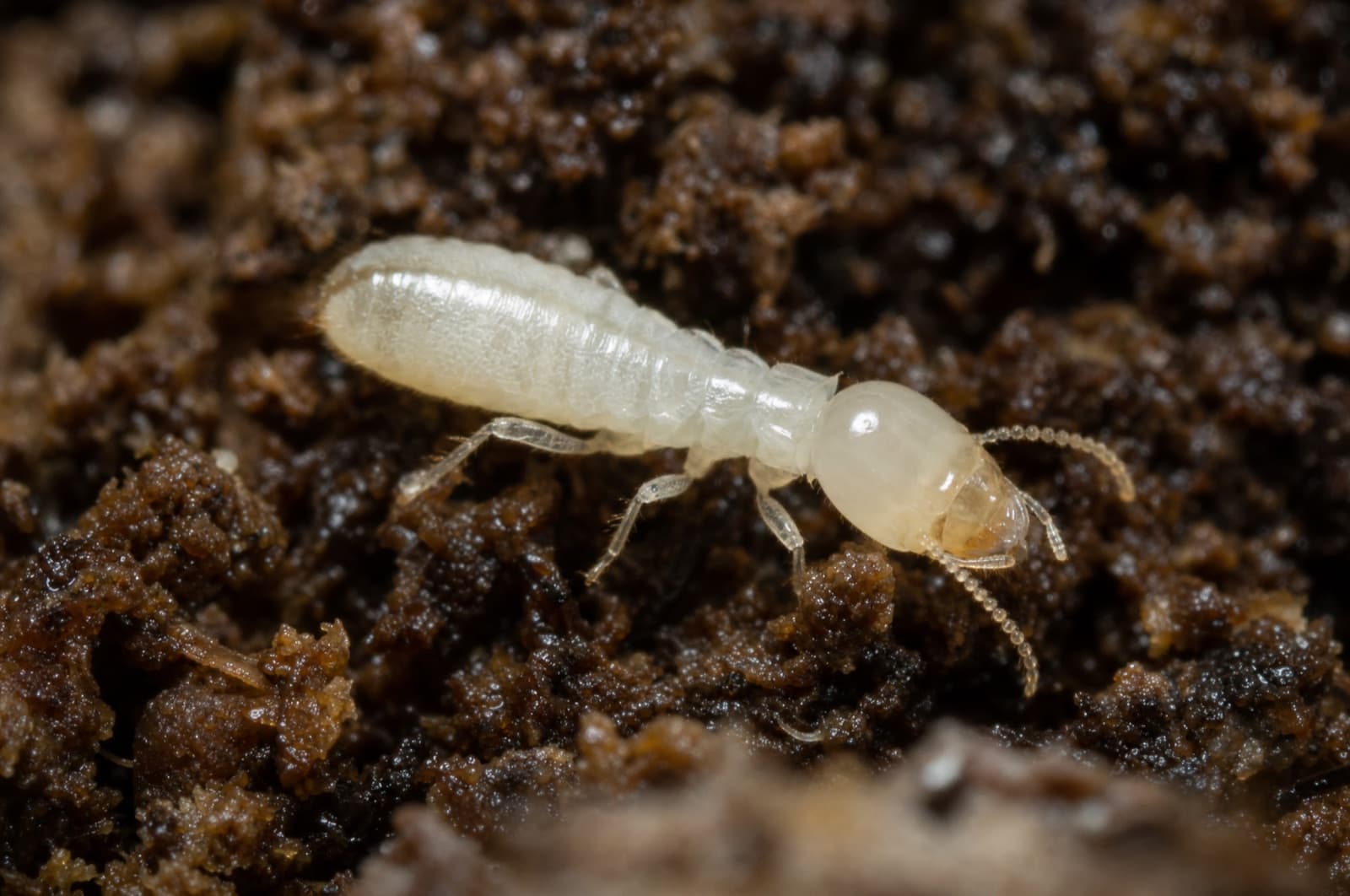
What Attracts Eastern Subterranean Termites to Your House?
At a glance
- Short answer: Termites aren't drawn to your house by wood — they're drawn up out of the soil, and the predictor is wood touching the ground plus moisture.
- The verdict: Something specific
The attractant verdict
Four possible answers to why this species turned up. Three stay unlit — and that's the argument: the honest answer could have been any of them, and for this species it wasn't.
Termites aren't drawn to your house by wood — they're drawn up out of the soil, and the predictor is wood touching the ground plus moisture.
Most advice, including our own previous page, says these termites are drawn to a house mainly by wood and moisture, in that order, as if any structural lumber were equally at risk. That framing makes it sound like the species itself — wood-framed construction — is the attractant.
Eastern subterranean termites live in the soil and cannot survive being cut off from it for long; they have very little resistance to drying out. They reach a structure only where wood actually touches soil, or by building mud (shelter) tubes that carry soil moisture up and across a foundation wall to reach wood that doesn't touch the ground directly, or through cracks in a slab and gaps where plumbing penetrates concrete. Moist or decayed wood — from a leak, poor grading, or condensation — is far more attractive than dry, sound wood, which is why damage concentrates around those exact spots rather than spreading evenly through a structure.
“Termites aren't drawn to your house — they're drawn up out of the soil, and what predicts them is wood touching the ground plus moisture, not what your walls are framed with.”
Direct soil-to-wood contact (a porch post set in dirt, siding buried below grade, form boards left in a foundation) or a chronic moisture source — a leak, poor drainage, condensation — that lets termites build a mud shelter tube from the soil to wood that doesn't touch the ground at all. The colony itself lives in the soil and needs that connection to survive.
It means the fix isn't about the house being made of wood — nearly all houses are. It's about specific, findable conditions: grade sloping toward the foundation, mulch piled against siding, a downspout draining next to the slab, wood siding or trim touching soil. Two houses built from identical lumber can have very different risk depending only on these details.
Calibrated from: University of California IPM (ipm.ucanr.edu) and Missouri and Clemson Cooperative Extension: subterranean termites must maintain contact with the soil or another moisture source to survive, and infestations occur where wood contacts soil directly or where shelter tubes carry that connection to wood above grade.
Why it's here, in full
Why "wood" isn't the specific answer
Nearly every house in New Hampshire has structural wood, so "they're attracted to wood" can't be the real explanation for why one house gets a termite colony and the one next door doesn't. The distinguishing factor is soil contact and moisture. Eastern subterranean termites nest in the ground and depend on it: they have almost no ability to survive dehydration once separated from soil moisture. UC IPM describes them as termites that "nest in or near the soil and maintain some connection with the soil," and Clemson Cooperative Extension is direct about the mechanism: "They live in the soil and must maintain contact with the ground or some other moisture source to survive."
That single requirement explains almost everything about where damage shows up. Missouri Extension notes infestations occur "when subterranean termite workers locate structural wood in contact with soil or when termites build shelter tubes from the soil across foundation walls and into structural wood." A porch post set directly in dirt, siding that extends below grade, or form boards left behind in a poured foundation are all direct soil-to-wood bridges. Where wood sits above the soil line, termites compensate by constructing shelter tubes — narrow, protected runways of soil and saliva that keep the humid environment they need intact all the way from the ground to the food source.
Why moisture without soil contact still counts
Moisture matters even where wood never touches the ground, because damp or decayed wood is simply easier and more attractive to work than dry, sound wood. A slow plumbing leak, a downspout that empties against the foundation, poor grading that lets water pool near the slab, or condensation in a crawlspace can all create the moist wood conditions termites favor, even several feet from any visible soil contact. That's why termite damage tends to cluster around bathrooms, kitchens, crawlspace edges, and areas with a known water history rather than appearing randomly throughout a structure — the wood there is simply more hospitable, not more "wooden."
Damage severity and structural risk are a separate question owned by /faq-pest-damage-and-risks; this page is only about why a colony reaches a structure in the first place.
How to tell it's actually this species
Real signs only — a species with four honest tells gets four, and stops. Where a sign is weak on its own, we say so.
Mud (shelter) tubes — pencil-width tunnels of soil and saliva running up a foundation wall, pier, or slab edge toward wood
Could be something else: Old, abandoned tubes can be dry and crumbly; a tube alone doesn't confirm an active colony, but it does confirm the soil-to-wood connection this page describes.
Wood that sounds hollow or papery when tapped, or that dents easily under light pressure, especially near a sill plate, door frame, or area with a known moisture history
Swarms of winged reproductives (or their shed wings on a windowsill) indoors, typically on a warm day in spring
Blistered or darkened paint or drywall over a spot that turns out to conceal tunneling underneath
Want eastern subterranean termite gone?
This page only answers why it's here. Every removal step for this exact species — what to seal, what to set, what actually works — lives on its own dedicated guide.
Two questions, two pages
Here: why it turned up at all — the honest answer, blame removed.
There: the step-by-step removal guide for this exact species.
Key takeaways
- The specific attractant is soil-to-wood contact plus moisture — not wood construction in general.
- Mud shelter tubes are how termites extend that soil connection to wood that doesn't directly touch the ground.
- Grading, drainage, and buried or contacting wood are the conditions that actually predict risk, not the presence of lumber.
- Removal and treatment are a different question — see /top-diy-methods/eastern-subterranean-termite.
Found a mud tube or soft wood near the foundation?
This page is about why termites reach a structure. Removal and treatment are covered at /top-diy-methods/eastern-subterranean-termite.
Frequently asked
Sources(3)
- [1]University of California Statewide IPM Program — Subterranean and Other Termites
Subterranean termites nest in or near the soil and maintain a connection with the soil
extensionverified 2026-07-17 - [2]University of Missouri Extension — Subterranean Termites (G7420)
Infestations occur where wood contacts soil or where shelter tubes bridge the soil to structural wood
extensionverified 2026-07-17 - [3]Clemson Cooperative Extension — Subterranean Termite Control
Termites live in the soil and must maintain contact with the ground or another moisture source to survive
extensionverified 2026-07-17
Written & reviewed by
VerifiedDaniel Brady
NH-Licensed Pesticide Applicator · License #782664 (NHDAMF, RSA 430)
Daniel Brady is the New Hampshire–licensed applicator behind Anchor Pest Services, a family-owned pest control company serving the Manchester area since 2017.
Last updated Jul 2026
It's the moisture, not the lumber
We check the soil-contact points, not just the walls
Same-day inspections across southern and central New Hampshire, focused on where wood actually meets ground or moisture.
- Family-owned in Manchester since 2017
- NH commercial applicator #782664, category F1
- We will tell you when the answer is do nothing
NH License #782664 · No obligation · We answer in person