
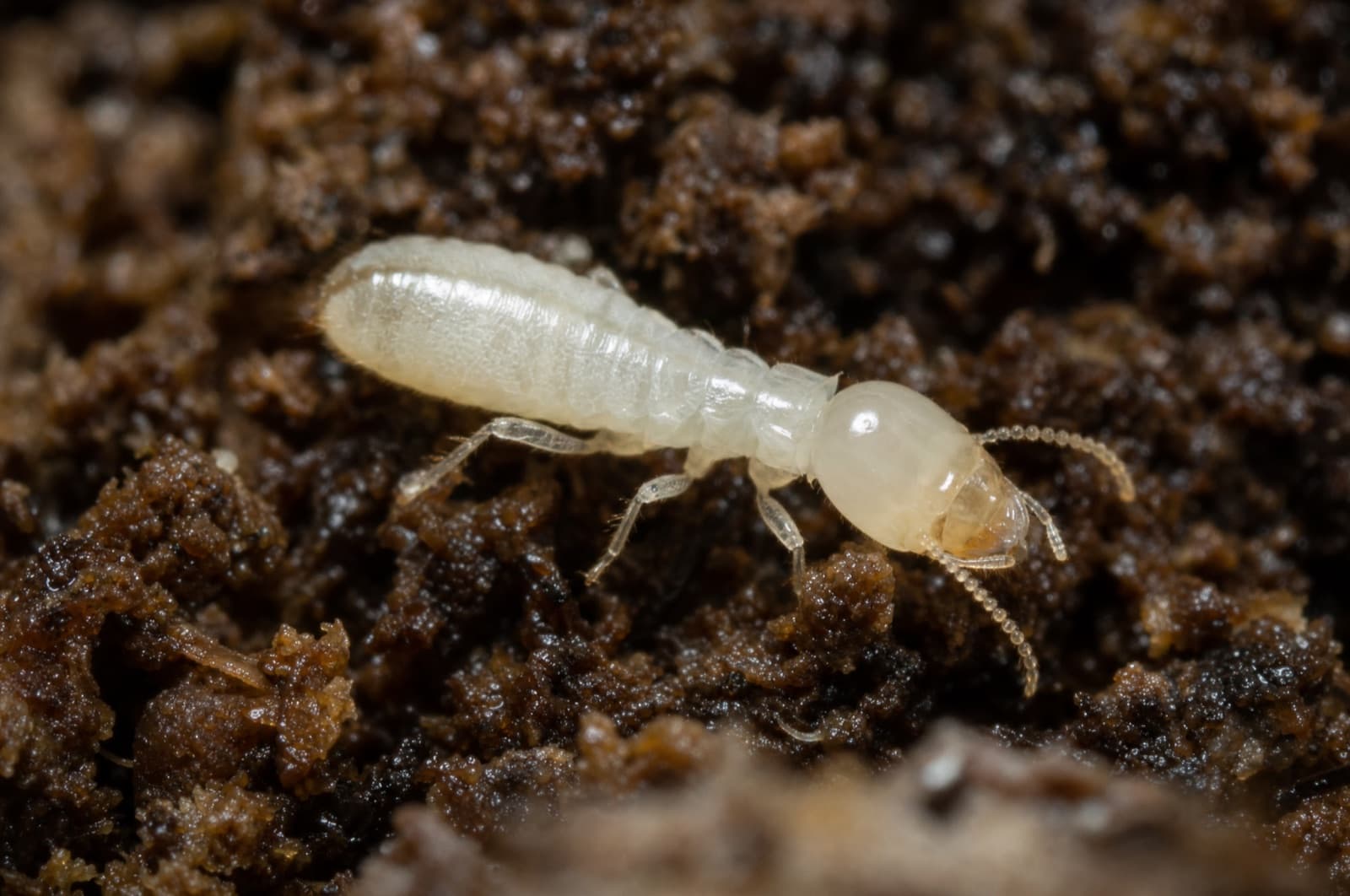
Eastern Subterranean Termite in NH — ID, Signs & Control
Also called Subterranean termite
The Eastern subterranean termite (Reticulitermes flavipes) is the only termite of structural concern in New Hampshire and the most common termite in New England. NH is near its northern range edge, so risk concentrates in southern NH and lower river valleys. Termites eat structural wood silently for months or years — the action threshold is effectively zero. If you see mud tubes, shed equal-length wings, or spring swarmers, get a professional inspection immediately.
- Species
- Reticulitermes flavipes — the most frequently encountered termite in New England
- Connecticut Agricultural Experiment Station (CAES)
- NH status
- Present; concentrated in southern NH and lower valleys; near the northern range edge
- University of Florida IFAS; HUD/USDA Termite Infestation Probability (TIP) zones
- Colony size
- 100,000–1,000,000 workers; forage up to 150 ft for food
- University of Florida IFAS
- Swarmer identification
- Four equal-length wings, straight bead-like antennae, thick uniform waist — no pinch
- University of Georgia CAES
- Worker size
- ~3 mm, soft-bodied, creamy-white, blind and wingless
- University of Florida IFAS
- Insurance coverage
- Most standard homeowner policies exclude termite damage
- Industry standard; verify your policy
- DIY verdict
- NO — always a professional inspection; soil treatments and baiting require licensed application
- UNH Extension; CAES
Termites in New Hampshire — the pest that earns a zero-tolerance policy
Two myths about New Hampshire termites need correcting before anything else.
Myth one: 'We're too far north for termites.' False. New Hampshire is near the northern edge of the Eastern subterranean termite's range — not outside it. The species (*Reticulitermes flavipes*) is established in New England, identified by the Connecticut Agricultural Experiment Station as the most frequently encountered termite in the region, and is active in southern NH and the Merrimack and Connecticut River valleys. Federal HUD/USDA Termite Infestation Probability (TIP) data show NH's northernmost counties (Grafton, Carroll, Coos) in the lowest 'none to slight' risk band — but the southern portion of Anchor's service area carries measurable, 'slight to moderate' risk.
Myth two: 'Those few winged bugs by my window in spring are harmless ants.' Possibly false — and this matters enormously. Termite swarmers (winged reproductives) emerging indoors signal an established worker colony already feeding in or under your home. The three-feature check takes five seconds: equal-length wings + straight bead-like antennae + thick waist (no pinch) = termite. Unequal wings + elbowed antennae + pinched waist = ant. Capture one in a bag, photograph it, and get a professional inspection.
Subterranean termites tunnel up from the soil through pencil-width mud tubes to eat structural wood — silently, continuously, for months to years. The damage is almost always hidden until it is significant. Most homeowner insurance policies do not cover termite damage, which is why early detection and a low action threshold are the only sensible approach. There is no effective homeowner-level treatment for subterranean termites; control requires licensed professional inspection and either soil termiticide application or an in-ground colony baiting system.
How to identify the Eastern subterranean termite — and distinguish it from a flying ant
The most important identification challenge in New Hampshire each spring is distinguishing a termite swarmer from a flying ant. Three features resolve it in seconds. Mud tubes on the foundation are the second key sign — no ant or other insect makes them. Workers, if you see them, are creamy-white, soft-bodied, and blind.
Eastern subterranean termite
- Scientific name
- Reticulitermes flavipes
- Family
- Rhinotermitidae
- Size
- Workers ~3 mm (≈ grain of rice); swarmers (alates) ~¼–⅜ in including wings
- Coloration
- Workers: creamy-white, soft, opaque; swarmers: dark brown to black body with pale wings
- Habitat
- Underground colonies — tunnels up from soil to reach wood in contact with or near the ground; sills, floor joists, subflooring, support posts, cellulose debris near foundations
- Active season
- Swarms in spring (March–May); active year-round underground and within heated structures; cold slows but does not stop activity in insulated buildings
- Diet
- Cellulose — structural wood, paper, cardboard, and other cellulose-based materials
- Reproduction
- Queen lays thousands of eggs per year; colonies grow to hundreds of thousands to millions over years
- Lifespan
- Queens can live for decades; colonies persist for many years
Ranges from southern Ontario, Canada, south to Key Largo, FL; New Hampshire is near the northern limit; most common termite in New England and the eastern U.S.
The tells — key ID features
- Swarmer (alate) best tell: four equal-length wings with a straight bead-like leading edge, straight (not elbowed) antennae, and a thick uniform waist — no pinch between thorax and abdomen.
- Workers: blind, wingless, soft-bodied, creamy-white, with rounded heads — virtually never seen unless you break open an infested wood member.
- Mud tubes: pencil-width structures of soil, feces, and saliva running up foundation walls, piers, or wooden structural members — no other insect builds them.
- Damaged wood: sounds papery hollow when tapped; damage runs with the grain; wood may appear blistered or buckled from outside.
- Shed equal-length wings: small piles of matched-length wings near windows, doors, and interior foundation walls after a swarm — the remaining evidence after swarmers die or depart.
Size, to scale
Workers ~3 mm; swarmers ~¼–⅜ in (body only)
A worker is about the size of a grain of dry rice; a winged swarmer is about the size of a grain of cooked rice
Flying ant (winged ant reproductive)
How to tell — The critical lookalike in spring. Flying ants have UNEQUAL wings (front pair clearly longer than hind pair), ELBOWED antennae (bent at a sharp angle mid-length), and a PINCHED waist between thorax and abdomen. Termites have EQUAL wings, STRAIGHT bead-like antennae, and a THICK uniform waist. Collect one specimen and check all three features.
Carpenter ant swarmer
How to tell — Large (13–17 mm), solid black, with the same ant features: pinched waist and elbowed antennae. Carpenter ants excavate wood (leaving sawdust-like frass and clean galleries) but do NOT eat wood and do NOT build mud tubes. If you see sawdust near a wood member with no mud tubes, carpenter ants are more likely. See /pests/carpenter-ant for full detail.
Winged reproductives of other ant species
How to tell — Smaller than carpenter ant swarmers, but the same three ant tells apply: pinched waist, elbowed antennae, unequal wings. No ant species builds mud tubes or has the straight bead-like antennae of termites.
Signs of a problem
Termites are cryptic — they feed inside wood and travel inside mud tubes, so you rarely see them directly. These six signs are what to look for during spring inspection and before any renovation or real-estate transaction.
Pencil-width mud tubes running up foundation walls, piers, exposed beam ends, or crawl-space surfaces
What it means — Strong evidence of active or recent subterranean termite activity — the tubes are their highway from soil to food; no other NH insect makes them.
A spring swarm of dark-winged insects emerging from the soil, foundation walls, or floor openings — often in the morning after a warm rain
What it means — A mature colony nearby; indoor swarmers specifically signal the colony is in or under the structure.
Small piles of equal-length shed wings on interior window sills, near interior doors, or along foundation walls
What it means — Recent swarm — swarmers shed their wings almost immediately after landing; a pile of matched-length wings means a swarm occurred recently.
Wood that sounds hollow and papery when tapped, or surfaces that look blistered or sunken
What it means — Internal feeding damage — termites hollow wood from the inside following the grain; external surfaces may appear intact until damage is advanced.
Sagging floors, sticking doors or windows without obvious cause, or settling in one area of a floor
What it means — Possible structural compromise from extended termite feeding — warrants immediate professional inspection.
Mud or dirt within cracks in structural wood or between wood and foundation near the soil line
What it means — Active termite galleries; the mud packing is used to maintain humidity in their feeding galleries.
The real risks, calibrated
Subterranean termites pose no direct health risk to people — they do not bite or sting. Their risk is entirely structural and financial, and it is severe over time.
Structural damage — silent and compounding
SevereOnset: Months to years of concealed feeding
A colony feeding continuously on sills, joists, and subflooring can compromise load-bearing structural members. Damage typically reaches serious levels before any visible sign appears. Eastern subterranean termites are the most economically damaging structural pest in the United States.
Hidden infestation until damage is advanced
HighOnset: Months to years
Cryptic behavior means a termite infestation can be active for one to several years before mud tubes, swarmers, or hollow-sounding wood are noticed. By the time typical visible signs appear, significant feeding has usually already occurred.
Financial loss — typically uninsured
HighOnset: Ongoing and cumulative
Most standard homeowner insurance policies specifically exclude termite damage and the resulting repair costs. Structural repairs to sills, joists, and subflooring are expensive. Early detection through professional inspections is the only financial protection available.
Recurrence without complete treatment
ModerateOnset: Ongoing
Subterranean termite colonies persist for years and will re-invade untreated structures. Partial control measures are not sufficient; the colony must be eliminated via a soil termiticide barrier or a monitored baiting system.
DIY — what works, what backfires
Honest verdict: NO for treatment — always a professional inspection and licensed application. There is no effective homeowner-level treatment for subterranean termites. However, there are meaningful steps you can take to reduce conducive conditions and detect problems early.
What actually works
- Reduce conducive conditions: maintain at least an 18-inch gap between soil/mulch and any wood structural member; keep mulch layers thin and back from the foundation.
- Fix moisture and drainage: repair gutters and downspouts so water drains away from the foundation; improve crawl-space ventilation; fix any plumbing leaks that keep soil moist near the foundation.
- Store firewood elevated and at least 20 feet from the house — never against the foundation or in contact with soil.
- Inspect the foundation perimeter each spring for mud tubes: check foundation walls, piers, beam ends in the crawl space, and any wood-to-soil contact points.
- Schedule a professional inspection at any sign: mud tubes, spring swarmers, shed equal-length wings, hollow-sounding wood, or before any real estate transaction.
What backfires
- Don't tear open walls or woodwork trying to chase swarmers — you will not eliminate the colony and you may compromise structural integrity. Let a licensed pro do the investigation.
- Don't spray a swarm with over-the-counter pesticide and consider it solved. Indoor swarmers signal an established worker colony already feeding in the structure. Killing the swarmers does nothing to the colony.
- Don't delay an inspection. Termites do not self-resolve; the longer a colony feeds undisturbed, the greater the structural damage and the greater the cost of eventual repair. The action threshold is effectively zero.
Eastern subterranean termites in New Hampshire
New Hampshire sits near the northern limit of Reticulitermes flavipes's North American range. Federal HUD/USDA Termite Infestation Probability (TIP) data place NH's northernmost counties — Grafton, Carroll, and Coos — in the lowest 'none to slight' risk band. Southern New Hampshire, including the Merrimack River valley (Manchester, Concord, Nashua), the Connecticut River valley (Keene corridor), and the seacoast, carries 'slight to moderate' measurable risk — the area served by Anchor Pest Services. NH swarming season typically falls in spring, roughly March through May, often triggered by warm morning temperatures after a rain event. For local specimen identification, UNH Cooperative Extension offers an Insect Identification Service. Note: no standalone UNH termite fact sheet exists; UNH's termite content is integrated into its carpenter-ant materials and applicator study materials.
Peak season
Swarms in spring (roughly March–May), often after warm morning rain; active year-round underground and in heated structures
You might actually have
- Carpenter ant swarmers — spring swarmers that are often confused with termites; pinched waist and elbowed antennae distinguish them
- Flying pavement or odorous-house ant swarmers — smaller, same three ant tells: pinched waist, elbowed antennae, unequal wings
We serve these communities
- NH-licensed applicator · #782664
- Same-day service
- Family-owned since 2017
Service Area Map
Southern New Hampshire
When to call Anchor Pest Services for termites
Any sign that could indicate subterranean termite activity — mud tubes, spring swarmers, shed equal-length wings, hollow-sounding wood, or unexplained settling — warrants a prompt professional inspection. Effective subterranean termite treatment requires licensed application under NH commercial applicator license F1 (which covers structural pest control under RSA 430) and uses either a soil-applied liquid termiticide barrier or an in-ground colony baiting system, both of which must be properly installed to reach the underground colony. Anchor's team is NH-licensed and experienced with the southern-NH range-edge conditions that determine where termite pressure is real.
When to call a pro
- Any mud tubes on the foundation — even old-looking ones that may still be active.
- Spring swarmers emerging from floors, walls, or foundation areas indoors.
- Piles of equal-length shed wings near windows or interior foundation sills.
- Wood that sounds hollow when tapped, especially sills, floor joists, or porch structural members.
- Before buying or selling a home — a termite/WDI inspection is the only way to know the structure's status.
- Any uncertainty about whether what you're seeing is a termite swarmer or a flying ant.
Eliminate wood-to-soil contact
Maintain an 18-inch gap between soil, mulch, or debris and any wood structural element — sills, posts, deck supports, stair stringers. Wood-to-soil contact is the single most significant termite conducive condition.
Control moisture at the foundation
Grade soil away from the foundation, keep gutters clean and downspouts extended at least 3 feet away, repair any plumbing leaks, and ventilate crawl spaces. Moist soil near the foundation accelerates termite foraging activity.
Schedule periodic professional inspections
For homes in southern NH, a professional inspection every 1–3 years is the most reliable early-detection measure. Inspections in advance of any renovation that opens walls or floors can catch infestations before they become structural emergencies.
Not sure it's a eastern subterranean termite?
A licensed NH technician can confirm the species and tell you honestly whether it's a DIY fix or a job for a pro — free inspection, same-day service across Southern New Hampshire.
Frequently asked questions
Sources(7)
- [1]Connecticut Agricultural Experiment Station — Eastern Subterranean Termite
species identification as most frequently encountered termite in New England
extensionverified 2026-06-30 - [2]University of Florida IFAS — Subterranean Termites (IN369)
range (southern Ontario to Key Largo; NH near northern limit), colony size (100k–1M), foraging range (150 ft)
extensionverified 2026-06-30 - [3]HUD / USDA — Termite Infestation Probability (TIP) Zones
NH TIP zone data: northern counties 'none to slight'; southern NH 'slight to moderate'
govverified 2026-06-30 - [4]Northeast IPM Center — Eastern Subterranean Termite
identification, signs of presence, management in northeastern states
extensionverified 2026-06-30 - [5]University of Georgia CAES — Biology of Subterranean Termites in the Eastern United States
swarmer wing characteristics; Isoptera = equal wing; colony biology
extensionverified 2026-06-30 - [6]University of Maryland Extension — Ants and Termites: How to Tell the Difference
three-feature swarmer-vs-ant disambiguation (wings, antennae, waist)
extensionverified 2026-06-30 - [7]UNH Cooperative Extension — Insect Identification Services
local NH specimen identification resource
extensionverified 2026-06-30
Written & reviewed by
VerifiedDaniel Brady
NH-Licensed Pesticide Applicator · License #782664 (NHDAMF, RSA 430)
Daniel Brady is the New Hampshire–licensed applicator behind Anchor Pest Services, a family-owned pest control company serving the Manchester area since 2017.
Last updated 2026-06-30

New Hampshire pest control
Dealing with eastern subterranean termites in your home?
Anchor Pest Services identifies and handles eastern subterranean termite problems across southern and central New Hampshire. Family-owned since 2017, NH license #782664.
- NH-licensed applicators (#782664)
- Same-day service · free inspection
- Family-owned since 2017
Your next step
- Next step
Is Raid Double Control Ant Baits Safe for Pets?
Read the answer - What to do next
How to Get Rid of Eastern Subterranean Termites
Read the answer - Also relevant
Carpenter Ants vs Termites: Damage, Identification, and Which One You Have
Read the answer - Also relevant
How do termite infestations weaken homes over time?
Read the answer - Also relevant
Can termites or ants damage fences or sheds?
Read the answer