
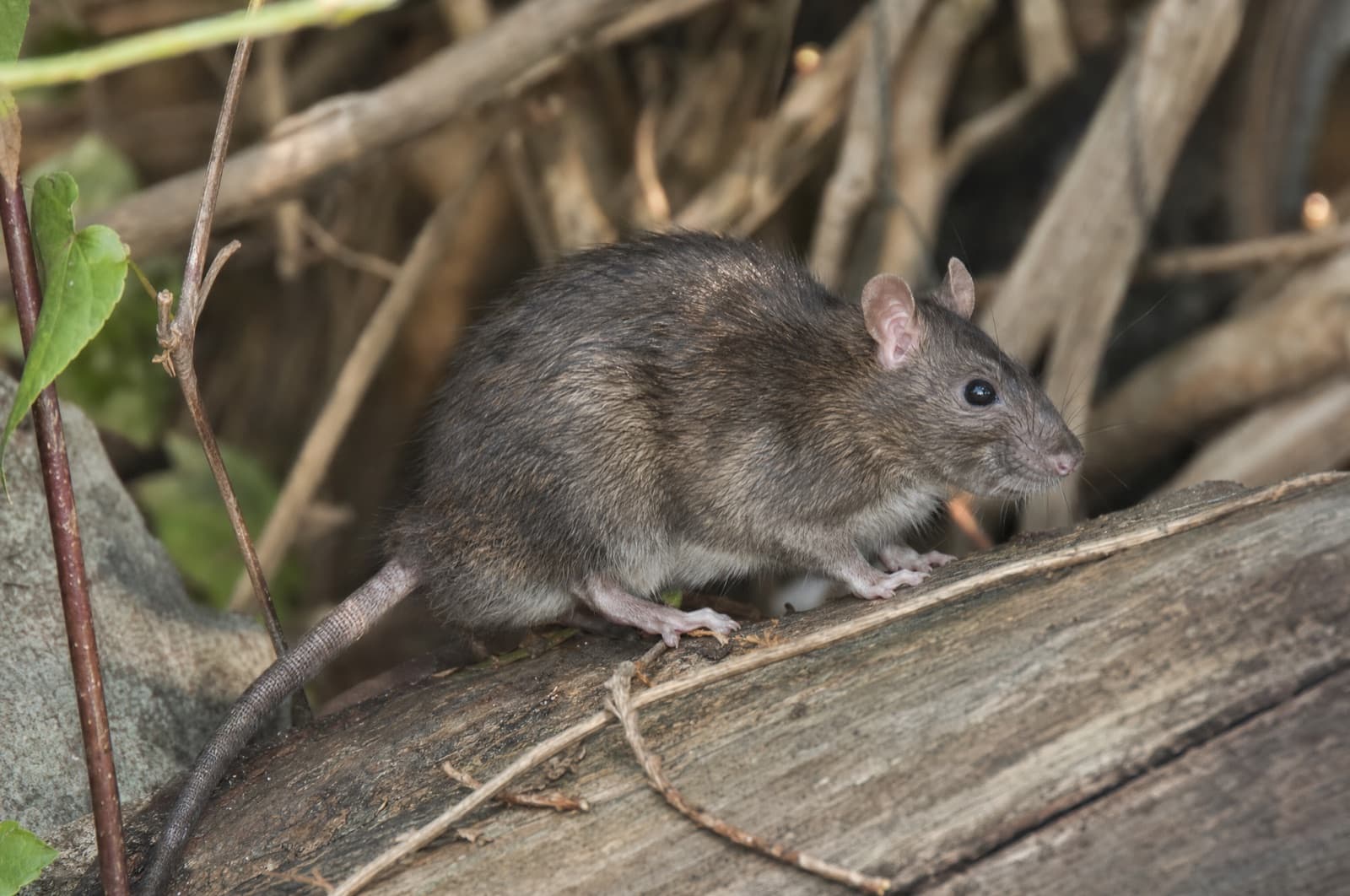
What Attracts Roof Rats to Your House?
At a glance
- Short answer: Roof rats aren't established in New Hampshire. What you likely have is a Norway rat.
- The verdict: You didn't attract it — you carried it in
The attractant verdict
Four possible answers to why this species turned up. Three stay unlit — and that's the argument: the honest answer could have been any of them, and for this species it wasn't.
Roof rats aren't established in New Hampshire. What you likely have is a Norway rat.
Our own old page said roof rats are drawn in mainly by "food, shelter, and water" — the same three words used to describe the Norway rat, and for good reason: in New Hampshire, that description is almost always a Norway rat being called by the wrong name.
Roof rats (Rattus rattus, also called black rats) are a warm-climate and coastal species established along the lower East Coast, the Gulf states, and Hawaii — not in New England. Rattus norvegicus, the Norway rat, has greater cold tolerance and has displaced roof rats from cooler, temperate regions including New Hampshire. When a genuine roof rat does appear far outside its normal range, it's typically traced to freight or cargo shipments, not to a house's conditions.
“If you have a rat in New Hampshire, it's a Norway rat, not a roof rat — the roof rat isn't established this far north, and a real one here almost always arrived by cargo, not by choice.”
Why it's here, in full
Why "roof rat" is usually the wrong name in New Hampshire
Roof rats and black rats are the same species, Rattus rattus, under two common names, and they're a warm-climate, coastal animal — established in the southeastern United States, the Gulf states, Hawaii, and small pockets of the Pacific coast, with cold, temperate regions largely off the map. New Hampshire's climate favors the Norway rat instead: Rattus norvegicus has greater cold tolerance and has displaced roof rats from cooler parts of North America, taking over the ground-level burrows and structures a roof rat would use in a warmer climate. Where the two species do overlap elsewhere in the country, roof rats are the better climbers and tend toward upper floors and rooflines, while Norway rats stay near the ground — one more reason a ground-level rat here points to the Norway rat.
That means a rat sign in New Hampshire almost always belongs to the Norway rat, even when "roof rat" gets used out of habit. This isn't the same as saying a roof rat has never been recorded here — isolated introductions outside a species' normal range do occur — but it is not the established, breeding population the rest of this catalogue describes.
The one honest exception: cargo, not attraction
The rare, genuine exception is a roof rat arriving via freight or a shipping container — documented introductions like this have occurred far outside the species' usual range when an infested shipment moved rats into a new area. Even then, the rat isn't responding to anything about a house; it was transported in, much like bed bugs are. If you have an active rat problem in New Hampshire, treating it as a Norway rat situation is almost always the accurate starting point — see /top-diy-methods/norway-rat for what that involves.
How to tell it's actually this species
Real signs only — a species with four honest tells gets four, and stops. Where a sign is weak on its own, we say so.
Fresh gnaw marks on wood, wiring, or food packaging
Could be something else: This is general rat sign, and in New Hampshire it points to a Norway rat far more often than a roof rat.
Dark, clumped droppings along a regular travel path
Could be something else: Droppings alone don't distinguish between rat species and are common across rodents generally.
Scratching or movement sounds inside a wall, attic, or ceiling void at night
A burrow opening at ground level near a foundation
Could be something else: Roof rats are climbers that favor elevated nesting sites, so a ground-level burrow is itself a sign pointing toward a Norway rat instead.
Want roof rat gone?
This page only answers why it's here. Every removal step for this exact species — what to seal, what to set, what actually works — lives on its own dedicated guide.
Two questions, two pages
Here: why it turned up at all — the honest answer, blame removed.
There: the step-by-step removal guide for this exact species.
Key takeaways
- Roof rat and black rat are the same species, Rattus rattus, not two different animals.
- Roof rats are not established in New Hampshire; the cold-tolerant Norway rat occupies this region instead.
- A genuine roof rat this far north would almost always trace back to a cargo or freight introduction.
- For an active New Hampshire rat problem, /top-diy-methods/norway-rat is the more accurate starting point.
Have an active rat problem in New Hampshire?
This page is about species identity. Removal guidance for the rat New Hampshire actually has is covered at /top-diy-methods/norway-rat.
Frequently asked
Sources(2)
- [1]University of Arizona Cooperative Extension — Roof Rats: Identification, Ecology, and Signs
Roof rats are established in most coastal and southern states, favor warm climates, and isolated populations elsewhere have traced back to infested freight or cargo shipments
extensionverified 2026-07-17 - [2]Smithsonian Environmental Research Center — NEMESIS Species Summary: Rattus rattus
Rattus rattus was rapidly displaced by the more cold-tolerant Rattus norvegicus in cooler, northern regions of North America
academicverified 2026-07-17
Written & reviewed by
VerifiedDaniel Brady
NH-Licensed Pesticide Applicator · License #782664 (NHDAMF, RSA 430)
Daniel Brady is the New Hampshire–licensed applicator behind Anchor Pest Services, a family-owned pest control company serving the Manchester area since 2017.
Last updated Jul 2026
Not established here — almost always a Norway rat instead
Whichever rat it turns out to be, we handle the rest
Same-day inspections across southern and central New Hampshire.
- Family-owned in Manchester since 2017
- NH commercial applicator #782664, category F1
- We will tell you when the answer is do nothing
NH License #782664 · No obligation · We answer in person