
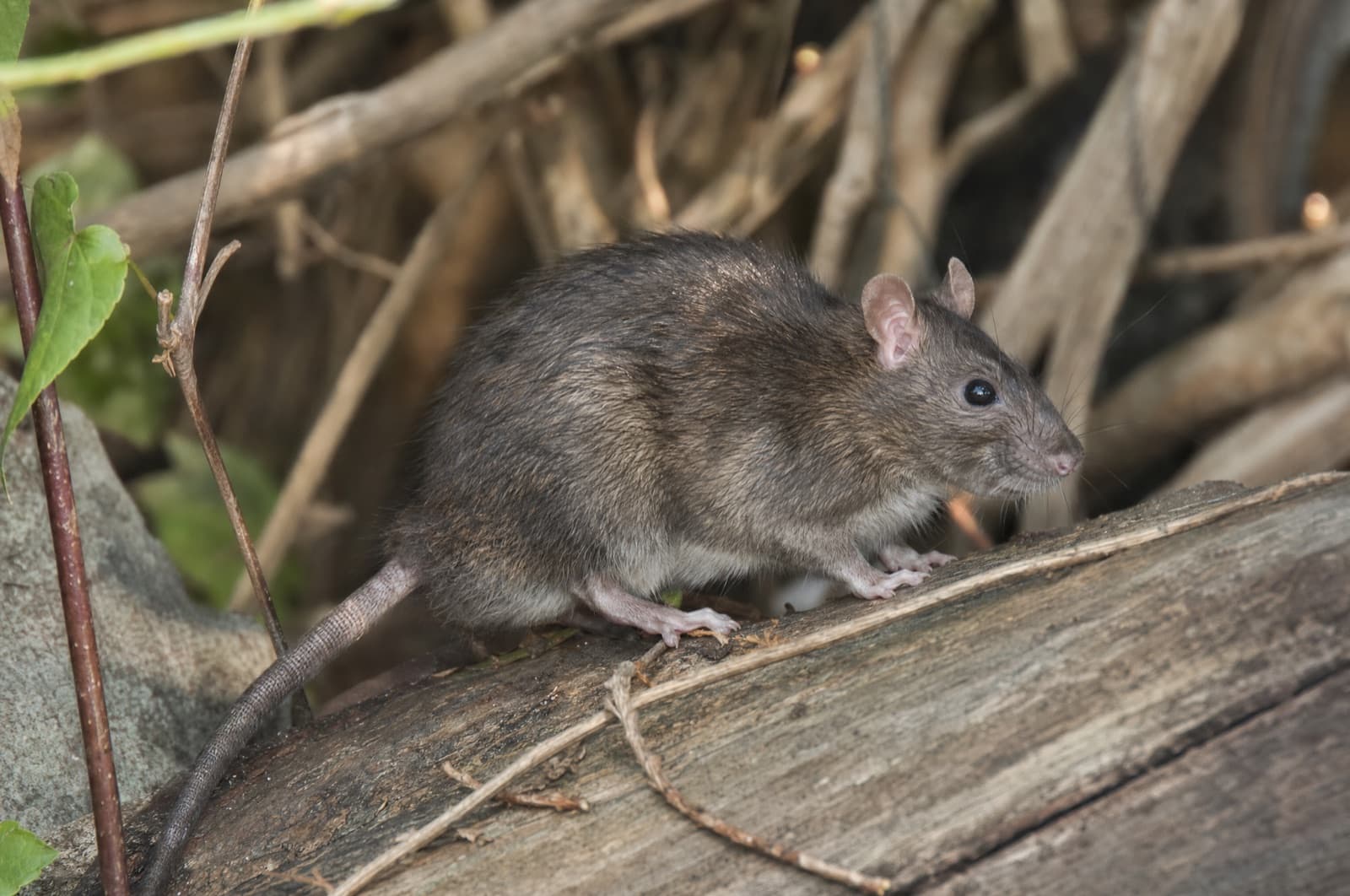
Roof Rat in New Hampshire — Or Is It a Squirrel?
Also called Black rat · Ship rat
The roof rat (Rattus rattus) is an agile climbing rat not established in New Hampshire's cold climate — NH occurrences are rare ship-borne strays. If you hear rats in your attic in NH, it is almost certainly a gray squirrel (daytime noise) or a Norway rat at ground level, not a roof rat. Confirm the species before calling for roof-rat service.
- NH status
- Not established — ship-borne strays only
- ICWDM
- Total length
- ~16 in; tail (6–8 in) longer than body (6–8 in); 5–12 oz
- ICWDM
- Climate limit
- Warm coastal/southern climates; less cold-adaptable than Norway rat
- ICWDM
- Real NH attic culprit
- Gray squirrel (daytime) or Norway rat (ground level)
- Colonial Pest Control
- Best tell
- Tail longer than the body (vs. Norway rat: shorter)
- ICWDM
- Legal status
- Unprotected; controllable any time
- Cowleys / ICWDM
Roof rats are not established in NH — here is what is actually in your attic
The roof rat (Rattus rattus — the same species as the black rat) is an agile climber that colonizes upper floors, attics, and arboreal routes in warm southern and coastal U.S. cities. But it is not established in New Hampshire's cold climate. The ICWDM is explicit: the roof rat is 'more at home in warm climates, and apparently less adaptable, than the Norway rat.' Occasional NH coastal sightings are ship-borne strays, not self-sustaining populations.
The real answer to 'I have rats in my attic' in New Hampshire: almost always an eastern gray squirrel (active and noisy during the day — squirrels are diurnal) or, less commonly, a Norway rat that has accessed upper areas through a structural gap. The roof rat is biologically unlikely here.
Fast ID if you see the animal: the roof rat has a pointed nose, large ears, a slender build, and — most critically — a tail that is distinctly longer than its body. The Norway rat's tail is shorter than its body. Color is not reliable. This page exists to prevent misidentification and an unnecessary, incorrectly targeted treatment.
How to identify a roof rat — and tell it from what you probably have in NH
The roof rat is a slender, agile climbing rat. The single most reliable field mark is the tail-to-body ratio: the roof rat's tail is longer than its body. The Norway rat's tail is shorter. If you have a dark or brown rat in NH with a tail shorter than its body and a blunt nose, it is a Norway rat — not a roof rat.
Roof rat
- Scientific name
- Rattus rattus
- Family
- Muridae
- Size
- 6–8 in body + tail longer than body (6–8 in); 5–9 oz (up to 12 oz)
- Coloration
- Brown to black above, lighter belly — color variable and NOT a reliable identifier
- Habitat
- Where established: attics, upper floors, trees, vine-covered fences; arboreal climber
- Active season
- Year-round where established in warm climates
- Diet
- Omnivore; prefers fruit, nuts, and grain
- Reproduction
- Prolific where established; multiple litters per year
- Lifespan
- ~1 year in the wild
Not established in NH — warm coastal/southern U.S. climates; NH occurrences are ship-borne strays only
The tells — key ID features
- Tail longer than the body — the single most reliable identification trait.
- Pointed nose and large ears (reverse of the Norway rat's blunt nose, small ears).
- Slender build; strong agile climber.
- Color brown to black — do NOT identify on color alone.
Size, to scale
6–8 in body + tail longer than body; 5–12 oz; total ~16 in
Total length about a 12-inch ruler; the tail outmeasures the body.
Norway rat
How to tell — Heavier and stockier; blunt nose; small ears; tail shorter than the body — the rat that is actually established in New Hampshire.
Black rat
How to tell — The black rat and roof rat are the same species (Rattus rattus) — 'black rat' refers to the darker color form.
Eastern gray squirrel
How to tell — Bushy tail; gray-brown coat; larger than a rat; diurnal (active and noisy during the day) — the most likely attic animal in NH when 'roof rat' is suspected.
Signs of a problem
If you are observing these signs in New Hampshire, they almost always point to a gray squirrel or a Norway rat — not a roof rat.
Thumping, scratching, or scurrying in the attic during the day
What it means — Daytime attic noise in NH is the classic gray squirrel signature — squirrels are diurnal and roof rats are not established here.
Gnawed entry holes at the roofline, soffits, or gable vents
What it means — In NH, almost always a gray squirrel enlarging an existing gap — inspect for bushy-tail animal and daytime activity.
Dark pointed droppings found in elevated areas
What it means — Verify the species; in NH these droppings are far more likely to be a Norway rat (which can climb) or a squirrel than a roof rat.
The real risks, calibrated
Where the roof rat is established, it carries meaningful disease and property risk. In New Hampshire, where it is not established, these risks from a local roof rat population are not applicable.
Leptospirosis and Salmonellosis
Low riskOnset: Days
Where established, contamination of food and surfaces with droppings or urine can transmit bacterial disease. In NH, these risks attach to Norway rats, not roof rats.
Historic plague vector
Low riskOnset: Not applicable in NH
In its established range, the roof rat carried fleas associated with historic plague transmission. Not a current NH concern given the species' absence.
DIY — what works, what backfires
If you suspect roof rats in New Hampshire, the most productive first step is confirming the actual species. In virtually all cases, you have a gray squirrel or a Norway rat.
What actually works
- Listen for timing of attic noise: daytime thumping and scurrying strongly indicates a gray squirrel, not a rat of any species.
- Check for Norway rat sign at ground level: 2–3-inch burrow holes along foundations, blunt-ended ½–¾-inch droppings, and rub marks at low runways.
- If you can observe the animal, check the tail-to-body ratio — a tail shorter than the body and a blunt nose confirms Norway rat, not roof rat.
- Seal roofline gaps (soffits, fascia, gable vents) and trim branches to within 8 feet of the roofline as prevention against both squirrels and any climbing rodent.
What backfires
- Don't pay for roof-rat-specific services in NH without a confirmed species identification — the treatment is equivalent but the marketing is not honest.
- Don't identify a brown or dark rat as a black/roof rat based on color — Norway rats are commonly dark and are far more likely in NH.
- Don't conflate daytime attic noise with rats — gray squirrels are the dominant attic pest in NH and are diurnal.
What you probably have — and how Anchor can help
In the unlikely event a confirmed roof rat is found in NH, control is the same as for any rat: exclusion of entry points, trapping, and sanitation. In the far more probable scenario — a gray squirrel or Norway rat — Anchor's Rodent Control and wildlife services address both. A free inspection will confirm the species.
When to call a pro
- Any confirmed rat or rodent activity in the attic or upper structure — a professional inspection determines the species and extent of the problem.
- Daytime attic noise — almost certainly a gray squirrel; one-way exclusion timing is critical to avoid trapping pups.
- Ground-level burrows at foundations — Norway rat, which requires a different approach than attic exclusion.
Seal the roofline
Inspect and seal soffits, fascia boards, gable vents, and ridge-cap gaps with 16-gauge or heavier galvanized hardware cloth — the primary entry route for squirrels and any climbing rodent.
Trim branches
Keep tree branches at least 8 feet from the roofline to eliminate the aerial highway squirrels (and, if present, any climbing rodent) use to access the roof.
Seal foundation gaps
Separately, seal ground-level gaps ¼ inch or larger with metal mesh or mortar to address any Norway rat risk at the foundation.
Not sure it's a roof rat?
A licensed NH technician can confirm the species and tell you honestly whether it's a DIY fix or a job for a pro — free inspection, same-day service across Southern New Hampshire.
Frequently asked questions
Sources(4)
- [1]ICWDM — Roof Rats
body dimensions, tail length, U.S. range, climate limitations
academicverified 2026-06-30 - [2]Animal Diversity Web — Rattus rattus
species biology, coloration, behavior
academicverified 2026-06-30 - [3]Colonial Pest — Could That Be a Roof Rat?
NH ship-borne stray explanation (citing Dr. Bobby Corrigan)
industryverified 2026-06-30 - [4]Cowleys Pest Services — Roof Rats
legal status — unprotected, controllable any time
industryverified 2026-06-30
Written & reviewed by
VerifiedDaniel Brady
NH-Licensed Pesticide Applicator · License #782664 (NHDAMF, RSA 430)
Daniel Brady is the New Hampshire–licensed applicator behind Anchor Pest Services, a family-owned pest control company serving the Manchester area since 2017.
Last updated 2026-06-30

New Hampshire pest control
Dealing with roof rats in your home?
Anchor Pest Services identifies and handles roof rat problems across southern and central New Hampshire. Family-owned since 2017, NH license #782664.
- NH-licensed applicators (#782664)
- Same-day service · free inspection
- Family-owned since 2017
Your next step
- Book a NH pro
Rodent Control in New Hampshire
Mice and rats move indoors every fall. We trap, seal entry points and keep them out.
Book now - Next step
How Long Do Rats Survive Indoors?
Read the answer - What to do next
How to Get Rid of Black Rats
Read the answer - What to do next
How to Get Rid of Norway Rats
Read the answer - Related guide
Black Rat in New Hampshire — Is It Even Here?
Read the answer - Related guide
Norway Rat in New Hampshire — ID, Signs & Control
Read the answer