
What Attracts Silverfish to Your House?
At a glance
- Short answer: Silverfish need two things at once — damp air and starchy material like paper or glue — so they turn up where humidity and old boxes meet.
- The verdict: Something specific
above 75%
Relative humidity silverfish need to thrive at typical indoor temperatures
UC Statewide IPM Program
The attractant verdict
Four possible answers to why this species turned up. Three stay unlit — and that's the argument: the honest answer could have been any of them, and for this species it wasn't.
Silverfish need two things at once — damp air and starchy material like paper or glue — so they turn up where humidity and old boxes meet.
Most advice, including our own previous page, says silverfish are attracted "due to specific conditions that provide them food, moisture, and shelter," without saying how tightly linked humidity and diet actually are for this species. The precise answer is that both conditions have to be present together.
Silverfish require consistently high relative humidity to survive and develop — UC IPM's Pest Notes state that at warmer indoor temperatures, the relative humidity has to be above 75% for silverfish to thrive — and they feed on starches, dextrin, book bindings, glue and paste, paper, and starched or natural-fiber textiles. Neither condition alone reliably explains an infestation: dry starchy material in a low-humidity room is a poor habitat, and a damp room with nothing starch-based to eat is also a poor habitat. It's the overlap — a damp bathroom, basement, or storage area that also holds cardboard boxes, books, or wallpaper paste — that predicts where silverfish actually establish.
“Silverfish need two things at once — damp air and starchy material like paper or glue — so they turn up where humidity and old boxes meet.”
Relative humidity above roughly 75% at typical indoor temperatures, combined with a nearby starch- or cellulose-based food source such as cardboard, book bindings, wallpaper paste, or starched fabric.
It explains why silverfish concentrate in specific rooms — bathrooms, basements, closets with stored boxes — rather than spreading evenly through a house, and it means reducing humidity alone, without addressing nearby starch sources, may not fully solve a persistent problem.
Calibrated from: UC Statewide IPM Program (Pest Notes 7475): silverfish require relative humidity above 75% at warmer temperatures and feed on starches, dextrin, and cellulose-based household materials.
Why it's here, in full
Why humidity and starch have to overlap
Silverfish are unusually specific about their environment, which makes them a useful example of an honest "something specific" attractant rather than a vague one. UC Statewide IPM Program's Pest Notes describe silverfish developing in damp, warm places, and state plainly that at higher indoor temperatures the relative humidity must be above 75% for them to thrive. That's a real, checkable threshold, not a loose description of "moisture."
The second half of the equation is diet: silverfish feed on starches, dextrin (the glue in book bindings and wallpaper paste), paper, and starched or natural-fiber textiles — a narrower category than "food" in the household sense. Because both conditions have to be present together, silverfish reliably concentrate in specific rooms rather than spreading evenly: a humid bathroom with stored toilet paper or magazines, a damp basement holding cardboard boxes, or a closet with old books and papered walls. A dry room full of cardboard, or a damp room with nothing starch-based nearby, is a much weaker habitat either way.
How to tell it's actually this species
Real signs only — a species with four honest tells gets four, and stops. Where a sign is weak on its own, we say so.
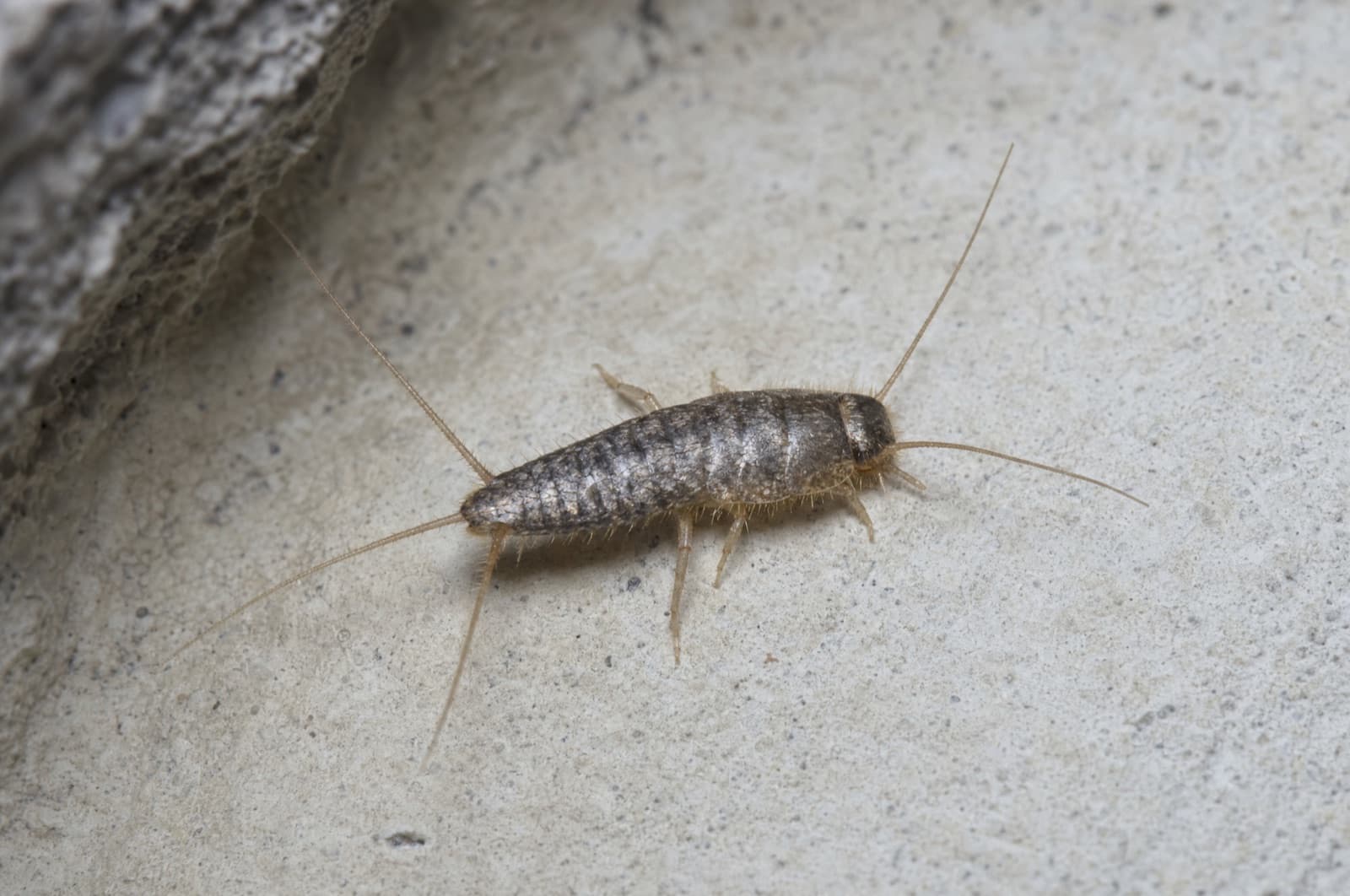
Small, wingless, silvery-gray insects with a tapered, fish-like body, most often seen at night in a bathroom, basement, or closet
Irregular holes, notches, or a yellowish stain on paper, book bindings, wallpaper, or cardboard
Tiny, pepper-like shed skins found in the same damp area where activity is suspected
Small dark droppings similar in size to ground pepper, found near paper or fabric items in a humid room
Could be something else: Droppings that small can be confused with other insect frass; they're supportive evidence alongside a damp room and a starch source, not proof by themselves.
Want silverfish gone?
This page only answers why it's here. Every removal step for this exact species — what to seal, what to set, what actually works — lives on its own dedicated guide.
Two questions, two pages
Here: why it turned up at all — the honest answer, blame removed.
There: the step-by-step removal guide for this exact species.
Key takeaways
- The specific attractant is high humidity (above roughly 75%) combined with starch-based material.
- Neither humidity nor starch alone reliably explains an infestation — both need to overlap.
- That's why activity concentrates in specific rooms rather than the whole house.
- Moisture reduction and removal steps are covered at /top-diy-methods/silverfish.
Damp room with old boxes or books?
This page is about why silverfish are there. Moisture control and removal steps are covered at /top-diy-methods/silverfish.
Frequently asked
Sources(3)
- [1]UC Statewide IPM Program — Silverfish and Firebrats (Pest Notes 7475)
Silverfish require relative humidity above 75% at warmer temperatures and feed on starch-based material
extensionverified 2026-07-17 - [2]University of Florida IFAS Extension — Silverfish and Firebrats
Silverfish humidity and diet requirements
extensionverified 2026-07-17 - [3]North Carolina State University Extension — Silverfish and Firebrats
Silverfish biology, habitat, and diet
extensionverified 2026-07-17
Written & reviewed by
VerifiedDaniel Brady
NH-Licensed Pesticide Applicator · License #782664 (NHDAMF, RSA 430)
Daniel Brady is the New Hampshire–licensed applicator behind Anchor Pest Services, a family-owned pest control company serving the Manchester area since 2017.
Last updated Jul 2026
It's humidity plus starch, not one or the other
We check both conditions, not just the bugs
Inspections across southern and central New Hampshire that look at humidity and nearby starch sources together.
- Family-owned in Manchester since 2017
- NH commercial applicator #782664, category F1
- We will tell you when the answer is do nothing
NH License #782664 · No obligation · We answer in person