
Silverfish in New Hampshire — ID, Damage & Control
Also called bristletail · fishmoth
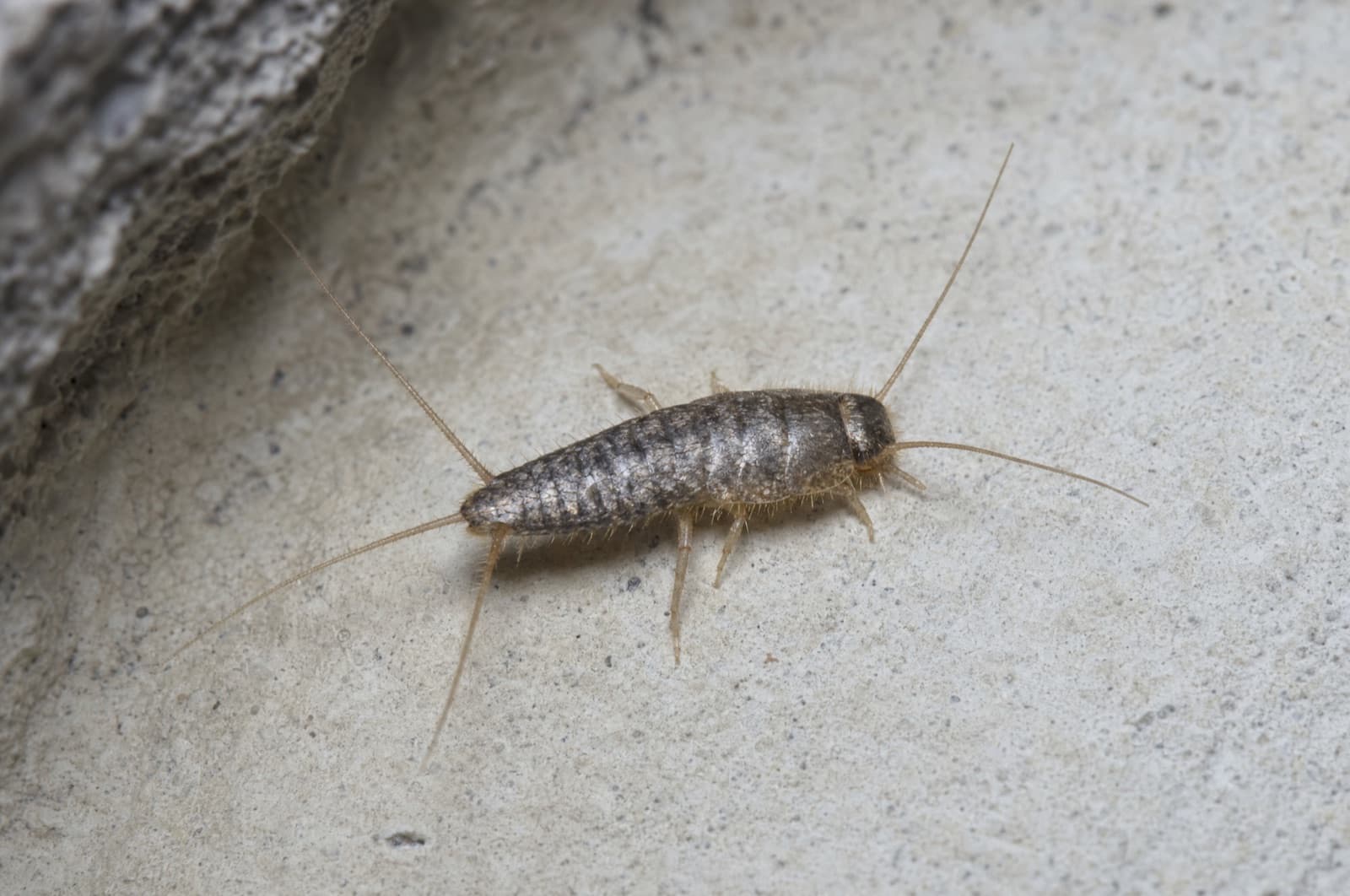
The silverfish is a teardrop-shaped, silvery, wingless insect that wriggles like a fish and bolts for cover when you turn on the light. It loves cool, damp places — basements, bathrooms, under sinks — and eats starches, which means it can damage books, paper, and stored fabrics over time. It is harmless to people, and the fix is moisture control, not spraying.
- Size
- ~½–¾ in
- MU Extension
- Habitat
- Cool, damp, dark — basements, bathrooms, under sinks
- UMD Extension
- Diet
- Starch — paper, glue, flour, fabric
- UMD Extension
- Bite/disease?
- None
- Virginia Tech Extension
- Lifespan
- 2–8 years
- Virginia Tech
- Eggs
- Fewer than 100 per lifetime
- Virginia Tech Extension
The cool-damp half of NH's bristletail duo
The silverfish is the silvery, carrot-shaped, wingless insect that bolts for cover the moment you turn on the bathroom light — three long bristle-tails trailing behind it as it wriggles fish-like across the floor. It lives in cool, damp, dark places: basements, bathrooms, under-sink cabinets, closets, and anywhere books and starchy materials share space with persistent humidity. It is the cool-damp half of New Hampshire's bristletail duo; its heat-loving relative, the firebrat, lives near furnaces and water heaters instead.
The silverfish is harmless to people — it doesn't bite and doesn't transmit disease — but it is not harmless to your stuff. It eats starches: paper, book glue, wallpaper paste, flour, and natural fabrics. Over months an established population can quietly damage books, archived documents, and stored linens. The fix is moisture-first: dehumidify the affected space below 60% relative humidity, fix any leaks, ventilate bathrooms, and store keepsakes in sealed plastic bins rather than damp cardboard boxes. Spraying without addressing the humidity is a short-term fix — the population returns as long as the dampness remains.
How to identify a silverfish
The silverfish's fish-like wriggling run and uniform silver coloring make it one of the easier insects to recognize. Three features clinch the ID: the silvery scales, the tapered teardrop shape with three rear bristle-tails, and the cool, damp location — always absent from hot spots near furnaces.
Silverfish
- Scientific name
- Lepisma saccharina
- Family
- Lepismatidae (order Zygentoma)
- Size
- ~½–¾ in
- Coloration
- Silvery-gray scales over a tapered teardrop body — uniform silver throughout
- Habitat
- Cool, damp, dark — basements, laundry rooms, under sinks, closets, bookshelves
- Active season
- Year-round indoors
- Diet
- Carbohydrates and starch: paper, book glue, wallpaper paste, flour, fabrics; can digest cellulose
- Reproduction
- Fewer than 100 eggs per lifetime, laid in cracks; eggs hatch in 2–8 weeks
- Lifespan
- 2–8 years; molts throughout adult life
Cosmopolitan worldwide; a year-round indoor pest throughout New Hampshire.
The tells — key ID features
- Silvery scales plus a fish-like wriggling run when exposed to light — the single most recognizable tell.
- Tapered teardrop ('carrot') shape, widest at the head, narrowing to three long rear bristle-tails.
- Long antennae, wingless, ~½–¾ inch.
- Prefers cool, damp locations — contrasts with the firebrat's preference for heat near furnaces.
- Bolts for cover when disturbed — found in undisturbed dark spots (under sinks, behind baseboards).
- Associated with bathrooms, basements, closets, and bookshelves wherever cool humidity and starch coexist.
Size, to scale
~½–¾ in
About the length of a grain of basmati rice including its tails — slim and tapered.
Firebrat
How to tell — Firebrats are mottled gray-brown (not uniform silver) and live near heat sources like furnaces and water heaters — not in cool damp spots. Location is the fastest tell.
Jumping bristletails (outdoors)
How to tell — Outdoor bristletails have a humped back and jump; silverfish are flat and dart without jumping, always indoors in cool damp areas.
Earwig
How to tell — Earwigs have visible rear pincers (cerci); silverfish have three slender bristle-tails and no pincers. Earwigs are also flatter and not silvery.
Signs of a problem
Silverfish are nocturnal and secretive. These are the signs that reveal an active population — and the humidity problem driving it.
Silvery insects darting from light when you enter the bathroom or open a basement cabinet
What it means — Classic silverfish sighting — the startled run for cover is their most visible behavior.
Irregular holes, notches, or scrape marks on paper, book pages, wallpaper, or book bindings
What it means — Starch-feeding damage; a sign of an established, active population near a paper or fabric food source.
Yellowish staining on linens, paper, or stored fabrics
What it means — Silverfish feces and shed scales discolor surfaces they rest and feed on over time.
Tiny shimmering scales or pepper-like residue near baseboards or bookshelf backs
What it means — Shed exoskeleton — silverfish molt repeatedly throughout their multi-year lifespan.
The real risks, calibrated
Silverfish pose no threat to people but can damage starchy belongings over time. Honest risk framing: the severity is low to moderate for property, zero for health.
Book, paper, and document damage
ModerateOnset: Over weeks to months of active feeding
Irregular holes, notches, and yellow staining in books, papers, wallpaper paste, and stored documents — potentially irreplaceable items.
Fabric and textile damage
Low riskOnset: Over time in larger populations
Holes and staining in natural fabrics such as linen, cotton, and silk stored in damp closets or boxes.
Pantry contamination
Low riskOnset: When exposed starchy food is accessible
Minor contamination of flour, cereals, or dry goods left in open packaging in damp areas.
Bite/disease
Low riskOnset: N/A
Silverfish do not bite people and do not transmit disease. No human health risk has been documented.
DIY — what works, what backfires
Silverfish control is moisture control. Find the humidity source and fix it — spraying without addressing dampness is a short-term patch that invites the population back.
What actually works
- Run a dehumidifier in the basement or crawl space, targeting relative humidity below 60%.
- Fix leaks under sinks, around pipes, and in crawl spaces — silverfish follow moisture.
- Ventilate bathrooms after showers; use exhaust fans to lower humidity consistently.
- Store papers, books, and fabrics in sealed airtight plastic bins, not damp cardboard boxes.
- Use sticky traps in affected areas to monitor population size and reduce numbers.
- Declutter cardboard boxes — both a food source and a harborage for silverfish.
What backfires
- Don't store irreplaceable keepsakes (photos, letters, rare books) in a damp basement cardboard box — silverfish will find them.
- Don't rely on insecticide sprays without fixing the underlying humidity; they kill visible adults but the population rebounds.
- Don't ignore a silverfish sighting — it is a reliable humidity signal that deserves a moisture check.
Silverfish in New Hampshire homes
Across Manchester, Nashua, Concord, and the broader southern NH service area, silverfish are a year-round indoor presence in damp basements, crawl spaces, and poorly ventilated bathrooms. New Hampshire's older housing stock — with stone foundations and uninsulated crawl spaces — creates exactly the cool, dark, humid microclimates silverfish need. Seeing one in a bathroom or basement is a reliable humidity signal: the space is consistently above 60% relative humidity.
Peak season
Year-round indoors; most noticed in humid summer months
You might actually have
- Firebrats (hot humid half — found near furnaces and water heaters, not cool spots)
- Camel crickets (same damp driver — the humpbacked jumper in the basement)
- Springtails (tiny hopping specks — also a moisture indicator)
We serve these communities
- NH-licensed applicator · #782664
- Same-day service
- Family-owned since 2017
Service Area Map
Southern New Hampshire
When to call a pro for silverfish
If silverfish keep appearing despite dehumidifying and sealing, or if you are finding damage to valued books or documents, a licensed technician can apply targeted crack-and-crevice treatment alongside a moisture-correction plan — the combination that actually stops them long-term.
When to call a pro
- Ongoing sightings in multiple areas despite running a dehumidifier and fixing visible leaks.
- Active damage to irreplaceable books, documents, or textiles.
- Unable to identify the moisture source driving the infestation.
Maintain humidity below 60% RH
Use a hygrometer to monitor basement and bathroom humidity. Run a dehumidifier whenever levels exceed 60% — that single change removes the primary draw for silverfish.
Seal and store starchy valuables
Books, photographs, and linens belong in sealed airtight bins, not open shelves or cardboard boxes in humid spaces.
Fix leaks and improve ventilation
Crawl spaces, under-sink cabinets, and poorly ventilated bathrooms are the typical silverfish entry conditions in NH homes — address these first.
Not sure it's a silverfish?
A licensed NH technician can confirm the species and tell you honestly whether it's a DIY fix or a job for a pro — free inspection, same-day service across Southern New Hampshire.
Frequently asked questions
Sources(5)
- [1]UMD Extension — Silverfish and Firebrats
habitat, diet, control approach, silverfish vs. firebrat distinction; diet includes cellulose
extensionverified 2026-06-30 - [2]MU Extension — Silverfish and Firebrats
size, coloration, nocturnal behavior
extensionverified 2026-06-30 - [3]Missouri Dept. of Conservation — Silverfish
physical description, tail bristles, antennae
govverified 2026-06-30 - [4]Virginia Tech Extension — Silverfish and Firebrats
lifespan 2–8 years, eggs fewer than 100, no health risk
extensionverified 2026-06-30 - [5]UNH Cooperative Extension — Insect Identification
NH presence and moisture-first guidance
extensionverified 2026-06-30
Written & reviewed by
VerifiedDaniel Brady
NH-Licensed Pesticide Applicator · License #782664 (NHDAMF, RSA 430)
Daniel Brady is the New Hampshire–licensed applicator behind Anchor Pest Services, a family-owned pest control company serving the Manchester area since 2017.
Last updated 2026-06-30

New Hampshire pest control
Dealing with silverfishs in your home?
Anchor Pest Services identifies and handles silverfish problems across southern and central New Hampshire. Family-owned since 2017, NH license #782664.
- NH-licensed applicators (#782664)
- Same-day service · free inspection
- Family-owned since 2017
Your next step
- Fall guide
Fall Pest Control in New Hampshire
What matters before frost: the fall invader window, mice at the foundation, and what to seal first.
Read the answer - What to do next
Common Household Pest Prevention: Dry It Out, Seal It Up
Read the answer - What to do next
How to Get Rid of Firebrats
Read the answer - Also relevant
Why do silverfish live in bathrooms and basements?
Read the answer - Also relevant
Do silverfish eat paper, fabrics, or photos?
Read the answer - Related guide
Firebrats in New Hampshire — ID, Heat & Moisture Control
Read the answer